

Listen to the audio version of this article (generated by AI).
Key Points
- Meta is entering the AI cloud market, using excess AI computing capacity to generate new revenue while competing with Amazon Web Services, Microsoft Azure, and Google Cloud.
- The announcement lifted Meta shares but pressured AI infrastructure, semiconductor, and memory stocks as investors worried about excess AI capacity.
- Despite the near-term market reaction, Meta’s cloud strategy could diversify its business beyond advertising and create a significant long-term growth opportunity in the expanding cloud-computing market.
If you have excess AI compute, they will buy it.
Although that line isn’t quite as memorable as the famous one from the movie Field of Dreams, it’s become a reality for Big Tech in 2026.
I’m talking about Meta Platforms (META), which is getting into the cloud business, as Bloomberg reported on July 1.
The decision makes plenty of sense for Meta CEO Mark Zuckerberg, who had hinted about this possibility during the company’s May shareholder meeting. Meta has excess AI compute capacity, so why not monetize it?
The market applauded Zuckerberg’s decision, as Meta shares surged roughly 8% when the news was announced.
But what does this move mean for the rest of the AI and tech space? Well, that gets a bit more complicated.
Meta’s new neocloud competitors did not fare well on July 1. CoreWeave (CRWV) lost nearly 14%, and Nebius (NBIS) dropped a staggering 17%.
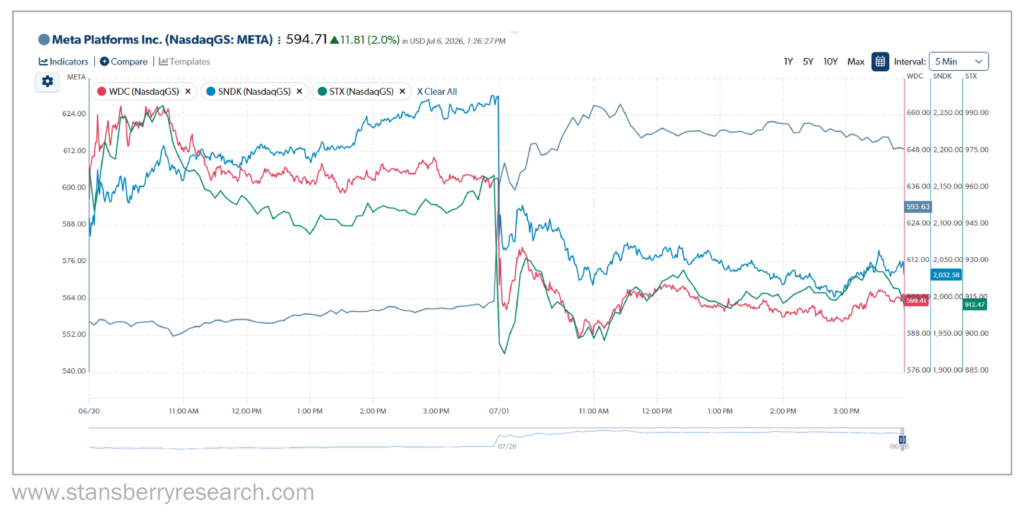
But it wasn’t only Meta’s future cloud competition that felt pain on July 1. The memory sector was hit hard, too. Even current Wall Street AI darling Micron Technology (MU) took a beating that day, dropping more than 10.5% despite announcing a major long-term agreement with General Motors (GM) to supply the American automaker with memory and storage needed for vehicle production. Bottom of Form
Fellow memory makers Sandisk (SNDK), Seagate Technology (STX), and Western Digital (WDC) fell by 10.6%, 5.2%, and 6.3%, respectively.
Even chip stocks weren’t spared. Nvidia (NVDA), Advanced Micro Devices (AMD), Marvell, Qualcomm (QCOM), Intel (INTC), and Arm Holdings (ARM) took small losses, with Intel suffering the largest loss (9%) among this group.
Clearly, Meta’s decision to enter the cloud business had some serious ripple effects across the broader market.
Previous AI Failures Pushed Meta Into the Cloud Business
It’s no secret that Meta’s forays into AI have not gone well.
When I analyzed Meta’s massive layoffs in late May, I wrote:
Zuckerberg’s laser focus on Meta’s AI ambitions is understandable, considering the company has fallen behind many of its competitors.
Earlier this year, after pouring billions into the project, Meta delayed the release of its new foundational AI model (code name: Avocado, official name: Muse Spark) until April due to performance issues…
That delay was just the latest AI setback for Meta. In February, the company stopped the release of its chatbot because internal testing found that it egregiously (between roughly 55% and 67% of the time) failed to block dangerous content involving minors…
On a less disturbing note, back in September 2025, Meta’s AI repeatedly – and rather embarrassingly – failed during a live demonstration of the company’s new smart glasses at its Meta Connect event.
All of this, to me, leads to a simple question: What exactly is Meta’s AI goal?
Now we know. Meta, in fact, had no specific AI goal. The company took more of a “throw everything at the wall and see what sticks” approach. Unfortunately for Meta, hardly anything stuck to the wall.
So, Zuckerberg wisely pivoted, with Meta announcing that it plans to sell access to its expansive – and excess – AI compute power and models.
Current cloud giants Alphabet’s (GOOGL) Google Cloud, Microsoft (MSFT) Azure, and Amazon (AMZN) Web Services (“AWS”) snapped to attention. Meta could soon emerge as a significant player in enterprise AI infrastructure.
This is a huge plot twist and a major strategic shift for Meta. The company spent heavily on data centers and AI capacity for years, but never with the intention of selling access to others. Meta was using this infrastructure to run Facebook, Instagram, Threads, and other projects.
Then, over the past few months, Elon Musk decided to rent SpaceX’s (SPCX) excess AI compute from its Memphis, Tennessee-based Colossus 1 and 2 data centers to Anthropic and Google. Those agreements call for Anthropic to pay SpaceX $1.25 billion per month for at least three years and for Google to pay $920 million per month for roughly three years.
Like Meta, Musk took this path because of the struggles his own AI company, xAI (now known as SpaceXAI), had internally training its Grok models. With all that capacity and infrastructure already built, why not capitalize on it?
Meta’s Cloud Advantage Over Its Competitors
It’s still early, so nobody really knows how this will all play out for Meta.
What we do know is that Meta is planning to sell access to its AI-infrastructure models. Like Amazon’s serverless Bedrock platform, Meta would operate the hardware and data centers that power the AI models while charging developers for access. But that’s only one piece of Meta’s reported cloud puzzle.
The other is Meta Compute, a division that plans to sell raw compute capacity built specifically for AI computing, as a neocloud provider such as CoreWeave or Nebius does.
Meta’s two-pronged approach – selling both infrastructure access and raw compute capacity – is something AWS, Google Cloud, and Azure simply can’t currently offer.
Considering Meta plans to spend $145 billion on data centers and hardware designed to run large AI workloads and train models, the billions in revenue generated by selling or renting its technology and capacity will certainly come in handy.
But the bigger picture is more important here. The global cloud market, as of May 1, was valued at nearly $918 billion and projected to pass $1 trillion by the end of the year.
Today, in the U.S., AWS leads the way with 30% market share, followed by Azure with 25% and Google Cloud with 13% (“Others” account for 28%).
If Meta can secure even a 5% slice of that pie, it’s looking at at least $50 billion in recurring, high-margin revenue within the next year. Likely more, as the cloud market continues to expand. And that’s huge, considering 98% of Meta’s first-quarter revenue in 2026 came from digital advertising.
Meta is undoubtedly making a statement by entering a business segment where its competitors currently dominate. But Zuckerberg clearly has enough faith in Meta’s AI infrastructure to bet on the company in a big way.
The Big Reason AI Stocks Dropped on Meta’s Cloud News
What does this reaction say about Meta’s entrance into the cloud business? For its direct competitors, like CoreWeave and Nebius, the implications are obvious.
But for the memory and chip manufacturers, the overarching concern among investors comes down to one word: excess. As in excess capacity. The thinking goes: If Meta already has so much compute capacity that it’s going to sell it to other businesses, is there already an AI-infrastructure oversupply?
And, if so, will hardware and components (like semiconductors, processors, high-bandwidth memory chips, etc.) sales slow as a result?
It’s a valid concern.
Looking at a company like Micron, which has seen its stock price soar by roughly 682% in the past year and continues to report impressive results quarter after quarter, it’s a bit surprising that its price was affected so much on July 1.
Sure, the possibility of infrastructure oversupply and a reduction in orders is worrisome… but Micron has also sold out its entire 2026 inventory and most of 2027. So, it has billions in guaranteed revenue for the foreseeable future.
A broader theme may pose a more serious risk to Micron and other AI-hardware companies. Investors are selling off a significant number of AI-hardware stocks and turning a tidy profit in the process. And many of those dollars are being rotated back into AI-software companies.
That’s why, despite Meta moving into their competitive space, shares of Amazon, Alphabet, and Microsoft weren’t negatively impacted by Meta’s cloud news. In fact, all three finished higher on July 1 (by varying degrees) following the news.
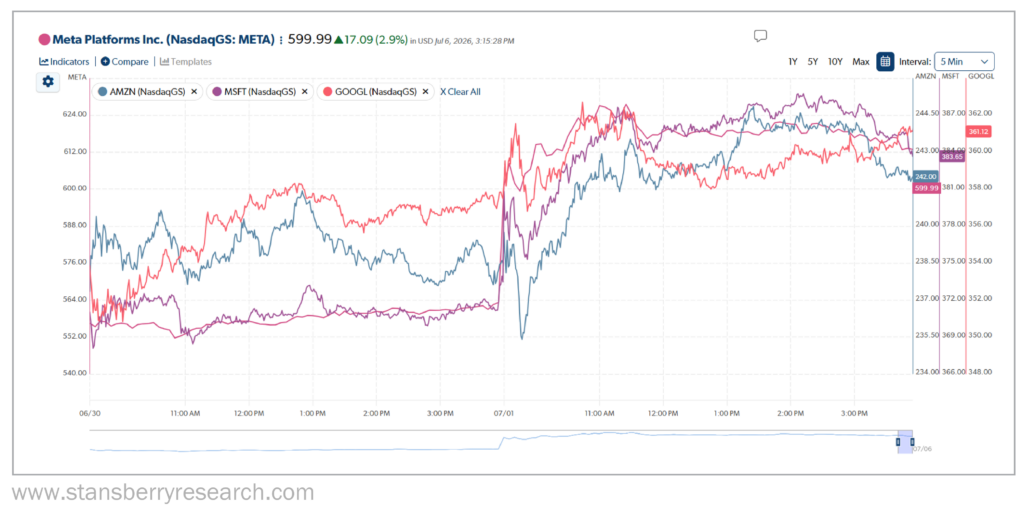
Should AI-hardware investors panic? I don’t believe so. After all, we’ve just spent months analyzing those stocks and how much money they’ve made investors. That’s not likely to change.
What does change is the market. It changes as the wind blows. By tomorrow, Micron could push past $1,000 again. All it takes is one juicy nugget from the 24-hour news cycle to push the market back toward chips and memory – or in an entirely different direction.
Is Meta a Good Buy Right Now?
Meta has been on a very bumpy ride over the past year. Its previous AI ventures bombed. The company has laid off more than 10,000 employees since 2025. And Zuckerberg’s grand visions were more “Meh-taverse” than Metaverse.
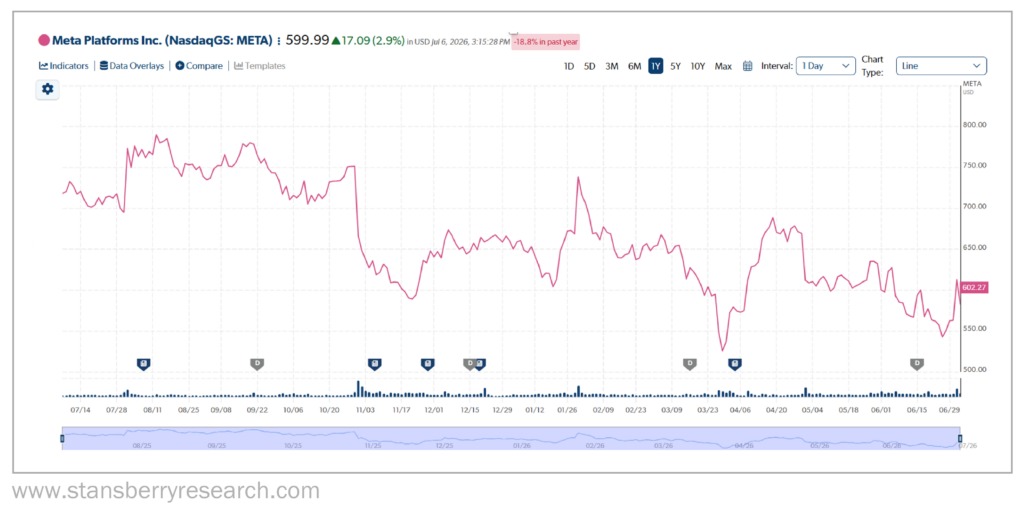
But the company is still highly profitable.
Meta delivered $56.3 billion in revenue in the first quarter, up 33% year over year (“YOY”) with $26.8 billion in net income, up 61% YOY.
So, what’s the consensus on Meta? At market close on July 7, Meta was trading at $615.58. That’s up some from the past month or so, but it’s still trading closer to the low end of its 52-week range of $520.26 to $796.25.
It definitely looks like there is more room for Meta to run. Keep a close eye on any cloud-computing and/or AI-infrastructure deals the company makes in the coming months. That should be a solid indicator as to how successful Meta’s cloud business might be moving forward.
Regards,
David Engle
Editor’s Note: One group of Americans is quietly building extraordinary wealth right now, while another is falling further behind with every passing month. Whitney Tilson — the hedge fund legend CNBC called “The Prophet” — says we’ve hit the “Ripping Point,” and the split is accelerating fast. He’s sharing what he believes everyone needs to do immediately (including two free stock picks) in this urgent free presentation.