
Image Credit: Associated Press
Listen to the audio version of this article (generated by AI).
Key Points
- Microsoft (MSFT) secured additional power for its AI ambitions through a 20-year natural-gas agreement with Chevron (CVX) to support its Project Kilby data center.
- Data-center electricity consumption has already exceeded projections for its share of power demand, highlighting the rapid growth of AI infrastructure.
- Hyperscalers are increasingly striking direct energy deals with utilities and power producers to ensure reliable electricity supplies for expanding data-center operations.
Chevron (CVX) announced on Monday that it has reached an agreement with Microsoft (MSFT) to supply its massive Project Kilby data center with natural gas for 20 years.
As part of the deal, Chevron’s partner GE Vernova (GEV) will work with construction and engineering-equipment company Caterpillar (CAT). Together, they’ll supply the specialized natural-gas turbines to power the Texas-based data center.
And there’s going to be a lot of gas flowing…
Project Kilby is expected to consume about 2.7 gigawatts (“GW”) of power. According to CNBC, that’s enough power to fuel more than 2 million homes. Construction hasn’t started just yet. The data center is expected to start receiving power in 2028.
Chevron has a large footprint in the Permian Basin in West Texas and southeastern New Mexico. This allows it to quickly and efficiently supply power to Texas data centers like Project Kilby, says Jeff Gustavson, Chevron’s president of New Energies, in a statement announcing the deal.
News of the deal sent Chevron’s stock higher, while the rest of the market fell.
With the conflict in Iran, oil prices have spiked higher, then come back off their highs. Overall, higher energy prices mean thicker margins for energy companies.
But energy prices are not the only driver for this sector. Another powerful tailwind comes from artificial intelligence (“AI”), which is creating major demand for energy.
Artificial Intelligence Needs Massive Amounts of Power
AI models run complex calculations. These require more energy to execute quickly than traditional computing does.
As my colleague David Engle wrote in October, AI data centers “devour” power. Right now, by various estimates, data centers account for anywhere between 1% and 3% of global energy usage… But that’s just the starting point.
As David wrote…
According to Deloitte analysis, the power demand from AI data centers alone could increase more than 30 times in the U.S., going from 4 GW in 2024 to 123 GW by 2035. That’s enough to electrify nearly every household on the East Coast, or 100 million homes.
And as Corey McLaughlin wrote in the February 18 edition of Stansberry Digest, AI’s power grab is ahead of schedule…
When OpenAI’s ChatGPT launched the AI boom back in November 2022, data centers only made up about 4% of total power demand in the U.S.
But since then, their energy share has increased substantially – hitting 7%, according to analysts at Goldman Sachs.
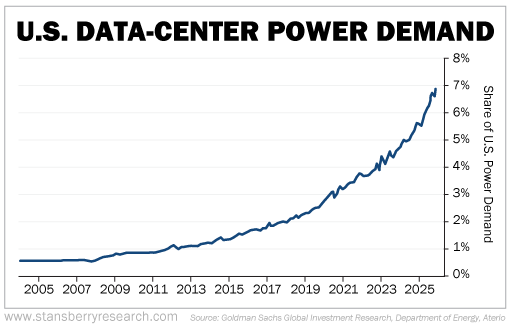
The trend will only continue from here.
At the end of 2024, the Department of Energy projected that data centers could make up anywhere from 6.7% to 12% of total power demand by 2028.
Here we are, only about a year after that projection, and data centers in the U.S. are already in that range – two years sooner than expected. And those are just the headline numbers.
In short, AI is putting extreme stress on the U.S. power grid. But that’s not stopping AI companies from upping their AI spending.
Hyperscalers Go Straight to the Source for More Power
As we’ve written recently at MarketWise, Big Tech companies are going straight to utilities and energy companies to meet their AI-power needs.
Here’s a recent list of deals…
- Microsoft locked in 20 years of power from Constellation Energy’s (CEG) Three Mile Island nuclear plant.
And this increased demand is leading utility companies to team up, too. Last month, NextEra Energy (NEE) and Dominion Energy (D) – two of the largest utilities in the U.S. – announced they were merging in the largest-ever utility deal.
The reasoning is simple: A combined company will have a larger footprint and more assets. That gives it a better chance of meeting the growing demand for power by AI.
Is Chevron a Good Buy After Its Data Center Deal With Microsoft?
Chevron is a household name in the energy sector. It’s one of the largest oil-and-gas exploration-and-production companies out there.
As Gustavson said,
AI is reshaping the global economy, and abundant, affordable, reliable energy is essential to fueling that transformation.
Chevron is uniquely positioned to deliver power to customers with certainty, speed and at a competitive cost, leveraging Permian natural gas and our proven execution capabilities.
Chevron has a huge footprint in U.S. oilfields, and it operates both as an “upstream” (production) and “downstream” (refinery) company.
Does this news help make Chevron a good play for AI infrastructure investors? Let’s take a look at Chevron using our proprietary Stansberry Score…
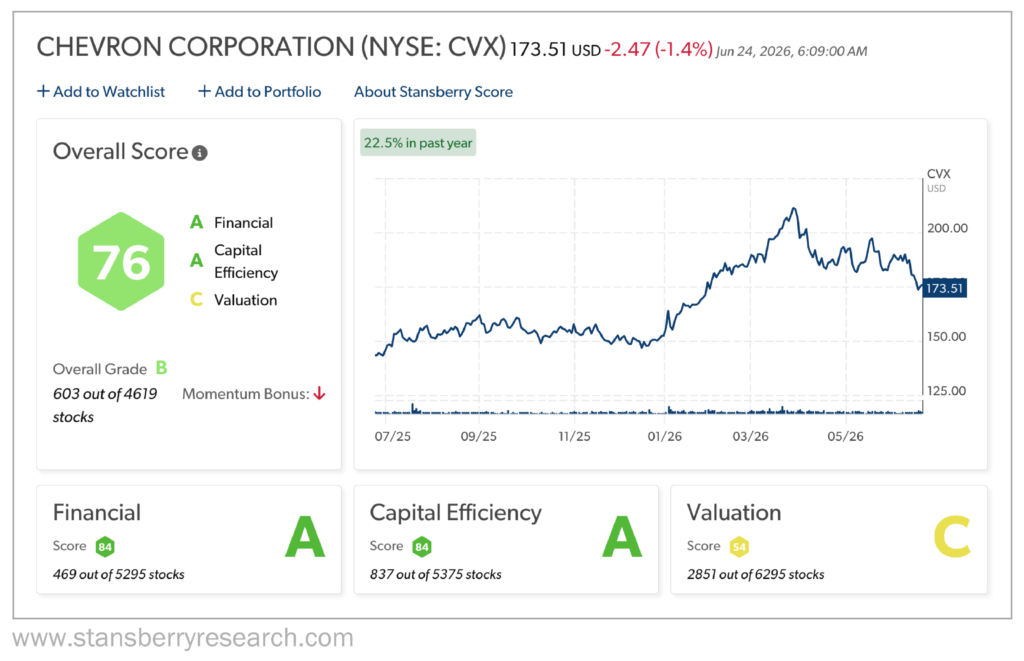
Chevron gets an overall grade of “B” and a total score of 76 out of 100. That’s good enough to rank it 602 out of the more than 4,600 stocks our system covers.
Looking under the hood, Chevron gets an “A” grade for both its Financial and Capital Efficiency scores – meaning it has a solid income and balance sheet and generates plenty of cash flow relative to its equipment spending.
The only “ding” to Chevron’s score is its Valuation, where it received a “C” grade. At a price-to-earnings (P/E) ratio of 30, Chevron is more expensive than the S&P 500 (which has a P/E ratio of around 27) and the State Street Energy Select Sector SPDR Fund (with a P/E ratio hovering around 20).
So yes, Chevron does trade at a premium to both the broader market and the energy sector. But a strong business like this one (as evidenced by its other “A” grades) rarely goes on sale.
Our system still believes Chevron is a solid long-term investment, even with its rich valuation. And as of June 24, the stock is down more than 17% from its all-time high set in March.
That could provide an attractive entry point for investors looking to open a position in a massive U.S. energy company benefiting from the AI build-out.
The Project That Will Dwarf Microsoft and Chevron’s Deal
I expect partnerships like this – matching energy-hungry tech giants with companies ready to supply power – to continue for years. The hyperscalers have committed more than $700 billion to the AI build-out in 2026 alone.
They’ll have to keep throwing money at AI to make sure that the massive amount they’ve already invested doesn’t go to waste. And they’ll continue to need energy to power their new data centers.
But while this latest announcement is large enough to power more than 2 million homes, that’s just a drop in the bucket in the grand scheme of things…
As my colleague Steven Longenecker wrote last month, there’s another data center in the works that could be three times as large.
From Steven…
The largest private AI energy project in the world is five hours from the nearest major airport, surrounded by 7,500 acres of Texas Panhandle scrubland.
When construction is finished, the site will generate 17 gigawatts of electricity. That’s enough to light up more than 8 million homes.
Professor Joel Litman recently gave an exclusive interview explaining what he calls “Dark Energy” at a planned data center construction site in Texas. Put simply, “Dark Energy” is Joel’s term for on-site, natural gas power generation built around a specific kind of turbine.
That’s exactly what we’re seeing with the Chevron and Microsoft deal – natural gas provided on-site and skipping the broader energy grid. And it won’t be the last.
In his interview, Joel explains why he believes the biggest winners from this trend won’t be the household names like Chevron. Instead, Joel has identified a small group of stocks he expects will soar as the Dark Energy trend gains momentum.
Again, if you haven’t watched Joel’s latest interview, we urge you to do so here.
Good investing,
Nick Koziol