Image Credit: Associated Press
Oil spiked 7% today. WTI crude blew through $75 a barrel. Brent nearly touched $80.
And every retail investor in America is asking the same question: is it too late to buy oil stocks?
Here’s my answer, after 28 years trading options — including years as a market maker on the CBOE floor: stop asking pundits. The options market already voted, with real money. And I’m going to show you exactly how to read the ballot.
Why Are Oil Prices Surging Today?
Quick recap of the news, because it matters:
President Trump declared the ceasefire with Iran over after three tankers were attacked near the Strait of Hormuz. The U.S. struck Iran overnight, with threats of more strikes and a renewed naval blockade to come. The Treasury Department revoked the waiver that had allowed Iran to sell its crude. And the Strait — the chokepoint that carries roughly a fifth of the world’s oil — is once again effectively closed to most shipping.
That’s the headline story. Now here’s the part the headlines can’t tell you: what the smart money expects to happen next.
The Free CVOL Chart That Answers ’What Comes Next’ for Oil
The CME Group publishes a free tool called CVOL — think of it as the VIX, but for oil (and gold, and silver, and everything else that trades as a future). It’s a speedometer built from real option prices: one number that tells you how BIG a move traders are paying for.
You don’t trade futures? Doesn’t matter. Crude oil options are where the world’s biggest energy traders — producers, refiners, hedge funds — place their real bets. When oil moves, XLE, USO, Exxon and Chevron move with it. This is the X-ray of the market that drives your oil stocks.
Here’s what that X-ray showed today:
Crude oil’s skew ripped higher today. Skew tells you which direction the money leans. When upside calls cost more than downside puts at equal distances from the price, traders are paying for higher prices — not protecting against lower ones. And today, as crude gapped 7%, the skew didn’t just stay positive — it JUMPED, one of its sharpest one-day moves of the year. Traders piled into upside calls.
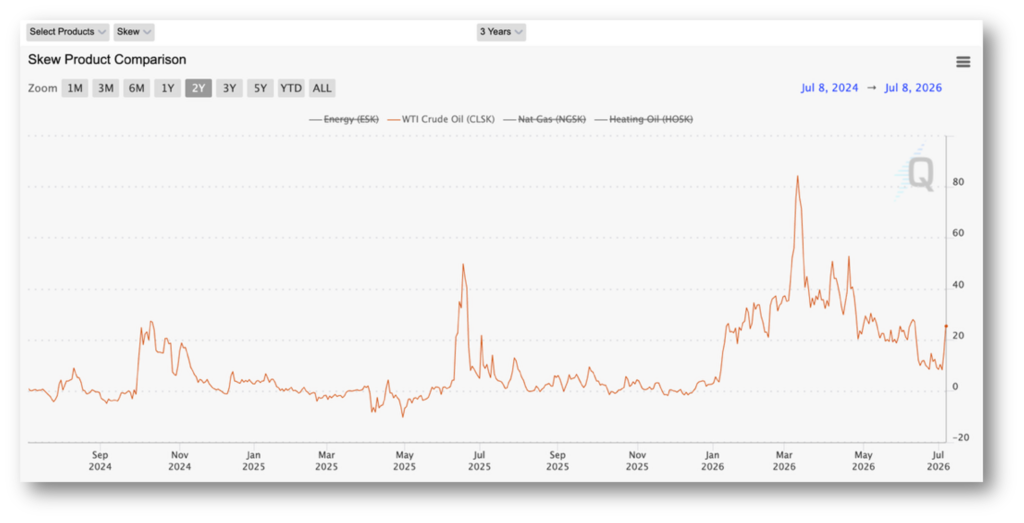
The expected-movement gauge is elevated too — crude’s CVOL sits around 60, roughly double its calm-market levels — but today’s tell was the skew. That’s the difference between “the market expects movement” and “the market is paying for a SPIKE.” Crude’s upside-skew regime started when the Hormuz crisis first erupted this spring, and today it re-accelerated.
Translation, in plain English: the options market is priced for a market that SPIKES, not one that fades quietly back to $60.
One honest caveat, because I trade this stuff and you should know it: extreme readings cut both ways. When skew gets WAY out of line, you’re often near the top or bottom of a big systematic move. Today’s reading is elevated — not yet at the panic extreme we saw this spring, when it briefly went off the charts before crude pulled back. Watch that.
The Quiet Winners: Refinery Stocks and the Crack Spread
Here’s the part of this story almost nobody is writing about — and it’s where the strongest bid in the energy tape is showing up: refiners.
Quick definition. The crack spread is a refiner’s profit margin. A refinery buys crude oil, “cracks” it into gasoline and diesel, and sells the products. The crack spread is simply the price of what they sell minus the price of what they buy. When product prices rise faster than crude, the spread widens — and refiner profits explode.
Right now, it’s not widening. It’s ripping.
The gasoline crack spread is running above $53 a barrel — near its highest level since June 2022. The standard 3-2-1 refining margin is more than DOUBLE where it sat before the Iran conflict broke out. And that’s with U.S. refineries already running near maximum capacity, in the 92–95% utilization range.
Why? Follow the barrels. With Hormuz restricted, the world isn’t just short crude — it’s short refined products: diesel, jet fuel, gasoline. U.S. Gulf Coast refiners sit in the sweet spot. They buy WTI-based crude — which trades several dollars cheaper than Brent — and sell finished products into a global market paying panic prices. Cheaper input, premium output, maximum volume. That’s the whole business, and right now the math has rarely been better.
The names with that exact profile: Valero (VLO), Marathon Petroleum (MPC), and Phillips 66 (PSX) — the big Gulf Coast independents with WTI-advantaged crude access. Shell has already told the market to expect significantly higher trading results from this volatility; the pure-play refiners are the more direct expression.
Two honest caveats. First, headline crack spreads include renewable fuel credit costs, so true margins are somewhat lower than the sticker number. Second — and this is the real risk — refining margins are cyclical and mean-reverting, and $50+ cracks have already drawn political fire: the White House is publicly demanding lower pump prices. Fat margins attract attention. Trade the spread while it’s wide; don’t marry it.
Oil Stocks and ETFs: What Today’s Spike Means
I’m not going to hand you a buy list — that’s not what this piece is. But here’s the map for the tickers everyone is searching today:
XLE (Energy Select Sector SPDR). The one-click basket of big energy. In a spike regime, the majors inside it — Exxon Mobil (XOM), Chevron (CVX) — benefit from higher realized prices, and Shell has already signaled sharply higher second-quarter trading results on exactly this volatility. But XLE has already moved. The options data says expect violence in both directions, not a smooth ride.
USO (United States Oil Fund). The retail favorite for “just give me oil exposure.” Understand what you own: USO holds crude futures, and in a supply-shock market, futures curves get weird. It tracks the panic on the way up and bleeds in the chop. It’s a trade, not an investment.
Producers with barrels outside the blast radius. When a fifth of the world’s oil is bottlenecked in the Gulf, barrels that DON’T transit Hormuz get more valuable. That’s the lens for U.S. shale names like Occidental (OXY) and the Permian producers. The EIA reported U.S. crude and product exports already hit record levels as the world scrambles for non-Gulf supply.
The trap to avoid: chasing a 7% gap with your whole position. When volatility doubles, position sizes should shrink, not grow. Risk gets decided before entry — that’s not a slogan, it’s how floor traders survive decades.
How to Watch CVOL Yourself (Free, 5 Minutes a Day)
You don’t need my newsletter to track this. Bookmark cmegroup.com/cvol — no account, no cost.
- Open the dashboard and find WTI Crude Oil.
- Watch the CVOL number. Rising = bigger moves coming (either direction). Falling = the storm is passing.
- Check the skew. Positive and rising = traders paying for higher prices. If it flips negative while headlines are still bullish — that’s the tell that the smart money is quietly buying crash protection.
That’s how you stop guessing what traders think and start reading what they’re paying for.
Editor’s Note: Does a 114-acre tract of grass and swamp in Tennessee hold the secret to the biggest moneymaking opportunity of 2026? Industry leaders thought this strange development was impossible. Competitors flew spy planes overhead. Now the truth is out — and it could generate big profits for investors who get in immediately. Click here for the details…
Frequently Asked Questions
Why are oil prices surging today? Renewed U.S.–Iran conflict: after attacks on tankers near the Strait of Hormuz, the ceasefire was declared over, the U.S. struck Iran and revoked its oil-export waiver, and traffic through the world’s most important oil chokepoint is severely restricted. WTI crude jumped roughly 7% to the mid-$70s.
Is it too late to buy oil stocks? Nobody can promise you a top or bottom. What the options market shows is that traders are paying for MORE movement, with bets skewed toward higher prices — while extreme readings historically appear near turning points. If you enter here, size small and define your risk before you click buy.
What is the best oil ETF right now? It depends on what you want. XLE gives you the big producers’ stocks (and their dividends). USO gives you direct crude futures exposure, which tracks spikes closely but behaves poorly over long holding periods. They are very different vehicles.
How high will oil prices go? The honest answer: the options market is pricing a wide range, with more premium on the upside than the downside. Forecasters are split — some see Brent falling back to the $60s if tensions cool; the EIA’s scenario keeps prices elevated while Hormuz stays restricted. Watch the skew, not the pundits.
Why are refinery stocks going up? Because the crack spread — the gap between what refiners pay for crude and what they sell gasoline and diesel for — has exploded to some of the widest levels since 2022. With the Strait of Hormuz restricted, the world is short refined products, and U.S. refiners like Valero (VLO), Marathon Petroleum (MPC), and Phillips 66 (PSX) are buying discounted domestic crude and selling into global shortage prices at near-max capacity.
What is CVOL? The CME Group Volatility Index — a free “fear gauge” for oil, metals, bonds, and other futures markets, calculated from real option prices at cmegroup.com/cvol.
Want to learn to read the market this way every single day?
To learn more, check out the Masters in Trading Challenge — where we teach real, usable information for traders and investors: the same tools, the same process, the same follow-the-money doctrine you just read.
Join the Challenge: InvestorPlace.com/Challenge2026