
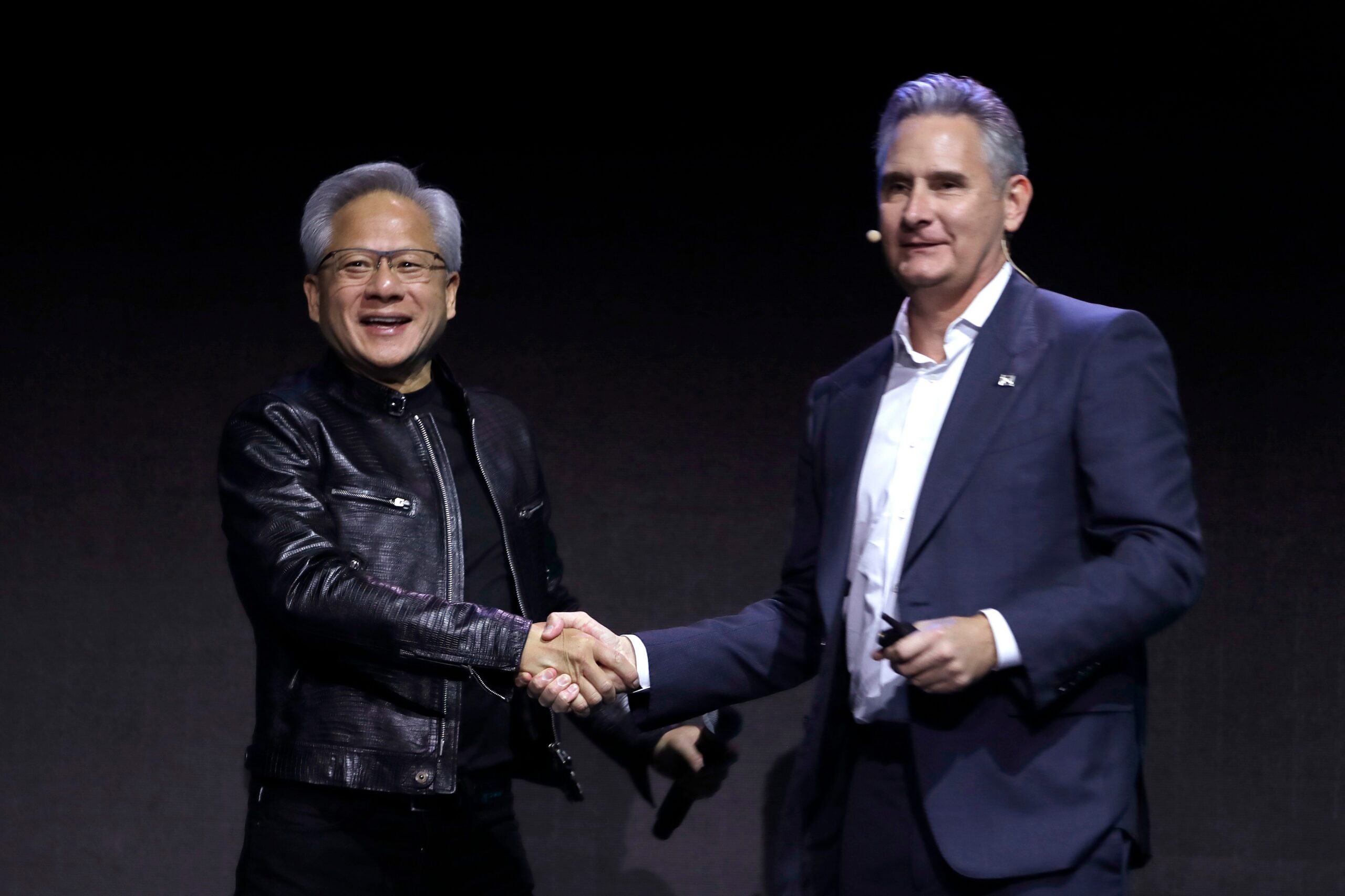
Image Credit: Associated Press
At COMPUTEX 2026, Nvidia CEO Jensen Huang turned to Marvell CEO Matt Murphy on stage and declared: “The next trillion-dollar company, ladies and gentlemen.”
Those words are destined to become a self-fulfilling prophecy. And they just blew up my Marvell stock price target – in a good way.
Back in February 2026, I likened Marvell Technology (MRVL) to Nvidia (NVDA) in 2022: overlooked and full of potential (emphasis added).
My award for fantastic potential returns is Marvell Technology Inc. (MRVL), a Broadcom rival that’s starting from a far smaller base. The company trades at just a third of its larger rival on a price-to-sales basis, and my models project a 76% upside to a $147 justified value on relatively conservative assumptions. Using more aggressive figures suggests potential 100% upside.
Shares have since blown past my most aggressive assumptions.
And here’s the thing: what Mr. Huang said was more than a quip. It was a signed check. And so, I’m updating my justified value of MRVL to $400 and penciling in a longer-range target of $650-$700. Here’s why the math works – and what could still go wrong.
Why My Original Marvell Stock Price Target Is No Longer Enough
When Huang called Marvell “the next trillion-dollar company” on June 2, the market’s reaction was simple: Huang blessed it, so buy it. Shares rose 30% almost immediately, putting the stock within striking range of $300.
On the face of it, that means my original call has now played out. I recommended MRVL when it was trading at roughly a third of the valuation of its closest rival, Broadcom (AVGO). After a 150%-plus run, that gap has largely closed. Marvell stock now trades just 30% below its larger rival on a relative basis, a fair discount for a less profitable player.
Ordinarily, I would close out my recommendation and move on. Before June 2, Marvell was one of several merchant vendors competing for a slice of the hyperscaler custom-silicon pie. Yes, it had a fantastic history of wily acquisitions under CEO Murphy, who took over in 2016. And yes, Microsoft Corp.’s (MSFT) North American data centers currently source 100% of their optical chips from Marvell.
But the company never had the scale of Broadcom or the intellectual property of ARM Holdings (ARM). Returns on invested capital have lagged its peers.
Jensen Huang’s declaration changes that.
Suddenly, it’s looking far more likely that Nvidia will compete against Broadcom in custom chips (ASICs and XPUs). And to do so, it will be leaning on Marvell for its technology.
How the Marvell-Nvidia Partnership Makes MRVL a Different Stock
To see why that matters, rewind to March 31. That’s when the two firms formed a strategic partnership connecting the pair through Nvidia’s NVLink Fusion, a rack-scale platform for semi-custom AI infrastructure. Under the arrangement, Marvell would supply custom chips to Nvidia, and Nvidia would drop them into its product lineup. It was a way for Nvidia to compete against custom chips (which are far more efficient at the “inferencing” part of AI calculations), while not offering fully custom chips themselves.
The deal also included a $2 billion investment by Nvidia into Marvell and a pledge to collaborate on silicon photonics (using light instead of electricity in microchips).
The rationale on Nvidia’s part is straightforward: highly efficient, customized AI chips will eventually outnumber the general-purpose GPUs, and Nvidia is unwilling to lose its AI business to firms like Broadcom.
The on-stage prediction on June 2 suggests Nvidia plans to take the Marvell partnership far further than anyone anticipated. We’ve known that the rise of custom AI chips is breaking Nvidia’s grip on the AI market. Huang’s statement suggests Nvidia is ready to use Marvell to fight back.
For its part, Marvell is also expanding in areas beyond custom silicon. In its Q1 fiscal 2027 earnings call on May 27, 2026, the firm said revenues from its interconnect products (the components that connect chips together) are expected to rise 70%, up from previous guidance of 50%. It is also a leader in optical networking, which puts it in competition against high-growth firms Lumentum (LITE) and Coherent (COHR).
My New MRVL Stock Price Target: $400 – Here’s the Math
The key question now: what is MRVL stock upside from here? 30%? 130%? 300%? Let’s start with the conservative case of 30% — and work up from there.
We know that Marvell should generate about $16.5 billion in fiscal 2028 sales, a figure management itself guided during its May 27 earnings call. A $400 price tag brings its valuation to roughly 21X sales, the same multiple the stock trades at as of June 2. If you assume that margins remain consistent, you get a company trading at 50X expected earnings – a high but justifiable level for a chip designer in an AI age.
In other words, we don’t need Marvell to do much to justify a 30% upside to $400 per share. We just need it to close the last of the gap to Broadcom, deliver the guidance already on the table, and let NVLink Fusion turn that $16.5 billion guidance into a floor rather than a ceiling.
That’s the conservative 30% upside case. Here’s where the 130% comes from.
If you believe Huang’s call changes Marvell’s quality, then Marvell deserves Broadcom’s premium multiple, not just its growth. Award the stock something close to Broadcom’s ~30X sales on fiscal 2029 revenue, and the math runs to roughly $650-$700 a share, or 130% above MRVL’s June 2 closing price of $291. I think it’s certainly possible that Marvell is re-rated as an industry leader rather than a perennial runner-up, but that would mean beating Broadcom at its own game.
Could Marvell Stock Hit $1 Trillion? My Honest Assessment.
I won’t disown Huang’s trillion-dollar prediction. But let’s consider what must happen for Marvell to reach this milestone:
A $1 trillion market cap works out to roughly $1,140 per share, a 300% upside from MRVL’s June 2 closing price of $291. Against fiscal 2028 revenue, that’s a 60X sales multiple, a figure that only makes sense for licensing firms like Arm Holdings at these scales.
That isn’t happening on fiscal 2028 numbers. Marvell remains a chip designer without the operating leverage enjoyed by Arm, or even Advanced Micro Devices (AMD). It would take optimism on the level of the dot-com bubble to bring a company as large as Marvell across the $1 trillion mark in its current state.
However…
Marvell has proved itself to be a highly adept acquirer of companies and has grown its operating income 24X since CEO Murphy took over. In addition, we know that the future of AI compute is in custom silicon. Custom chips dominate mature, computationally intensive areas like bitcoin mining, video encoding, computer networking, signal processing and more. AI compute lends itself perfectly to custom chips.
That means Nvidia’s trillion-dollar call could become self-fulfilling. Marvell is a serial acquirer, and high share prices will allow it to use richly priced (perhaps overvalued) stock to snap up competitors. Customers might also be more willing to work with larger vendors that can supply multiple data center products.
Furthermore, Marvell has one of the best histories of acquisitions in the semiconductor industry, and its CEO shows no signs of slowing down. I give it a solid 30% chance of becoming a trillion-dollar firm within five to seven years.
The Risks to My Marvell Stock Price Target: What Could Make Me Wrong
Now, there are some significant risks to consider.
- Momentum. Marvell’s shares are overbought by most technical metrics, making this rally extremely fragile. This is not a company for conservative investors.
- Margins. Nvidia’s deal is a double-edged sword. While NVLink Fusion is a phenomenal growth engine, it is also structured so Nvidia earns on every rack deployed. We may see margins compress.
- Demand. There’s a genuine customer-conflict risk: Marvell’s biggest custom-silicon customers are the same hyperscalers trying to reduce their Nvidia dependence. These same hyperscalers are now watching Marvell jump into Nvidia’s camp.
- Valuation. Finally, the valuation cushion that drove my original call is gone. At its June 2 closing price of $291, the stock is priced for near-perfect execution, with little room for a stumble. Marvell’s high growth rates also mean we must rely on valuation methods from the venture capital world, which often overstate what companies are worth.
Nevertheless, it’s generally unwise to be a bear in a bull market. It’s even worse to bet against a trend (custom silicon) that’s clearly strengthening before our eyes. And so, I’m giving Marvell stock a price target of $400 in the near term with a longer-range target of $650-$700. And I’m calling it one of the best-positioned firms to help Nvidia keep its grip on the AI market.
5 Frequently Asked Questions
What is my Marvell stock price target?
My near-term Marvell stock price target is $400, representing approximately 30% upside from MRVL’s June 2 closing price of $291. I’m also penciling in a longer-range target of $650-$700 — roughly 130% upside — if Marvell is re-rated as an industry leader on par with Broadcom.
What did Jensen Huang say about Marvell at COMPUTEX 2026?
At COMPUTEX 2026 on June 2, Nvidia CEO Jensen Huang turned to Marvell CEO Matt Murphy on stage and declared: “The next trillion-dollar company, ladies and gentlemen.” The market reacted immediately — MRVL shares rose 30% almost instantly, putting the stock within striking range of $300.
What is the Marvell-Nvidia partnership?
On March 31, Nvidia and Marvell formed a strategic partnership through Nvidia’s NVLink Fusion, a rack-scale platform for semi-custom AI infrastructure. Under the arrangement, Marvell supplies custom chips to Nvidia for its product lineup. The deal also included a $2 billion investment by Nvidia into Marvell and a pledge to collaborate on silicon photonics.
Could Marvell stock reach $1 trillion?
A $1 trillion market cap would require MRVL shares to reach roughly $1,140 — a 300% gain from its June 2 closing price of $291. That implies a 60X sales multiple on fiscal 2028 revenue, a level that only makes sense for licensing firms like Arm Holdings. I give it a solid 30% chance of happening within five to seven years, driven by Marvell’s history as a serial acquirer and the self-fulfilling nature of Huang’s trillion-dollar call.
What are the biggest risks to Marvell stock?
I see four key risks: overbought technical momentum making this rally extremely fragile; potential margin compression from the Nvidia deal structure; customer conflict risk, as Marvell’s biggest custom-silicon customers are the same hyperscalers trying to reduce their Nvidia dependence; and valuation, with the stock now priced for near-perfect execution at its June 2 closing price of $291.
Editor’s Note: While the financial media tells you what to buy, legendary Wall Street analyst Louis Navellier has spent 46 years tracking where billionaires and institutions actually position their money. His proprietary stock grading system — the same one wealthy firms paid $24,000 per year for me to evaluate stocks with — measures the three factors that predict institutional buying before it happens. Right now, his system is detecting something he’s only seen twice before in his career: massive money flows that signal the largest wealth transfer in American history. And most investors are positioned on the wrong side. See what Navellier’s system is revealing — including the specific sectors where institutional money is flooding in while retail investors look elsewhere — in his urgent presentation here.