

Image Credit: Associated Press
Listen to the audio version of this article (generated by AI).
Key Points
- While Nvidia remains the clear leader in GPU market share, AMD is gaining traction in AI inference, data-center infrastructure, server CPUs, and gaming, helping briefly push its market capitalization above $900 billion.
- AMD’s strategy of offering open-source AI tools, lower-cost GPUs, enterprise AI partnerships, and innovations in memory optimization and edge computing is attracting customers looking for alternatives to Nvidia’s ecosystem.
- Although Nvidia continues to dominate AI hardware, AMD’s growing presence in agentic AI, edge computing, and enterprise infrastructure could create significant long-term growth opportunities as AI workloads become more diverse.
June 15 was a banner day for chip giant Advanced Micro Devices (AMD). That morning, AMD’s market capitalization passed $900 billion for the first time, the latest in a lengthy run of success for the Santa Clara, California-based tech titan.
That raises a question that was unthinkable just a couple of years ago: With AMD closing in on a $1 trillion market cap, should chip bellwether and primary rival Nvidia (NVDA) be worried about losing market share to AMD?
While it’s true that Nvidia far outpaces AMD (and every other competitor) in revenue, market cap, and market share, AMD’s growth explosion over the past two years should not be ignored.
But before we dig into the numbers, it’s important to know what’s driving AMD’s rapid growth and why it shouldn’t be brushed aside by Nvidia.
AMD’s AI Strategy Is Paying Off
You don’t become a $900 billion company by resting on your laurels. You do so by innovating and strategizing, even when your chief rival is a $5 trillion behemoth that dominates the AI-chip, data-center graphics-processing-units (“GPUs”), and graphics-cards markets.
That’s exactly what AMD is doing. The company is exploring other avenues to gain ground on Nvidia while providing its customers with innovative solutions.
In a piece I wrote in May covering AMD’s blowout first-quarter earnings, I noted that:
[T]here has been a growing movement for companies to diversify their AI infrastructure and avoid vendor lock-in. Even if it means moving away from Nvidia.
This has led some hyperscalers to create AI accelerators tailored to their workloads. A few examples include Google’s TPU, Microsoft’s Maia, and Amazon’s Trainium.
But this movement has also resulted in increased adoption of AMD’s products – especially its GPUs. Companies are seeing a favorable price-to-performance ratio in AMD’s products, such as its Instinct MI300X and MI350 GPUs, which offer lower prices and greater AI-infrastructure flexibility, helping customers get the best value for their money…
AMD is also standing apart from Nvidia for its Linux performance and open-source ROCm platform (versus Nvidia’s closed CUDA platform) that helps developers mitigate lock-in to Nvidia’s CUDA software.
That last part is especially important. Many developers don’t want to be locked into closed ecosystems, which is what you get with Nvidia’s GPUs and CUDA software.
AMD strategically offered an alternative with its open-source platform, which enables developers to customize their GPU computing stack without vendor lock-in. That’s a smart way to win enterprise-AI infrastructure business, a significant area of focus for AMD.
That’s why it recently partnered with Rackspace Technology (RXT), a global enterprise-AI infrastructure and solutions provider, “for the phased deployment of an initial 30 [megawatt] footprint dedicated to AMD-based compute deployments across Rackspace’s global data centers beginning in late 2026 through 2028,” according to AMD.
The partnership will use AMD Instinct GPUs and AMD EPYC central processing units (“CPUs”) within an integrated enterprise AI cloud architecture.
The company is also targeting memory, which has become a major AI bottleneck, as it seeks to gain ground on Nvidia and grow its enterprise business. On June 15, AMD announced it had acquired MEXT, a company that develops AI-driven memory-optimization technology.
In its statement, AMD noted that:
MEXT has developed innovative AI-powered predictive memory technology designed to make flash behave more like [dynamic random-access memory], helping expand usable memory capacity while maintaining performance and efficiency. This approach has the potential to reduce infrastructure costs, improve resource utilization, and help customers more effectively scale general-purpose and AI workloads.
The addition of MEXT to AMD’s data-center portfolio will accelerate AI deployment while helping AMD’s enterprise customers realize greater value from their infrastructure investments.
AMD is also making headway in local-AI computing, also known as edge computing. With AMD’s Ryzen AI PRO processors, local AI runs directly on a device, such as a smartphone or computer, rather than in the cloud. That means all AI operations are performed directly on the device, offline, rather than over the Internet. This is huge for businesses with increasingly remote employees.
Local-AI computing is also a major benefit for budget-conscious businesses because it eliminates the need to rent cloud GPUs or Nvidia servers or spend on application-programming-interface subscriptions for developers. Everything is done locally on the hardware.
Of course, Nvidia recently rolled out its potentially game-changing RTX Spark super-chip, which looks to deliver unparalleled local-AI performance to personal computers. So, we’ll see how that ultimately impacts AMD’s local-AI-computing business.
AMD’s Strategy Helped It Surge to a $900 Billion Market Cap
AMD has parlayed its AI strategy into the company’s record-high market cap, which eclipsed $900 billion on June 15. (As of June 22, it’s dipped below that mark, around $876.2 billion.)
The number itself is impressive. But when you see how far AMD has come over the past decade, the results are mind-blowing.
Going back to 2018, AMD’s market cap was $21.73 billion – certainly nothing to sneeze at. Since then, it’s grown by roughly $854 billion, a staggering 3,932% increase.
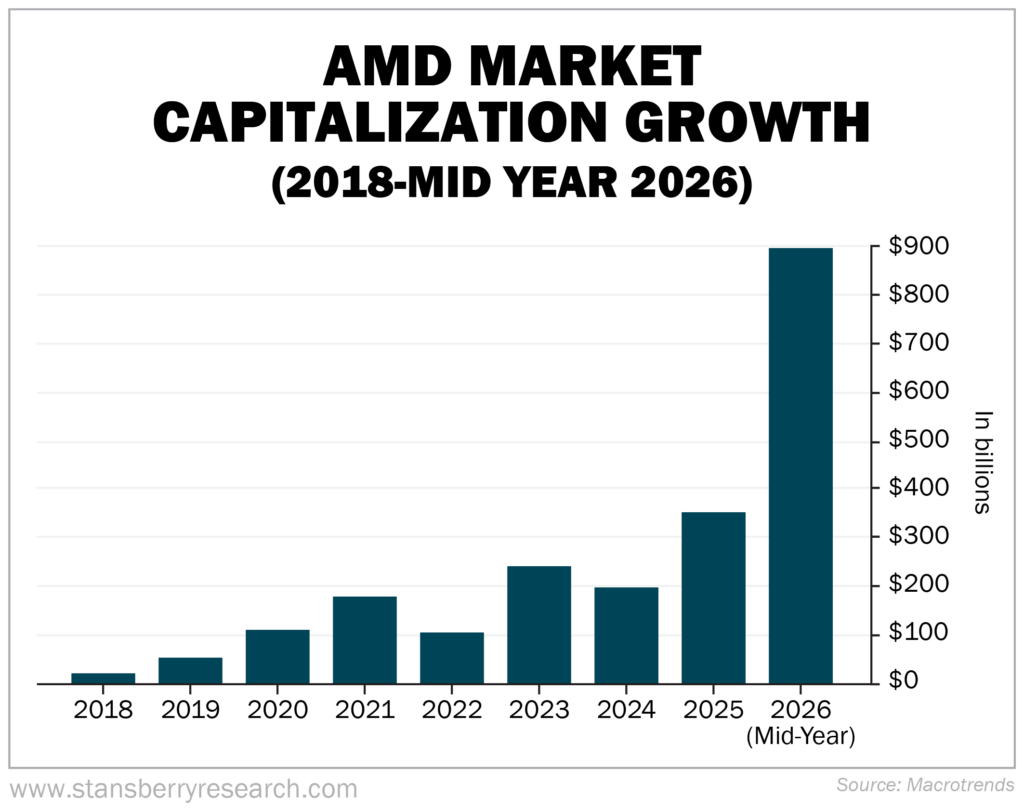
Of course, perspective matters. In that same time frame, Nvidia’s market cap exploded from roughly $81.3 billion in 2018 to around $5.1 trillion as of June 22. That’s an unfathomable 6,140% increase.
It’s not easy to make a 3,932% gain look small. But that’s exactly what Nvidia did.
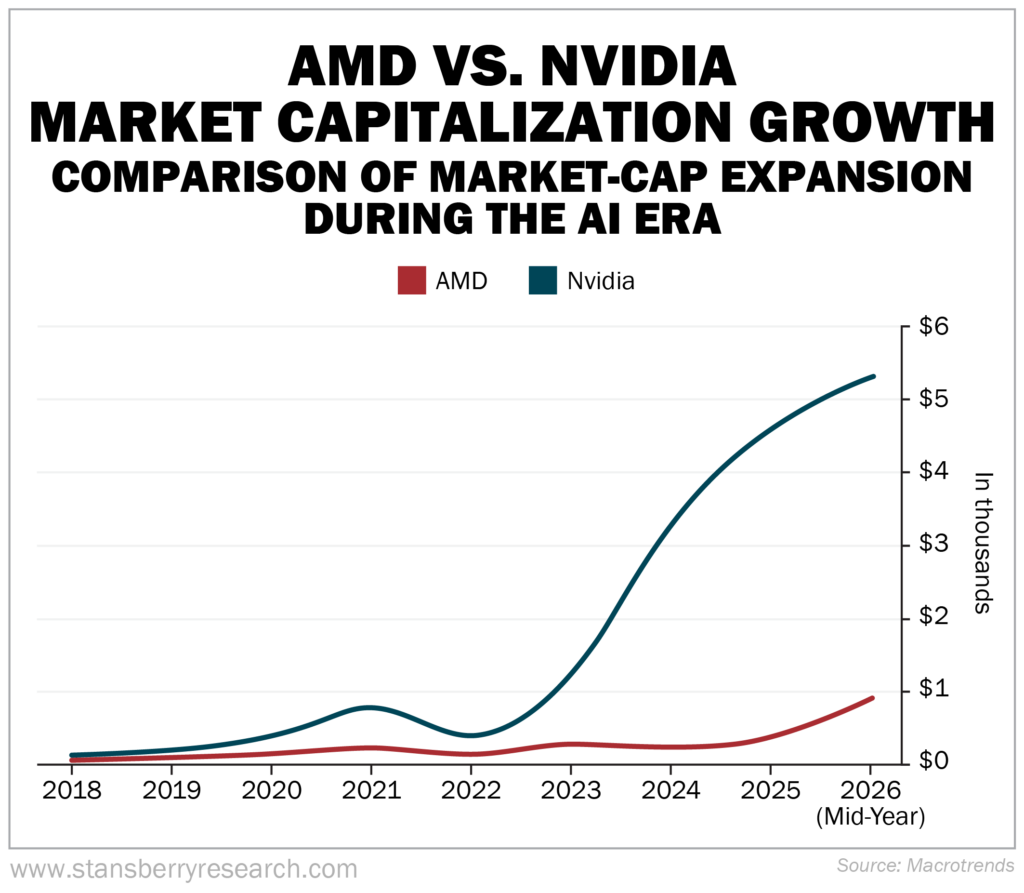
That shouldn’t diminish the gains AMD has made, however. Not just related to its own valuation, but also in market share as it chips away (pun intended) at its competitors’ leads.
AMD Is Making Gains in AI Markets
Let’s get one thing out of the way. Nvidia is so far ahead of AMD in overall GPU market share that it’s not a stretch to say that AMD will never catch Nvidia. Ever. Unless Nvidia CEO Jensen Huang just decides to shut the company down forever. And why would he, considering the juggernaut Nvidia has become?
As I wrote on May 8:
By the end of the fourth quarter in 2025, Nvidia had claimed 94% of the add-in board (“AIB”) market share to AMD’s 5%. (An AIB is a circuit board added to a computer’s motherboard expansion slot to enhance graphics, memory, and other capabilities – like a GPU.)
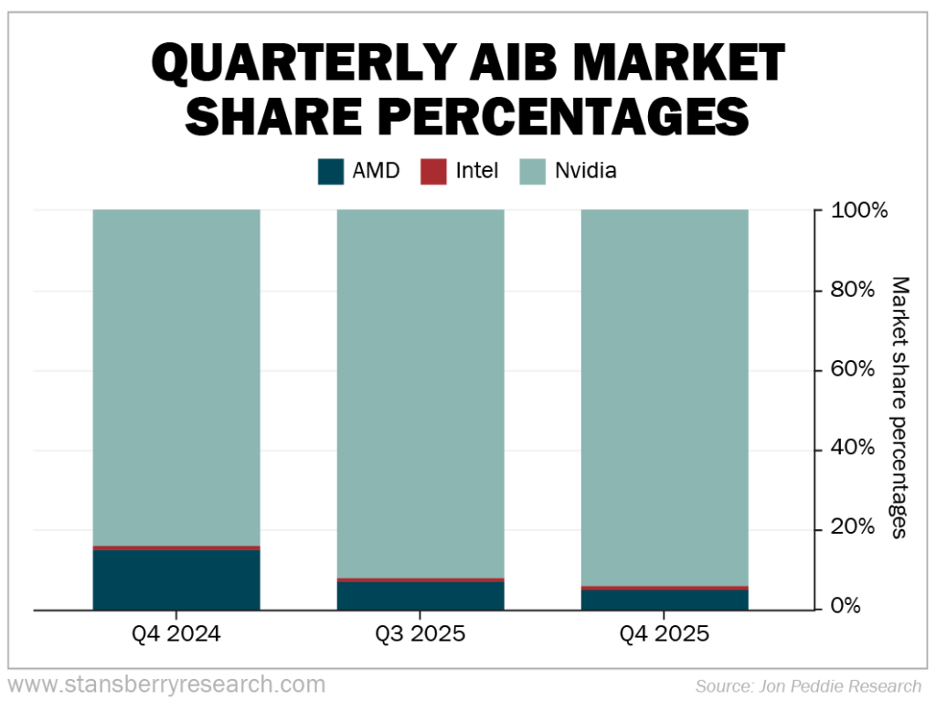
As you can see, there’s a Grand Canyon-sized gap between Nvidia’s and AMD’s respective AIB GPU market shares.
However, if we dig a bit deeper, we can see specifically where AMD is taking some bites out of Nvidia.
Agentic-AI-Server CPUs
Perhaps the area where AMD can truly move customers – and investors – away from Nvidia is agentic AI. As businesses transition into more complex agentic-AI workflows, AMD stands to gain more than Nvidia thanks to its robust server-CPU portfolio.
This shift in AI infrastructure is quite beneficial for AMD, as CPUs are projected to be more integral to AI data-center operations than ever before. In fact, the number of server CPUs shipped during the first quarter of 2026 was up more than 10% year over year. And AMD’s EPYC-server CPUs are meeting that demand.
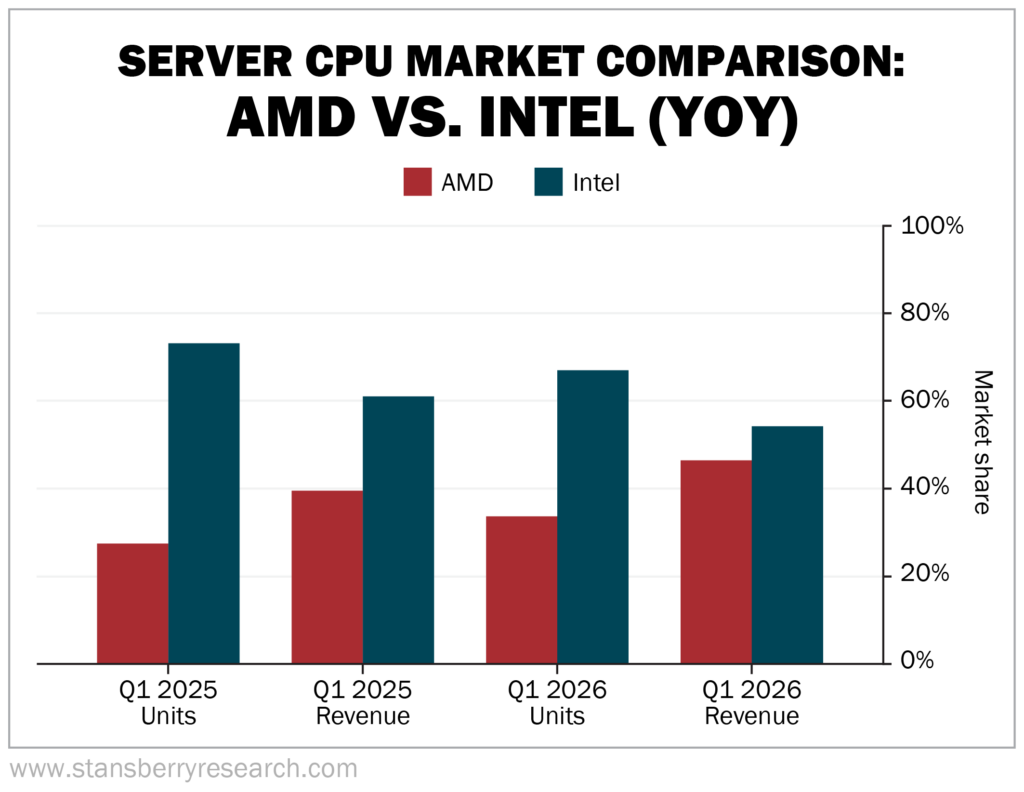
While it’s not competing directly against Nvidia in this market, AMD can continue to eat into Nvidia’s overall business through its CPU offerings. Its primary competition for CPU market share is actually American chipmaker Intel (INTC), which owns roughly two-thirds of the server-CPU market.
But AMD has gained considerable ground, reaching a company-record 33.2% market share of all server CPUs shipped. That figure represents a strong increase from 28.8% in the fourth quarter of 2025. And the company’s EPYC CPUs accounted for 46.2% of all server CPU spending, according to Mercury Research – also an AMD record high.
AI and Data Center GPUs
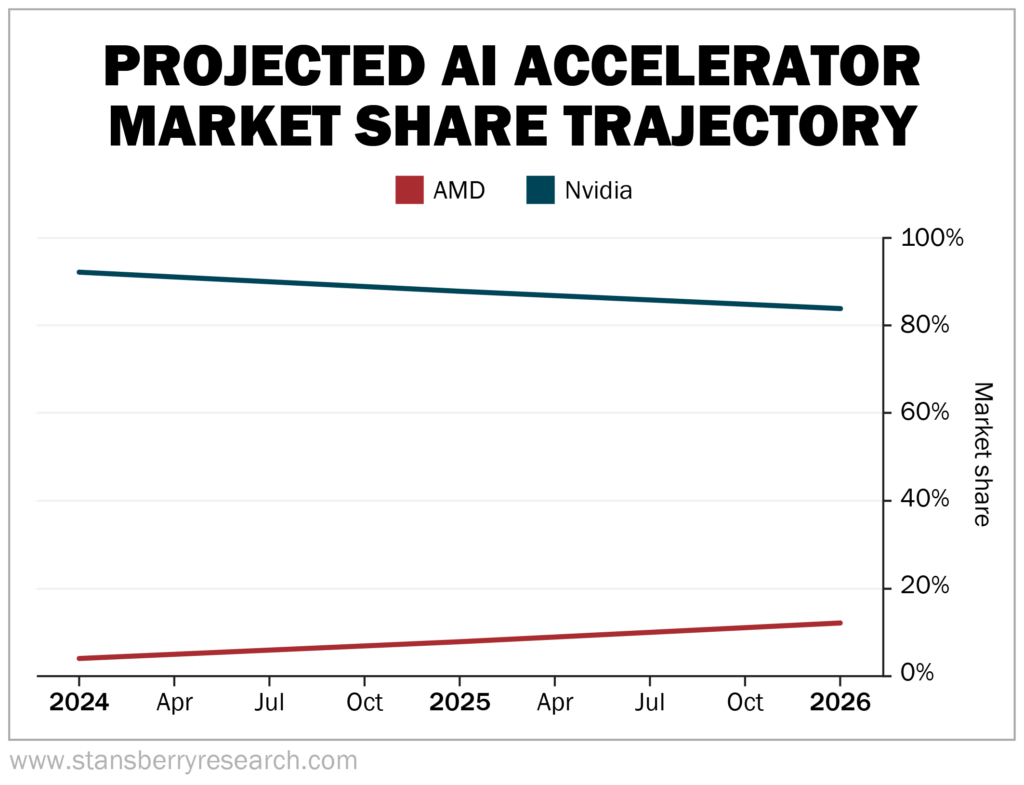
Nvidia dominates this subset of the larger GPU market. As of April, Nvidia owned roughly 80% of the AI accelerator market share, whereas AMD held between 5% and 7%.
However, AMD is making incremental gains, especially in AI inference (the actual running of AI workloads vs. AI training), thanks to its Instinct GPUs, which have earned the company lucrative contracts with Meta Platforms (META), Microsoft (MSFT), Rackspace Technology, and others.
And though the gap remains significant, the chart below shows that AMD has been gradually eating into Nvidia’s AI accelerator market share over the past two years. When considering that Nvidia earned roughly $130 billion in data-center-GPU revenue alone, every percentage point of market share gained by AMD represents a significant amount of money.
The Gaming Market
If you look at the numbers for discrete-desktop GPUs, Nvidia once again has a stranglehold on the market, with roughly 94% market share, compared to AMD’s roughly 5%. That’s simply insurmountable for AMD.
But when looking at the larger gaming market – which includes Steam PC hardware, gaming consoles, and handheld-PC-gaming devices – AMD is a major player.
- For Steam PCs, more than 19% of users have AMD video cards (up from 16.9% in 2025), compared to nearly 72.5% with Nvidia video cards.
- As far as gaming consoles, AMD holds a near-monopoly in the market. Its hardware is found in Sony PlayStation 5 and Microsoft Xbox Series X and S consoles. Nvidia’s presence in this area is practically nonexistent.
- Similar to consoles, AMD dominates the handheld-gaming-PC market, whereas Nvidia is not a factor in this space… yet.
So, while Nvidia continues to own the graphics-card market, AMD is seeing gains in its overall gaming segment. In the first quarter of 2026, AMD’s gaming revenues increased 11% year over year to $720 million, driven (surprisingly enough) by strong sales of its new Radeon 9000 series graphics cards.
We’ll never see AMD overtake Nvidia in GPU hardware sales. But the point here is, every small gain AMD makes in these areas gradually loosens Nvidia’s grip on the market. And that’s enough to have Nvidia looking over its shoulder.
Nvidia vs. AMD: Which Stock Is a Better Investment?
Hardly a day goes by without Nvidia making headlines, and deservedly so. The company, especially under CEO Huang’s leadership, has transformed itself from a successful computer-hardware business into an AI mammoth and the world’s most valuable company.
But AMD should not be overlooked, despite the massive valuation gap. When comparing both companies’ stock trajectories over the past five years, we see that Nvidia has gained an impressive 1,030%. In that same time, AMD has gained 535%.
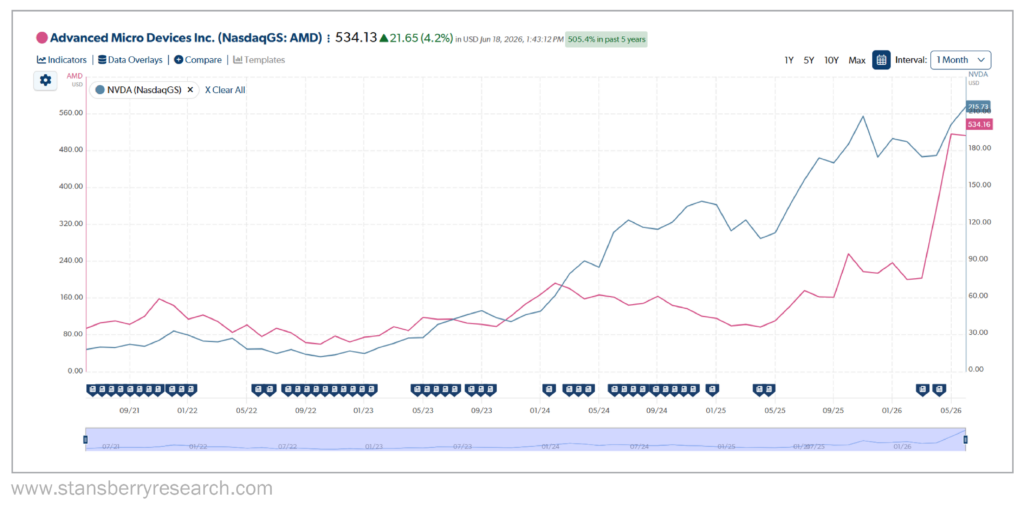
It’s hard for investors to go wrong either way. As long as AI is around, Nvidia should continue to make fistfuls of money and dominate certain markets, which we covered above.
But the same can be said for AMD. The difference between the two tech giants is that AMD arguably has more room to grow and run.
AMD has major hyperscaler data center partnerships to rely on, specifically with Meta and Oracle (ORCL), whose AI chip deal we covered last fall. These include not only custom chips but also AI infrastructure.
And while Nvidia’s RTX Spark super-chip will have something to say about it, AMD is gaining significant ground on Nvidia through its advances in local-AI and agentic-AI computing. AMD’s specially designed processors enable developers to run large AI models directly on their PCs. This is a double win for AMD because customers won’t need to rent cloud services from Nvidia.
The bottom line? Nvidia is the hands-down GPU king and will be for the foreseeable future. So, AMD prioritized other pieces of the AI puzzle over GPUs, such as agentic-AI-server CPUs, AI PCs, rack-scale systems, edge computing, and the other innovations we already covered.
If the transition to agentic AI and inference continues, it could shift the entire market as CPUs begin to outnumber GPUs in AI data centers. And that’s where AMD can potentially flip the script and dominate the AI industry.
Regards,
David Engle
Editor’s Note: What ever happened to the AI stock boom? Even AI darlings like Nvidia have essentially gone nowhere since summer 2025. Our friend and colleague at InvestorPlace, Louis Navellier, may have the answer. According to Louis, the AI industry is quietly “staging” ahead of the next great AI breakthrough… a new class of AI he calls “Superintelligence… but better.” How will it trigger a $100 trillion reset of the AI markets. How will the launch of this tech send some stocks to zero, and others soaring? And why does Louis say: Don’t buy or sell an AI stock in 2026 until you see what’s coming next? Go here for the full story (and Louis’ #1 pick).