
Image Credit: Associated Press
Key Points
- Meta Platforms cut roughly 8,000 jobs and reassigned thousands of employees to AI-focused teams on May 20 as CEO Mark Zuckerberg accelerates investment in artificial intelligence and data-center expansion.
- The restructuring is intended to strengthen Meta’s competitive position against AI leaders such as OpenAI, Alphabet, and Anthropic, despite ongoing delays and challenges with some of Meta’s AI initiatives.
- Rather than focusing primarily on enterprise AI or standalone chatbots, Meta is embedding AI across Facebook, Instagram, WhatsApp, and Messenger to boost personalization, engagement, and advertising revenue.
Meta Platforms’ (META) CEO Mark Zuckerberg said in late January that the company expected to spend between $115 billion and $135 billion in 2026 in capital expenditures (“capex”) – a significant portion of which would go toward artificial intelligence and data-center growth.
That seemed like a reasonable expectation, as Meta seeks to gain ground on its AI and data-center competitors, including Alphabet (GOOGL), OpenAI, and Anthropic. Meta is, after all, one of the “Magnificent Seven” tech stocks, so $135 billion in capex seemingly wouldn’t impact the company’s revenue much.
But Zuckerberg took it one step further in April during Meta’s fiscal first-quarter 2026 earnings call, when he stated that the company’s capex would likely be closer to $125 billion to $145 billion. When your company is valued at more than $1.5 trillion, what’s another $10 billion? A lot to investors, apparently, as Meta stock tumbled 9% after that revelation.
Anyway, about a week before the earnings call, Meta announced that roughly 6,000 open positions within the company would not be filled, with resources instead being reallocated to AI initiatives.
But the news got worse when Zuckerberg also informed Meta’s roughly 78,000 employees that 8,000 of them –10% of the company’s workforce – would be without a job starting on May 20.
That wasn’t even the end of the shake-up. Meta also let its employees know that roughly 7,000 of them would be moved to new AI-focused teams within the organization.
All of this follows Meta’s massive 11,000-employee layoff in November 2022 and another 10,000 jobs just a few months later in the spring of 2023.
Meta’s most recent round of layoffs would save the company at least a few billion dollars a year in payroll expenses, which could help cover the increased AI capex and other AI expenses. But this workforce reduction wasn’t about improving the bottom line at all.
Saving Money Didn’t Drive the Layoffs – Meta’s AI Pivot Did
The few billion that Meta would save with its layoffs is a drop in the bucket for the company.
Just look at the company’s financials during the first quarter of 2026:
- $56.3 billion in revenue, up 33% year over year (“YOY”)
- 41% operating margin, the same as last year
- $26.8 billion in net income, up 61% YOY
- $10.44 diluted earnings per share (“EPS”), a 62% YOY increase
- $32.23 billion of cash flow from operating activities
- $12.39 billion of free cash flow
To be blunt, the layoffs had nothing to do with boosting the near-term bottom line and everything to do with reinvesting those costs into AI. Ironically, many of those laid-off workers contributed to the creation of the technology that rendered their own roles expendable.
Zuckerberg’s laser focus on Meta’s AI ambitions is understandable, considering the company has fallen behind many of its competitors.
Earlier this year, after pouring billions into the project, Meta delayed the release of its new foundational AI model (code name: Avocado, official name: Muse Spark) until April due to performance issues.
According to reporting from the New York Times, Meta’s AI model did not master its internal reasoning, coding, and writing tests. While it did outperform Meta’s previous model as well as Google’s Gemini 2.5 model, it fell short of Google’s more recent Gemini 3 version.
That delay was just the latest AI setback for Meta. In February, the company stopped the release of its chatbot because internal testing found that it egregiously (between roughly 55% and 67% of the time) failed to block dangerous content involving minors – content that involved sexual exploitation, sex-related crimes, hate speech, violent crime, suicide, and self-harm.
On a less disturbing note, back in September 2025, Meta’s AI repeatedly – and rather embarrassingly – failed during a live demonstration of the company’s new smart glasses at its Meta Connect event.
All of this, to me, leads to a simple question: What exactly is Meta’s AI goal?
Meta Views AI Differently Than Its Competitors
Zuckerberg has been quoted as saying that Meta AI is “different from others in the industry,” because its focus is on AI superintelligence that benefits each user’s life personally as opposed to simply automating workplace tasks.
He’s also on the record stating that he wants to create “personal superintelligence,” or an AI model that can be used as a reliable personal assistant within Meta’s product and service ecosystem.
Meta’s CEO said:
I think an even more meaningful impact in our lives is going to come from everyone having a personal superintelligence that helps you achieve your goals, create what you want to see in the world, be a better friend, and grow to become the person that you aspire to be.
That’s not exactly how Anthropic, OpenAI, or Alphabet’s Google necessarily view their AI models.
For example, OpenAI has become the torchbearer for consumer AI, with nearly 1 billion active users per week. As of April, OpenAI’s ChatGPT dominated consumer-AI market share at nearly 77%. For context, Google’s Gemini is second in consumer-AI market share… at 9%.
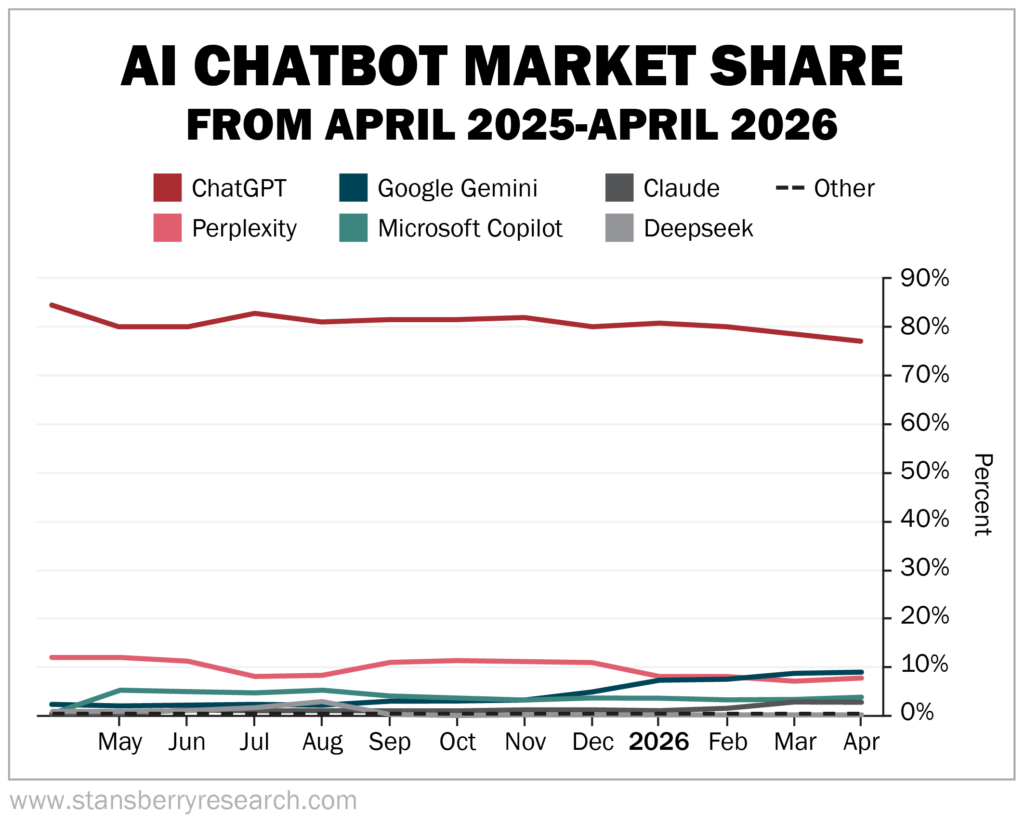
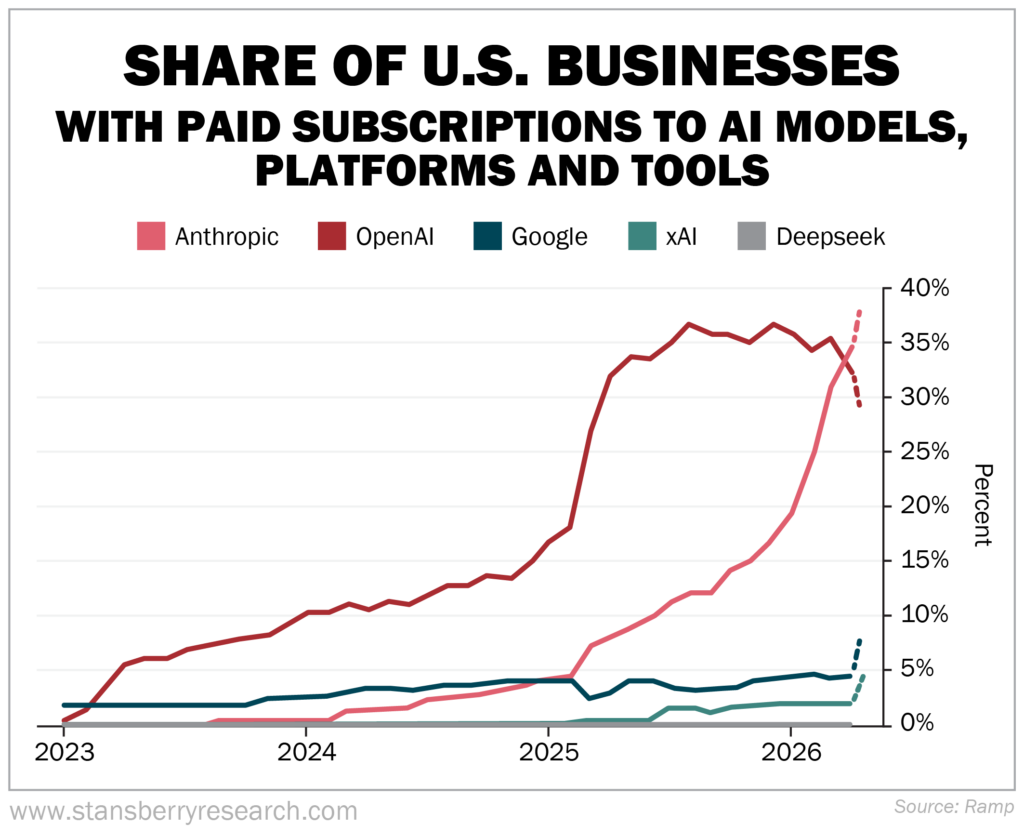
It’s worth noting that OpenAI also offers AI-agent workflows and enterprise tools. But this is not nearly at the same scale as Anthropic, which earns most of its revenue from business-to-business enterprise adoption. The company’s portfolio currently includes more than 1,000 enterprise customers paying Anthropic more than $1 million a year for its Claude services.
According to the Ramp AI Index, Anthropic passed OpenAI in business adoption for the first time ever. As of April, it held 34.4% of U.S. corporate market share compared with OpenAI’s 32.3%.
Google is more of a jack-of-all-trades option when it comes to AI services. Through integration with its Gemini models, no one comes close to matching Google’s AI search capabilities. AI search now comprises 30% of all search activity, and Google owns a near-monopoly 90% market share of global search.
Additionally, Gemini is picking up steam among chatbots, Google owns the most global AI compute capacity, and its Google Cloud Platform is quickly gaining ground on cloud market leaders Amazon’s (AMZN) Amazon Web Services and Microsoft’s (MSFT) Azure. (Notice which of the four U.S. hyperscalers is not included here… Yep, Meta.)
With all that in mind, from a high-level AI perspective, Meta simply can’t compete with these companies.
But that doesn’t appear to be Meta’s intent. Rather than focusing on separate AI tools, Meta is prioritizing integration of AI into its ecosystem, which includes Facebook, Instagram, WhatsApp, and Messenger.
Yes, you can use Meta AI as a chatbot/personal assistant online or through its own app, but it’s primarily used as an integrated tool within Instagram, Messenger, and WhatsApp chats. It also controls the algorithms that choose the content (like reels, ads, and posts) you see in your feeds.
And that’s the key.
Meta monetizes its AI by using it to create highly targeted ads that appear wherever an Instagram, Facebook, WhatsApp, or Messenger user is active. It also relies on the algorithms to pull together and recommend the content users want to see across the Meta ecosystem.
Directing users to that content keeps them on the platform for longer, leading to increased ad views and – most importantly – more revenue per user.
So do subscription plans. Meta is currently testing two tiers of Meta One AI subscriptions – for either $7.99 or $19.99 per month – in a few countries “so that people can pay to use more compute,” according to Zuckerberg. This is uncharted territory for Meta AI, so we’ll see how excited users are to pay for its services.
Overall, Meta’s goal is to reshape how AI impacts people’s lives every day by simply interacting with the apps, platforms, and content they already use.
Of course, that mission has impacted many thousands of lives – those who lost their jobs in the pursuit of AI supremacy. But, to Meta, that’s merely the cost of doing business as it works to make Zuckerberg’s AI vision a reality.
How Meta’s AI Focus and Layoffs Impact Investors
Interestingly, the stock market reacted differently to Meta’s earlier employee layoffs.
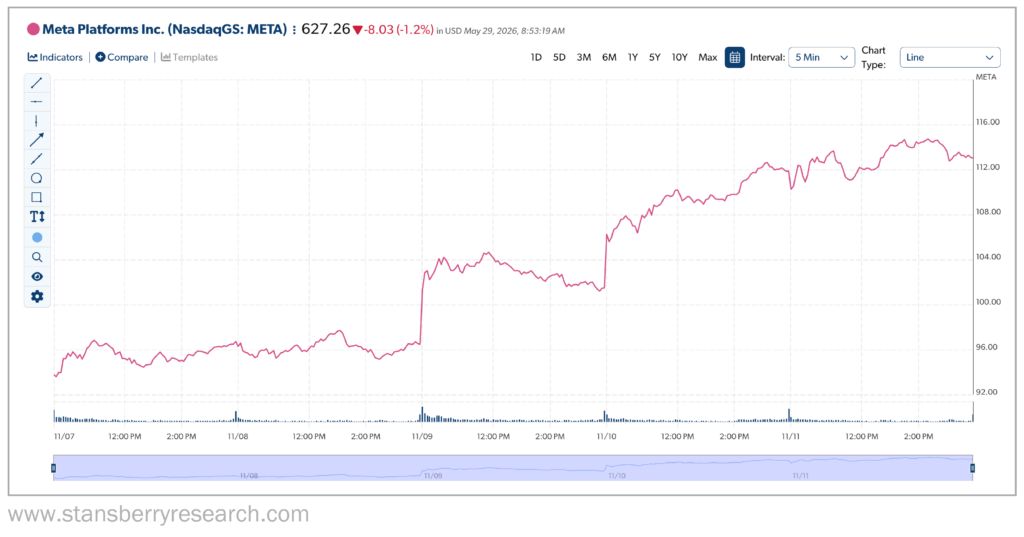
In November 2022, when Meta eliminated roughly 11,000 positions, the company’s stock immediately popped by 6.8% the morning of the announcement. At the start of that week, Meta was trading at just under $95. By the end of the week, its share price was roughly $113.
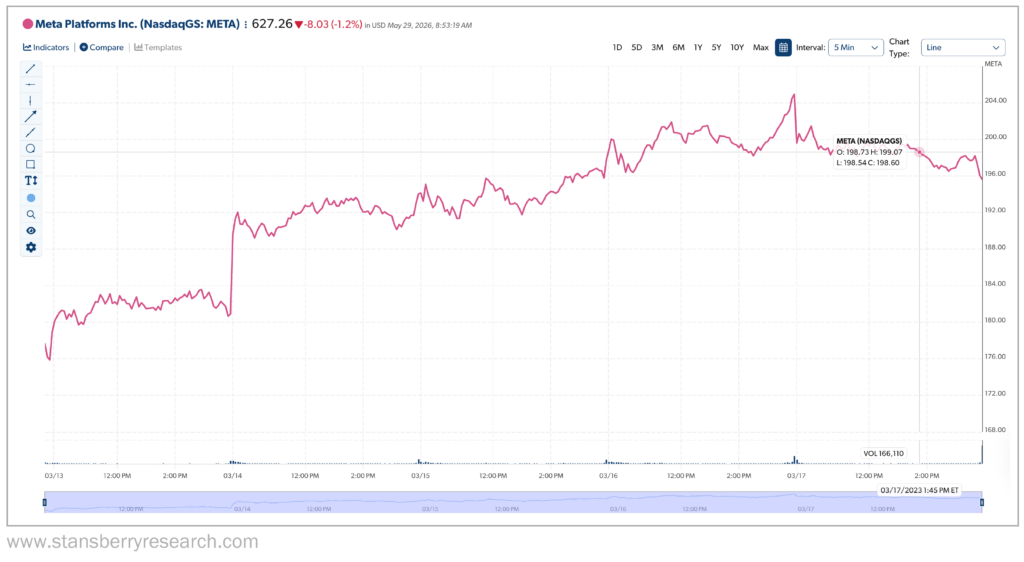
In mid-March 2023, Meta cut an additional 10,000 jobs and closed 5,000 more open roles. The day before that announcement, Meta closed at $180.90. The next morning, Meta was trading as high as $192. It closed at a little less than $205 that Thursday (up 13.3% at that point), before tumbling to $195.61 by the end of the week for a total gain of a little more than 8%.
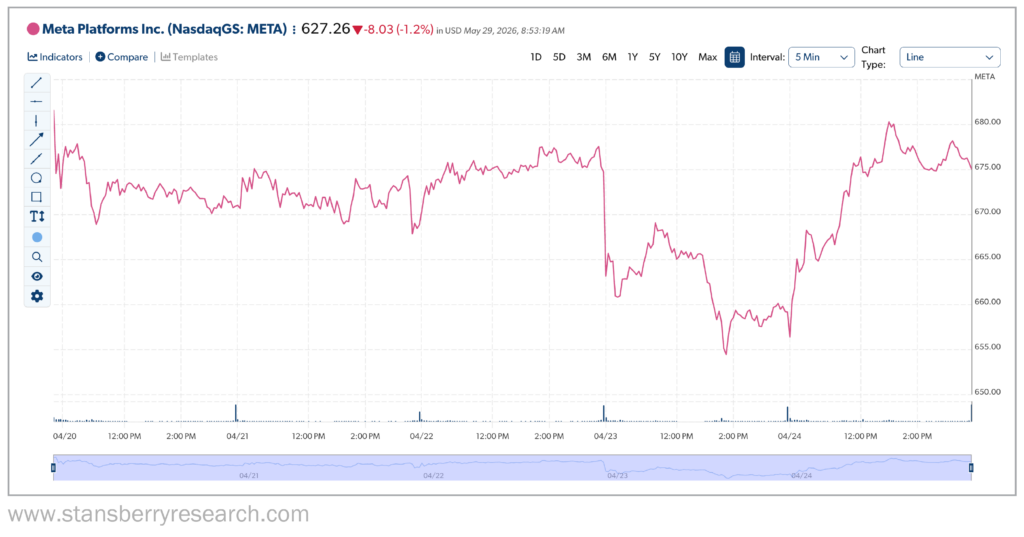
Finally, in the aftermath of the most recent layoff announcement on April 23, Meta stock took a different turn than the two prior layoffs. In the 24 hours following market close on April 22, Meta stock dipped roughly 2.3%. But it did rebound to finish the week at a little more than $675, a tick below where the stock began the week.
All in all, investors generally gained from Meta’s personnel cuts, which is nothing new. According to 2022 data reviewed by Bloomberg, the stocks of large American tech businesses increased 5.6% in the month following layoff announcements.
But it’s not Meta’s layoff-induced stock pops that will reward investors in the long term. It’s the company’s push toward AI greatness. As Zuckerberg told Meta employees in an e-mail announcing the most recent workforce purge:
AI is the most consequential technology of our lifetimes. The companies that lead the way will define the next generation.
He’s not wrong. And that’s why his focus is on making Meta AI an industry leader. He’s just using a different playbook than Meta’s competitors.
If that doesn’t work, Meta can always rent out its extra AI compute capacity to other businesses at a premium, an option that Zuckerberg recently noted is “definitely on the table.”
Is Meta Stock a Good Investment Right Now?
Analysts overwhelmingly think so, with near-unanimous agreement that the stock is a “buy” or “strong buy.”
And Meta’s median price target of $817.50 as of May 28 would indicate that its current trading price of roughly $640 is a bargain.
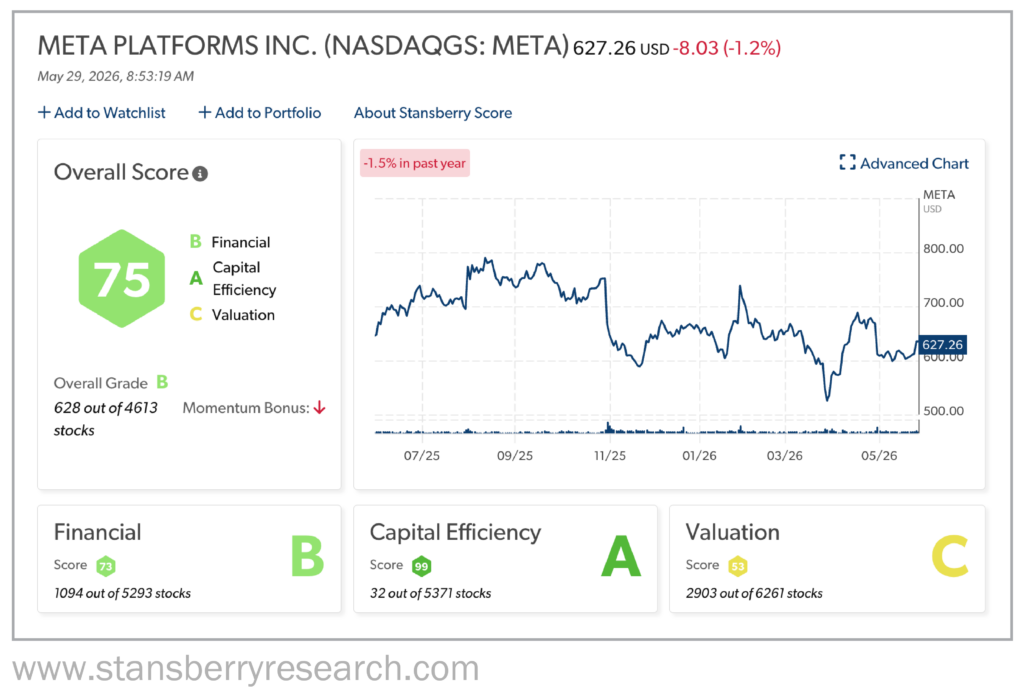
Meta’s Stansberry Score, a tool that helps determine the quality and long-term value of thousands of stocks, generally supports analysts’ bullishness, with an overall solid “B” grade highlighted by its strong financials (“B”) and outstanding capital efficiency (“A”).
As Meta navigates the AI realm toward its own version of dominance, it’s important to remember that the company views AI differently than its rivals. Whereas OpenAI and Anthropic aim to scale AI use among consumers and enterprises, Meta is prioritizing the personal experience.
From a strictly business perspective, the goals of OpenAI and Anthropic are more practical and, in my humble opinion, far more likely to make a seismic impact across the AI landscape.
But Meta’s approach is unique and interesting. Focusing on the daily impact its AI can make on users in a personal capacity has merit and is, dare I say, somewhat noble. Whether it fulfills Zuckerberg’s vision remains to be seen. But it’s certainly worth watching.
Regards,
David Engle
Editor’s note: Marc Chaikin, the founder of Chaikin Analytics, has built an award-winning system that turned “bearish” on software stocks two months before they crashed this year. Now, he’s warning that one AI lab’s breakthrough could CRASH the Nasdaq while igniting a $500 trillion wealth transfer.
This 60-year Wall Street legend has found a little-known $40 “pre-IPO backdoor” into the private startup behind this economic sea change. Click here for its name and ticker symbol before June 16.