
Image Credit: Associated Press
Listen to the audio version of this article (generated by AI).
Key Points
- AMD secured a major AI infrastructure win as Anthropic agreed to deploy up to 2 gigawatts of the company’s new Instinct MI450 chips using the AMD Helios AI platform, strengthening AMD’s position as Nvidia’s leading challenger.
- The partnership will help Anthropic meet surging demand for Claude, diversify its hardware beyond Nvidia, and potentially secure up to $5 billion in investment from AMD.
- AMD’s expanding ROCm software ecosystem and high-profile AI partnerships continue to challenge Nvidia’s market dominance as demand for AI chips remains strong.
A major deal between chip giant Advanced Micro Devices (AMD) and artificial-intelligence (“AI”) company Anthropic announced last Wednesday represents a clear strategic win for both companies. But it also puts a significant dent in the armor of chip bellwether Nvidia (NVDA), which is suddenly facing legitimate competition in the AI-infrastructure sector.
Under the terms of the agreement, first reported by the Wall Street Journal, Anthropic will purchase up to 2 gigawatts (“GW”) of AMD’s new Instinct MI450 Series chips, which will be deployed using AMD’s brand-new Helios rack-scale system.
In return, AMD will invest up to $5 billion in Anthropic, with Anthropic receiving payouts as it deploys AMD’s chips next year. The first GW will deploy in the first half of 2027.
Let’s break down what this deal means not only for AMD and Anthropic, but also Nvidia as its AI dominance slowly erodes.
AMD Scores a Big Strategic Win for Its Newest Chips
AMD’s deal with Anthropic looks like a major win for the Santa Clara, California-based chip designer on multiple levels. The most obvious benefit is the commitment of up to 2 GW of its newest Instinct MI450 Series chips via the company’s new Helios rack-scale systems.
Also, according to AMD’s press release announcing the deal, AMD and Anthropic “will collaborate to use Claude to optimize workloads for AMD Instinct [graphics processing units (“GPUs”)] and accelerate AMD ROCm development, and AMD will broadly adopt Claude across its engineering and product development teams.”
This is big for a few reasons. First, with Claude at its disposal, AMD can use the AI model to specifically optimize both training and inference workloads for AMD’s Instinct GPUs.
Second, Claude can help speed up the development of AMD’s Radeon Open Compute (“ROCm”) software, an open-source program made for GPU computing that allows developers to program and run AI workloads on AMD’s Instinct accelerators and Radeon graphics cards.
Why is this important?
Because up until now, Nvidia’s Compute Unified Device Architecture (“CUDA”) software ecosystem has thoroughly dominated the AI and high-performance computing space by powering the training and inference of most generative AI large language models (“LLMs”). CUDA drives much of the world’s scientific computing and serves as the foundation for cloud-based accelerated computing and AI infrastructure for the biggest cloud providers in the world.
Developers have been building within CUDA since 2007. So, once they’re locked into CUDA, it’s tough to switch platforms. That has been Nvidia’s primary defensive moat – that, and the fact that roughly 81% of AI chips in the world’s biggest data centers in 2025 were Nvidia chips that run on CUDA, which serves as the primary foundation for nearly all large-scale AI infrastructure.
That said, independent-research project Silicon Analysts forecasts Nvidia’s AI accelerator market share to dip to 75% by the end of 2026.
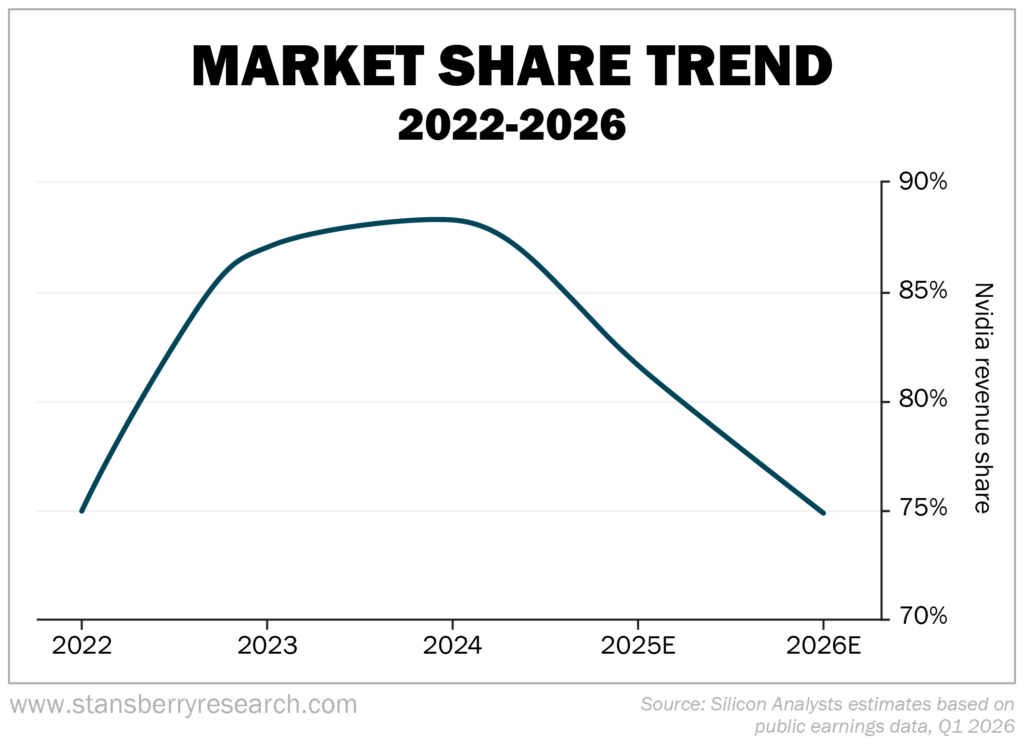
One reason for that drop is the emergence – and expected growth – of AMD’s ROCm software platform. It’s already gained significant traction, with Microsoft (MSFT) having integrated the ROCm platform into its Azure data centers. OpenAI and Oracle (ORCL) Cloud have since followed suit, deploying large AMD clusters backed by ROCm software in their data centers.
And, in a huge deal (reportedly worth up to $60 billion) announced in February, Meta Platforms (META) and AMD agreed to a multiyear, multigeneration partnership to supply 6 GW of AMD processors for Meta’s AI data centers.
AMD’s deal with Anthropic will further tip the scales in its favor. TechInsights predicts that AMD data-center chip market share, driven by wider adoption of the ROCm platform, will hit 13% by 2030. Daniel Newman, analyst and CEO of Futurum, takes it a step further:
I think there’s a serious case in which AMD does great and can get to 20% and 25%. And by the way, this is hundreds of billions of dollars of revenue.
If you’re thinking 13% to 25% market share doesn’t sound like all that much, consider that AMD currently holds a 4.5% share of the data-center GPU market versus Nvidia’s 95%, according to Newman’s Futurum. So, a jump from 4.5% to that range would be a massive shift.
Finally, AMD stands to benefit from the Anthropic deal in a way that most companies benefit from AI tools – it will have Claude available to its own teams to improve workflows.
Perhaps the biggest victory for AMD in this partnership is further validation. With the Anthropic collaboration, AMD proves its Instinct chips, ROCm software platform, and Helios rack-scale systems can deliver everything Nvidia can to the largest data-center operators in the world. It also shows a growing desire among some tech companies to diversify and move away (slowly) from Nvidia.
That’s huge for AMD.
Anthropic Gains Much-Needed AI-Compute Capacity
This agreement came at the perfect time for Anthropic. The demand to use Claude – especially its Claude Code enterprise AI coding assistant tool – has grown so rapidly that Anthropic, in April, publicly acknowledged Claude’s performance issues and wound up pulling back on customer usage to avoid outages… which inevitably occurred anyway.
Shortly after that announcement, Anthropic signed a deal with Elon Musk’s SpaceX (SPCX), which gave Anthropic the use of all the compute capacity at Musk’s Colossus 1 data center in Memphis, Tennessee. While Anthropic gained critical capacity for its infrastructure, it comes at a steep price… $1.25 billion per month to SpaceX through May 2029.
Along with the SpaceX deal, Anthropic agreed to major capacity deals with Amazon (AMZN), Alphabet (GOOGL), and Broadcom (AVGO) in the spring. But it still wasn’t enough. Anthropic co-founder Tom Brown said on July 22, “Access to compute is central to keeping Claude at the frontier and meeting demand from our customers.”
Hence the AMD deal, which not only provides needed compute capacity, but also gives the company a “diversified range of hardware [that] lets us map the right workloads to the right hardware,” according to Brown.
And, of course, there’s the money. Anthropic could receive an investment of up to $5 billion from AMD as it deploys the 2 GW of AMD’s latest chips, starting next year.
As big a win as this is for both AMD and Anthropic, it’s almost as big a loss for Nvidia.
AMD’s Deal With Anthropic Is a Major Blow to Nvidia’s Dominance
Some analysts and industry experts may brush this deal off, considering Nvidia’s historical market-share dominance. It’s an understandable point of view. However, this latest agreement for AMD should not be minimized.
We already looked at how AMD is slowly but surely cutting into Nvidia’s market share. That’s indisputable. Skeptics may still point to market-share charts and argue that Nvidia still holds a huge lead over AMD and other chipmakers.
But that’s not the point. If we’re being realistic, AMD will probably never catch Nvidia. There’s simply too wide a gap that has grown exponentially for years. But AMD doesn’t have to erase the gap. It needs to erode it, and it’s succeeding there so far.
The company, which only a few years ago held less than 1% of the AI data-center accelerator market share, now owns between 5% and 7%. That represents massive growth.
As a reminder, Futurum’s Daniel Newman suggested that number could soon reach 20% to 25%. And that equates to billions of dollars more in sales for AMD… and potentially less for Nvidia. That’s enough to make it a strong competitor, even without coming anywhere near overtaking Nvidia in AI-chip market share.
It’s also important to acknowledge the role that custom silicon designers are playing in Nvidia’s market-share erosion. Based on data from Bloomberg Intelligence, IDC, and Silicon Analysts, Broadcom’s custom application-specific integrated circuits (“ASICs”), Google’s tensor processing units (“TPUs”), and Amazon Web Services’ Trainium and Inferentia chips – along with AMD’s continued growth – are projected to whittle Nvidia’s share down to 75% by the end of this year.
Again, that’s billions of dollars potentially shifting away from Nvidia and into the bottom lines of its competitors.
AMD vs. Nvidia: Who Wins and Loses in This Anthropic Deal?
None of this is to suggest you should dump your Nvidia shares. The company is still dominant, and its stock has gained roughly 27% over the past year as of July 22, even as its AI competition has intensified.
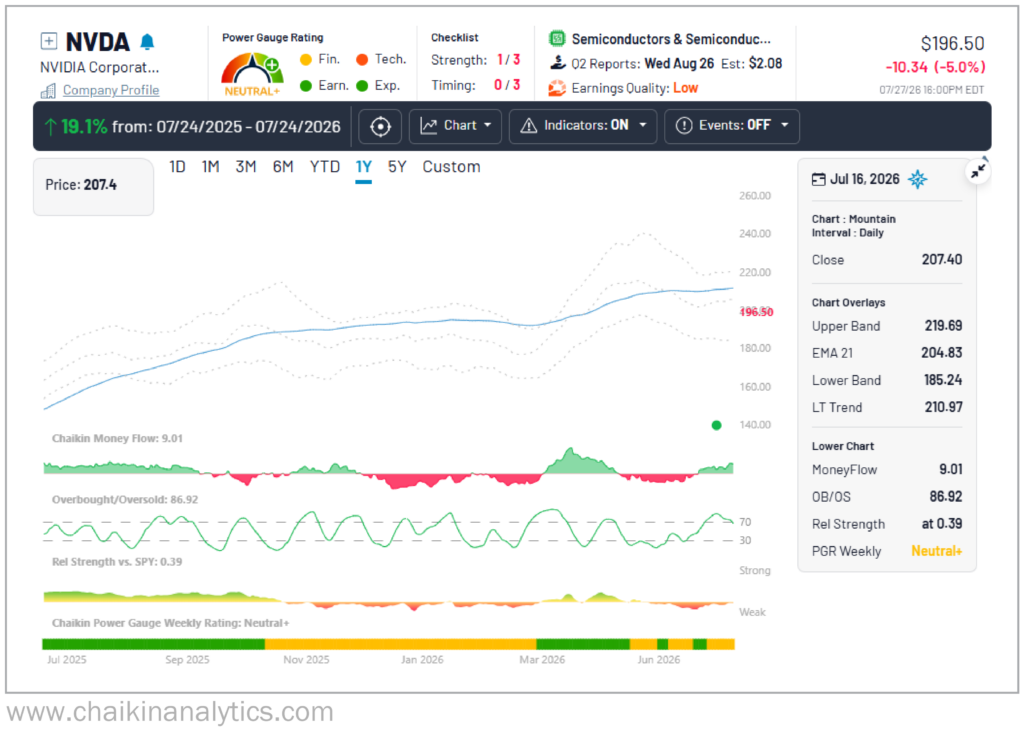
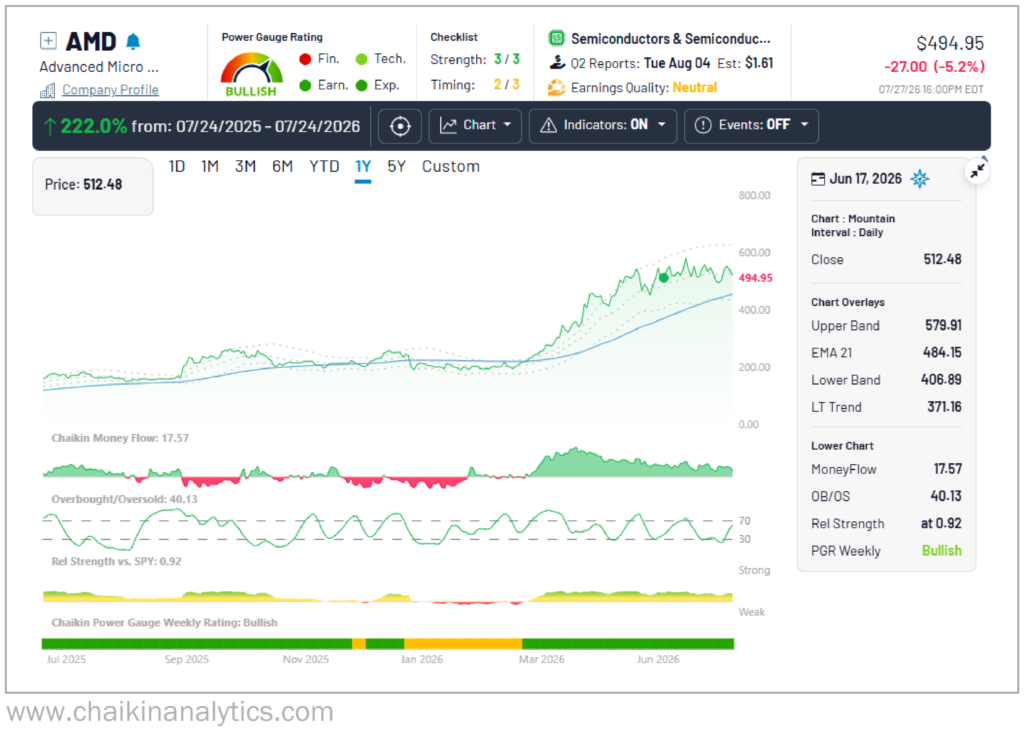
But look at AMD’s stock trajectory over the same period… 257% growth.
What’s important to keep in mind is that AI-chip demand far outweighs its supply. So, even as AMD and other chipmakers eat into Nvidia’s slice of the pie, Nvidia will be just fine. There’s simply too much demand for the products it and its competitors make to lose money. So, Nvidia’s revenue is expected to continue growing.
But remember, every percentage point that AMD or other competitors take from Nvidia means it’s making less money than it would if it maintained or grew its market-share lead.
During its first-quarter fiscal 2027 earnings call, Nvidia reported a record quarterly revenue of $81.6 billion, an 85% year-over-year increase. The company’s AI-specific data-center revenue increased 92% year over year, reaching a record $75.2 billion. Amazingly, Nvidia’s data-center revenue represented 92% of its total revenue.
AMD’s most recent earnings look far different from Nvidia’s, but they still reflect a highly successful business. Remember, AMD is simply operating at a different scale than Nvidia.
Revenue increased 38% year over year to $10.3 billion, which beat Wall Street expectations. AMD’s non-GAAP (generally accepted accounting principles) earnings per share (“EPS”) also surpassed expectations at $1.37, up from $0.96 in the first quarter of 2025. Non-GAAP net income was $2.3 billion, a significant year-over-year jump from $1.6 billion. AMD’s gross margins were strong as well, at 53% (GAAP) and 55% (non-GAAP).
Specific to its data-center business, AMD’s revenue soared to a company record of $5.8 billion, soaring 57% year over year.
And AMD’s second-quarter guidance is encouraging – roughly $11.2 billion in total revenue, which beats analyst projections of $10.5 billion.
Is AMD or Nvidia Stock the Better Buy Right Now?
There are no guarantees in the stock market, but assuming the demand for AI continues to surge, you can’t really go wrong either way. AMD’s gains have been much more dramatic than Nvidia’s, which has shown slower but steady growth in the past year.
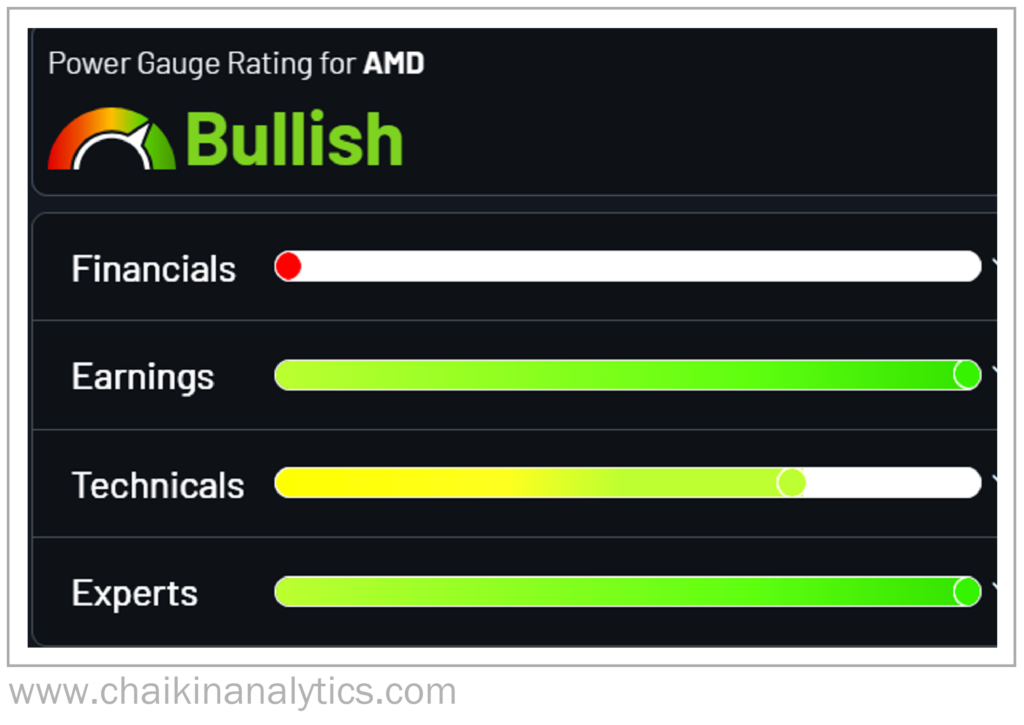
Chaikin Analytics, the investment-research platform founded in 2009 by legendary 60-year Wall Street veteran Marc Chaikin, rates AMD “bullish” in its Chaikin Power Gauge, a 20-factor stock-rating system that scans more than 5,000 stocks and 2,300 exchange-traded funds (“ETFs”).
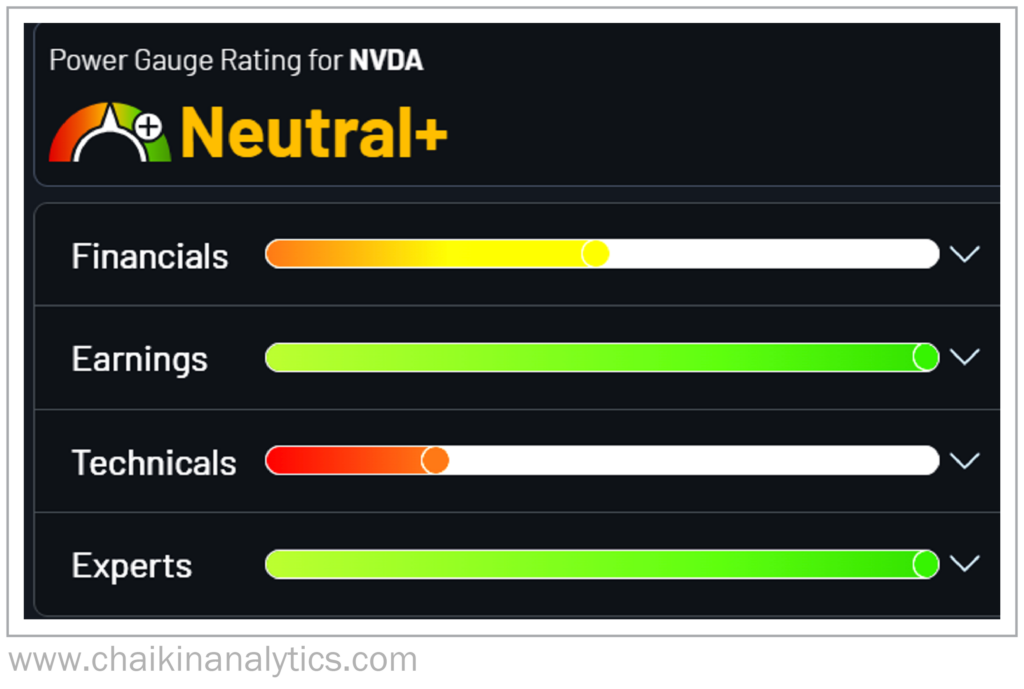
Nvidia’s Power Gauge rating is a slight step down.
AMD’s deal with Anthropic is about as win-win as an AI agreement can get. AMD gets up to 2 GW of its advanced Instinct MI455X chips (part of the MI450 Series) and its new Helios rack-scale system into Anthropic’s data centers, and Anthropic receives up to $5 billion in investments from AMD.
As AMD CEO Lisa Su stated, “Together, we will accelerate AI adoption at scale and establish Helios as a major platform for the next generation of AI infrastructure.”
Nvidia will continue to make its billions, but Nvidia’s execs may just lose a little bit more sleep over this partnership as its market share continues to erode gradually.
Regards,
David Engle
Editor’s Note: God mode. It’s a controversial idea. Irreverent, even. But, according to 60-year market legend, Marc Chaikin, there’s no better way to brace yourself for what’s coming next for AI. Forget fake videos. The new AI emerging from Silicon Valley labs is a digital entity that thinks for itself – without human input. A year ago, that might have sounded like science fiction, but consider this a warning: Marc says we’ll hit that day this summer. And when we do, you need to be ready for AI with its own free will. Because it will change how you work, how we live, and — of course — how you invest. That’s why he’s giving away a list of stocks to buy and sell absolutely FREE to help you position your money for a virtually unrecognizable world driven by this new “godlike” technology. Get Marc’s Frontier AI Hotlist of stocks right here…