Image Credit: Associated Press
Listen to the audio version of this article (generated by AI).
Key Points
- President Trump has floated the idea of the government taking a stake in OpenAI, but the plan shows how much trouble OpenAI is in, as it tries to conduct an IPO.
- OpenAI reported losses of $20.9 billion in 2025, and it appears the company may be structurally unable to become profitable, which makes an IPO difficult to realize.
- OpenAI’s difficulties could easily cascade throughout the AI industry, hurting key players such as Microsoft and Nvidia as well as up-and-coming chipmaker Cerebras Systems.
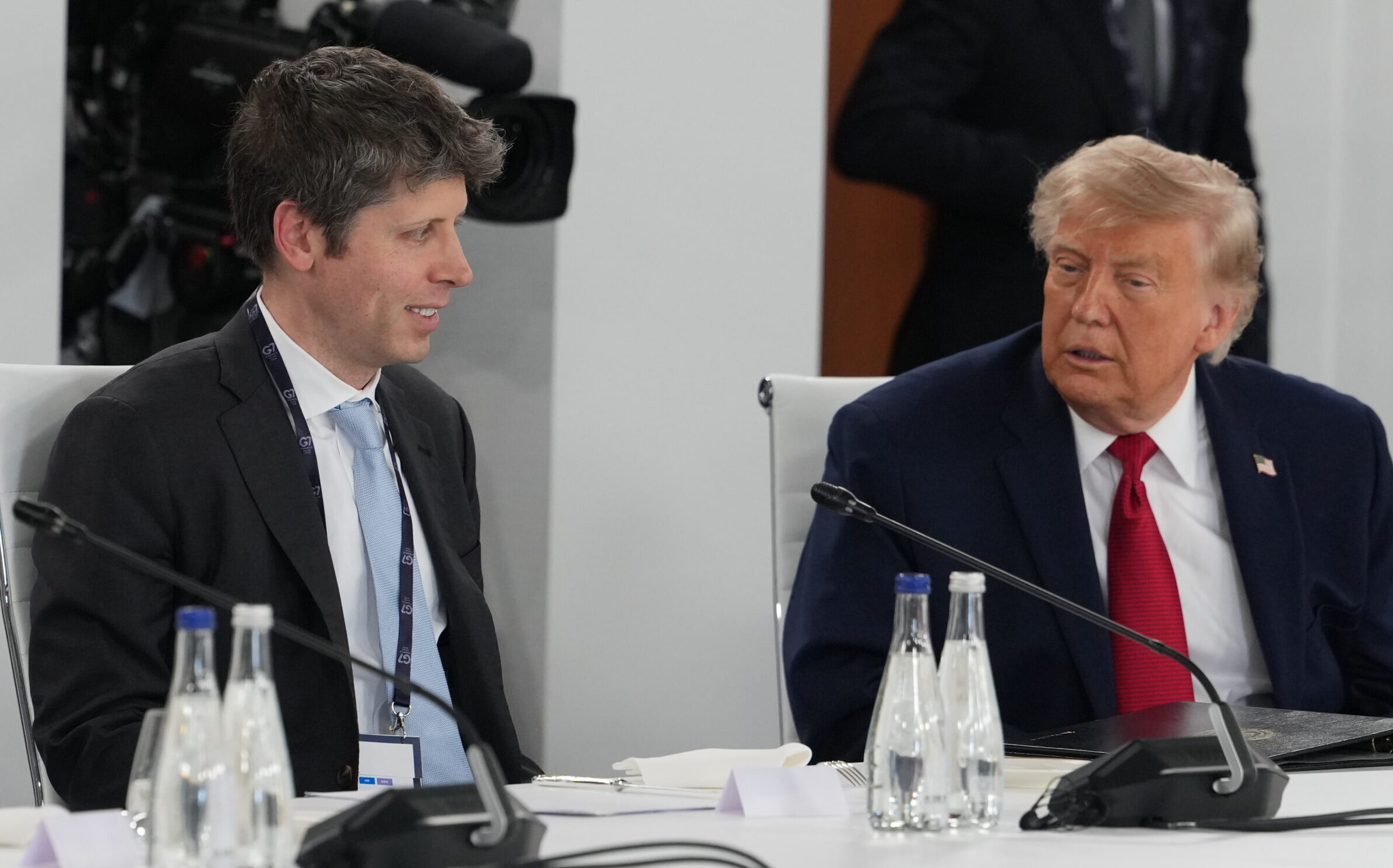
OpenAI is considering delaying its IPO until 2027, according to the New York Times. That news shook artificial intelligence (“AI”)-related stocks, but it’s closely related to news that the market mostly glossed over – President Donald Trump has floated the idea of AI companies donating shares of their stock to the government as part of a public wealth fund.
The pitch for the fund is that it would allow the public to enjoy the upside in AI’s growth, perhaps even directly receiving a cut of the fund’s profits. In fact, the White House and OpenAI CEO Sam Altman have been discussing the plan for more than a year, according to CNBC.
While some are concerned about the governance implications of such a deal, investors should understand what it says about the AI industry as a whole and where insiders see it going.
Some analysts see OpenAI’s move as a gambit to avoid overly stringent regulation or to box out key rivals such as Anthropic. But the rationale is even more straightforward, given OpenAI’s problem getting its initial public offering (“IPO”) out the door: It’s burning money furiously and needs a backstop.
If OpenAI can get the federal government to take a stake, it may enjoy special privileges, even become “too big to fail.” So, a public partnership may well enlist the public to bail out the AI firm.
Trump’s plan is particularly important to the AI industry as a whole, since OpenAI may never become profitable otherwise. If OpenAI can’t achieve an IPO and raise tens of billions in cash, the negative effects will spiral out across the market, potentially leading to trillions in losses in dozens of stocks closely connected with the AI trade.
Here are three stocks that are highly exposed to OpenAI failing to conduct its IPO.
OpenAI May Never Be Profitable
The key issue is that OpenAI may be structurally unable to turn a profit without significant subsidies or other government assistance. That’s why Altman is talking up a public partnership that would let taxpayers foot the bill and “share the gains” for a firm that can’t become profitable.
We now know just how unprofitable OpenAI has been over the past few years, thanks to leaked financials for 2024 and 2025. The losses are enormous:
- In 2024, OpenAI recorded sales of $2.7 billion and an operating loss of $8.8 billion.
- In 2025, OpenAI’s sales reached nearly $13.1 billion, while its operating loss ballooned to $20.9 billion.
- In the first quarter of 2026, OpenAI’s sales soared to $5.7 billion, while it recorded an estimated operating loss of around $7 billion.
If you annualize that first-quarter loss, OpenAI could lose $28 billion on an operating basis this year. For that quarter, every dollar in sales led to $1.22 in operating losses. So, the more OpenAI grows, the more it seems to lose.
Without a clear path to profitability, OpenAI will have a hard time completing a successful IPO. So, a delay on OpenAI going public makes a lot of sense. Plus, with Anthropic planning an IPO in the near term, it may make sense to wait to see how investors respond to that public debut.
We’ll get further details on the sustainability of AI finances when rival Anthropic’s financials are published as part of its likely $1 trillion-plus offering. Anthropic’s figures will likely shape how investors see OpenAI’s financials and how they respond to any subsequent AI-related IPO.
While private investors have been willing to sustain OpenAI’s string of losses for now, they may start to demand traction on all that spending. But the entire AI ecosystem needs OpenAI and Anthropic to both continue spending aggressively and ensure they meet their commitments. Yet, OpenAI has discussed the potential for a price war, a move that would hurt revenues for these key firms.
3 Stocks to Avoid if OpenAI Can’t Go Public
OpenAI is a lynchpin of the AI trade, making it vital for many companies that OpenAI continue to exist and push a growing stream of money through the AI ecosystem. OpenAI’s spending drives growth in sales and profits at other key AI firms, such as Microsoft and SpaceX (SPCX).
The intense need of key suppliers to keep OpenAI running and funded is evident in its latest funding round in March, when it raised $122 billion. But look who was funding it: Amazon, Nvidia (NVDA), and SoftBank (SFTBY), which chipped in a total of $110 billion of that capital.
So, if funding dries up at OpenAI, it funnels downstream to other key players. OpenAI already has $1.4 trillion in spending commitments, according to Barron’s, and it must keep revenues growing to meet them. If it doesn’t, it will cascade heavily through the industry.
Without an IPO, OpenAI will need to come up with tens of billions of dollars that it otherwise would have had to spend. Here are some key stocks that are likely to suffer in this scenario.
1. Microsoft (MSFT)
Microsoft might be the most obvious company to take a hit if OpenAI can’t go public and raise the funds to keep its spending binge on track. The company owns 27% of OpenAI, so the lack of an IPO means Microsoft will have an illiquid stake that it might never be able to sell.
It’s not out of the question that its stake (estimated at $230 billion, based on OpenAI’s $852 billion valuation in March) could end up effectively worthless. While this $230 billion stake is small compared with Microsoft’s $2.7 trillion market cap, it’s still $230 billion in lost value.
But the more important point may be the lost spending from OpenAI. In 2025, OpenAI paid Microsoft $17.2 billion for various services, a figure that has likely risen substantially in 2026, as AI investment from hyperscalers ratchets higher at a sharply higher pace. This increased spending has led to much higher earnings estimates for AI-related stocks such as Microsoft.
So, reduced funding for OpenAI will ultimately lower Microsoft’s spending.
2. Cerebras Systems (CBRS)
Cerebras Systems (CBRS) is a hot AI chip stock that recently went public at a blisteringly high valuation. Its promise is certainly great; however, its chips will need to capture a significant share of the market from leader Nvidia (NVDA) to meet the investors’ lofty expectations. For now, this money-losing company is priced at a steep multiple.
But this valuation relies heavily on spending from OpenAI, the company’s largest customer. Cerebras signed two deals with OpenAI earlier this year for $20 billion. In comparison, Cerebras expects to generate sales of less than $900 million this year, so OpenAI is a major driver of the company’s growth over the next few years.
If OpenAI is unable to meet its spending commitment, perhaps because it cannot raise cash through an IPO, the high-priced Cerebras is likely to feel a heavy impact.
3. Nvidia (NVDA)
Given its size and profitability, Nvidia might feel bulletproof, but it also needs aggressive amounts of spending to keep flowing briskly through the AI ecosystem. It has also benefited from increased spending by hyperscalers such as Microsoft, which is funding some of it through OpenAI’s spending.
Nvidia has seen significant revisions to estimates for its 2026 earnings over the past three months, as analysts incorporate even higher AI capital expenditures. Just 90 days ago, analysts expected Nvidia to earn an average of $8.30 a share in the current year. Now the figure has climbed to $8.96 per share, and the rising forecasts have helped boost the stock this year.
If the OpenAI IPO doesn’t happen, it would put a serious dent in the AI bull case, and that could begin to disrupt the entire narrative powering earnings revisions that seem ever higher.
OpenAI Is a Key to the AI Bubble
OpenAI is not the only big AI play, of course. But if it’s having serious trouble pushing its IPO out the door, this signals bad things for the industry as a whole. So, bad news here may act like a contagion that spreads to other AI plays, such as Anthropic, SpaceX, Cerebras, and many more.
Given the high prices of many AI stocks – or heightened earnings expectations for established companies such as Microsoft, Amazon, Nvidia, and others – a crack in the AI narrative would prove costly. OpenAI’s inability to go public may trigger the downswing, but enlisting public support from the White House shows how much trouble it is in.
Regards,
Editor’s Note: Time magazine recently named this lab “the most disruptive company in the world.” It’s not SpaceX or OpenAI. In fact, its annualized revenues have already surpassed both of those firms. One 60-year Wall Street legend believes it’s gearing up for a watershed product launch that could send its sales soaring even higher now. Click here to learn how you can access a “pre-IPO backdoor” into this firm for just $40 a share.