
Image Credit: Associated Press
Listen to the audio version of this article (generated by AI).
Key Points
- Oracle reported strong results in its fiscal first quarter, with sales and adjusted earnings per share soaring 30%, while AI cloud revenue surged 121%.
- Oracle delivered 850 megawatts of data-center capacity during the quarter and boosted its remaining performance obligations, a measure of future contract revenue, to $664 billion.
- Oracle’s success is so closely tied to contracted revenue from OpenAI that investors can’t afford to ignore the risk, especially as OpenAI’s fundamentals and business environment worsen.
Oracle (ORCL) reported strong results in its fiscal first quarter on Thursday, with earnings blowing past analysts’ expectations. Total revenue climbed 30% year over year, to $19.3 billion, while adjusted earnings per share grew 30% to $1.92, topping the Bloomberg analyst consensus of $1.75 per share.
All eyes should be on Oracle’s artificial-intelligence (“AI”) infrastructure business, since that’s where the company has staked its future growth. This Cloud Infra unit, as Oracle calls it, saw sales surge 121% to $7.4 billion in the quarter, above the analyst consensus of $7.19 billion.
Oracle noted that it delivered 850 megawatts of data-center capacity in the quarter. This allows the company to start generating revenue from the additional capacity.
Oracle signed $30 billion in AI cloud contracts in the quarter, bringing its remaining performance obligations (“RPO”) to $664 billion. The RPO is future contract revenue that Oracle expects to earn from its data-center tenants. This includes, most importantly, OpenAI, which represents about half of Oracle’s RPO, including a $300 billion deal between the two companies.
Management projected that the second quarter of fiscal 2027 would look similar to, or maybe better than, this quarter: sales up 30% to 34% and adjusted earnings per share of $1.85 to $1.93. That level of earnings per share represents growth of 21% to 25% – down from the first quarter.
Management stood firm on its prior sales expectations of $90 billion for the year, but raised earnings-per-share guidance from $8.05 to $8.10. It also stuck to its capital spending expectations of $90 billion to $95 billion for this year, a level that’s already strained its finances.
Oracle is spending aggressively to build out its data-center network, so its first-quarter earnings translated into negative $5 billion in free cash flow. The company has borrowed a staggering amount to fund the build-out – sporting $130 billion in notes payable and other borrowing, as of May – and completed a $20 billion equity offering in the quarter to raise non-debt financing.
The concern is significant enough that the company is telling investors that its new RPO contracts do not create the need for an incremental capital raise.
Oracle CFO Hilary Maxson detailed on the earnings call that the “vast majority of those new contracts were via prepay or bring your own hardware or similar mechanic,” and that the RPO wouldn’t hit revenue or capital expenditures until fiscal 2028 (which begins in June 2027) or beyond.
Oracle’s quarterly results may calm the nerves of some investors for now, but the company will need to show that its key data-center tenant can pay its bills. At this point, that’s not certain.
Oracle’s Future Is Linked to OpenAI’s Success
Oracle stock has been on a roller coaster over the past year as investors try to decide whether the company will be one of the biggest beneficiaries of AI… or one of the biggest losers. Big tech companies have hitched their AI fortunes to two money-losing firms: OpenAI and Anthropic.
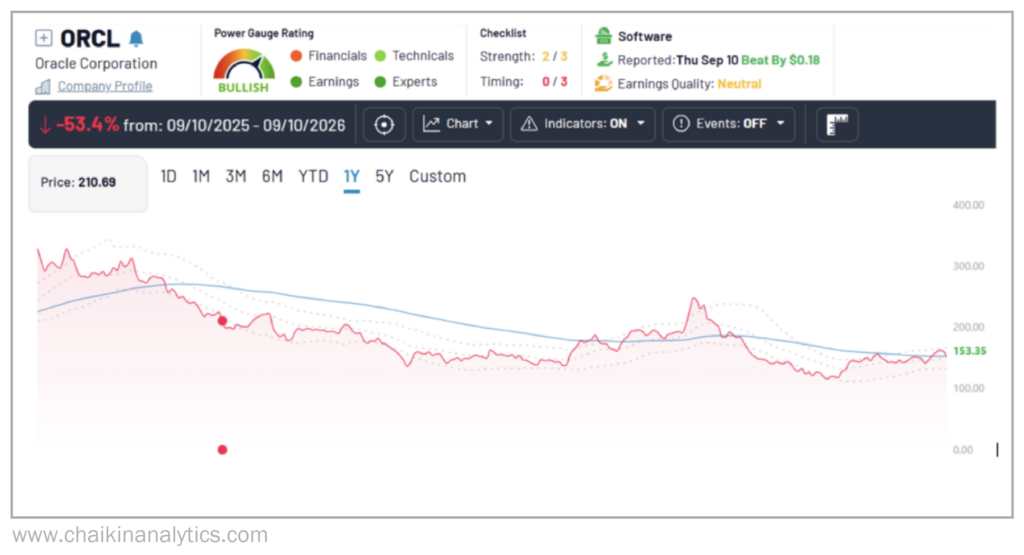
Some investors are betting big that Oracle will plummet – a 50% drawdown is well possible, after similar downdrafts in the past year – and the cost to insure Oracle’s debt against default has soared during that time.
The key risk is OpenAI, given its large share of Oracle’s RPO and OpenAI’s continuing losses. OpenAI is a linchpin in the AI industry, with future spending commitments to major players, including Cerebras Systems (CBRS), CoreWeave (CRWV), and Oracle. So, it’s crucial to the AI industry and Oracle that OpenAI stays solvent and continues to spend. If not, a range of AI-related stocks may go to zero if the bubble pops.
OpenAI Continues to Burn Billions in Cash
However, OpenAI is unprofitable, and it’s not clear whether it can ever turn a profit. OpenAI lost $20.9 billion on an operating basis in 2025, followed by a $9.3 billion loss in the first quarter and a further $12.3 billion loss, including stock compensation, in the second quarter.
The business environment continues to worsen for OpenAI, too. The company’s sales grew just 18% quarter over quarter, while Anthropic more than doubled its revenue in the same period.
Meanwhile, Chinese AI models are taking significant share from American models, including OpenAI. They’re offering good enough performance at substantially lower prices, so software developers are turning to these low-cost providers to build their models.
As if that wasn’t enough, token prices continue to plummet, reducing the revenue OpenAI can generate. Silicon Data’s LLM Token Expenditure Index shows token pricing cut in half from the end of May to late August, from $2 per million tokens to just $1.02.
With poor and worsening economics, OpenAI will need to raise at least tens of billions of dollars soon to stay afloat. So, in effect, Oracle’s success – some analysts say survival – depends on whether investors will keep funding OpenAI indefinitely.
Oracle’s own shakier financial status is shown by the fact that S&P Global Ratings downgraded the company’s debt by a notch to BBB-, just one level above “junk.” As mentioned, the cost to insure Oracle’s debt against default has sharply risen over the past year.
All of that is tied to OpenAI in some way or another.
So, while Oracle’s own first-quarter results look excellent on the surface, its key customer is showing severe problems. If not fixed, it’s only a matter of time before they become Oracle’s problems, too.
Regards,
James Royal, PhD
Editor’s Note: Whitney Tilson — the hedge fund manager CNBC called “The Prophet” — says America has reached its “Ripping Point.” The old financial order is being torn apart, and he believes most investors have no idea what’s coming in the next six months. He’s named the stocks he thinks will be destroyed in the chaos — and the ones he believes will soar. Watch his free presentation while it’s still available.