
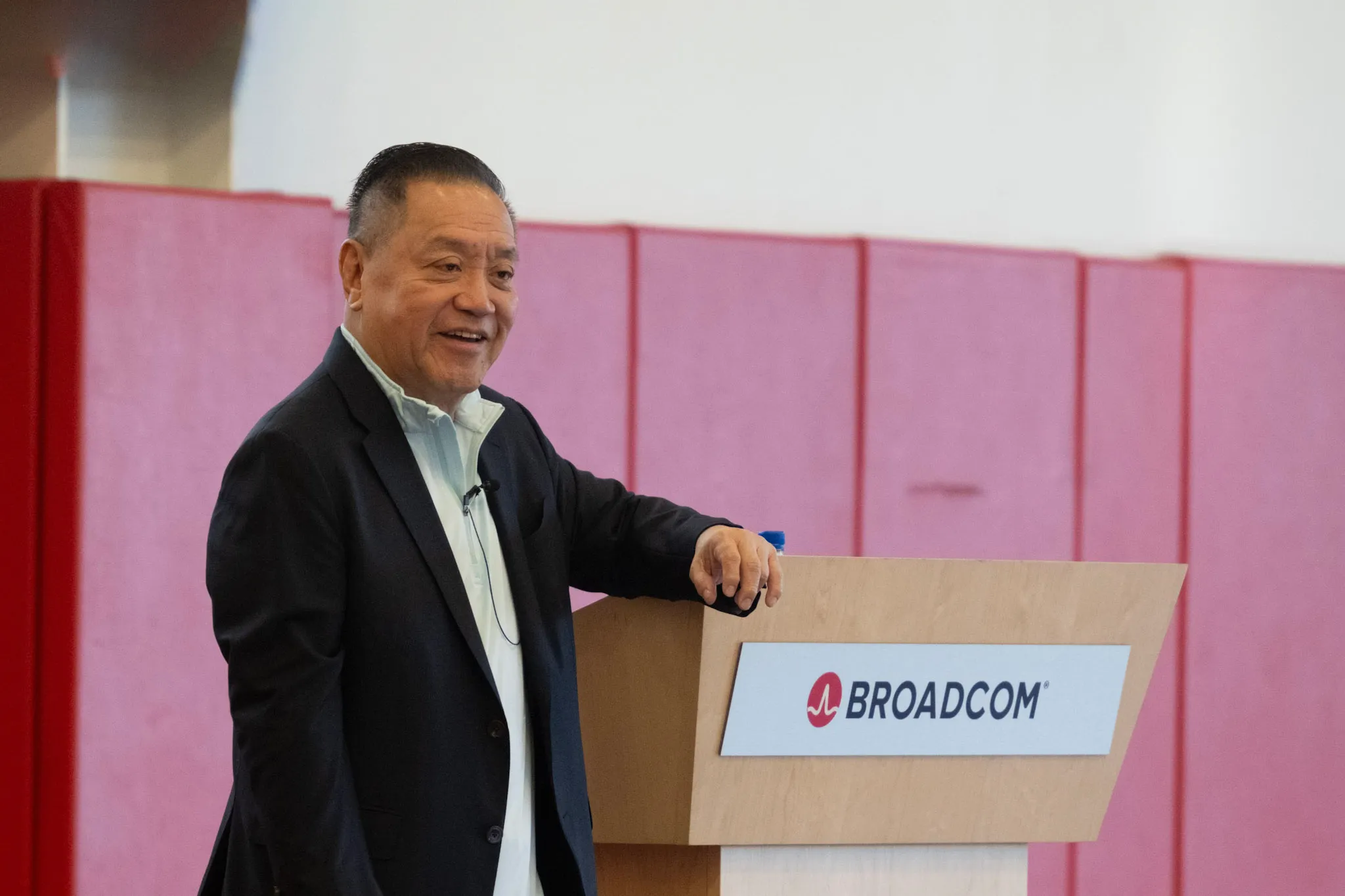
Image Credit: Associated Press
Key Points
- Broadcom suffered one of the largest one-day losses in market history on Thursday, shedding roughly $280 billion in value after management’s AI-chip sales outlook fell short of analysts’ expectations.
- Despite the sell-off, Broadcom delivered record revenue, operating profit, and free cash flow, while AI-chip sales jumped 143% year over year.
- With Big Tech AI spending still running strong and major IPOs such as SpaceX and Anthropic approaching, investor enthusiasm for AI remains high.
Broadcom (AVGO) notched one of the worst one-day losses ever on Thursday, after the semiconductor maker’s current-quarter AI chip sales forecast fell short of expectations. Its stock closed down 12.6% on that day, wiping out $280 billion in market value.
The one-day decline ranked Broadcom’s performance as the fourth-worst loss in total market capitalization since 2019, according to Yahoo Finance. It landed Broadcom in some esteemed, if not dubious, company, behind Nvidia’s (NVDA) $593 billion one-day loss in January 2025, Microsoft’s (MSFT) $357 billion one-day loss in January, and Apple’s (AAPL) $330 billion one-day loss in April 2025.
The reasons behind Broadcom’s sharp decline had less to do with the company’s latest report and more to do with estimates for the current quarter, in which management’s projections for artificial-intelligence (“AI”) chip revenue fell short of expectations.
So, in a quarter where Broadcom generated record revenue, record operating profit, and record free cash flow, the stock lost nearly $300 billion in value. That occurred even as AI-chip revenue surged 143% year over year to $10.8 billion, exceeding the company’s forecast.
But that’s the story in AI now: When you set high expectations, the market comes to expect even more. Excellent results are no longer excellent enough. Instead, they must now be outstanding.
In the second quarter, Broadcom reported sales of $22.2 billion, modestly ahead of analysts’ expectations of $22.1 billion – and up a whopping 48% year over year. Even earnings per share topped estimates by a bit, hitting $2.44, against expectations of $2.40.
It wasn’t overall estimates for the current quarter that gave Mr. Market the heebie-jeebies, though. In the current quarter, management expects total sales to reach $29.4 billion – up 84% from the previous year – and also ahead of analysts’ expectations of about $28.6 billion at the time of the earnings release.
Instead, it was management’s projections of current-quarter AI-chip sales that sent investors running for the exits. The projected $16 billion in AI-chip sales is below analysts’ expectation of $17.2 billion.
If the company hits its own number, it would achieve 200% year-over-year sales growth for its AI-chip unit and 48% sequential growth over the prior quarter. Breathtaking growth.
Investors may also have been disappointed that the company did not boost full-year AI-chip guidance. Management reiterated that full-year AI-chip sales would exceed $100 billion.
Again, that’s where we are in the AI cycle right now. Sure, Broadcom had a banner year. A year ago, the stock was trading below $250, and it nearly reached $500 before the earnings report.
With recent estimates of AI spending rising in 2026 and more on the way in 2027, Broadcom’s move could be a pullback that offers an opportunity for “buy-the-dip” investors.
Optimism for Broadcom: AI Spending Keeps Ramping Up
Even if spending on Broadcom’s AI unit wasn’t quite as robust as investors expected, overall AI spending continues to ramp up at a tremendous pace. Hyperscalers such as Amazon (AMZN), Microsoft, and Alphabet (GOOGL) are pouring hundreds of billions into AI, and everyone still expects this number to rise further (not go down) in 2027, which isn’t too far away.
Just two months into 2026, the big four hyperscalers – the three mentioned above, plus Meta Platforms (META) – were expecting to make capital investments of about $650 billion for this year. A few months later, this figure soared to an estimated $725 billion – again, from those four companies alone.
Alphabet is projected to spend $180 billion to $190 billion this year and an even higher amount next year, though it hasn’t specified a number yet. But the company is keeping its balance sheet more flexible by issuing a record $80 billion in equity – rather than debt – suggesting that it may be planning a substantially higher total in 2027.
Bank of America is expecting hyperscalers to increase investment through 2030. The bank boosted its estimated 2030 total addressable market for AI data-center systems from $1.4 trillion to $1.7 trillion. With spending set to continue, it’s a tailwind for Broadcom.
In a few months, we’ll likely start to get an idea of 2027 spending from hyperscalers and others, providing some clarity to investors who are looking for the accelerated growth to continue.
SpaceX, Anthropic IPOs Keep AI Investors Excited
Broadcom’s latest results come amid an environment that is flush with AI fever. SpaceX (SPCX) is scheduled to hold its initial public offering (“IPO”) on June 12, while Claude maker Anthropic recently filed its IPO prospectus confidentially with the U.S. Securities and Exchange Commission. The other key AI modeler, OpenAI, has also been a long-rumored IPO candidate for 2026.
Not only are these companies looking to take advantage of investors’ white-hot interest in AI and raise money at high valuations, but they’re also looking to hit the “IPO window” while they still can.
With public filings from SpaceX and soon Anthropic, companies can no longer hide behind vague statements about AI’s profitability. Investors can gain detailed insights into the economics of AI directly from the filings, helping them make informed decisions rather than speculative bets.
The recent prospectus from SpaceX provides insight into the economics of AI. While SpaceX is a grab bag of Elon Musk-related businesses, it does helpfully break out the AI unit’s financials.
For example, investors can now directly see just how cash-hungry SpaceX’s AI business is. It spent $12.7 billion on capital investments last year and already laid out an additional $7.7 billion in the first quarter. That compares to $818 million in sales for the AI unit, up by only 12.5% year over year.
Overall, SpaceX posted negative free cash flow of $12.8 billion for 2025. But it has gotten worse since the purchase of xAI in February, with SpaceX burning around $30 billion over the past four quarters.
The cash burn is one of the seven outlandish things from the recently published SpaceX prospectus.
With SpaceX’s financials now public and Anthropic’s soon on the way, OpenAI may feel some added pressure to get its own IPO going. A poor post-IPO performance from either stock might dampen investors’ enthusiasm and hurt its chances to raise money at a high valuation.
But even if AI’s economics are as poor as many investors expect, it won’t mean that the fun is over quite yet. As long as hyperscalers keep spending like princes and the investing public believes that AI is still going to take over the world, chip stocks like Broadcom can still party like it’s 1999.
Regards,
James Royal, PhD
Editor’s Note: Elon Musk has spent 27 years waiting for this moment. Now, it’s rolling out across America… and has the potential to be 15X-bigget than Space X. Luke Lango, who called Palantir, AMD, and Nvidia before they soared, says Musk’s latest rollout is the biggest wealth-building opportunity of his career. He’s giving away one free stock pick in this presentation.