

Everyone is trying to figure out how to own artificial intelligence without owning the froth. After a two-year sprint in chips and data-center names, “How do I hedge the AI bubble?” has become one of the most asked questions in investing.
I spent 28 years on the trading floors at the CBOE and CME before building Masters in Trading, and one lesson from the pits never changes: when everyone crowds the same trade, you look for the adjacent one nobody’s fighting over. Right now, that trade is cybersecurity stocks.
Here’s the logic, and it isn’t complicated. AI is a double-edged sword. The same technology racing through corporate America is also arming attackers, enabling faster, cheaper, autonomous attacks at a scale we’ve never seen. That means security stops being a “nice-to-have” line item and becomes a bill companies cannot stop paying. Cyber vendors get paid whether AI succeeds spectacularly or blows up in someone’s face. Both outcomes create threats. Both require defense.
We got a live preview of this rotation on Monday, September 14, the day the chip names sold off on fresh AI-risk warnings — with Nvidia down nearly 3% and the VanEck Semiconductor ETF (SMH) off 4.4% — the pure-play cybersecurity names had their best session in years. CrowdStrike hit a record high. Zscaler and SentinelOne jumped double digits. The market wasn’t fleeing AI. It was repricing who benefits from it.
Below are the 15 best cybersecurity stocks to buy now, each positioned to ride that shift and grouped by the role it plays in a portfolio.
How Big Is the Cybersecurity Market in 2026?
Before we look at the names, consider these numbers — because the size of this market is the whole thesis.
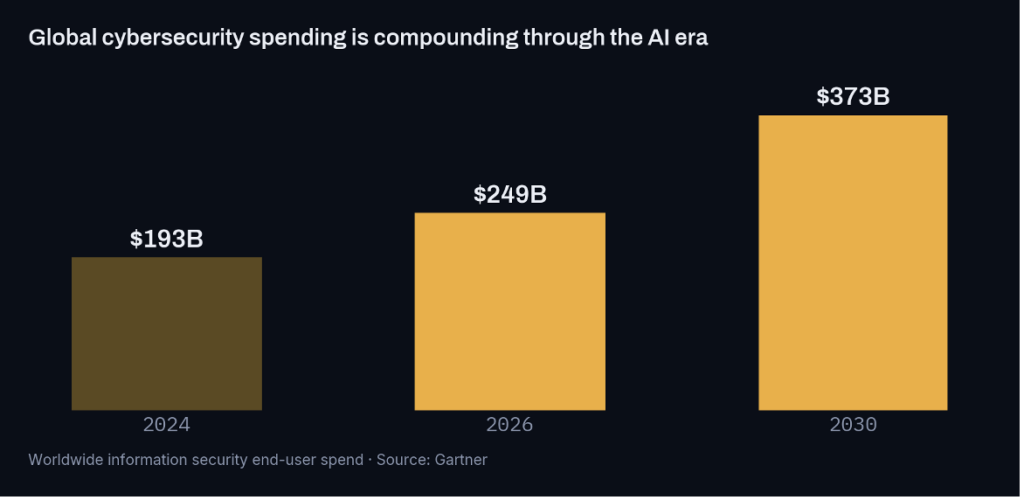
Gartner projects global information security spending will hit roughly $249 billion in 2026, up nearly 13% year over year, on track for about $373 billion by 2030. That’s up from just $193 billion in 2024 — a ~29% jump in two years, at a time when most enterprise software budgets are getting squeezed.
Add in security services, and Cybersecurity Ventures pegs the broader market above $520 billion. A Morgan Stanley survey of CIOs found cybersecurity budgets are expected to grow roughly 50% faster than overall software spending.
The fastest-growing slice of the entire market is a category that barely existed 18 months ago: “securing AI” — projected to overtake endpoint protection as the single largest security category by 2029.
Translation: this isn’t a headline-of-the-week trade. It’s a multi-year, structurally funded spending supercycle. Now onto the stocks.
Want to see how I’m trading this theme in real time? I break down setups like these — with live entries, exits, and risk levels — every weekday at 11 a.m. ET on MiT Live.
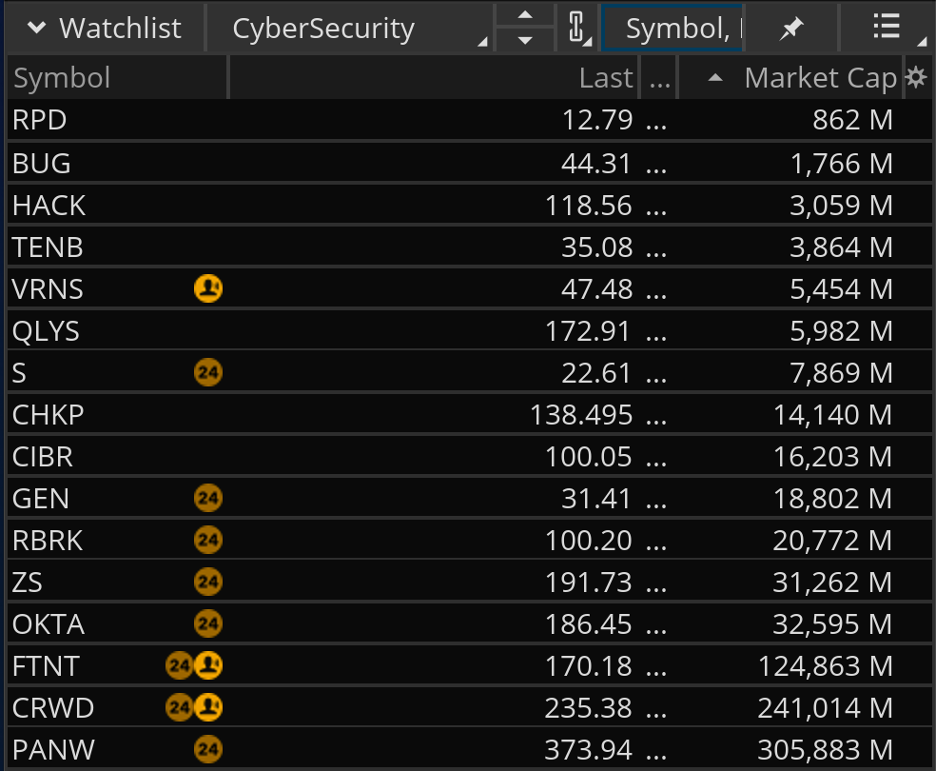
The 15 Best Cybersecurity Stocks at a Glance
| Stock | What it does | Est. rev. growth | Valuation | Analyst view |
| CrowdStrike (CRWD) | Endpoint / XDR | ~26% | Premium | Strong Buy |
| Palo Alto (PANW) | Platform / identity | ~25% | Above avg. | Buy |
| Fortinet (FTNT) | Network / firewall | ~20% | Value | Buy / Hold |
| Zscaler (ZS) | Zero Trust / SASE | ~24% | Moderate | Buy |
| Microsoft (MSFT) | Bundled security giant | Diversified | Moderate | Strong Buy |
| SentinelOne (S) | AI-native endpoint | ~23% | Value | Buy |
| Okta (OKTA) | Identity & access | ~11% | Value | Moderate Buy |
| Rubrik (RBRK) | Cyber resilience | ~48% | Moderate | Buy |
| Cloudflare (NET) | Edge / AI infra | ~36% | Premium | Hold / Buy |
| Check Point (CHKP) | Firewall / SASE | ~7% | Value | Hold |
| Qualys (QLYS) | Vuln. mgmt. | ~9% | Moderate | Hold |
| Varonis (VRNS) | Data security / DSPM | ~9%* | Moderate | Buy |
| Tenable (TENB) | Exposure mgmt. | ~11% | Value | Buy |
| Rapid7 (RPD) | Vuln. mgmt. / SecOps | ~flat | Value | Hold |
| Gen Digital (GEN) | Consumer security | ~4% | Value | Hold |
The Rose Take: Where I Would (and Wouldn’t) Put New Money
After 28 years reading order flow, I’ve learned the best company and the best stock aren’t always the same thing. Here’s how I’d rank them:
- Best business, hands down — CrowdStrike (CRWD). Nothing else in the group has its brand, retention, or platform breadth. The only knock is the price: it’s trading near Wall Street’s most bullish targets, so you’re buying perfection.
- My No. 1 pick for new money — Palo Alto (PANW). It has the scale of CrowdStrike, faster-improving platform economics, a brand-new identity engine from the CyberArk deal, and it still trades at a discount to CRWD. It’s the best risk-adjusted way to own the theme.
- Boldest high-upside bet — SentinelOne (S). The cheapest of the leaders, growing more than 20%, with real takeover optionality. If it keeps closing the gap with CrowdStrike, it has the most torque on the list.
- Handle with care — Cloudflare (NET) and CrowdStrike (CRWD). Two of the best stories in tech, at two of the richest multiples. I’d rather wait for a pullback than chase them here.
- The one I wouldn’t chase — Rapid7 (RPD). Revenue is essentially flat. It’s a turnaround-and-takeover bet, not a growth story — treat it that way.
The Blue-Chip Generals: Best Cybersecurity Stocks for Core Exposure
Large-cap, profitable platforms. They offer core exposure to the theme , and they’re the names institutions buy first.
1. CrowdStrike (CRWD)
The category gold standard. Its Falcon platform is the purest expression of the “AI threat means more security spend” trade, and management now openly calls the company “AI security infrastructure.” Net new annual recurring revenue grew more than 50% year over year in its most recent quarter, its new AI-detection product is scaling fast, and gross retention sits near 97% — a sign customers simply don’t leave. The catch: it’s the most expensive name in the group, and after a 4-for-1 split this summer, it’s already trading near Wall Street’s most bullish price targets. You’re paying up for the best.
2. Palo Alto Networks (PANW)
The consolidation play. While rivals sell point products, Palo Alto is pitching enterprises on running their entire security stack through one vendor — and it’s working, with next-generation security ARR above $9 billion and growing north of 30%. Its roughly $25 billion acquisition of CyberArk, which closed earlier this year, bolts on a dedicated identity pillar right as AI agents make machine identity a top priority. The catch: growth is decelerating off a huge base, and the stock has already had a monster year.
3. Fortinet (FTNT)
The value general. Fortinet owns better than half the global firewall market, differentiates with its own custom silicon, and — critically — is consistently profitable. It typically screens as the cheapest of the mega-cap pure plays, which makes it the “sleep at night” name in the group. The catch: it carries more hardware exposure than the pure cloud names, so its growth is steadier but slower.
4. Zscaler (ZS)
The zero-trust leader. Zscaler replaced the old perimeter-firewall model with cloud-native traffic inspection, and it’s leaning hard into securing agentic AI as its next growth leg, with ARR growing around 25% to nearly $4 billion. It often trades at a meaningful discount to CrowdStrike on forward earnings. The catch: the market punishes any hint of a growth slowdown here — recent guidance wobbles have triggered sharp drops.
5. Microsoft (MSFT)
The elephant nobody counts as a “cyber stock.” Microsoft has quietly built a security business worth roughly $37 billion — larger than CrowdStrike, Palo Alto, and Zscaler combined — and bundles it into enterprise agreements customers already sign. You won’t get pure-play torque, but you get the most defensible distribution in the entire industry with a fraction of the single-name risk. The catch: security is a rounding error in Microsoft’s overall story, so it won’t move the stock on its own.
The High-Growth Disruptors: AI Cybersecurity Stocks With the Most Upside
More torque, more risk. These are the challengers and turnarounds with the most upside if they execute.
6. SentinelOne (S)
The direct CrowdStrike challenger. Its AI-native Singularity platform and Purple AI tools are built exactly for the autonomous-threat era, ARR has crossed $1 billion, and it’s the cheapest of the leaders on a price-to-sales basis — trading around 3.5x forward revenue versus far richer peers. It’s also a perennial takeover candidate. That combination gives it the most torque on the list. The catch: it’s still proving durable profitability and faces the risk of being out-muscled by the platform giants.
7. Okta (OKTA)
The identity turnaround. Identity is the front door to every network — and with AI agents multiplying, every one of them needs an identity to manage. Okta is the leader in that lane and has been climbing steadily back after years in the wilderness. The catch: the platform giants are bundling identity too, so Okta has to keep proving it’s the better standalone tool.
8. Rubrik (RBRK)
The “after the breach” play. While most names focus on preventing attacks, Rubrik focuses on cyber resilience — clean, fast recovery after ransomware hits. That’s a fundamentally different exposure, and a critical one, since no defense is perfect. It’s been one of the stronger performers among the newer public names. The catch: it’s a younger, higher-volatility stock still scaling toward consistent profitability.
9. Cloudflare (NET)
The AI-infrastructure hybrid. Cloudflare isn’t a pure cybersecurity play — it sits at the intersection of edge computing, AI infrastructure, and security, growing revenue nearly 30%. For investors who want the AI build-out and the security angle in one ticker, it’s a rare two-for-one. The catch: that breadth means it competes on multiple fronts, and it trades at a premium valuation.
The Under-the-Radar Value & Niche Cybersecurity Stocks
Cheaper, specialized, less-crowded corners of the space — where the asymmetric setups often hide.
10. Check Point Software (CHKP)
The steady compounder. Check Point rarely grabs headlines, but it delivers consistent margins and cash flow while quietly building out its cloud and zero-trust offerings. It’s the low-drama way to own the theme.
11. Qualys (QLYS)
The profitable niche leader in cloud-based vulnerability scanning and compliance — the unglamorous plumbing that every regulated enterprise has to buy.
12. Varonis (VRNS)
A direct “securing AI” play hiding in plain sight. Varonis discovers, classifies, and monitors sensitive data and catches insider threats — exactly the problem that explodes when companies point AI models at their internal data. Its shift to a SaaS model is gaining traction.
13. Tenable (TENB)
The exposure-management specialist. Tenable helps organizations find what’s actually exploitable before attackers do — a discipline that only grows in importance as AI accelerates vulnerability discovery on the offensive side.
14. Rapid7 (RPD)
The small-cap wildcard. Same vulnerability-management and security-operations lane as the bigger names, but at a fraction of the market cap — which means more torque on any sector re-rating, and more risk if execution slips.
15. Gen Digital (GEN)
The consumer angle. The owner of Norton and Avast is the steadier, income-oriented way to play cybersecurity — protecting individuals rather than enterprises, with a profile closer to a cash-flow compounder than a hyper-growth bet.
Bonus: 3 Cybersecurity ETFs for One-Click Exposure
Not sure which horse to back? Own the whole field. These three ETFs give you diversified exposure without single-name blowup risk:
- First Trust NASDAQ Cybersecurity ETF (CIBR) — the largest and most liquid, weighted toward Palo Alto, CrowdStrike, and Fortinet. It’s pulled in roughly $1.5 billion of net inflows over the past year, so it’s where sector money shows up first.
- Amplify Cybersecurity ETF (HACK) — the original cyber ETF, with a similar large-cap tilt.
- Global X Cybersecurity ETF (BUG) — a cleaner pure-play tilt with less legacy-tech overlap.
The Bottom Line on the Cybersecurity Play
Cybersecurity is one of the only enterprise budgets still expanding through an uncertain economy — and AI is pouring fuel on it from both sides. That’s the definition of a durable trade.
A few rules to play it well. Treat the tiers as roles, not rankings — the generals for core exposure, the disruptors for torque, the niche names for less-crowded setups, and the ETFs when you’d rather own the theme than pick a winner. Watch net new ARR at every earnings report; it’s the one number that separates a real spending shift from a headline pop. And remember that after a big move like Monday’s, headlines fade but bookings don’t — the names that hold their gains are the ones with the recurring revenue to back it up.
The AI era needs defending. These are the companies getting paid to do it.
Editor’s Note: What ever happened to the AI stock boom? Even AI darlings like Nvidia have essentially gone nowhere since summer 2025. Our friend and colleague at InvestorPlace, Louis Navellier, may have the answer. According to Louis, the AI industry is quietly “staging” ahead of the next great AI breakthrough… a new class of AI he calls “Superintelligence… but better.” How will it trigger a $100 trillion reset of the AI markets. How will the launch of this tech send some stocks to zero, and others soaring? And why does Louis say: Don’t buy or sell an AI stock in 2026 until you see what’s coming next? Go here for the full story (and Louis’ #1 pick).
Cybersecurity Stocks FAQ
What is the best cybersecurity stock to buy in 2026?
There’s no single answer for every investor, but the strongest candidates are CrowdStrike for quality, Palo Alto for the best balance of growth and value, and SentinelOne for the most upside if you can stomach the risk. Match the name to your risk tolerance, not the other way around.
Are cybersecurity stocks a good hedge against an AI bubble?
They’re one of the more logical ways to stay exposed to AI without betting purely on the chip and data-center trade. Security spending is largely non-discretionary and rises whether AI adoption succeeds or produces new threats — so the group can hold up even if AI enthusiasm cools.
What is the best cybersecurity ETF?
The First Trust NASDAQ Cybersecurity ETF (CIBR) is the largest and most liquid, making it the default choice for diversified exposure. Amplify’s HACK and Global X’s BUG are smaller alternatives with slightly different holdings.
How is AI changing the cybersecurity industry?
AI is arming attackers with faster, cheaper, autonomous attacks — and forcing defenders to buy AI-powered tools to keep up. Gartner now tracks “securing AI” as its fastest-growing category, projected to become the single largest area of security spending by 2029.
CrowdStrike vs. Palo Alto — which is the better stock?
CrowdStrike is the higher-quality, faster-compounding business; Palo Alto is the broader platform at a more reasonable valuation. For new money at current prices, Palo Alto arguably offers the better risk-reward — but both belong on a serious watchlist.
Trade This Theme With Me – Live, Every Morning
A watchlist is a starting point. Turning it into actual trades — knowing when to get in, where to set risk, and when to walk away — is the hard part, and it’s what I do out loud every single day.
Join me on MiT Live, weekdays at 11 a.m. ET. I go live to break down the market’s biggest themes and the specific setups I’m watching in real time — cybersecurity, AI, and wherever the money is rotating next. It’s free, it’s unscripted, and it’s where lists like this one turn into real trade plans. Drawing on 28 years as a CBOE and CME floor trader, I’ll show you exactly how I’m thinking through these moves as they happen.
Watch live at youtube.com/@LiveOptionsWithJR — hit subscribe and set a reminder so you never miss the 11 a.m. open.
About the author
Jonathan Rose is a 28-year veteran trader who spent his career as a market maker on the Chicago Board Options Exchange (CBOE) and a floor trader at the CME and CBOT. He is the founder of Masters in Trading, where he teaches options and shares live trades and market themes every weekday at 11 a.m. ET on MiT Live. His focus is helping everyday investors think about risk and opportunity the way professional traders do.