
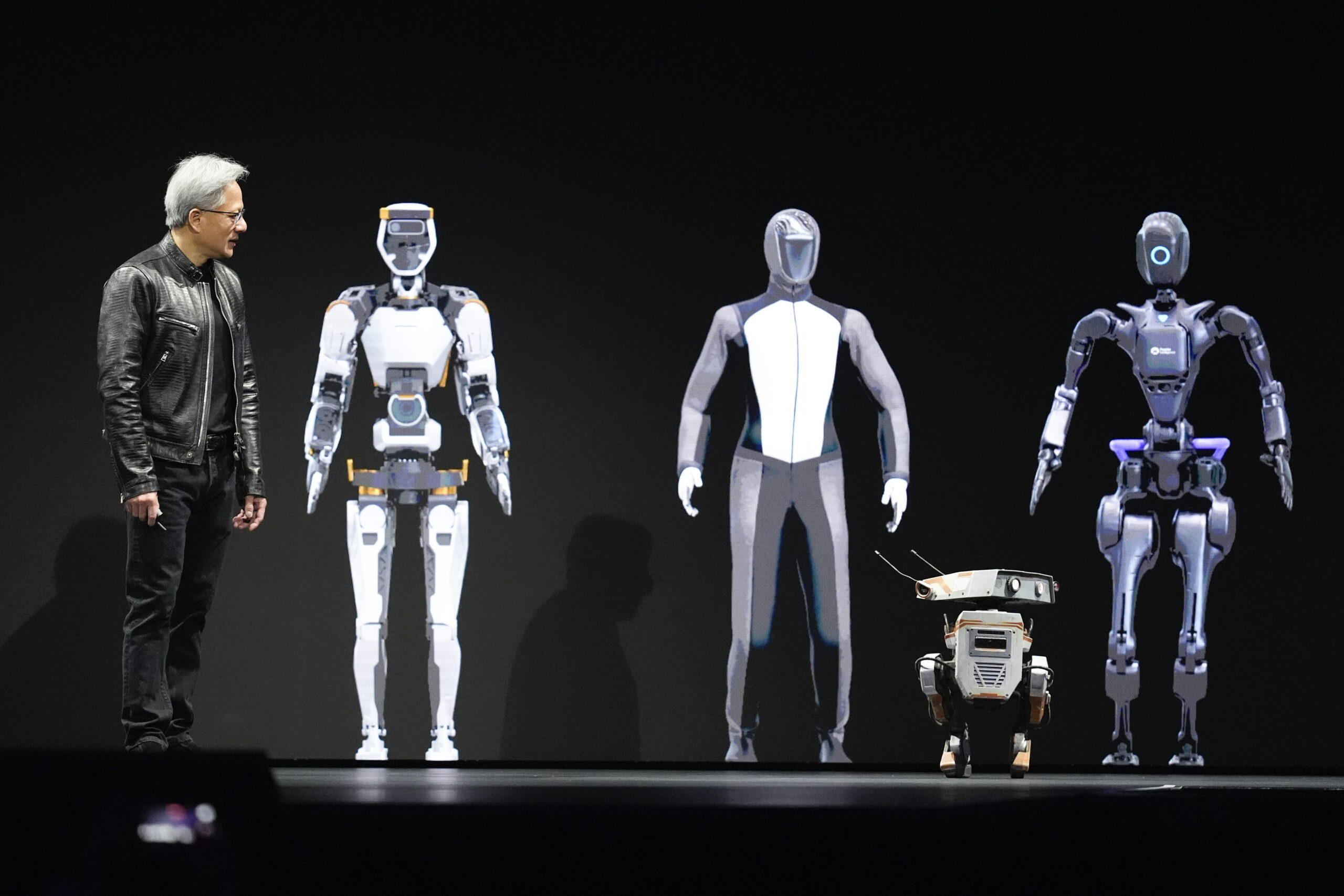
Image Credit Associate Press
Key Points
- Nvidia’s new Halos for Robotics platform aims to solve one of the biggest barriers to humanoid robot adoption by streamlining safety certification and regulatory compliance.
- Rather than building robots itself, Nvidia is positioning its chips, software, and safety infrastructure as essential technology for manufacturers deploying robots in real-world environments.
- As the humanoid robotics market accelerates, Halos could give Nvidia a long-term competitive advantage by becoming the trusted safety standard for Western enterprise customers.
Nvidia (NVDA) did not announce a new robot last Monday…
The tech titan announced the infrastructure that every robotics company must have. This is required before these companies’ machines can legally operate near humans.
The launch is called “Halos for Robotics.”
You see, Nvidia claims it has the only complete safety system for “physical AI.” This term refers to machines that work in the real world. Think of a warehouse floor with forklifts moving around… a car plant where robots and humans share the same floor, sometimes just two feet apart… or logistics facilities running 24 hours a day.
The market for the humanoid-robotics segment is about $3.9 billion. And it’s expected to grow to $17.8 billion by 2031.
This growth is real, too. Agility Robotics already has its humanoid Digit robots running live operations at Amazon (AMZN), GXO Logistics (GXO), and Toyota Motor (TM). The company signed on as Halos’ first partner.
What the Problem Actually Is
More than 140 companies now build humanoid robots. But almost none of them have cracked large-scale commercial deployment.
Technology isn’t the issue – the robots can do the work. The problem comes down to liability…
A manufacturer needs documents proving that a robot meets safety standards. This is required before the robot can be used near people. And that means certified, auditable, regulator-approved documentation.
The standards are fragmented. Some cover industrial systems. Others cover machinery safety or AI-specific requirements. Navigating all three simultaneously takes months – or even years.
Insurers lack actuarial data on humanoid-robotics risk. This forces businesses to either self-insure or pay high premiums. These costs often wipe out returns before the robot even starts working.
Put simply, a paperwork bottleneck has kept humanoid robots stuck in pilot programs.
Halos attacks that bottleneck directly…
Nvidia created the Halos AI Systems Inspection Lab. This is the first program accredited by the American National Standards Institute’s (“ANSI”) National Accreditation Board for physical-AI safety.
It brought together more than 40 companies from the manufacturing, certification, and safety sectors. TÜV Rheinland, UL Solutions (ULS), TÜV SÜD, and CertX all recognize it as part of the certification process. A robot manufacturer using Halos benefits from a pre-assessed, standards-aligned path to certification. Compared with starting from scratch, this path saves years of work.
What Nvidia Actually Built
Now, Nvidia didn’t build Halos from scratch. The company drew on more than 18,000 engineering years of autonomous-vehicle safety work. It addressed the key problem of keeping humans safe around machines making real-time decisions.
Halos is where that work now resides.
And Halos is three things working together…
The hardware layer begins with IGX Thor chips. They manage industrial-grade AI computing and include safety features.
That all works with the Holoscan Sensor Bridge. This bridge processes real-time data from cameras, lidar, and proximity sensors. It continuously feeds this data into the safety-compute domain.
The software layer runs on Halos OS. This manages safety functions – and introduces what Nvidia calls “outside-in safety.”
External cameras and AI agents monitor the robot from the environment – not just from its sensors. They can also override the robot’s behavior in real time.
Put simply, this means that the safety system doesn’t go blind the moment the robot’s own sensors have a bad frame. The environment is watching, too.
The certification layer ties it together…
The Inspection Lab offers manufacturers a clear path through the standards maze. This eliminates the need for three separate certification processes, streamlining them into one.
Why the China Competition Makes All of This More Important
Chinese manufacturers completed more than 80% of humanoid-robot installations globally in 2025. Companies like Unitree and AgiBot are aiming for more than 75,000 units in annual production by 2031.
This exceeds the total supply in the West.
These companies are creating their own computing options to compete with Nvidia. This effort is supported by government subsidies and supply-chain benefits that Western companies can’t match in cost.
But Nvidia doesn’t need to out-produce the Chinese competition. It just must be the layer that Western buyers want their robot vendors to use.
Western buyers value certification. Amazon, Toyota, and BMW don’t deploy robots that lack documentation. They face product liability, employee-safety duties, and regulatory risks.
As such, they won’t want a cheaper, uncertified robot.
A robot built on Halos has a faster path to certification under Western standards than one built on a Chinese alternative. From a procurement standpoint, that’s a big advantage. It shows up in the sales cycle.
What It Means for the Stock
Halos won’t move Nvidia’s earnings this quarter…
Barclays (BCS) estimates the broader robotics market will reach $200 billion in revenue by 2035. Goldman Sachs (GS) forecasts more than 250,000 shipments of humanoid robots in 2030. Most will be for industrial use.
By the mid-2030s, consumer sales are expected to surpass 1 million units each year. The bank puts the total market at $38 billion by 2035 – up from a prior forecast of $6 billion. Each of those robots needs compute. They also need a safety layer. And every enterprise buyer needs a certification pathway before signing a purchase order.
Again, Nvidia isn’t building robots…
It’s building the infrastructure that every robotics company needs. This is crucial for these companies’ products to work alongside humans on factory floors.
In fact, Nvidia (NVDA) CEO Jensen Huang sees humanoid robotics as a multitrillion-dollar chance.
Halos is Nvidia’s first step. The company is building a structure before most investors even notice.
And that’s exactly where Nvidia has won before…
Good investing,
John Evelius
Editor’s Note: Marc Chaikin, the founder of Chaikin Analytics, has built an award-winning system that turned “bearish” on software stocks two months before they crashed this year. Now, he’s warning that one AI lab’s breakthrough could CRASH the Nasdaq while igniting a $500 trillion wealth transfer. This 60-year Wall Street legend has found a little-known $40 “pre-IPO backdoor” into the private startup behind this economic sea change. Click here for its name and ticker symbol.