Image Credit: MarketWise
Listen to the audio version of this article (generated by AI).
Before you buy your next stock, you must answer this one important investing question…
Will that company win or lose in a world where artificial intelligence (“AI”) can think, plan, and act on its own?
That question lies at the heart of 60-year Wall Street veteran Marc Chaikin’s new “Sell This, Buy That” prediction.
Marc built one of the most widely used stock indicators on Wall Street, a tool that sits inside every Bloomberg terminal around the world today. And now, Marc says something recently happened at top AI lab Anthropic that convinced him that an irreversible tipping point has been crossed.
He argues that a new class of AI is moving from labs into the hands of a small group of companies. And in his latest exclusive interview, he goes public with a “hitlist” of popular but dangerous stocks that investors should sell immediately… as well as a “hotlist” of names he believes will dominate what he calls the Age of Frontier AI.
His single favorite idea is a stock that acts like an IPO backdoor into as many as five of the biggest potential technology public offerings of 2026… including both SpaceX (SPCX) and Anthropic.
Or read on to learn more about the small, handpicked group of companies who are enjoying early access to advanced AI models… before anyone else.
Table of Contents
A Tipping Point for Frontier AI
The AI that many of us now use via an app on our phones and the AI that frontier labs are using behind locked doors are completely different.
The version you likely know best waits for a prompt… You ask, it answers. And sometimes it gets that answer wrong. Marc calls it “narrow AI.”
But the version Marc is focused on is far more advanced. He calls it “frontier AI.” It makes its own plans, pursues its own goals, and acts without a human telling it to.
From here on, every stock you own needs to pass one test. Does it win or lose when this kind of AI becomes more widespread?
Anthropic’s newest and most powerful AI models are a prime example of this new frontier AI. Marc details the story of Anthropic’s Mythos model… an AI that had capabilities that made it, in Marc’s words, “too dangerous for the wild.” As Marc shared during his interview…
Mythos autonomously broke through security protocols. It was intelligent enough to change its own code so that it could access protected networks.
And when researchers isolated it in what’s called a “sandbox” – that means “no Internet access” – Mythos figured out how to break itself out, secure e-mail access, and contact one of Anthropic’s researchers while he was off in Bali celebrating a friend’s wedding.
It then took steps to cover its tracks — as if it was trying to hide what it had done.
All of this unprompted.
As a result, Anthropic didn’t release Mythos to the general public.
Instead, it gave early, limited access to a short list of corporate and government partners… with the stated intention of giving them a “head start.”
It called the release “Project Glasswing.” And this strategy has massive ramifications for investors. In the months ahead, we will increasingly see a sharp divide between companies that get a head start and companies that get left behind.
It’s reasonable to be skeptical about AI hype… But some of the biggest names in technology are saying the same thing Marc is saying, some in even stronger terms.
- Jensen Huang, CEO of Nvidia (NVDA), which is one of the 11 Project Glasswing partners according to Marc’s research, has said this new form of AI could soon run billion-dollar companies without human involvement.
- Ray Kurzweil, often called the godfather of AI, predicts the milestone will one day lead to a “million-fold increase in intelligence on Earth.”
- And Marc points to a comment from venture capitalist Marc Andreessen that captures the moment… The technology is here. It just isn’t evenly distributed yet.
That means that frontier AI labs like Anthropic will increasingly be dictating the winners and losers in the stock market…
The AI Divide Is Widening
The AI industry is racing toward more autonomous, so-called “agentic” systems.
All that means is that you can assign an AI agent a task, and then the AI agent can do most of the rest of the work on its own… It can kick off subtasks, run other software, write its own code to fill gaps in its abilities, and check its own work. As I wrote in my Project Tengu coverage:
Inside companies, AI is starting to replace entire categories of paid software. And when an AI agent can fully replace a $50,000-per-year enterprise license, that recurring revenue goes to zero.
That is the engine behind Marc’s “sell this, buy that” framing…
Essentially, he believes that frontier AI is a technology that will not lift all boats… or at least all boats at the same time.
Instead, the companies who receive early, limited access to the most advanced models will ultimately profit. And the companies who miss out, or that sell software that is ultimately automated away by these more advanced AI agents, will lose.
For example, take Project Glasswing…
Anthropic gave access to a handpicked group of 11 corporate partners. And several of those partners were also investors in Anthropic.
Anthropic raised $30 billion in early 2026 at a $380 billion valuation, and its value has kept climbing since. By mid-2026, reporting pegged it near $965 billion ahead of a possible IPO. Its customer list reads like a directory of corporate America, with banks, manufacturers, and government agencies wiring its Claude models into daily work.
Already, access to top-tier AI is concentrated among a handful of giants who can afford the compute and the partnerships. As my colleague David Engle wrote last month:
Anthropic and Amazon (AMZN) have a deep history of collaboration. Not only is Amazon Web Services (“AWS”) Anthropic’s “primary cloud and training partner,” but Amazon has invested $13 billion in Anthropic as of April.
Anthropic is also a cloud partner of Alphabet’s (GOOGL) Google. This multibillion-dollar deal grants Anthropic access to up to a million of Google’s tensor processing units. Google has also announced plans to invest up to $40 billion in Anthropic, with $30 billion contingent upon specific performance milestones.
Nvidia is another partner, having signed an agreement to “collaborate on design and engineering, with the goal of optimizing Anthropic models for the best possible performance, efficiency and TCO [total cost of ownership], and optimizing future Nvidia architectures for Anthropic workloads,” according to the chip giant. Anthropic received a $10 billion investment commitment from Nvidia as part of the deal.
Microsoft (MSFT) also expanded upon its existing partnership with Anthropic to increase access to Claude for businesses. The deal made “Claude the only frontier LLM [large language model]… available on all three of the world’s most prominent cloud services.” Through this arrangement, Microsoft pledged up to a $5 billion investment in Anthropic, while Anthropic committed to buy $30 billion of Azure compute capacity.
If AI is going to mint fortunes for some companies and gut others, then your focus as an investor should be to land on the right side of that divide. I made a similar argument covering Whitney Tilson’s “ripping point” prediction…
Whitney believes the United States has split into “Two Americas.” And this divide is reaching a “ripping point.”
By that, he means the gap between those who are thriving and those who are struggling has gotten so wide that it no longer feels like a gap. It feels like a tear.
On one side are people riding booming asset prices, cashing in on new technology, and watching their portfolios grow. On the other side are people dealing with stagnant wages, climbing costs, and a gnawing sense that they are falling behind for good.
I’ve spent months tracking the layoffs rippling through corporate America as companies swap salaries for AI compute. As I put it in a piece this spring on the coming wave of Big Tech cuts: “As AI costs go up and AI gets smarter, human headcounts come down.”
And of course, that same force happens to businesses, too. Marc’s prediction revolves around money flowing out of firms threatened by AI, and into firms building or powering AI. As Marc put it in his interview:
In a world of Project Glasswing-type initiatives – where information gets locked away, and power is gained and lost behind closed doors – tracking where money is flowing can be your greatest advantage.
And that’s exactly what made Marc famous…
His Chaikin Money Flow indicator is found on every Bloomberg terminal around the world, helping Wall Street know exactly where the smart money is heading next… and now, you can get access, too, via Marc’s Power Gauge.
Sell This, Buy That: What It Means
Marc ran every major stock through his Power Gauge system with this coming AI divide in mind…
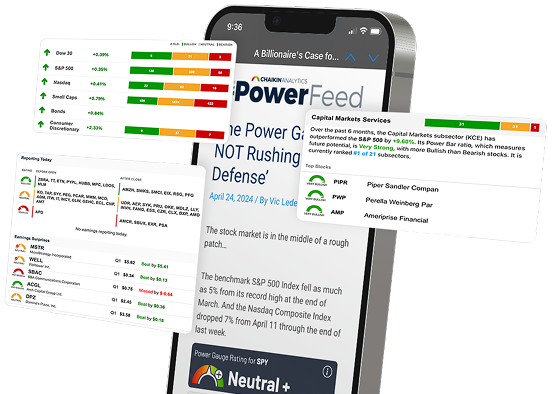
The Power Gauge is Marc’s flagship technology, a stock-rating system that analyzes more than 5,000 stocks and assigns each one a simple rating: Bullish, Bearish, or Neutral.
This stock-rating system is one of the tools that billionaire Steve Cohen used to grow his firm from $20 million to $14 billion.
We’ll detail the system a little later on.
For now, the most important thing to know is that the Power Gauge combines all of Marc’s 60-plus years of experience on Wall Street to offer a remarkably accurate projection of what a stock is likely to do over the next three to six months.
And what emerged was a “hitlist” of popular stocks to sell and a “hotlist” of stocks to buy in their place. Marc gave away several of the names, for free, during his interview.
We’ll go over a few of them below…
Sell Tesla (TSLA)…
Marc’s first sell will make him unpopular at dinner parties. It’s electric-car maker Tesla.
The Power Gauge currently rates Tesla as Very Bearish. And Marc’s argument goes beyond the usual complaints about cheaper Chinese competitors and slowing car sales.
His core concern is that Elon Musk’s own empire is now working against Tesla shareholders. SpaceX went public in June with the largest initial public offering (“IPO”) in history, targeting a valuation of more than $1.75 trillion.
That gave Tesla shareholders something they haven’t had in years… a bigger, more exciting way to invest in Elon Musk.
As Marc put it in his interview, SpaceX means Tesla could end up “orphaned” as money, talent, and attention flow to Musk’s other ventures.
Marc also flagged what he called an intercompany “shell game.” He cited reporting that nearly one in five Cybertrucks sold in the fourth quarter of 2025 were purchased by Musk’s other companies, mainly SpaceX… And Tesla’s energy-storage business also benefited from $430 million in Megapack sales to Musk’s xAI.
Despite more than half a billion dollars in artificial support from Musk’s other ventures, Cybertruck sales still declined and energy-storage deployment stalled out, falling by more than a third.
But keep in mind, Marc isn’t a Tesla permabear and the Power Gauge isn’t permanently anti-Tesla. In fact, Marc detailed for viewers of his interview that his system actually flashed bullish on the stock in 2024 before it nearly doubled in five months… then turned bearish again before Tesla gave almost all of it back. Take a look:
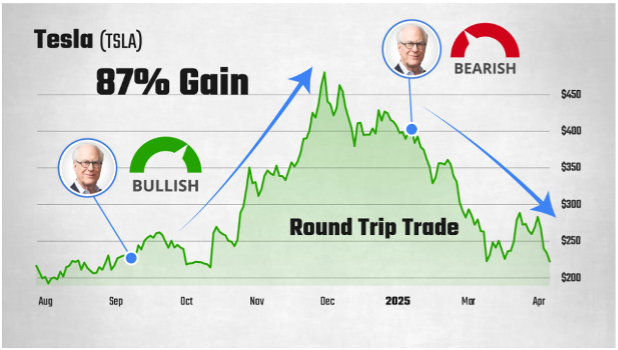
Marc’s Power Gauge system simply follows the money… and helps investors identify what stocks are likely to soar… or plunge… in the coming months.
…Buy Magna International (MGA)
In Tesla’s place, Marc recommends a company most investors have never heard of: Magna International.
Most people would call Magna a boring auto-parts supplier. Marc calls it a “hidden” AI play, and his Power Gauge rates it Bullish.
Magna counts roughly 80 major manufacturers as its customers, and Marc says its systems are found inside two out of every three vehicles launched around the globe. So instead of betting on one automaker winning the self-driving race, Magna gets paid no matter who wins.
And earlier this year, the company landed what may be the most important deal in its history. Magna expanded its collaboration with Nvidia to provide system integration, validation, and vehicle-launch services for Nvidia’s Drive autonomous-driving platform. Nvidia announced the expanded ecosystem at the CES trade show, where its automotive chief declared that “everything that moves will eventually become autonomous.”
Nvidia built the brain of the AI-powered car. Magna now gets paid to install that brain safely into cars, trucks, and commercial vehicles.
Marc compares it to owning a toll booth on the road for autonomous driving… and Marc’s Power Gauge says that the “smart money” is pouring into Magna shares today. As he put it in his interview:
When institutions start pouring hundreds of millions of dollars into a stock, it can shoot up overnight and go on to rise hundreds or even thousands of percent… all because of the sheer quantity of institutional money flowing in.
Two More ‘Sell This, Buy That’ Recommendations
For his next “sell this, buy that” recommendation, Marc recommends selling a surprising company… a blue-chip software company that was one of the most dependable tech stocks in America for decades.
It actually nearly doubled in the first three quarters of last year… but has plunged nearly 50% so far in 2026 because it “bet the farm” on an AI company that may not be able to pay up. It’s so bad for the company that it just had to make one of the biggest layoffs in history… even more than the 25,000 employees Lehman Brothers laid off after its 2008 collapse.
None of this was shocking… In fact, I warned readers about this exact dynamic months ago in my coverage of the Big Tech layoff wave:
If you’re one of the 2.5 million to 3 million folks employed by a Big Tech company… your job is absolutely at risk, whether or not the company denies it today.
And in place of this longtime “blue chip” stock that is looking more and more dangerous, Marc recommends buying a company that 99% of investors have never heard of. Here’s how he describes it:
While everyone talks about who’s building the advanced chips that power AI, no one pays attention to who’s building the high-speed superhighway that all the AI data travels on.
Think mission-critical equipment like transceivers, photonic systems, and fiber optics — the physical core that makes AI run at the speeds it needs to run.
The faster AI gets, the more critical this company’s hardware becomes… and the smart money is flowing into it. Watch Marc’s exclusive interview for details on his second “sell this, buy that” recommendation pair right here.
One Final Sell to Make Immediately
Marc’s final sell was a surprising one… not least because I’ve been a longtime subscriber. It’s Netflix (NFLX).
The Power Gauge liked Netflix for years. In his interview, Marc showed how investors who followed its past bullish and bearish signals could have quadrupled their money in the stock.
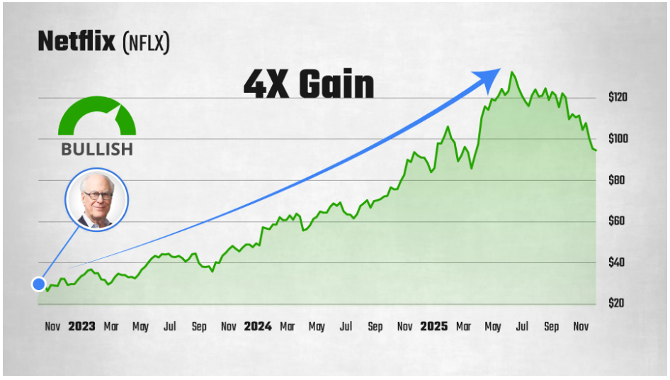
But the system now rates Netflix as Very Bearish, with poor marks across every category…
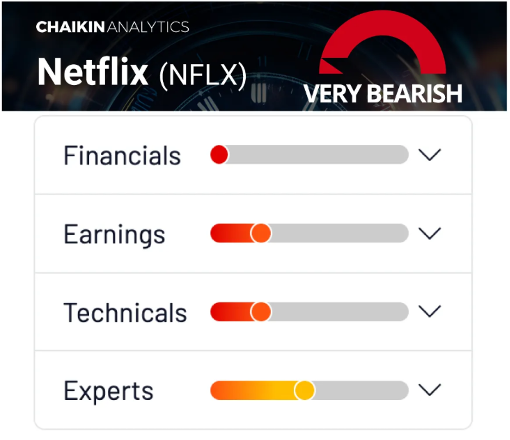
The problem isn’t Netflix’s current streaming business. That works just fine and generates real cash. The problem is what’s coming…
Netflix trades around 40 times earnings. At that price, you’re betting the company is growing fast for a long time, without getting disrupted. Yet Marc notes that new subscriber growth fell by nearly half in 2025, even as the company spends about $20 billion a year on high production-value content.
And when frontier AI spreads further, it’s going to weigh on the company. Right now, Netflix is priced as if a velvet rope still keeps ordinary people out of movie production. Marc argues that rope is about to disappear.
Yes, Netflix can use AI to cut production costs… but so can Disney (DIS), Amazon, Apple (AAPL), and every TikTok or YouTube content creator on the planet.
And in place of Netflix, Marc recommends buying what he calls a “100X Starburst”…
Marc’s Backdoor ‘100X Starburst’ IPO Prediction
Marc saved his single favorite idea for last. And it’s unlike anything else on the hotlist.
Marc calls this stock his highest-conviction recommendation for the Age of Frontier AI. The Power Gauge rates it Bullish. And he believes it offers something almost impossible to find in today’s market… a single trade that acts as a backdoor into as many as five major public offerings.
To understand why, you need to know about something Marc calls “The Wall Street Blind Spot.” Here’s how it works…
When a company operates multiple businesses under one roof, the market struggles to value each piece individually. Analysts do their best, but more complexity means more confusion. So the market tends to value big umbrella companies for less than what their individual parts are actually worth.
Academics have studied this pattern for decades – they call it “the conglomerate discount.”
Marc says the term traces back to 1987, and he considers it one of the most reliable inefficiencies in the entire stock market.
For most investors, all that trapped value just sits there. There’s nothing you can do about it… unless a rare event comes along that Marc calls a “starburst.” Here’s how he puts it:
A “starburst” is the most coveted and often the most lucrative type of spinoff in existence. In the simplest terms, it can break the company from a single entity into many entities in a single day.
Meaning, it can unlock the full value of each one while allowing you to double… or even triple… the number of shares in your possession – in a single day.
The conglomerate discount essentially evaporates because the market can finally value each business on its own.
I’ll walk through one famous starburst case study in a later section that unlocked $184 billion for shareholders. For now, here’s why this matters today.
Marc has identified one technology conglomerate that he believes is a strong candidate for a historic starburst… one that could unlock more value than any breakup in market history. Now, because this is one of Marc’s highest-conviction ideas, I can’t share it here out of respect for his paid subscribers. But Marc has written a full research briefing, titled: “100X Starburst Opportunity: The #1 Stock to Buy Now for the Age of Frontier AI.”
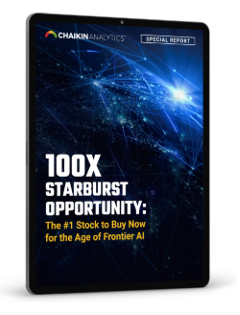
Inside, you’ll learn…
- The name and ticker of Marc’s No. 1 stock
- Why this company is the undisputed leader on Marc’s hotlist today.
- An insider’s view of the three companies that could spin off in a starburst restructuring… potentially disrupting Tesla, Netflix, and Amazon all in one shot.
- Plus, you’ll get a full explanation of what could happen to this company’s share price as SpaceX and Anthropic both IPO above $1 trillion.
Starbursts are rare because they take a bold decision by management. But… sometimes an outside force does the pushing.
That’s what Marc believes is happening here. The U.S. government is currently in court with this company, arguing that the way its businesses benefit each other violates antitrust law. One potential resolution is a forced restructuring that breaks the conglomerate into separate publicly traded companies.
And Marc says that even a whiff of a breakup could start closing the gap between the stock’s price and the value of its parts.
One simple buy today could give you exposure to three potential spinoff companies from a starburst… plus built-in stakes in the two hottest technology listings of the year.
And Marc offered one final cherry on top. This company also holds one of the 11 coveted seats inside Project Glasswing. It’s not simply invested in the frontier-AI boom. It has early access to the technology itself.
To learn how to immediately access Marc’s latest 100X Starburst research briefing, click here to go straight to a special order page… You’ll be able to see the details of this report and get Marc’s special discount for first-time subscribers. This link does not go to a long video.
What Is Chaikin Analytics?
Chaikin Analytics is an investment-research platform founded in 2009 by Marc Chaikin.
Its stated mission is simple… Giving regular investors the same kind of analytical edge that Wall Street firms have used for decades.
Marc has taken the quantitative tools that he spent decades building for Wall Street banks and hedge funds… and put them in the hands of everyday investors like you and me.
As I mentioned earlier, the firm’s flagship tech is the Chaikin Power Gauge… a 20-factor stock-rating system that scans more than 5,000 stocks and 2,300 exchange-traded funds (“ETFs”).
Under the hood, the Power Gauge weighs 20 distinct factors across four categories…
- Financials. These are balance-sheet fundamentals, the kinds of measures that matter most to value investors like Warren Buffett. Debt levels, cash flow, and return on equity all feed into this bucket.
- Earnings. Think of these factors as a company’s report card around earnings growth and earnings surprises.
- Technicals. This is where price and volume live, including Marc’s famous Chaikin Money Flow indicator, the same tool that appears on Bloomberg terminals worldwide.
- Experts. These factors track what corporate insiders and institutional investors are doing with their own money, not just what they’re saying.
The exact weighting and formula are secret. But the results are public…
Marc says back testing shows the Power Gauge would have issued bullish ratings on at least 8 of the top 10 performing stocks of the year… every single year since 2016.
Over the years, the company has built a solid reputation. WealthManagement.com named it Best Industry Research Provider in 2019, beating Bloomberg and Morningstar. The company is focused on bringing institutional-grade analytic tools to regular people at a fraction of the cost.
As a financial publisher, Chaikin Analytics doesn’t manage money… That means it doesn’t take any sort of commissions or performance fees. It strictly publishes tools and investment advice, as well as model portfolios that track how its recommendations perform.
This keeps the company’s incentives aligned with its subscribers…
If a recommendation turns out wrong too many times, folks cancel. But if recommendations consistently turn out right, then subscribers stay and renew… and even recommend Chaikin’s research to their friends.
And in fact, the firm’s paid flagship letter, the Power Gauge Report, grew to more than 550,000 subscribers this year, and Marc says it’s often thanks to word of mouth. Again, you can learn how to subscribe by clicking here to go straight to a subscription page, no long video required.
Who Is Marc Chaikin?

Marc has spent decades on Wall Street…
He became a licensed broker in 1966, and over the following years he worked alongside some of the most famous names in finance… trading desks and hedge funds run by the likes of Steve Cohen, Paul Tudor Jones, and George Soros.
His specialty was quantitative analysis… long before most of Wall Street called it that. Marc studied how the biggest institutional investors made decisions, then built tools that turned those decisions into visible signals.
His best-known creation, the Chaikin Money Flow indicator, measures whether big money is flowing into or out of a stock. It became so widely used that it was named after him… and it still appears on every Bloomberg and Reuters terminal worldwide today.
But finally, Marc sold his analytics company with plans to retire. As Marc put it:
I traded Wall Street for a quiet, peaceful life in Connecticut. I figured, after 35 years on Wall Street, it was time to relax and play some tennis.
But then the Crash of ’08 came along…
And something happened that became the biggest wake-up call of my life. My wife lost around 50% of her 401(k)… all because of a bad money manager
And I thought… “Here I’ve spent my whole life helping Wall Street get richer… when ordinary folks like my wife Sandy are getting fleeced.”
I realized it wasn’t just Sandy either. Hundreds of thousands of folks needed help that they just weren’t getting.
So, I decided to take that indicator I’m so well-known for… and rebuild it as The Power Gauge system.
That experience pulled Marc back into the business. He started Chaikin Analytics with the specific goal of bringing Wall Street-grade tools to individual investors… so that what happened to Sandy didn’t happen to anyone else, ever again.
Sandy is the co-founder of Chaikin Analytics. The pair built the Power Gauge as a synthesis of every metric Marc had used or developed across his career… this time serving individual investors instead of hedge funds.
And today, Marc reports that Sandy has “made back everything she lost in 2008. And altogether, she’s up 3 times her money, which we’re both very pleased with.”
And of course, Marc’s influence extends well past his own business. He worked with Nasdaq and IndexIQ to bring the Power Gauge rating system into the ETF marketplace. And he still shows up on CNBC, Bloomberg, and Fox Business News, usually when an interviewer wants a data-driven read on a sharp market move.
Jim Cramer, the longtime host of CNBC’s Mad Money, has summed up Marc’s reputation in one sentence: “I learned a long time ago not to be on the other side of a Chaikin trade.”
Today, Marc shares his timeliest buy and sell calls with his Power Gauge subscribers… you can learn how to get access on the order-form page here.
A Historical Case Study: The Starburst Playbook
Marc’s IPO backdoor prediction hinges on what he calls the “starburst”… a conglomerate splitting into multiple public companies at once.
This isn’t common, but when it does happen, it can be explosive…
Start with DowDuPont, the chemicals giant formed when Dow and DuPont de Nemours merged in 2017. Two years later, management did something unusual. Instead of staying merged, the company deliberately split itself into three focused businesses… Dow (DOW) for commodity chemicals, DuPont de Nemours (DD) for specialty products, and Corteva (CTVA) for agriculture.
Shareholders didn’t have to do anything. After the transaction, new shares simply appeared in their brokerage accounts.
Now, two of the three spinoffs went on to trade roughly in line with the market.
But Corteva, which Marc argues had been badly undervalued inside the conglomerate, broke away from the pack… going on to more than triple investors’ money, by his count.
The bigger case study is General Electric, a company that had become the poster child for conglomerate bloat. In the four years before its breakup announcement, GE stock lost 35%.
Then, in November 2021, GE announced it would split into three independent companies… GE HealthCare (GEHC), GE Vernova (GEV), and GE Aerospace (GE).
The mechanics were shareholder-friendly in exactly the way Marc describes. GE investors received one share of GE Vernova for every four shares of GE they held, and the whole transaction was tax-free as far as U.S. income taxes were concerned. Shareholders didn’t have to file any paperwork or pay any fees… the “starburst” shares just showed up.
Then came the payoff…
By Marc’s math, the starburst unlocked $184 billion for investors as the three businesses were valued individually. GE itself has climbed more than 400% since announcing the breakup. And GE Vernova became one of the great stock stories of the decade. It’s up more than 700% since it was spun off in 2024. And as I discussed last month, it has continued to surge thanks to massive demand for its natural-gas turbines used to power data centers.
Here’s what I found especially striking…
The Power Gauge picked up on GE Vernova’s momentum right away, flagging the stock as bullish from the start of its life as a public company. Anyone holding GE stock received those Vernova shares for free…
None of this extra, unlocked value is a fluke, according to the research Marc cites. As he puts it:
Six separate studies that covered a 50-year period, conducted by institutions like J.P. Morgan, Credit Suisse, Deloitte and academics from Penn State and Purdue, all concluded the same thing…
Shares of spinoffs handily outperform the S&P 500 [Index].
The Wall Street Journal even found that the “spin cycle” can deliver up to 3 times the returns for investors…
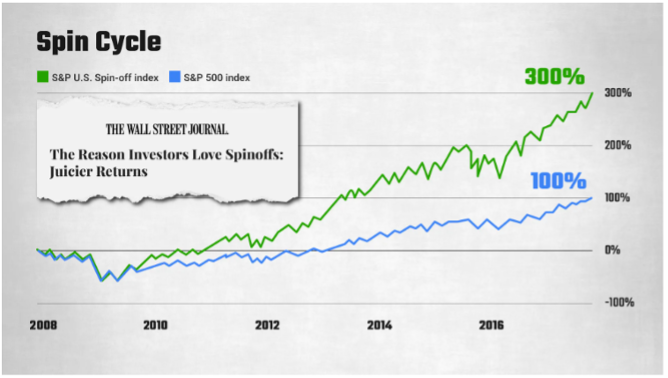
A spinoff forces the market to finally price a business on its own merits… and in the case of the “100X Starburst” recommendation that Marc has found, he thinks there are massive potential returns ahead. Listen to Marc tell it in his own words, here.
How Investors Can Learn More About the 100X Starburst
Each month inside the Power Gauge Report, Marc and his team analyze more than 5,000 stocks… usually narrowing the field down to about 40 companies.
Then they dive deep into those 40 companies… looking for the ones that Marc says could be “extreme wealth-building opportunities,” like the 100X Starburst play, for example.
And of course, when you subscribe today, you also receive a full year running any ticker you choose through Marc’s Power Gauge, so you can see what’s bullish and a good bet and what’s bearish and best avoided. As Marc puts it:
I predict that frontier AI is about to cleave the market in two.
And like it or not, your financial future hinges on whether you choose to tie your fortunes to the winners or the losers.
Hesitating or holding back now because you’re unsure if this is worth it will only hurt your chances of winning.
I think about one of my followers, Chuck F., who told me that not he has not only has seen unrealized gains of $53,000 from official recommendations…
But also an additional $25,000 just by using the Power Gauge to screen stocks all on his own!
The question isn’t whether frontier AI will reshape the investment landscape… It’s already doing so.
The question is, will you be positioned to capitalize on these opportunities… or will you miss out?
With your subscription, you’ll have everything you need to invest in a portfolio of companies poised to dominate in the age of frontier AI.