Image Credit: Associated Press
Key Points
- SpaceX is highlighting major AI partnerships and new technology initiatives to strengthen its investment narrative ahead of its highly anticipated June 12 IPO.
- The company recently unveiled its AI1 orbital satellite, a cornerstone of Elon Musk’s vision for space-based AI data centers.
- Multi-billion-dollar agreements with Google and Anthropic could create significant AI-compute revenue opportunities, though investors remain divided on whether they justify SpaceX’s expected $1.77 trillion valuation.
The long-awaited, much-debated SpaceX (SPCX) IPO is here. But rather than simply wait for what certainly will be an all-out frenzy on IPO day, Elon Musk and company have used the days leading up to June 12 to rake in a few more billions and show off some new technology.
Let’s look at what SpaceX has been cooking up ahead of its historic day.
The First Look at the AI1 Orbital AI Satellite
On June 8, SpaceX posted a 30-minute video to its X account, detailing the design and specifications of the company’s AI1 satellite. This is the satellite that SpaceX plans to build and launch millions of to create an AI data center in space.
As my colleague Steven Longenecker wrote in his analysis of orbital AI on May 1:
SpaceX asked the government for permission to launch a constellation of up to 1 million satellites. Each one would carry specialized artificial intelligence (“AI”) chips, act as a mini data center, and link to its neighbors with lasers to form a single, planet-circling computing network.
For perspective, SpaceX had around 9,400 Starlink satellites in orbit at the time of its [FCC] application. One million satellites represent a 106-fold jump in fleet size.
Grandiose visions have never stopped Musk before… And they won’t now.
Here are some notable specs for the AI1 satellite:
- 150-kilowatt (“kW”) peak compute payload, 120 kW on average, using Nvidia (NVDA) racks, 70-kW efficiency per ton
- 150-kW solar arrays that deliver 250 watts per square meter
- 230-foot (70-meter) wingspan (wider than a Boeing 747 jet) and 66-foot (20-meter) deployed height
- Single compute module with interchangeable hardware design compatible with other manufacturers’ processors
- Deployable liquid-radiator thermal-management system
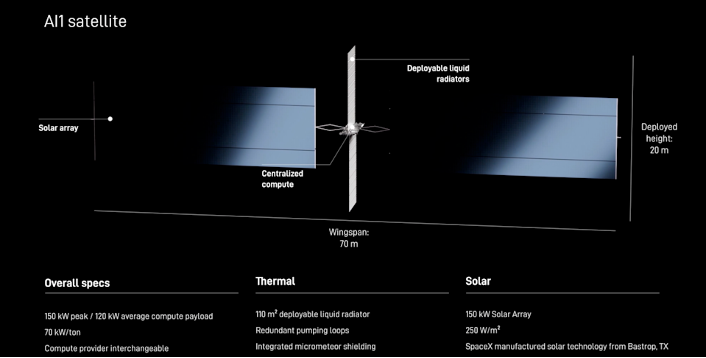
The AI1 satellites will operate from roughly 372 miles (600 kilometers) above the planet, in low Earth orbit (“LEO”). And Musk noted that the AI1’s compute payload will pull roughly the same as one Nvidia GB300 rack, which is about 140 kW on the ground. So, one AI1 satellite basically equals one Nvidia GB300 rack in orbit.
A key question when it comes to orbital AI data centers in general (not necessarily SpaceX’s AI1 satellite specifically) is, “What about cooling?”
On Earth, liquid cooling of AI components is critical. In space, that’s a problem. In fact, it’s a nonstarter because, well, water doesn’t exist in the vacuum of space.
In mid-May, as I examined the orbital AI space race between Nvidia and Advanced Micro Devices (AMD), I wrote:
First, there’s thermal management. AI GPUs run extremely hot, making some type of cooling system a must to ensure the chips don’t melt. In space, without any air, that cooling comes from rejecting waste heat through thermal radiation in the vacuum of space (which consumes no water whatsoever).
So, how is SpaceX handling the cooling conundrum? With redundant pumping loops that distribute specialized coolant (possibly ammonia) liquid near the AI processors to contain the heat they generate. The heated liquid is then pumped to huge deployable radiators, which expel the thermal energy into the vacuum of space as infrared light.
I suppose Musk knew what he was talking about when he downplayed cooling concerns, telling SpaceNews in March that it’s “safe to say SpaceX knows how to do heat rejection in space.” Fair point, considering there are more than 10,000 Starlink satellites in space.
Aside from cooling, there’s one other AI1 specification that caught my eye – the ability to swap out processors from different chipmakers. This is important because SpaceX can’t supply its own chips for the satellites. Why? Because SpaceX doesn’t make chips… yet.
Musk has planned for this situation, however, with the construction of Terafab in Texas, where SpaceX and Tesla (TSLA) – with plenty of help from American chip giant Intel (INTC) – will make their own chips.
The problem is that chip production won’t start until 2027 at the earliest (in the prototype fab of the Terafab project). Large-scale production at the main fab likely won’t begin until 2028 or 2029.
But SpaceX will likely need chips for its AI1 satellites before Terafab is reliably producing them – hence the satellite’s intentional compatibility with other chips.
Manufacturing of the AI1 satellites is expected to begin in 2027 at the gargantuan, 11-million-square-foot Gigasat complex in Bastrop, Texas. Initial satellite deployments are planned for 2028.
Will SpaceX actually produce a million of these satellites to fulfill Musk’s vision of a massive data center in space? We’ll have to wait a couple of years to find out. But he’s certainly created some interesting pre-IPO buzz by unveiling the satellite specs.
SpaceX and Google Agree to Massive Deal a Month After Landmark Anthropic Deal
Just a week before the SpaceX IPO, the company announced a significant deal with Alphabet’s (GOOGL) Google to rent SpaceX cloud supercomputing capacity.
The agreement, according to Reuters, calls for Google to pay SpaceX $920 million per month to access a cluster of 110,000 Nvidia graphics processing units (“GPUs”) as well as central processing units (“CPUs”), memory, and other AI processing components. Google will use this as emergency bridge capacity for Gemini Enterprise and its AI agent platforms.
The agreement takes effect in October and will run through June 2029, though there are stipulations for its cancellation. By the time the deal expires, Google will have paid SpaceX roughly $30 billion to rent its computing capacity.
This agreement follows the one forged between SpaceX and AI heavyweight Anthropic in May. Anthropic stated that its deal includes the use of all the computing power in SpaceX’s Memphis-based Colossus 1 complex for $1.25 billion per month. Colossus 1 holds more than 220,000 Nvidia processors, enough to deliver 300 megawatts (“MW”) of new capacity to Anthropic’s chatbot Claude.
Interestingly, Anthropic also added that, “As part of this agreement, we have also expressed interest in partnering with SpaceX to develop multiple gigawatts of orbital AI compute capacity.”
While no further details were provided, that statement is the first indication that SpaceX’s future orbital AI data centers may serve other businesses, not just itself.
Between Google and Anthropic, SpaceX stands to bring in roughly $26 billion annually – and $70 billion in total – assuming the deals are entirely fulfilled.
Was the Pre-IPO Timing of These SpaceX Deals Strategically Sound?
Yes… and no. Supporting the “yes” argument is the fact that, prior to these deals, SpaceX’s AI business wasn’t making money and had no actual customers. In fact, it was hemorrhaging billions – more than $20 billion – in capital expenditure. Once Google and Anthropic joined the fold, SpaceX instantly gained $26 billion in annual revenue.
And SpaceX needed this cash infusion ahead of its IPO. My colleague James Royal, in his analysis of SpaceX’s IPO, said this:
SpaceX is set to go public this month, in what’s expected to be the largest IPO of all time. Musk is targeting a $1.75 trillion valuation for the company, though he’s also teased a $2 trillion figure.
But at any IPO price in that range, the stock looks unfathomably expensive by any reasonable valuation ratios – price to earnings, price-to-book value, price to sales, for example.
The Anthropic and Google deals give Musk and SpaceX some much-needed leverage (not that they necessarily need it) to justify the mind-blowing anticipated valuation that will be revealed on June 12.
On the flip side, skeptics point out that early termination clauses could torpedo these deals should either SpaceX or Google/Anthropic exercise that option. So, while that revenue looks great on the ledger, it could potentially fall well short of the reported numbers.
There’s also a bit of a conspiratorial angle to the timing of these deals, so close to the SpaceX IPO, as the company seeks to further justify the expected market capitalization.
For example, Goldman Sachs serves as the lead underwriter for SpaceX’s IPO. So, it’s on the investment firm to build up SpaceX and justify its opening $135 share price to investors. While there’s no evidence pointing to actual involvement from Goldman as far as the timing of the Google deal is concerned, critics still find that timing to be rather convenient.
You can be the judge of that.
More concrete is Google’s involvement. Not related to its deal with SpaceX, but because Google’s parent company, Alphabet, holds a 6% stake in SpaceX. Google renting SpaceX’s AI compute has raised eyebrows because the money Google pours into SpaceX increases SpaceX’s valuation – which makes Google more money on its 6% ownership of SpaceX. That could be around $100 billion.
Whether you subscribe to those theories or not, SpaceX is certainly doing all it can to pump up its valuation ahead of the June 12 IPO. The Google and Anthropic deals – and their timing – prove that.
We already know that SpaceX will be the largest and, arguably, most accessible IPO in history, with roughly 30% available for retail investors. But will these recent moves be enough to justify what looks like a $1.77 trillion valuation for SpaceX? Especially considering the company lost more than $4.9 billion last year and $4.3 billion already in the first quarter of 2026?
So many questions, so little time ahead of the IPO. Get your popcorn ready, it’s going to be a very entertaining day.
Regards,
David Engle
Editor’s Note: Elon Musk has spent 27 years waiting for this moment. Now, it’s rolling out across America… and has the potential to be 15X-bigget than Space X. Luke Lango, who called Palantir, AMD, and Nvidia before they soared, says Musk’s latest rollout is the biggest wealth-building opportunity of his career. He’s giving away one free stock pick in this presentation.