
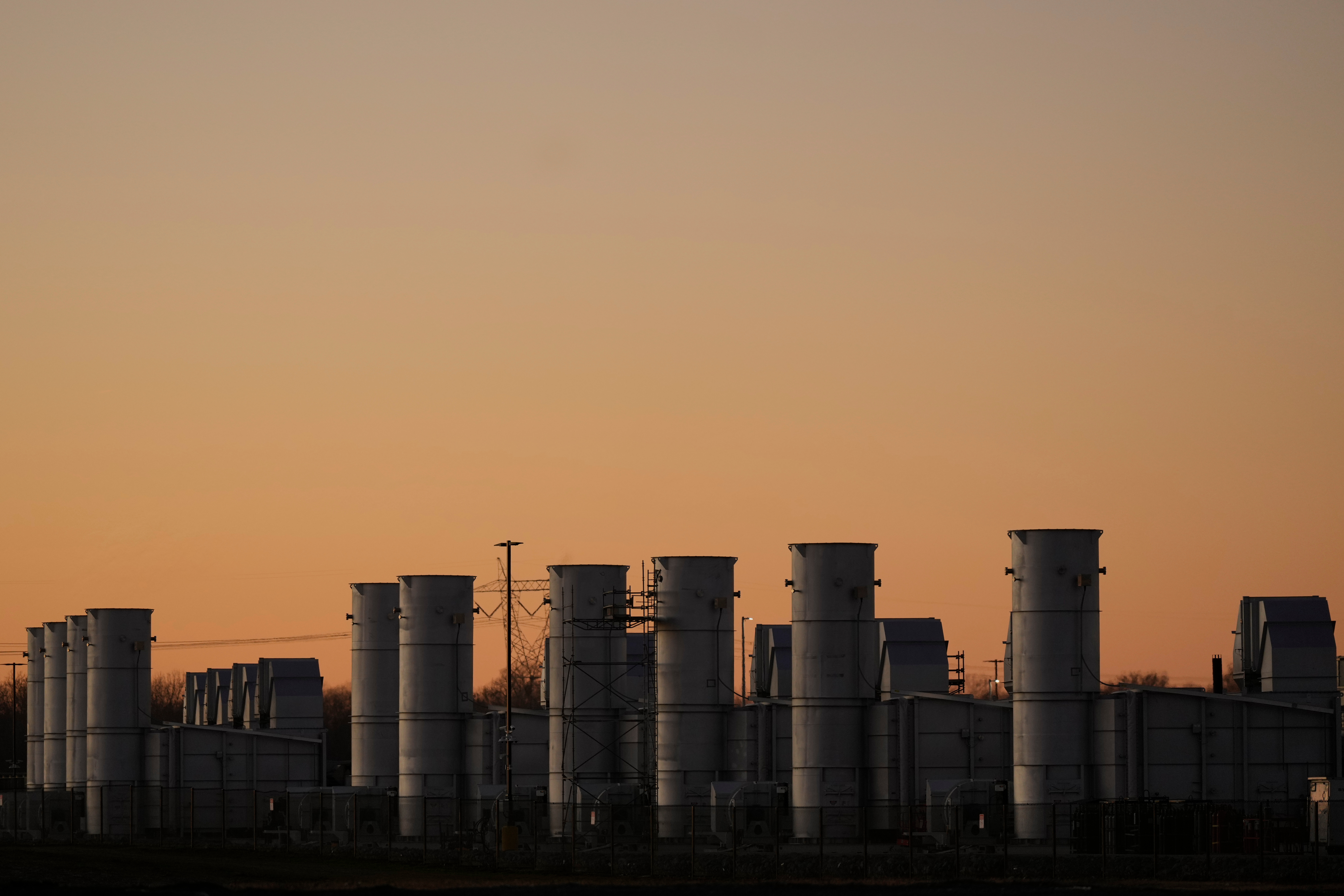
Image Credit: Associated Press
Key Points
- SpaceX recently disclosed that its xAI division plans to spend more than $2.8 billion on natural-gas turbines over the next three years.
- The investment supports Professor Joel Litman’s “Dark Energy” thesis that AI’s growing power demands are pushing hyperscalers toward private, behind-the-meter energy generation.
- The development reflects a broader trend across the AI infrastructure buildout: significant opportunities for investors alongside increasing public and political backlash.
Elon Musk will be one of the world’s top buyers of gas turbines over the next few years…
SpaceX has committed to spending more than $2.8 billion on these turbines for its artificial intelligence (“AI”) build-out, the company recently revealed in its initial public offering (“IPO”) filing…
In March, SpaceX agreed to buy $805 million worth of turbines from an unnamed supplier, with deliveries running through 2029. Then in late April, the company struck a separate, still-pending deal for roughly $2 billion worth of mobile gas turbines and related equipment from another vendor.
As SpaceX admits in the “risks” section of its filing, these turbines are a big bottleneck to the AI build-out, stating: “We currently rely significantly on natural gas and gas turbine technology to power our data center operations.” The company also warned that any injunction or revoked permit could damage its AI business.
And it confirms something my colleague Professor Joel Litman has been saying for months…
This kind of off-grid “Dark Energy” is the next stage of the AI boom. As I explained in our Dark Energy deep-dive last month:
Dark Energy is a clean, reliable power source. Specifically, it’s a class of natural-gas turbines… essentially a jet engine adapted into an electric generator. They start in minutes, run on natural gas instead of jet fuel, and can produce tens of megawatts of power per unit. Stack enough of them together, and you have a private power plant.
These devices have been around for decades. They’ve powered tanks, ships, and remote oilfields.
But until recently, no one was using them at scale to power the world’s most advanced AI labs. Now that they are, the suppliers building them are sold out for years.
The filing from SpaceX is the clearest sign yet that any hyperscaler’s AI ambitions will rise or fall based on access to power.
The U.S. Power Grid Can’t Keep Up
Joel uses the term “Dark Energy” to describe a specific solution to AI’s power crisis: on-site, behind-the-meter natural-gas turbines that let data centers generate their own electricity and skip the grid entirely.
Joel serves as a senior adviser to Fermi America, which is building what it calls the world’s largest private “HyperGrid” campus in the Texas Panhandle, designed to deliver up to 17 gigawatts of power straight to AI hyperscalers.
That means he’s not just researching from a distance… He’s directly involved in one of the largest private AI energy projects anywhere in the world. As he noted in his recent interview:
My biggest advantage is that I’m “in the room,” so to speak…
It’s one thing to research Dark Energy on Google… or ask ChatGPT about it.
It’s another thing to be out here, living it.
I know about “Dark Energy” because I can see it with my own eyes.
Dark Energy will increasingly power AI data centers for one simple reason… the U.S. power grid can’t keep up. Already, utilities in major cities across the nation are rationing power. Other cities have simply called a moratorium on new data-center projects until 2030 or beyond.
So the tech giants racing to train ever-larger AI models face a choice: Wait upward of five years for a grid connection… or bring a Dark Energy power plant to the data center.
And Musk’s $2.8 billion in orders is one of the biggest confirmations yet that the trend toward Dark Energy is accelerating.
Backlash and Environmental Lawsuits
However, these natural-gas turbines have also landed xAI and Musk in legal and regulatory trouble.
The NAACP, joined by local environmental groups, sued the company for its operation of gas turbines at its AI data centers. As TechCrunch reported:
At issue is the “mobile” nature of the turbines. The Southern Environmental Law Center, which filed the lawsuit on behalf of the NAACP, says the turbines are being operated in violation of federal law, which states that power plants mounted on a trailer can still be considered stationary and subject to air-pollution regulations.
So far, the company has been granted permits for just 15 turbines… while operating up to 46.
There’s also a lot of support for local governments to do something to prevent data centers. As I warned about in my piece on the AI data-center rebellion, where opposition has turned bipartisan and, in some cases, violent:
According to Data Center Watch, a research firm tracking the backlash, at least 142 activist groups across 24 states are now organizing to block data center construction.
Over the past two years, residents have blocked or delayed a staggering $64 billion worth of data-center projects. And roughly 55% of the elected officials who have spoken out against data centers are Republicans, not Democrats.
The backlash here isn’t along the usual political fault lines.
It’s widespread… made up of regular folks worried about their water, their electric bills, their property values, and whether their elected officials are cutting deals behind closed doors.
That’s one reason why Joel says there’s more money to be made by focusing on the suppliers, rather than the hyperscalers themselves. As I noted last month:
The biggest investing winners aren’t always the “headline names” when a new technology hits the market. Often, they’re obscure suppliers… companies that are able to take advantage of bottlenecks in a new technology build-out.
Joel explained that these kinds of stocks can go from unknown to high-profile, virtually overnight. As he explains in his Dark Energy interview…
When you have a string of key suppliers all built around a single technology, you often see multiple stocks soar around the same time.
This is what happened with computer chip stocks – and the obscure stocks related to them.
Still, the fact that Musk is buying another $2.8 billion in turbines, even as the ones he’s currently running are drawing lawsuits, shows just how desperate the power crunch has become.
Who Will Win the AI Race?
There’s a reason Musk reaches for portable turbines while other AI hyperscalers draw up multiyear utility contracts. He needs to move quickly.
He has won multiple markets before simply by being first… by figuring out a different way of doing things… or by putting in the kind of work that other companies simply won’t.
For example, as I noted in my explanation of the coming SpaceX IPO back in April…
Before SpaceX, the economics of space were absurd. You’d spend hundreds of millions of dollars building a rocket, fire it once, and let it crash into the ocean. Think of it as building a brand-new 747 for every single flight and then scrapping it after landing.
That was how the entire industry worked for half a century.
Musk’s team figured out how to land boosters and fly them again. That single innovation cut the cost of reaching orbit by more than 90.
And it was devastating for the competition.
Or more recently, when Musk built the world’s largest AI supercomputer in a converted factory outside Memphis. Industry veterans said it couldn’t be done on his exceptionally short timeline. Nonetheless, he did it in 122 days, as I covered in my deep dive on Project Apex.
Data centers of that scale normally take as long as four years to build. Musk’s team built the most powerful AI training facility on the planet in about a third of a year.
But again, that speed was only possible because Musk refused to wait for the grid. He brought in a fleet of gas turbines and made his own power.
Now he’s extending that same playbook across SpaceX’s growing footprint. And it pairs with Musk’s ambition to eventually put AI data centers in space, an idea I unpacked when I wrote about SpaceX’s dominance ahead of its IPO.
For now, though, the power comes from gas-powered turbines… exactly as Joel predicted with his Dark Energy thesis, which you can hear in his own words by clicking here.