

Image Credit: Associated Press
Key Points
- Bitcoin prices have trended lower throughout 2026, recently falling below the $60,000 level.
- Strategy followed a recent small bitcoin sale with a new $101 million purchase at the start of June, but the cryptocurrency continued to face significant fund outflows and liquidations.
- Strategy’s inability to reverse bitcoin’s decline on its own highlights how large and decentralized the bitcoin market has become.
After selling bitcoin (BTC) for the first time since 2022 at the end of May, Strategy (MSTR) went back to doing what it does best – buying it.
The bitcoin holding company – led by Michael Saylor – bought 1,550 bitcoin between June 1 and June 7 for $101 million. Despite these purchases, the bitcoin market (at the time) continued to fall.
If you understand why bitcoin prices kept going down, then you know something important about the crypto that many investors often miss entirely.
Bear with me as I go deep into the weeds to explain…
See, Strategy purchased those coins at an average price of $65,332 each. That pushed the company’s total treasury to 845,256 BTC, worth roughly $54 billion at current prices.
During that period, from June 1 to June 7, bitcoin dipped to as low as $59,000, spending very little time in the $65,000 range.
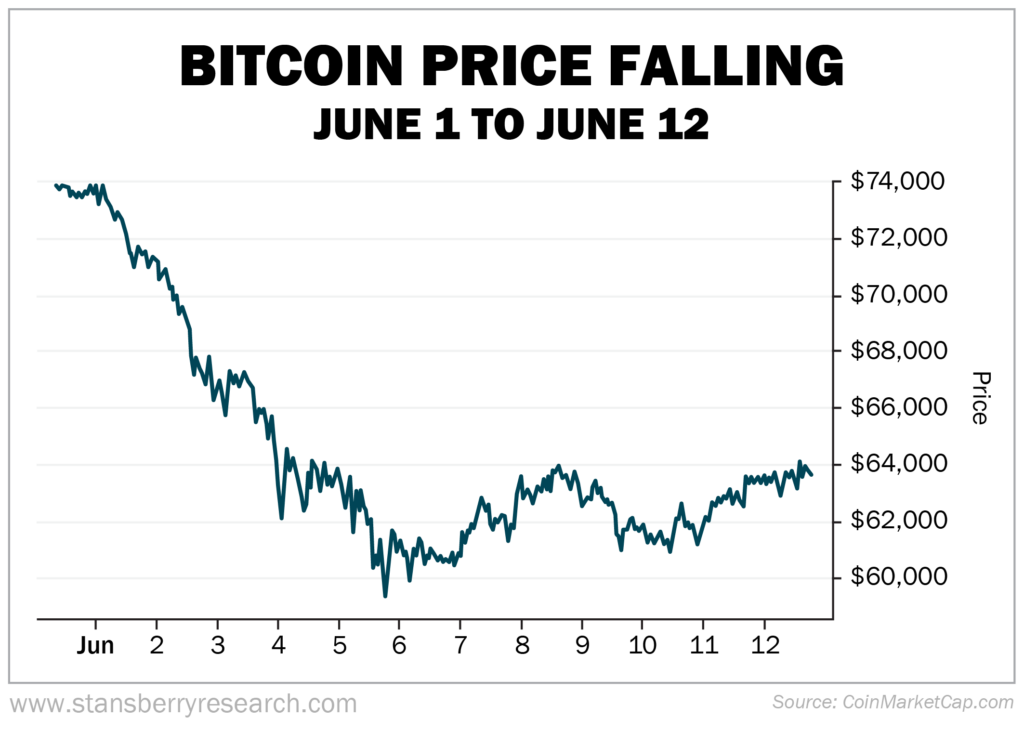
Saylor’s Strategy, the world’s most public bitcoin maximalist, stepped into a falling market with nine figures of conviction… and the crypto’s price dropped another $6,000 anyway.
That doesn’t fit the narrative a lot of folks have built around Saylor’s operation. And it’s because bitcoin’s market is bigger and more complex than any one participant.
What the Sell-Off Says About Bitcoin’s Actual Market Structure
Here’s the thing most people don’t realize…
Although bitcoin’s market capitalization is well over $1 trillion, market cap is not the same as liquidity. The overwhelming majority of bitcoin doesn’t trade. It sits in wallets that haven’t moved in years, some for more than a decade. The coins mined by bitcoin inventor Satoshi Nakamoto alone represent roughly 1.1 million bitcoin that have never touched an exchange.
Add in the long-term “HODLers” – who treat their position like a savings account, rather than a trading vehicle – and you’re left with a circulating float that’s genuinely much smaller than the headline number.
That matters when you’re trying to understand price mechanics. A $101-million bitcoin purchase sounds massive. Against a free float, where a few billion dollars of actual daily-trading activity sets the marginal price, $101 million is a substantial amount to pour into bitcoin. But it’s not enough to reverse a macro-driven rout.
Thirteen straight sessions of outflows from U.S. spot bitcoin exchange-traded funds totaling around $4.4 billion… plus a stronger-than-expected jobs report that pushed out central-bank rate-cut expectations… plus a wave of leveraged liquidations all hit the market simultaneously.
Strategy’s latest purchases were a rowboat heading into that particular tide.
The Bitcoin Network Keeps Working While the Price Corrects
While traders were liquidating bullish speculators who’d borrowed heavily to take on their positions on the way down, it was business as usual for the network itself.
The dip in price revealed that some bitcoin miners were showing signs of capitulation… turning off their least efficient machines. But that could be a temporary problem. You see, the bitcoin blockchain self-adjusts to make sure new blocks are found every 10 minutes… no matter how many miners are running. This is what’s called the difficulty adjustment.
When miners are plentiful, it becomes more difficult to find a block. When miners give up, it becomes less difficult. Miner shutdowns are bad enough that the next difficulty adjustment bitcoin faces is expected to decrease by 11%. That’s a big adjustment and should help miners who were thinking of throwing in the towel.
But historically, struggling miners are a mark of the later stages of a selling cycle, not the beginning.
As far as traders go, the opposite happened after the bottom: Leveraged shorts were liquidated just as quickly on the way back up.
The market effectively cleaned itself out in both directions – a functioning price-discovery mechanism doing exactly what it’s supposed to do.
But until this week, I would have expected a large Strategy buy to trigger that type of short-squeezing bounce.
Instead, enough long-term holders sold into the dip (another classic capitulation signal) to offset Strategy’s buying. When the HODLers who sat through three prior bear markets finally hit the sell button, it tends to indicate bitcoin is closer to the floor than the ceiling.
Meanwhile, bitcoin’s fast, low-cost layer for small payments, the Lightning Network, kept processing payments through the whole episode without a hiccup. Lightning moves value peer to peer at fractions of a cent per transaction. That’s the kind of boring infrastructure that doesn’t make headlines precisely because it works.
Add to that the recent developments in the regulatory picture. The GENIUS Act cleared the Senate in 2025, putting stablecoin legislation on a real timeline for the first time. The FIT21 framework and the Clarity Act are both inching toward a vote, which would give bitcoin and other digital assets the legal classification the industry has wanted since 2015.
President Donald Trump’s administration has also not backed away from its stated goal of a strategic bitcoin reserve. Whatever your politics, that’s the U.S. government treating proof-of-work assets as a legitimate national store of value. You don’t unwind that posture quietly.
Proof-of-work infrastructure survived the drawdown intact.
What Recent Trading Actually Indicates About Bitcoin’s Health
Strategy failing to single-handedly reverse a bitcoin sell-off is not a glitch in the market. It’s evidence that bitcoin’s market is bigger and more distributed than any one participant, including the largest corporate holder outside of the Satoshi wallets.
No single actor, including one holding more than 4% of the total supply, can successfully corner bitcoin because the free float is too widely distributed… and the conviction base is too deep to be shaken loose by one week of headlines.
Sure, Strategy’s recent $101 million purchase is significant. But even if the company were stuffing its pockets with cheap bitcoin, the purchases showed that bitcoin isn’t entirely in Strategy’s pocket either.
As someone who has publicly stated that bitcoin is likely to reach $1 million per coin in our lifetimes, I’m happy that the biggest bull still can’t push the price around.
Editor’s Note: Whitney Tilson — the hedge fund manager CNBC called “The Prophet” — says America has reached its “Ripping Point.” The old financial order is being torn apart, and he believes most investors have no idea what’s coming in the next six months. He’s named the stocks he thinks will be destroyed in the chaos — and the ones he believes will soar. Watch his free presentation while it’s still available.