Image Credit: Associated Press
A $77 billion water-treatment company just paid $4.75 billion in cash for a private liquid-cooling specialist most investors have never heard of.
That sentence is the most important M&A signal of 2026 for retail investors who care about where AI infrastructure spending is actually going.
Twenty years on a trading desk teaches you to read M&A like a treasure map. The headline number tells you what happened. The deal pricing tells you what the smart money believes is about to happen. And the layer one removed from the deal — the public companies that do the same thing for the same customers — tells you where the next leg of capital is heading before retail figures it out.
That’s the trade. Follow the money. Find the layer nobody is watching. Get there before the headlines.
On March 20, Ecolab — the global water and hygiene services giant — agreed to pay 29 times next-twelve-months adjusted EBITDA for CoolIT Systems, a Calgary-based liquid-cooling company owned by KKR. The transaction will represent one of KKR’s largest realizations in recent years, generating approximately 15 times the original equity invested. The deal closes in Q3 2026.
Read that pricing again. 29 times forward EBITDA in cash for a private company. That is not the multiple you pay for a sleepy industrial business. That is the multiple you pay when you believe a category is on the cusp of a structural transformation, and you do not want to be left out.
The retail investing public has spent the last three years treating AI as a chip story (NVIDIA), then a power story (transformers, turbines, grid), then a hyperscaler story (Microsoft, Alphabet, Amazon, Meta). Almost nobody has yet treated it as a water story.
The Ecolab-CoolIT deal is the smartest money in industrial M&A telling you that’s about to change.
Below are 11 publicly-traded AI data center cooling stocks organized into three buckets — six on the cooling hardware side, five on the water-infrastructure side — that you can use to express the same thesis Ecolab just put $4.75 billion behind.
Why a Water Company Just Bought a Cooling Company
Before the deal, the demand picture.
Every AI chip running a workload generates heat. As Nvidia’s flagship Blackwell rack architecture scales toward 100 kilowatts per rack — and as AMD and custom hyperscaler silicon push densities even higher — the heat problem becomes the binding physical constraint on whether a data center can run at all.
Air cooling cannot solve this at scale. The physics of moving enough cool air through a 100-kilowatt rack is a losing battle. Liquid cooling — pulling heat directly off the chip with a fluid loop — is the only proven solution that works for the rack densities AI requires.
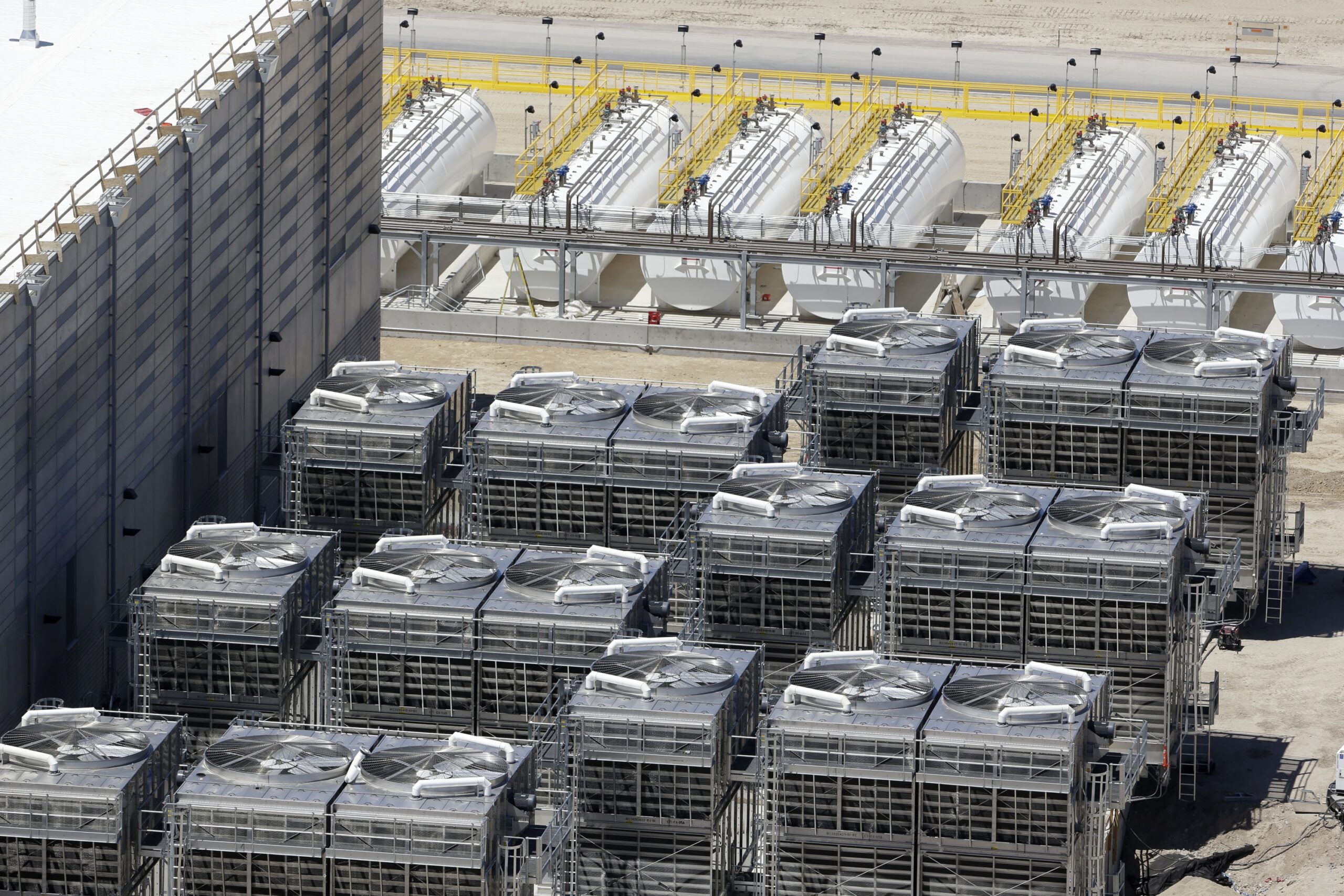
That liquid loop has two parts. The hardware that contacts the chip and the heat exchanger. And the water treatment infrastructure that supplies clean, conditioned coolant in and recycles dirty coolant out. Every hyperscale data center being designed for 2026 to 2028 commissioning is liquid-cooled by default. Every one of them needs both halves.
That’s why a water company bought a cooling company. Not because Ecolab wanted to diversify. Because Ecolab and CoolIT, in combination, can sell the whole stack to a hyperscaler in one contract instead of two — and the hyperscaler does not have to coordinate two suppliers across an integration.
Ecolab CEO Christophe Beck described the strategic logic plainly: the combination “provides our customers with a complete cooling solution that improves performance and reliability, while reducing water and energy use.” Ecolab’s existing high-tech growth engine doubles from $5 billion to $10 billion as a result.
The investor’s takeaway is simpler. The cooling stack and the water stack are now one trade. The companies that have meaningful exposure to either layer are about to become beneficiaries of an integrated AI-cooling capex cycle that didn’t exist as a category two years ago.
This is the pattern that repeats across every transformative technology in market history. Retail investors chase the consumer-facing brand. The institutional money quietly buys the supply chain underneath. The California Gold Rush made very few prospectors wealthy and made Levi Strauss extraordinarily so. The smartphone era made Apple a household name and made Taiwan Semiconductor and ASML quiet compounders that returned more in many cases than Apple itself. The AI cycle is following the same playbook. Chips first. Power second. Now cooling and water — and most retail investors haven’t even started looking.
That’s the entire reason this article exists.
Why the AI Cooling Trade Has Just Begun
If the case for cooling and water stocks were already widely understood, Ecolab would not have needed to pay 29 times forward EBITDA to assemble it inside a single corporate structure. Nor would KKR have generated a 15-times return on the underlying CoolIT investment.
Premium multiples and venture-style returns on industrial assets are how the market signals that the next leg of capital deployment has not yet arrived.
Three additional data points reinforce the timing.
Vertiv just reported Q1 2026 results on April 22. Organic sales grew 23% year-over-year. Americas grew 44% organically. The backlog stands at roughly $15 billion — up 109% year-over-year — with a book-to-bill ratio of 2.9 times, meaning Vertiv is booking nearly three dollars of new orders for every dollar of equipment shipped. Management raised full-year 2026 guidance to $13.75 billion in revenue and $6.35 in adjusted EPS, implying 51% earnings growth. That is not a slowing trade. That is a trade in the early innings of acceleration.
Trane Technologies posted Americas Commercial HVAC applied solutions bookings up more than 120% in Q4 2025, with a book-to-bill ratio of 200%. That is the cleanest leading indicator we have for whether hyperscaler capex is converting into hard orders rather than just press-release ambition. The numbers say it is.
Hyperscaler capex guidance keeps getting revised higher. Wall Street consensus now pegs 2026 hyperscaler capex at roughly $527 billion. Goldman has flagged that consensus estimates have undershot actuals for two straight years, with realized growth exceeding 50% against implied 20%.
These are not lagging signals. These are companies, at scale, telling investors in real time that the cooling and water-infrastructure layer of AI is where the next round of capital is being deployed.
Top 2 AI Data Center Cooling Stocks to Own Now
If you only buy two names from this thesis, buy these.
Ecolab (ECL) — ~$77B market cap
The CoolIT acquisition makes Ecolab the most strategically interesting name in the entire AI-cooling and water-infrastructure universe. They were a water-treatment giant with a quiet but growing high-tech business. After the close, they become the only publicly-traded company offering an integrated water-and-cooling stack purpose-built for AI data centers.
The deal is being financed in cash, with pro-forma net leverage of approximately 3 times adjusted EBITDA at close, targeted to fall to 2 times within two years. Ecolab maintains its strong investment-grade profile. Translation: management was willing to lever up materially to own this category.
When a 25-year compounder makes that kind of capital allocation decision, you should at least take a hard look at the thesis. Up only modestly over the trailing twelve months — the deal’s full implications have not yet been priced in.
Vertiv Holdings (VRT) — Q1 2026 backlog ~$15B
The closest thing to a pure-play on data center power and cooling combined. Q1 2026 results, just reported, were exceptional. Revenue, margins, free cash flow, backlog — all setting records. Management raised full-year guidance.
The pushback on Vertiv is valuation. The stock has had a substantial run on the thesis. Forward P/E is in the 40s. That is the bear case.
The bull case is the order book. A 2.9 times book-to-bill ratio means the company is locking in revenue years into the future at faster rates than it can ship. Management’s 2029 operating margin target of 25% implies that the order growth is converting into structural margin expansion, not one-time pricing power. If that conversion plays out, the current valuation looks reasonable in retrospect.
This is a name where position sizing matters more than entry timing. A core position scaled appropriately to portfolio risk is the right way to express the thesis.
Bucket 2: 4 Liquid Cooling Hardware Stocks for Data Center Exposure
The cooling-side basket. Different angles on the same demand wave.
Eaton (ETN) — Power management combined with thermal management. Eaton completed its $9.5 billion acquisition of Boyd Thermal in March 2026 specifically to integrate cooling and power at the rack level. The strategic logic is identical to Ecolab-CoolIT: hyperscalers want integrated systems, not piecemeal sourcing. Eaton’s running near record backlogs on hyperscaler demand alone.
Modine Manufacturing (MOD) — The small-cap pure-play. Modine has spent the last three years transforming itself from a legacy automotive components business into a focused data-center cooling company. Auto-parts divestitures are accelerating in 2026. Pure-play exposure with a clean strategic narrative.
Schneider Electric (SBGSY) — The hardware-and-software integrator. Schneider is the European-listed peer to Eaton, with a deeper software moat through their grid-management and data-center management platforms. Both grid-scale exposure and data-center-specific exposure. Schneider acquired Motivair in 2025 specifically to extend into liquid cooling.
Trane Technologies (TT) — The Americas HVAC giant. Q4 2025 Americas Commercial HVAC applied solutions bookings up over 120%. Record enterprise backlog of $7.8 billion. Management has been explicit that data center demand is a primary driver. The diversified-industrial way to play the trade — same thesis, more downside protection through non-data-center revenue.
Bucket 3: 5 Water Infrastructure Stocks for Data Center Cooling
The water-side basket. Same trade, different layer.
Xylem (XYL) — Water pumps, treatment systems, and metering at scale. Trading at a more reasonable forward multiple than the cooling pure-plays. The company announced a $1.5 billion share buyback authorization. The conservative way to own the water-infrastructure side of the AI thesis without paying cooling-stock multiples.
Pentair (PNR) — Water filtration, flow control, and related infrastructure. The cheapest-quality name in the basket on a forward P/E basis. Less direct AI exposure than the others, but pricing power on water infrastructure is improving as drought and data-center water restrictions tighten.
Energy Recovery (ERII) — Pressure exchangers used in desalination and industrial water reuse. Speculative — execution has been challenging — but the long-term thesis is unique. If water scarcity becomes a binding constraint on data center site selection, ERII’s desalination exposure becomes meaningful. Size accordingly.
Essential Utilities (WTRG) — A regulated water utility with millions of customers across multiple states. Boring. Reliable. Pays a yield. The conservative way to own the water-scarcity thesis through a utility wrapper rather than a cyclical industrial.
Solstice Advanced Materials (SOLS) — The chemicals layer. Solstice spun off from Honeywell on October 30, 2025, as a pure-play specialty materials company with leading positions in refrigerants, semiconductor materials, and data-center cooling chemistry. The newest company in the basket. The least-followed. Worth attention before the rest of the market realizes it is positioned as a coolant supplier to the same AI-cooling buildout.
The Catalysts That Will Move AI Data Center Cooling Stocks
You don’t need to read every press release. Watch four things.
The next round of hyperscaler capex guidance. Microsoft, Alphabet, Amazon, and Meta all report Q1 results within the next several weeks. Any incremental upward revision flows directly to ECL, VRT, ETN, TT, and the rest of the basket. A flatlining of guidance would be the bear-case signal for the entire group.
Additional M&A in the sector. The Ecolab-CoolIT deal proved the convergence is real and the multiples paid are aggressive. The next deal is the question. Vertiv could be a buyer. Modine or Energy Recovery could be a target. Each transaction re-rates the comparable companies.
Bookings and backlog commentary on every earnings call. Vertiv’s $15 billion backlog. Trane’s 120%+ bookings growth. Eaton’s hyperscaler exposure. These are the leading indicators. Acceleration is bullish. Deceleration is the warning signal.
Drought and water-scarcity news from major data-center hubs. Phoenix, Northern Virginia, central Ohio, Newton County (Georgia), and Iowa data-center corridors are all water-constrained to varying degrees. Any local moratorium or mandatory restriction that affects data center water usage becomes a direct catalyst for the water side of the basket.
The Risks for AI Data Center Cooling Stocks
This is not a one-way trade.
Hyperscaler capex deceleration. The entire thesis depends on hyperscaler capex continuing at or above current trajectories. If even one of the four announces a meaningful cut, the entire group rerates lower. Watch the calls in the next several weeks.
Cooling technology displacement. Liquid cooling is the dominant solution today. Immersion cooling, two-phase cooling, and other approaches could take share over the next five years. The basket is built to be agnostic to which specific cooling technology wins, but a fundamental shift could disadvantage particular names.
Valuation. Vertiv has tripled in twelve months. Modine has doubled. These are not undervalued names. The new money is paying premium multiples for a thesis the smart money already validated through M&A. Position sizing matters more than entry timing.
Deal closure risk. The Ecolab-CoolIT transaction is expected to close in Q3 2026 but is subject to customary regulatory approvals. Any unexpected antitrust or regulatory friction would slow the integration thesis at Ecolab specifically.
A reasonable approach to this trade is a basket position rather than a concentrated bet, sized so that any individual name’s underperformance doesn’t damage the overall thesis.
The Bottom Line on AI Data Center Cooling Stocks
Ecolab paid 29 times forward EBITDA in cash for a private cooling company. KKR generated 15 times their original equity. Vertiv’s backlog grew 109% year-over-year. Trane’s bookings doubled in a single quarter.
That’s not noise. That’s a coordinated signal from four different vantage points — a strategic acquirer, a private equity exit, a public-company order book, and a public-company bookings number — all telling you the same thing. AI infrastructure capital is rotating into the cooling layer and the water layer.
The chips trade is famous. The power trade is in motion. The cooling-and-water trade is where retail still has time to be early.
The Ecolab-CoolIT deal is the announcement. The 11 names above are the trade. Follow the money.
Jonathan Rose is a former CBOE market maker and the founder of Masters in Trading at InvestorPlace. He hosts Masters in Trading Live every weekday at 11 AM ET. Follow him on X at @JRoseTrades.
Editor’s Note: Here’s what most investors don’t understand: The biggest gains don’t come from being in “the market.” They come from being in the right sectors at the right time. For 46 years, Louis Navellier has used a quantitative grading system to track where institutional billions flow before anyone else sees it. The same system wealthy firms paid $24,000 per year for me to evaluate stocks with. Companies like Palantir at $13 (before it hit $186). Applovin at $38 (before it reached $622). Carvana at $24 (before $340). His system detected institutional accumulation months before these stocks exploded. Right now, Navellier’s grades are changing across entire sectors — patterns he’s only seen twice before. See which sectors are lighting up with institutional buying in his presentation here.