
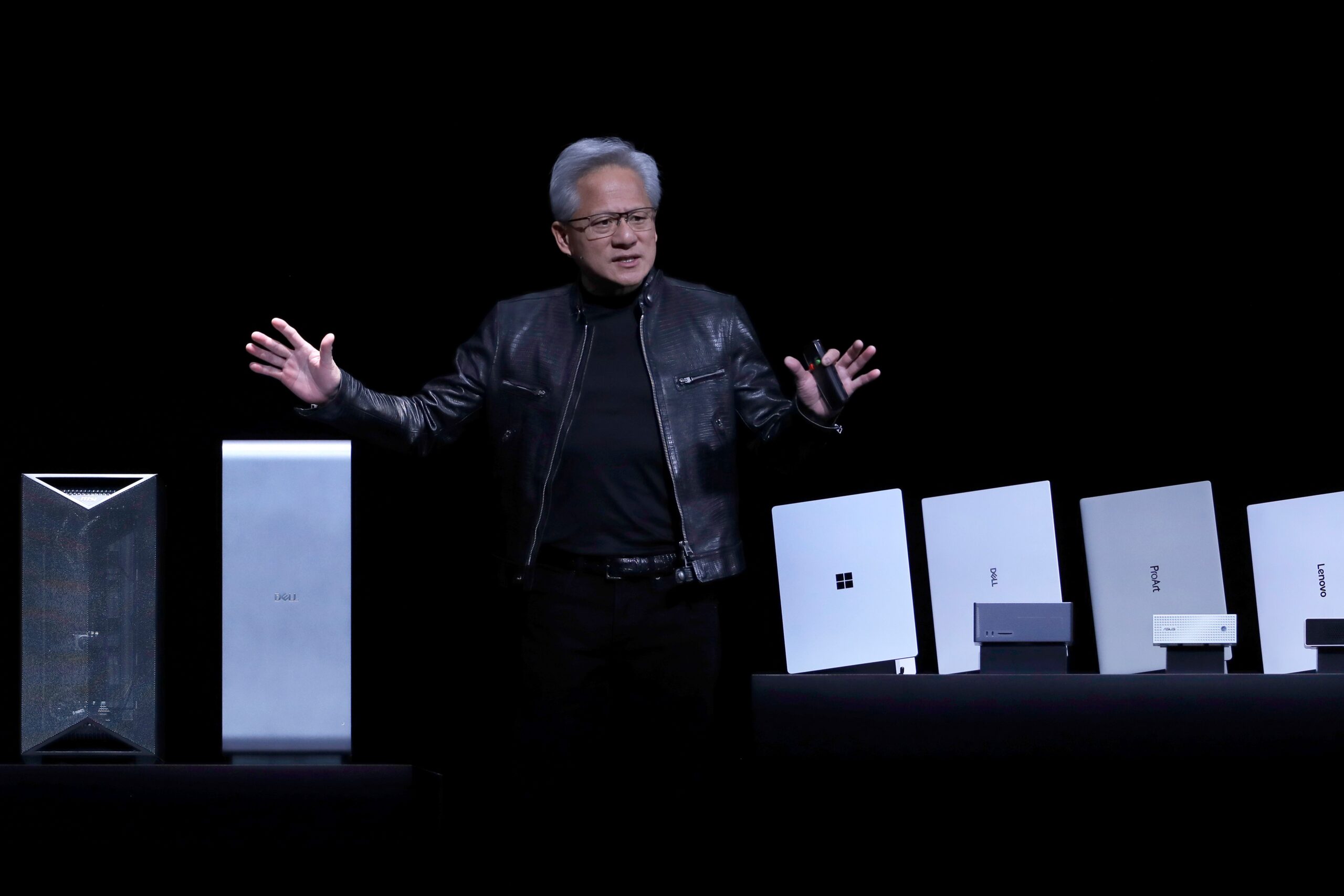
Image Credit: Associated Press
Key Points
- Nvidia’s new RTX Spark superchip brings supercomputer-class AI performance to Windows PCs, enabling advanced AI agents, content creation, and gaming without relying on cloud infrastructure.
- The launch could reshape the PC market by putting Nvidia in more direct competition with Intel, AMD, and Qualcomm while accelerating the transition to AI-native personal computing.
- Investors welcomed the announcement, sending Nvidia shares higher and reinforcing the company’s position as a leader in AI innovation and next-generation computing.
Chip bellwether Nvidia (NVDA) made a giant splash at the Computex conference in Taiwan on June 1 when the company introduced its new RTX Spark super-chip.
The RTX Spark is a supercomputer-grade system-on-a-chip (“SoC”) built specifically for the next generation of Windows laptops and PCs, meaning these computers will run solely on Nvidia’s architecture. More importantly, it means that agentic AI and supercomputer-level performance will become available on PCs.
Here’s what Nvidia posted on social media platform X as the RTX Spark was unveiled:
Nvidia’s entry to the Windows PC market is a major announcement that will likely revolutionize personal computing as we know it.
Below, we’ll examine how this significant development is likely to impact Nvidia’s stock and why the RTX Spark super-chip is such a big deal for both Nvidia and the computer electronics industry as a whole.
Nvidia’s New RTX Spark Brings Agentic AI Into Your Home
If you’re up to date on the latest in tech, the following may make sense to you.
Nvidia says that the RTX Spark “features an Nvidia Blackwell RTX GPU with 6,144 CUDA cores and fifth-generation Tensor Cores with FP4 precision, connected via the Nvidia NVLink-C2C chip-to-chip interconnect to a high-performance, 20-core Nvidia Grace CPU.”
For the rest of us, that means this super-chip brings unparalleled local AI performance to personal computers.
Here are the nitty-gritty details of Nvidia’s new RTX Spark super-chip, and what they all mean:
- 1 petaflop of AI computing performance: In simple terms, a petaflop is an insanely fast and unprecedented processing speed for a personal computer. For users, 1 petaflop enables on-device AI agents to run and tackle complex tasks directly on the computer – no need to transmit data to and from a remote cloud server.
- 128 gigabytes (“GB”) of unified memory:This is the random-access memory (“RAM”) shared between the computer’s central processing unit (“CPU”) and graphics processing unit (“GPU”). While most users may not need this much memory, it’s perfect for AI developers, 3D artists, video editors, animators, designers, and gamers thanks to its ability to make AI and studio-level work highly accessible. These same users will also benefit from RTX Spark, which offers the full Nvidia AI and graphics technology stack on the chipset.
- Redesigned Adobe Photoshop and Premiere:Nvidia announced that Adobe is “rearchitecting Photoshop and Premiere from the ground up for RTX Spark to deliver 2 times faster AI and graphics performance.” This is excellent news for artists and content creators, who will be able to design and edit with assistance from Windows AI agents.
- Industry-leading performance-per-watt platform:Keeping in mind how much energy AI requires, Nvidia designed the RTX Spark to be quite efficient. For web browsing, the chip may expend less than 10 watts. But for higher-intensity tasks like gaming or running AI workloads, the chip will scale up to 80 watts. This is a significant blow to competitors like Qualcomm, which was banking on its trademark power efficiency to stand apart from the competition in the AI industry.
Nvidia says that the RTX Spark-powered Windows laptops will be ultraslim – just 14 millimeters thick – and weigh less than 3 pounds.
Computer manufacturers have already lined up to get the RTX Spark into their next-generation laptops and PCs. Launching this fall will be new RTX Spark-equipped computers from Dell Technologies (DELL), HP (HPQ), Asus, Lenovo, Microsoft (MSFT), and MSI. Acer and Gigabyte will follow with their own next-gen PCs shortly thereafter.
What RTX Spark Means for the PC Industry
The word “earthquake” and a phrase like “reinvent the PC” don’t get tossed around lightly. But they’re exactly what are being used to describe the ARM-based Nvidia RTX Spark (ARM is a family of advanced processors).
It may all sound a bit hyperbolic, but the RTX Spark is going to change the way many people use a computer at home.
Basically, the RTX Spark will equip personal computers with “supercomputer-grade” AI that goes beyond merely answering questions in a chat. These new PCs will feature 24/7 AI agents that can read, comprehend, and even reason about your work, manage workflows, and seek out software bugs in the background. And they’ll do it without the user having to open apps or type commands. This will all be performed locally and securely within the PC (not through data centers).
This tech looks like a literal game changer for hardcore PC gamers. Whereas other Windows-on-ARM devices had trouble keeping up with graphics-intensive games, the RTX Spark’s Blackwell GPU architecture with 6,144 CUDA cores is designed to deliver smooth performance in any game.
Beyond the devices themselves, Nvidia’s new super-chip is going to disrupt the laptop market in a big way. Because Nvidia had never waded into the Windows processing waters before, rivals like Intel, Qualcomm, and Advanced Micro Devices (AMD) simply competed among themselves without worrying about Nvidia joining the fray.
Well, that’s all changed. They’ll all now be in direct competition with Nvidia, a fight that none of those companies really wanted to pick. How Nvidia’s rivals respond to the RTX Spark will be worth watching in the coming months.
The Market Impact of RTX Spark
Nvidia’s announcement is not only good news for Nvidia but also troublesome for competitors like Intel, Qualcomm, and AMD.
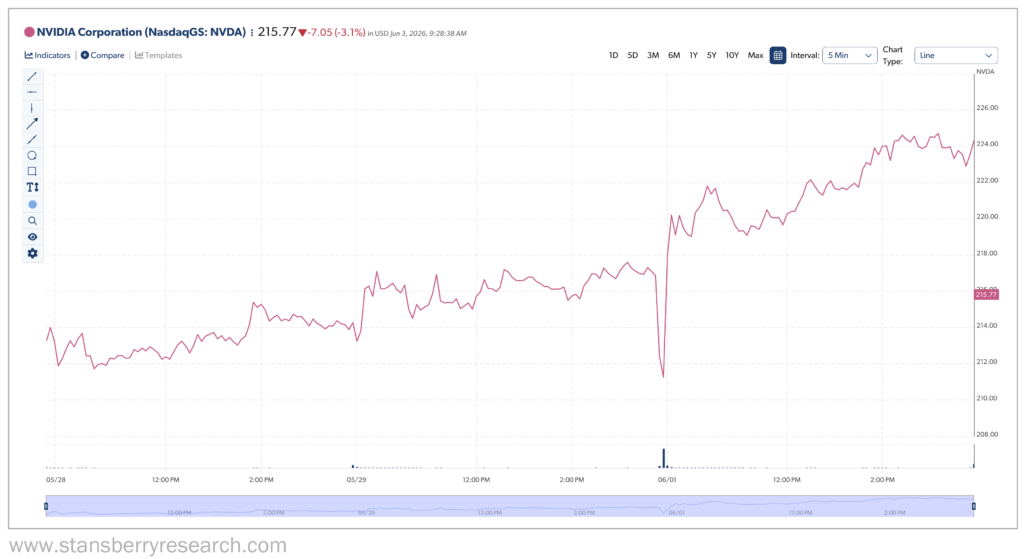
The RTX Spark news made an immediate impact on Nvidia stock, which had been fairly stagnant over the past several months. After closing at $211.14 on May 29, Nvidia rebounded on the announcement of the RTX Spark to close at $224.36 on June 1 for a gain of more than 6%.
The impact wasn’t quite as positive for Nvidia’s competitors, all of whom have reason for concern because there’s now a new – and quite formidable – competitor in the AI PC market.
Intel
Intel has been on a huge roll for about a year now, riding the tailwinds of CPU demand and high-profile partnerships with Apple and with Elon Musk’s Terafab chip plant.
But Nvidia’s entry to the Windows PC market with its ARM-based architecture signals danger for Intel and presents a direct threat to Intel’s longstanding x86 architecture. As analyst Richard Windsor wrote in his Radio Free Mobile blog, Intel’s “x86 architecture was effectively called out as obsolete in both the data centre and the PC, both of which are Intel’s core markets.”
In other words, Nvidia not only encroached on Intel’s territory – it also marked it.
Qualcomm
As for Qualcomm, Nvidia is now directly competing against the company in the Windows-on-ARM market, where Qualcomm’s Snapdragon X was a prominent component in Snapdragon Copilot+ devices.
Now, however, it faces intense competition from a rival that’s much more trusted by users. Premium-computer consumers will soon choose between high-end PCs equipped with Qualcomm’s Snapdragon X Elite and Snapdragon X2 Elite Extreme super-chips or Nvidia’s RTX Spark chipset. My guess is that Nvidia wins that competition.
AMD
Nvidia’s chief rival has made a name for itself designing premium chips for high-end computers used by content creators and gamers. Nvidia is now competing directly in that space. And like Intel, AMD uses x86-based processors, so it faces the same threat unless it starts creating its own ARM-based chips.
As a side note, Arm Holdings (ARM) emerged from Computex as a winner, along with Nvidia. After opening June 1 at $389.95, Arm closed at $408.85 – a one-day gain of 4.8%.
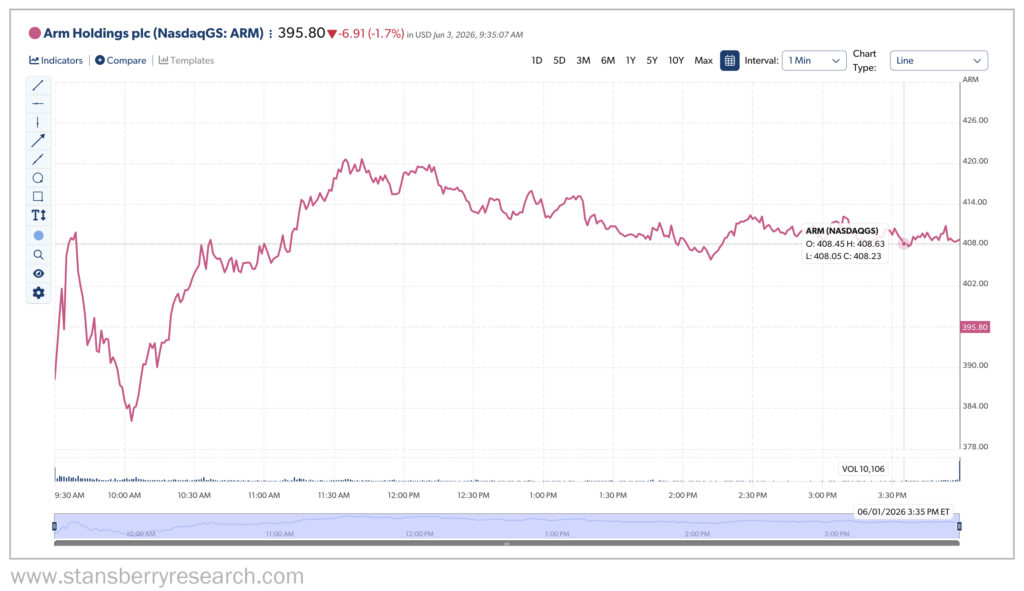
For Nvidia’s competitors, however, the results were predictably rough, particularly in morning trading.
Intel, Qualcomm, and AMD all dipped around the time of Nvidia’s RTX Spark announcement on June 1.
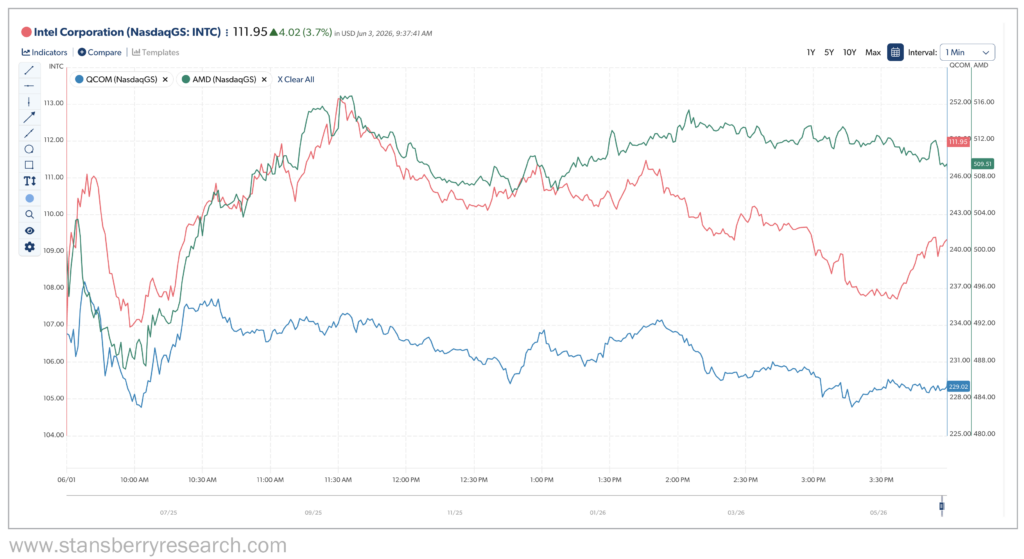
But they all rallied from their low points to varying degrees throughout the day. The reasons for the semi-rallies? The realization that the initial reaction to the RTX Spark news may have been a bit overblown.
Not that Nvidia’s news wasn’t huge… It absolutely was. But this is important to keep in mind – these new computers built with RTX Spark are meant for users who need that performance for their work or their passions. And the price tag will reflect that. While no prices have been set yet, Morgan Stanley (MS) estimates that the lowest-priced model will start at around $1,799, with other models starting at roughly $2,899.
The everyday computer user who typically only needs enough power and speed to browse the web, game casually, and perform simpler tasks with less-complex programs and apps won’t have much use for these premium PCs. And those typical computer users are probably satisfied with a simple AI chatbot like Google’s Gemini or Microsoft’s Copilot.
The bottom line is, low- to mid-range laptops and desktops are still perfectly sufficient for these users – at a fraction of the price.
And these folks comprise the majority of computer users. That means there’s still plenty of need for CPUs and GPUs for entry- to mid-level computers – those made by AMD, Intel, Qualcomm, and yes, even Nvidia.
Is Nvidia a Good Investment Right Now?
Nvidia stock is always a hot topic, whether it’s moving up, down, or sideways. But the bottom line is it’s a consistently successful and highly profitable company. You don’t become the world’s most valuable company (market capitalization over $5.2 trillion) by accident.
What’s surprising is that, despite its mind-blowing market cap and impressive revenue, profits, gross and net margins, and return on equity, Nvidia isn’t universally considered overvalued.
It’s not universally considered undervalued, either. There continues to be plenty of debate on the topic. But, considering Nvidia is worth more than any other company on the planet and is continuously innovating in the most booming industry on the planet, I think the bull case is stronger than any bear argument.
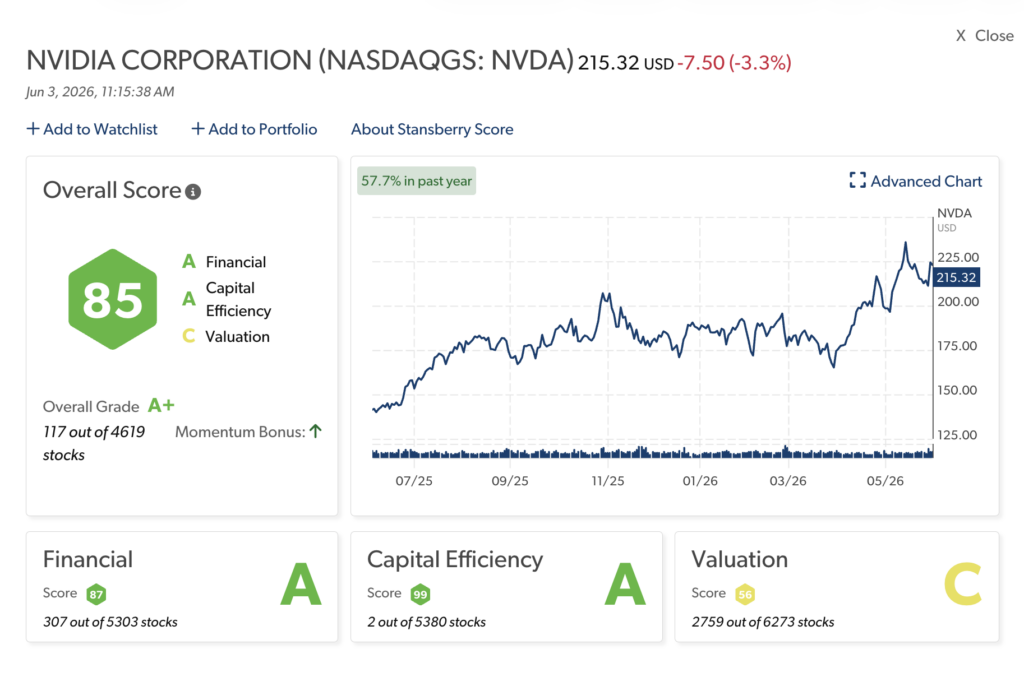
Most analysts agree. Nvidia is generally considered a strong buy. Nvidia’s Stansberry Score, a tool that helps determine the quality and long-term value of thousands of stocks, backs that up with an overall “A+” score, fueled by the company’s outstanding financials and capital efficiency (“A” for both).
Nvidia’s RTX Spark super-chip is just the most recent innovation on a long list of them. And it looks to be a total game changer. Putting agentic AI into a razor-thin supercomputer laptop and making it accessible to the public (albeit at a premium price) literally alters the landscape of personal computing.
Given its history of redefining technology, it’s no surprise that Nvidia was the company to accomplish this feat. The RTX Spark may signal the beginning of a new era of AI-native personal computing. And investors and consumers will be watching closely when the units launch this fall.
Regards,
David Engle
Editor’s note: As America celebrates its 250th birthday, a Wall Street legend is sounding the alarm. Whitney Tilson (the hedge-fund manager CNBC dubbed “The Prophet”) says the AI revolution is rewriting the rules of wealth faster than most people realize.
Some investors are already seeing extraordinary gains. Others are being wiped out. Tilson says the next six months will determine which side you end up on ‒ and he’s sharing exactly what to do about it in the free presentation here.