Image Credit: Associated Press
Key Points
- Investors have grown increasingly concerned about a potential “SaaSpocalypse” in 2026 as agentic AI threatens to disrupt the traditional software industry.
- Much like the shift to cloud computing ultimately benefited companies such as Microsoft, Oracle, and Salesforce, agentic AI is likely to transform the industry rather than destroy it.
- AI agents are expected to become the primary users of software, operating autonomously behind the scenes and connecting AI models with corporate data, applications, and workflows.
Warning to investors: Artificial intelligence (“AI”) is going to kill software companies.
Or at least, that has been the growing narrative in the markets these days.
The big shift happened when Anthropic dazzled and shocked the technology world earlier this year with powerful updates to its Claude AI. The new tools showed that AI could do things on its own, like creating complex documents and spreadsheets, updating files, and writing fully functioning software code.
For most, it was their first experience with what’s now widely known as “agentic AI.” This new type of AI can perform complex tasks with little to no human intervention.
It felt like a paradigm shift. Until then, most folks had only interacted with what’s known as “generative AI,” the kind that OpenAI popularized with the release of ChatGPT in late 2022. Generative AI can create text or media and answer questions and prompts in seconds.
Generative AI is cool. But agentic AI is a potential game changer.
It’s much more than a tool you can have a conversation with. It can do things for you on its own with minimal direction.
Anthropic’s Claude showed that agentic AI is no longer a theory. It’s here now. And folks raced to figure out how it could impact the future.
Their first conclusion: Soon, we simply won’t need software anymore.
The Start of the ‘SaaSpocalypse’
Here’s the logic.
If agentic AI can write code with a simple prompt, who needs software companies and their expensive engineers?
And if AI can automate repetitive tasks and complete entire business processes on its own, will we need specialized software and humans to do these things?
Software stocks – a long-time investor favorite – suddenly became toxic and uninvestable. Not just some software stocks… all of them. Investors dumped these stocks like never before, erasing around $2 trillion in market value earlier this year.
Longtime market darlings like Oracle (ORCL) plunged 56%. Microsoft (MSFT) fell 34%. Salesforce (CRM) collapsed 38%.
These are some of the most profitable companies on the planet.
The sell-off was dubbed the “SaaSpocalypse,” since many of the hardest-hit names were software-as-a-service (“SaaS”) stocks. It was the largest sell-off of software stocks since the 2008 financial crisis.
What we’re witnessing in this sector is classic herd mentality. It’s based on emotion (fear), not logic. And it’s happening on broad, knee-jerk assumptions with little deep thought.
This “death of software” thinking is a case of forgotten history. The software industry has seen this before.
Reality is much more nuanced. AI is just the latest technology to alter the landscape and strike fear in the hearts of investors.
AI Won’t Kill Software, It Will Be Turbocharged
Before AI, the biggest technological threat was the move to the cloud. The “cloud” refers to software and data stored on someone else’s computers and servers.
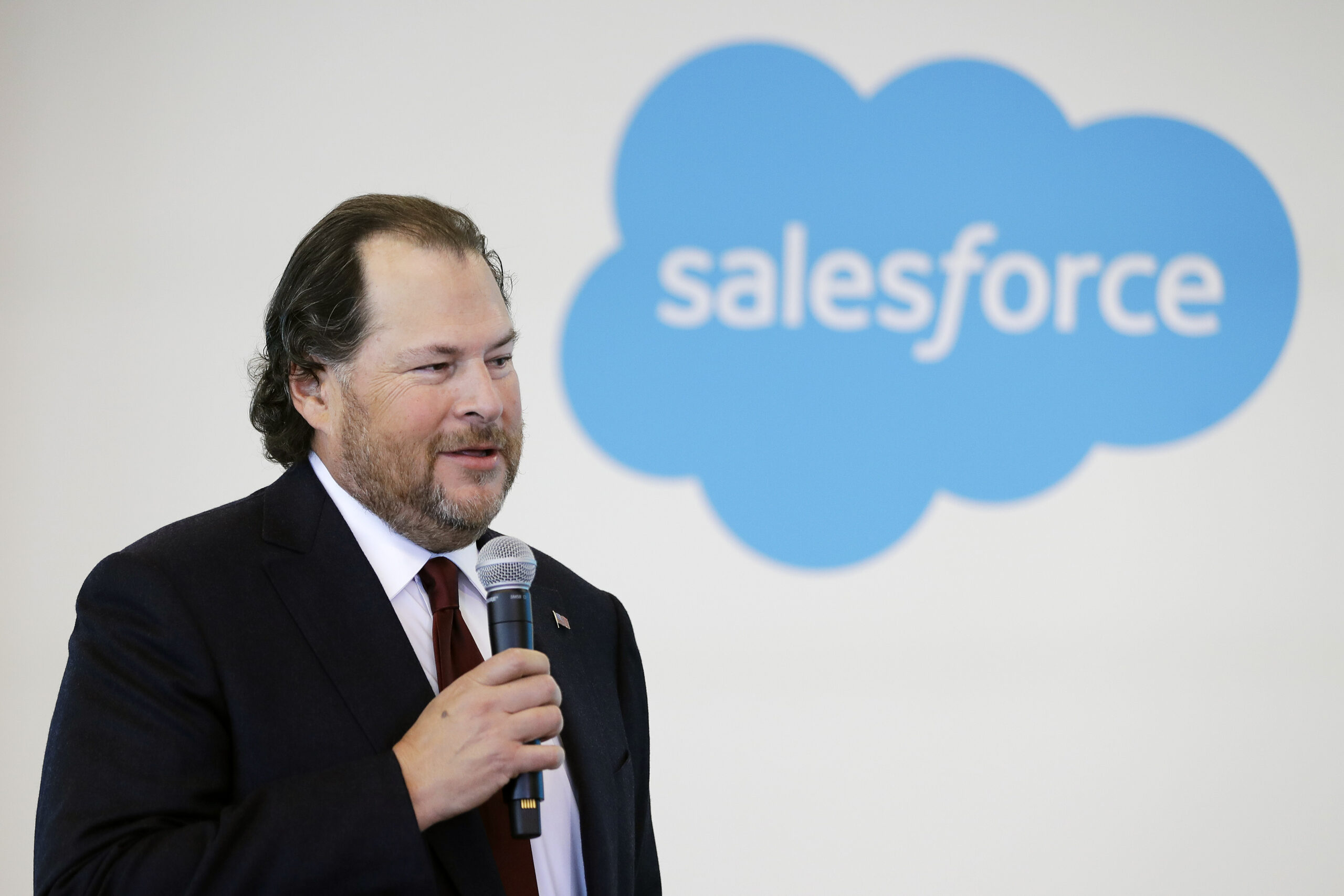
Salesforce CEO Marc Benioff pioneered the SaaS model. He introduced this concept to the world when he took Salesforce public in 2004. Moving software to someone else’s computers was a radical idea at the time.
Customers didn’t need to buy any expensive hardware to install his software. They just needed an Internet connection. They could access it from anywhere in the world… And they didn’t have to pay big license fees. Instead, they paid much smaller subscription fees over time.
Benioff’s goal was to “democratize” software, making it cheaper and more widely available. And that’s exactly what happened.
Thanks to its lower cost and ease of use, software usage exploded. Thousands of new software companies popped up, following Salesforce’s lead, creating highly specialized cloud software.
As venture capitalist Marc Andreessen famously said in 2011, “Software is eating the world.”
Reading today’s headlines, you’d think the software industry is in danger of being eaten by AI.
Here’s what folks are forgetting…
When SaaS began to take off a few decades ago, many thought it would “eat” traditional software companies too. But that’s not what happened.
Software giants like Microsoft, Oracle, and Adobe (ADBE) pivoted. They also started offering their software in the cloud. They had to price it and deliver it differently. Like the rest of the industry, instead of charging huge, up-front license fees, they charged recurring subscription fees for the right to use their products and access them in the cloud.
Instead of killing these software giants, SaaS injected new life into their businesses. Oracle’s sales have increased fivefold since 2005. Microsoft’s sales are up seven times.
The new technologies that made the SaaS model possible were a rising tide that lifted nearly every software boat. Annual software revenues have increased sevenfold from around $200 billion in the mid-2000s to $1.4 trillion today.
That kind of growth would not have happened without the technologies that made SaaS possible. I expect that agentic AI could have an even greater impact on software sales.
Marc Benioff’s Three Truths About Agentic AI
Looking at the massive software sell-off, it’s clear not many agree. Investors see the threats, but are overlooking the benefits.
We should listen to Marc Benioff, who is still running Salesforce today. Besides being the man behind the SaaS revolution, he has lived through other disruptive technologies, such as the rise of smartphones and social media.
Benioff says that every technology revolution begins with a honeymoon phase. At first, everyone has lofty expectations and dreams of how new tech will change the world. But these expectations usually don’t materialize in the ways folks imagine they will.
When technologies meet real-world complexity, dreams fade. Eventually, the reality of how those technologies can be used becomes clearer.
Benioff recently wrote an article in Time magazine on the three truths about AI that people need to understand.
The first is that the AI models will become commodities. He’s talking about large language models (“LLMs”), such as Anthropic’s Claude and OpenAI’s ChatGPT.
Everyone loves these products today. To Benioff, though, they’re just another layer of software. These LLMs are losing billions of dollars in the race to leapfrog each other. Benioff thinks LLMs will become less important in the future. AI agents will simply choose the best LLM for the task at hand.
The second truth is that the most valuable layer is sitting on top of the LLMs: trusted data and workflows. This is the layer that traditional software companies own.
Data isn’t something you hand over to a startup. It’s one of the most valuable assets any company owns. It needs to be protected like gold. No company is going to let AI agents access and update its data unless it trusts the software maker and the AI agents.
That’s why software incumbents have a huge advantage. They’ve spent decades building trust with their customers. We’re talking about some of the most valuable companies on the planet, including Microsoft, Oracle, SAP (SAP), ServiceNow (NOW), and Benioff’s Salesforce.
It’s true that AI can write amazing software code, and it’s only going to get better. But ask yourself this: Who is in the best position to benefit from using AI to write software code?
The answer should be obvious. It’s the software companies.
They employ armies of experienced software engineers with deep industry and customer knowledge. But for some reason, the market seems to think the answer to this question is 22-year-old college kids in their dorm rooms.
Benioff’s last truth is that humans will stay at the center of business. He sees AI as a tool that works alongside humans, boosting their productivity. AI has already boosted the productivity of Salesforce’s engineers by more than 30%.
AI will help humans focus more on what they do best… build relationships, lead, create, and make decisions.
And AI is about to usher in the next era of growth for the software industry.
AI Agents Will Become the New Users of Software
Here’s what is about to change for software firms…
AI agents will replace humans as the primary users of software. They will work autonomously behind the scenes, connecting LLMs with corporate data and workflows.
The software industry needs to pivot − just like it did when SaaS came on the scene – to profit from this new reality.
Instead of building software to enable humans to work, it needs to build software to allow AI agents to perform the work. And just like they did with SaaS, software firms will adjust how they price their software.
Most software companies charge by the “seat” (or user account) today. Seats are for human users. In the near future, though, companies will charge based on the number of AI agents using their software, the actions agents take, the tasks they complete, or other outcomes.
Big software companies like Salesforce and ServiceNow have already started doing this.
Salesforce has delivered 2.4 billion “agentic work units” across its AI products.
Half of ServiceNow’s new business now includes some form of non-seat-based pricing.
With AI agents handling the bulk of repetitive tasks, we should see an explosion in software use. Companies will be able to do far more with fewer employees. Instead of spending money on hiring new employees, they’ll use those dollars to buy more software for AI agents to perform tasks.
As Nvidia (NVDA) CEO Jensen Huang said recently, “AI won’t replace enterprise software, it’ll use it.” Huang argues that AI agents will use software the way humans do today, “just faster and more broadly.”
Over time, revenue from AI agents using the software will surpass revenue from the old human seat-based licenses. And the software pie should grow even larger.
We saw it happen when software moved to the cloud more than 20 years ago. We’ll likely see it happen again as more AI agents use software. That’s why I believe agentic AI is the biggest thing to hit the software sector since the move to the cloud.
How to Pick Software Winners in the Agentic AI Era
Because of agentic AI, software companies will become more important, not less.
The market doesn’t understand this yet. It has thrown the baby out with the bathwater. That makes this a fantastic time to be a software investor.
Now, I’m not saying all software companies will make the pivot. Some will die because they sell applications that can easily be replaced by AI. But many won’t. They have critical applications and databases that no corporation can afford to rip out.
We’ll see lots of new software companies go public in the years ahead. And we’ll see many existing software companies soar to new heights. Savvy investors can make a fortune by understanding which companies will survive and thrive.
Still, expect more volatility ahead. We’re in the transition phase of the move to agentic AI, and there will be bumps along the way. It took many years for the transition to SaaS to fully play out.
Every impressive new AI-model release will scare more software investors into running for the exits. Every software firm that reports falling customer-retention rates will do the same.
This volatility is creating massive opportunities for patient investors.
The next generation of software winners won’t be obvious to most investors. Stansberry Research has spent decades working in and analyzing the software industry, and we’ve built a proprietary system to help separate the companies likely to thrive in the age of agentic AI from those at risk of being left behind. Learn more here.
Good investing,
Mike DiBiase
Editor’s Note: Will AI crash the stock market? Every bubble in history eventually bursts, and Marketwise CEO Dr. David “Doc” Eifrig believes this AI bull market is no different. But his team’s research suggests the more important question isn’t “if,” but “when” – and they’ve discovered the exact quantitative signal that has ended every bull market, including this one. What makes this research particularly interesting: Doc and his team recommend you take three specific steps now that could make the next year the most profitable of your life — and show you when to get out. See his full presentation here.