
Image Credit: Associated Press
Listen to the audio version of this article (generated by AI).
Key Points
- Nvidia is expanding its dominance beyond chips, investing billions in AI-related companies such as Intel, SpaceX, OpenAI, CoreWeave, and Nebius while helping build the infrastructure that drives demand for its technology.
- Nvidia’s investments create a powerful ecosystem effect: It provides capital that helps AI companies access its GPUs, while those companies become customers and expand Nvidia’s reach across AI infrastructure.
- The strategy isn’t without risk. Nvidia’s growing exposure to AI startups, infrastructure projects, and financing arrangements could amplify losses if AI spending slows or the sector experiences a major downturn.
When you’re the world’s most valuable company – with a market capitalization of roughly $5.27 trillion – like Nvidia (NVDA), you don’t necessarily need to find new ways to build onto that mind-blowing figure. After all, Nvidia would continue to rake in money if it kept making and selling its innovative chips and artificial-intelligence (“AI”) platforms.
But Nvidia didn’t become the world’s most valuable company through luck or by resting on its laurels. Nvidia innovates… and it invests. And those investments are laying the groundwork for the next phase of Nvidia’s AI strategy.
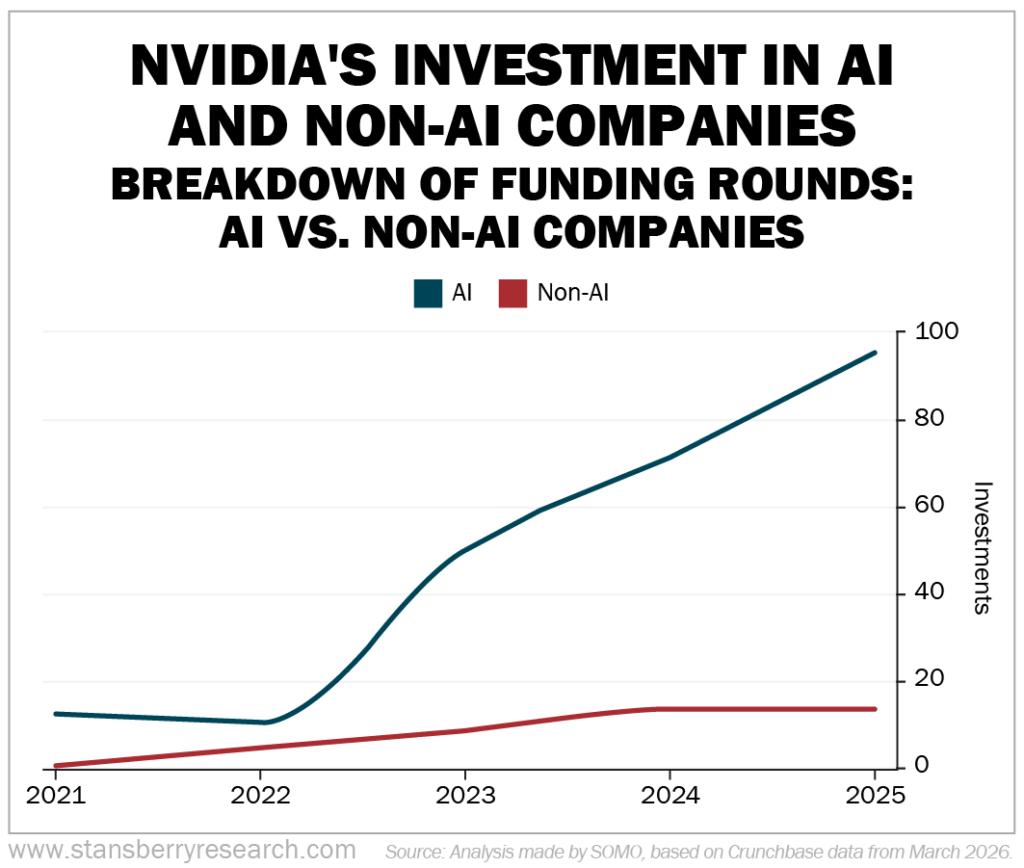
Between 2021 and 2025, Nvidia participated in 283 funding rounds involving 241 different companies. Many of those companies (nearly 85%) were AI startups, including existing and potential future competitors.
Nvidia then doubled down in late 2025 when it finalized a $5 billion equity investment in American chipmaker Intel (INTC). And just last week, Nvidia disclosed a nearly $21 billion stake in SpaceX (SPCX) in the form of roughly 122.8 million shares – enough stock to make Nvidia the sixth-largest investor in Elon Musk’s sprawling venture.
Nvidia’s investment strategy appears to be paying off so far. But key risks remain. Let’s look at Nvidia’s investments, the company’s strategy, and what the Intel and SpaceX deals mean for the AI industry.
What’s Behind Nvidia’s AI Investment Strategy?
Short answer: Money. As in, Nvidia literally has so much money, it doesn’t know what to do with it all. So, it invests to make more money.
It’s undeniable that there’s plenty of strategy behind Nvidia’s investments. In fact, investing is part of Nvidia’s business strategy.
The company literally wrote a blog post about it on Nvidia’s website. According to Nvidia, the company takes a three-pronged approach toward investing.
First, through Nvidia’s corporate investments, overseen by [Vishal] Bhagwati. Second, through NVentures, our venture capital arm, led by [Sid] Siddeek. And finally, through Nvidia Inception, our vehicle for supporting startups and connecting them to venture capital.
So, Nvidia makes direct investments, invests in startups, and helps train those startups on the Nvidia platform and ecosystem.
And the company’s investments are vast:
- In 2023, Nvidia was the fourth-largest corporate venture investor, behind only Microsoft (MSFT), SoftBank (SFTBY), and Alphabet (GOOGL).
- Of the 241 companies Nvidia invested in between 2021 and 2025, six received at least three investments from Nvidia, including AI startups Cohere (four times), Perplexity AI (four times), and Mistral AI (three times).
- All of top 10 most-funded AI startups on the Forbes AI 50 list of privately held AI companies received investments from Nvidia. Among those were competitors such as OpenAI and Anthropic.
Here you can see just how much Nvidia’s investments in AI startups have increased over the past five years.
Nvidia’s roster of investments includes:
- Roughly $30 billion in OpenAI, which includes agreements for OpenAI to buy Nvidia systems
- $2 billion each to neocloud leaders CoreWeave (CRWV) and Nebius (NBIS), data-center connectivity standout Marvell Technology (MRVL), chip-design software company Synopsys (SNPS), and global photonics leaders Coherent (COHR) and Lumentum (LITE)
- Up to $2.1 billion in data-center operator Iren (IREN)
- Up to $3.2 billion in Corning (GLW) for specialized glass and optical connectivity
These deals often represent a win-win for both Nvidia and whichever company receives its money and/or backing. For the startups, the reason why is rather obvious. They receive a boatload of capital (that they might not otherwise have access to) from the world’s most valuable company – not to mention the huge, invaluable reputational boost that comes with being an Nvidia partner.
Finding the win for Nvidia, however, requires some deeper digging. But it lies in graphics processing unit (“GPU”) access – or the lack thereof for most startup companies. GPU computing power is expensive, so most startups don’t have the financial means to acquire it.
That poses a problem for Nvidia. Because if AI companies can’t secure enough GPU power, AI growth slows. For Nvidia, that’s bad for business.
So Nvidia gives those companies the money they need to access the computing power necessary to grow. If that sounds self-serving, well, it is. Nvidia is essentially financing smaller AI companies so they can purchase the hardware and platforms their businesses need… That hardware and those platforms happen to be built and sold by Nvidia.
That’s called a massive strategic advantage. And it’s pretty brilliant.
By investing in these AI startups, Nvidia not only opens the door for those companies to buy Nvidia products, but it also expands Nvidia’s AI imprint across the globe.
Of course, this also raises questions about the authenticity of the larger AI market since these investments can be considered circular financing.
IDC (International Data Corporation), a Boston-based global market-intelligence firm, summed up circular AI financing perfectly:
Circular financing in AI describes investment structures where the same capital flows simultaneously as vendor payment and equity stake. A company funds its own customer’s revenue while also supplying that customer’s core infrastructure. The result is reported revenue growth that is real but not cleanly separable from investment activity.
While it’s not explicitly illegal, circular AI financing raises ethical concerns. Especially when you consider that these investments have helped companies like Nvidia buy access to startups’ services and technologies without acquiring the company and going through a strict acquisition or merger review process.
You can decide on the ethics. But the strategy has clearly paid off so far for Nvidia and many of the startups it has invested in.
But Nvidia’s investment strategy isn’t limited to small AI companies.
Nvidia’s Massive Investments in Intel and SpaceX, Plus Its Wall Street Partnership
Intel
Nvidia grabbed some headlines last December when it finalized a purchase of roughly 214.7 million shares of Intel stock at $23.28 per share. That came to about $5 billion in shares, and it bought Nvidia a 4% slice of Intel.
Since then, Intel’s stock has exploded. At $92.80 per share (as of August 19), that investment is now worth roughly $19.9 billion. At its peak, when Intel stock reached roughly $140 near the end of June, that investment was valued at a little more than $30 billion.
The money, as if Nvidia needs more, is great. But it’s what Nvidia’s investment in Intel bought that matters just as much, if not more.
As part of this investment, Intel builds custom x86 central processing units (“CPUs”) with Nvidia NVLink integration for AI infrastructure within data centers. Intel also develops system-on-chips (“SoCs”) that combine its CPU cores with Nvidia RTX GPU chiplets for personal computing.
Put simply, Nvidia’s investment builds a bridge between its own architecture and Intel’s. And that matters given Intel has been a top competitor to Nvidia for years.
SpaceX
Just last week, Nvidia disclosed a stake of nearly $21 billion – roughly 122.8 million shares at $170.86 per share – in SpaceX, the Elon Musk-led space and AI company. The investment was originally a $10 billion stake in xAI that converted to SpaceX shares after Musk’s SpaceX acquired, yes, Musk’s xAI.
(With SpaceX stock down to roughly $140 as of August 19, Nvidia’s stake is now valued around $17.2 billion.)
Nvidia is now the sixth-largest investor in SpaceX, and SpaceX is now Nvidia’s second-largest equity holding… behind only Intel.
Again, this represents a big win for both parties. Nvidia holds a significant stake in a highly ambitious (though quite volatile) company, and SpaceX builds its AI data centers only with Nvidia chips. There’s that circular pattern again – Nvidia invests in SpaceX, SpaceX buys Nvidia’s products, the resulting innovation elevates SpaceX’s stock price, and Nvidia’s stake grows more valuable.
Wall Street Asset-Management Firms
With investments in Intel and SpaceX seemingly not enough for Nvidia, the chip bellwether decided earlier this month to partner with six of Wall Street’s biggest asset managers – Blackstone (BX), Apollo Global Management (APO), BlackRock (BLK), Brookfield Asset Management (BAM), Goldman Sachs (GS), and KKR (KKR).
The goal? Raise $500 billion in funds to help enterprises, hyperscalers, and frontier AI labs build data centers and buy essential hardware. Why? So Nvidia’s smaller customers – both current and potential – can afford to buy from the company without financing through loans that carry high interest rates.
Through this Wall Street alliance, the asset-management firms involved would underwrite the AI hardware – such as data centers, GPUs, and networking – to secure the multibillion-dollar loans that would contribute to the overall $500 billion goal. Essentially, Nvidia’s hardware that is being leased or purchased serves as an investable asset, like real estate.
A key stipulation in this partnership is that Nvidia will backstop up to 25% of certain projects to help lower interest rates, keep demand steady, and reassure lenders if things go sideways.
Key Risks These Investments Pose for Nvidia
To be clear, investing in AI comes with a high level of risk, whether it’s a simple $1,000 investment in AI-related stock or Nvidia purchasing $5 billion worth of shares from Intel. The advantage for individual investors: They aren’t nearly as reliant on AI continuing to boom as Nvidia is.
AI and data centers now represent more than 90% of Nvidia’s revenue. If the AI bubble bursts, Nvidia would be heavily exposed.
Nvidia’s own business would undoubtedly take a massive hit. But its investments would be in severe jeopardy as well, given how many AI companies it has stakes in. Nvidia could lose hundreds of billions of dollars in an instant.
Given the circular nature of those investments, any downturn that hits AI startups and other businesses Nvidia has invested in would be felt twice as hard by Nvidia and its investors.
What This Means for Nvidia’s Stock
If you’re factoring Nvidia’s own investments into determining whether you want to invest in Nvidia, you’re not likely to get very far with your decision.
It’s truly a mixed bag that presents several benefits such as locking AI startups into Nvidia’s very sticky ecosystem and using AI computing power as a financeable asset to raise hundreds of billions of dollars from Wall Street for smaller AI companies to borrow.
But Nvidia’s investments also expose the company’s own capital to risk through backstopping projects and offering credit support. And Nvidia’s circular dealings could backfire spectacularly should the AI sector experience a major pullback.
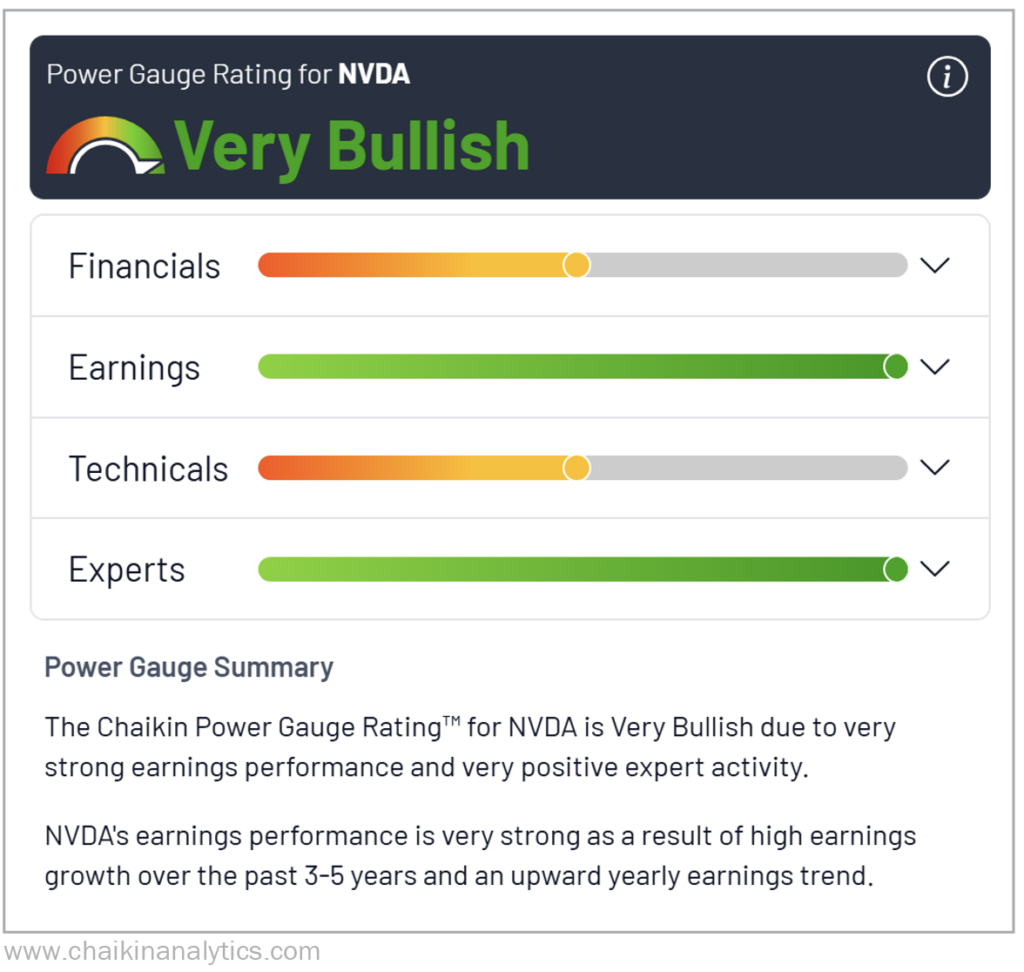
All that said, Nvidia has been an excellent stock to own. While its 15% year-to-date gains are more modest than, say, Intel’s at 136% or Micron Technology’s (MU) at 197%, Nvidia’s strong earnings push the stock to a “very bullish” rating from legendary Wall Street veteran Marc Chaikin’s Chaikin Power Gauge, a 20-factor stock-rating system that scans more than 5,000 stocks and 2,300 exchange-traded funds.
While AI stocks are risky and volatile, I don’t see the AI bubble – if one even exists – bursting anytime soon. And Nvidia has earned its status as the global king of AI. Its investments only reinforce that status.
Regards,
David Engle
Editor’s Note: Marc Chaikin, the founder of Chaikin Analytics, built an award-winning system that flagged Nvidia as a BUY before it soared as high as 45,000%. It also turned “bearish” on software stocks two months before they crashed this year. Now, Marc’s warning that a “jump to lightspeed” has taken place behind the doors of a Silicon Valley AI lab – and says the repercussions are about to cleave the market in half this summer. This 60-year Wall Street legend has a FREE Hotlist of stocks to buy and an urgent Hitlist of stocks to sell now. Click for the full story, including stock names and tickers here…