
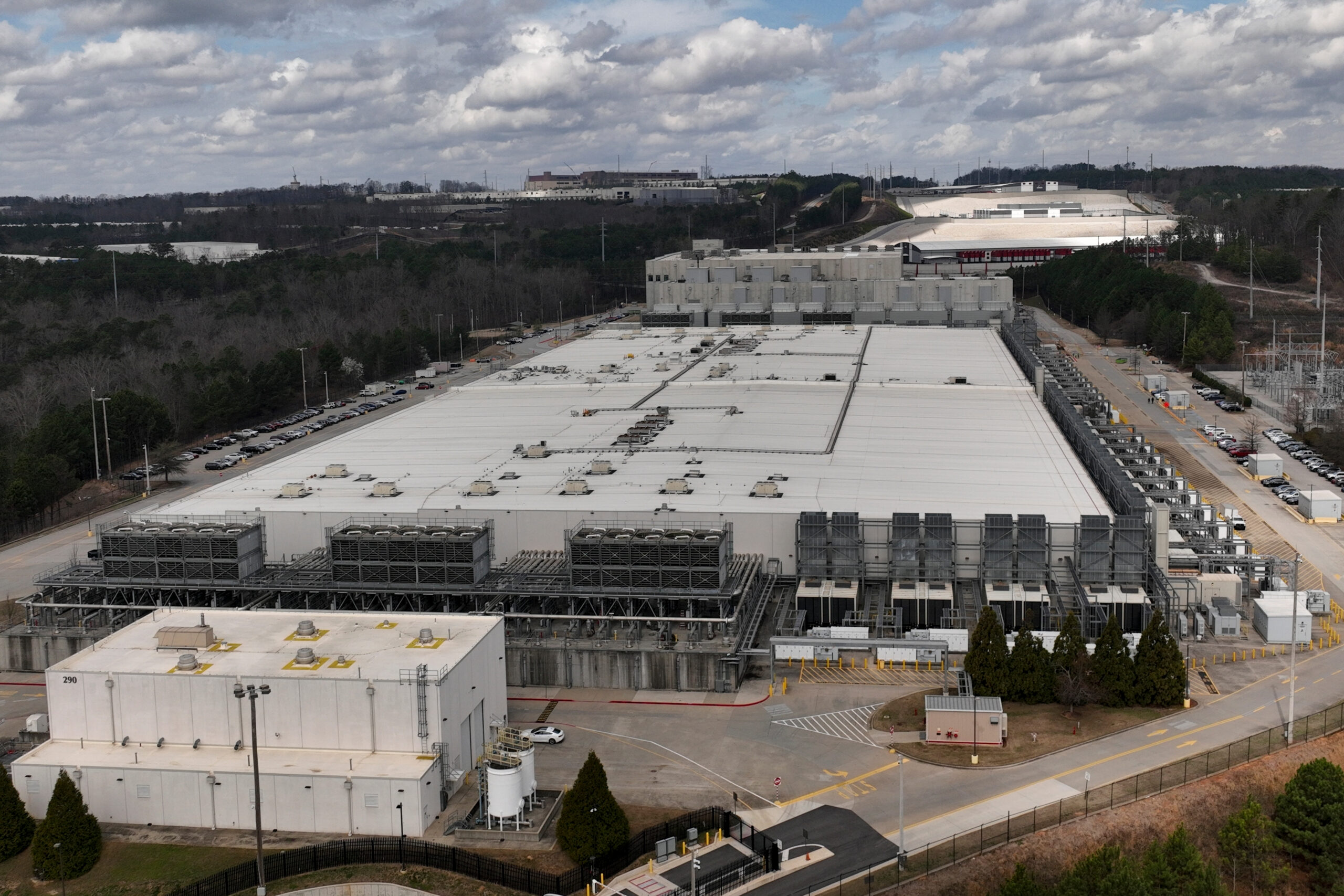
Image Credit: Associated Press
Key Points
- The Blackstone Digital Infrastructure Trust is a newly public REIT focused on AI data centers, offering investors another way to benefit from the data-center boom.
- Because the company is structured as a REIT, it may appeal to income-focused investors seeking a dividend that could grow over time.
- One key risk is the trust’s external management structure, which many real estate investors view less favorably.
Investors have numerous ways to play the trillions of dollars being funneled into artificial intelligence (“AI”), from direct investments into AI companies to utilities that supply the power.
One new option for investing in data centers is the Blackstone Digital Infrastructure Trust (BXDC). And it may prove particularly attractive to dividend investors.
The Blackstone Digital Infrastructure Trust recently completed its initial public offering (“IPO”) in mid-May, raising $1.75 billion on the strength of Blackstone’s reputation and its plan to buy AI data-center assets. So, the company is sitting on a pile of cash and ready to deploy it.
Income investors may find the company interesting because it’s organized as a real estate investment trust (“REIT”). A REIT is a company that pays no tax at the corporate level in exchange for paying out at least 90% of its taxable income to investors. So, this structure means that investors can ride the trend of AI data-center investment while receiving a hefty cash payout.
Because of these tax benefits, REITs have an edge in acquiring and managing real estate, particularly investment-grade property. REITs can be attractive partners for larger companies looking to become more capital-efficient and avoid tying up a ton of capital in real estate when it could be put to work in their core business.
Since the new company has only its cash assets for now, it’s relying entirely on Blackstone’s (BX) track record. The asset manager has more than $150 billion in data-center assets worldwide, and more than $1.3 trillion in total assets under management. So, while this company is new, it’s working with an established set of managers.
And the opportunity sounds enormous for a well-positioned company with a proven track record of real estate investment, such as Blackstone.
As the company notes in its prospectus: “With an estimated $1 trillion total addressable stabilized data center market expected over the next five years, we believe the industry represents a substantial investment opportunity.”
Here’s how Blackstone intends to manage the company, generate returns for its investors, and what key risks to watch for.
Blackstone Digital Infrastructure’s Business Strategy
The Blackstone Digital Infrastructure Trust is capitalizing on its REIT advantage. Its strategy is to invest in newly constructed data centers leased to investment-grade hyperscalers under long-term contracts. Hyperscalers are the biggest players in the AI data-center world, companies such as Microsoft (MSFT), Alphabet (GOOGL), Amazon (AMZN), and Meta Platforms (META).
Blackstone is focusing on mission-critical data centers valued at $250 million to $1.5 billion, corresponding to 20 to 100 megawatts of power. It will focus on higher-quality assets located primarily in Tier 1 markets, which are the better markets.
Blackstone uses triple-net leases, meaning that tenants are responsible for paying basically all costs associated with a property, including operating expenses, taxes, and insurance. Its leases run from 10 to 20 years, and they use escalators that bump up the rent by 2% to 3% per year. So, rent keeps rising steadily year after year, keeping cash flow moving up.
Blackstone currently has about $25 billion in potential opportunities, including in northern Virginia, Ohio, and Maryland, as well as in the cities of Phoenix, Arizona and Austin, Texas. Data-center vacancies declined to an estimated 1.3% in 2025, indicating the market remains quite robust.
It aims to have debt comprise about 40% of the company’s enterprise value and, over the longer term, to become an investment-grade issuer, helping to reduce the cost of funds.
With no cash-flowing assets on its books yet, the company has not estimated its potential dividend payout in its prospectus. So, investors will need to make their own estimates based on the company’s expected asset yield of 5.75% to 7.0%, then factor in the cost of debt.
Risks of Blackstone Digital Infrastructure Trust
Like any investment, the Blackstone Digital Infrastructure Trust comes with risks.
External Management
External management involves hiring managers who may work for more than one company, and while it’s not uncommon in the REIT world, investors often don’t value these REITs as highly as internally managed ones. External management creates a conflict of interest, often resulting in shareholders paying the price through higher fees or poor alignment.
For example, since some external managers are paid based on the company’s assets or even just transactions, they may grow the company regardless of the quality of the investments.
In this company’s case, Blackstone has two forms of primary compensation: a management fee and an incentive fee.
- The management fee runs on a sliding scale, starting at 1% of market capitalization per year up to the first $25 billion in market cap. Above that level, the rate declines.
- The incentive fee charges 0.25% of market cap for each quarter in which the total shareholder return is greater than 8% annually, and the volume-weighted average price exceeds the stock’s initial offering price.
Add those up, and Blackstone could be taking about 2% of assets each year. The incentive pay helps align the manager’s interests with those of investors, even if the threshold return is not especially high.
AI Data Centers Are White-Hot
It’s hard to imagine a real estate sector that is hotter than AI data centers. They play on a huge megatrend in AI development, and many are associated with the market’s most financially solid companies, including the hyperscalers. The potential for growth here is significant as well. It all means that investors are pushing up prices on these assets, making the investment riskier.
Rising Interest Rates
Longer-term interest rates are creeping up, making real estate less valuable as an investment and reducing the value of future cash flows. The benchmark 10-year Treasury yield has now peaked back above 4.6%. Sustained higher rates can create a downturn in the REIT sector.
REITs typically borrow significant amounts of money to fund their growth, so higher rates are a key factor in a REIT’s profitability, growth potential, and asset value.
Uncertain AI Economics
The economics of AI remain uncertain, though some analysts think that they’re not sustainable. If so, real estate investments such as this one are unlikely to fare well, particularly given the high use of debt financing that is typical in the sector. While investment-grade tenants help reduce the risk here, the underlying economics of AI will ultimately determine whether they pay the rent.
Is Blackstone Digital Infrastructure Trust a Good Investment?
Investors have quite a few things to like about this new Blackstone REIT, including the track record of its managers, the potential for a solid, growing dividend, the possibility of capital appreciation, and the high-quality tenants locked in under long-term leases with escalators. But they should not overlook the risks of the external management structure and other risks, either.
Those looking to play AI and generate investment income may find this company attractive, but they should be careful not to overpay for the opportunity. Real estate assets – even those associated with AI – don’t have the same kind of upside as a good tech asset.
Regards,
James Royal, Ph.D.
Editor’s Note: A highly secure site in West Texas now houses an emerging potential $10 trillion technology backed by Elon Musk and Sam Altman. This breakthrough could completely replace our need for foreign oil – and send one small group of stocks soaring in the process. Click here to learn how you can invest in Elon’s next $10 trillion move.