Listen to the audio version of this article (generated by AI).
Key Points
- Elon Musk’s acquisition of APR Energy underscores the growing importance of “Dark Energy”—off-grid natural gas turbines that can quickly power AI data centers as electricity demand outpaces grid capacity.
- Natural gas turbines have become one of the most sought-after assets in AI infrastructure, with multiyear order backlogs driving hyperscalers and data-center operators to secure alternative power through acquisitions and long-term partnerships.
- Investors should watch companies tied to AI power infrastructure, as demand for behind-the-meter energy solutions continues to benefit turbine manufacturers and energy providers supporting the AI boom.
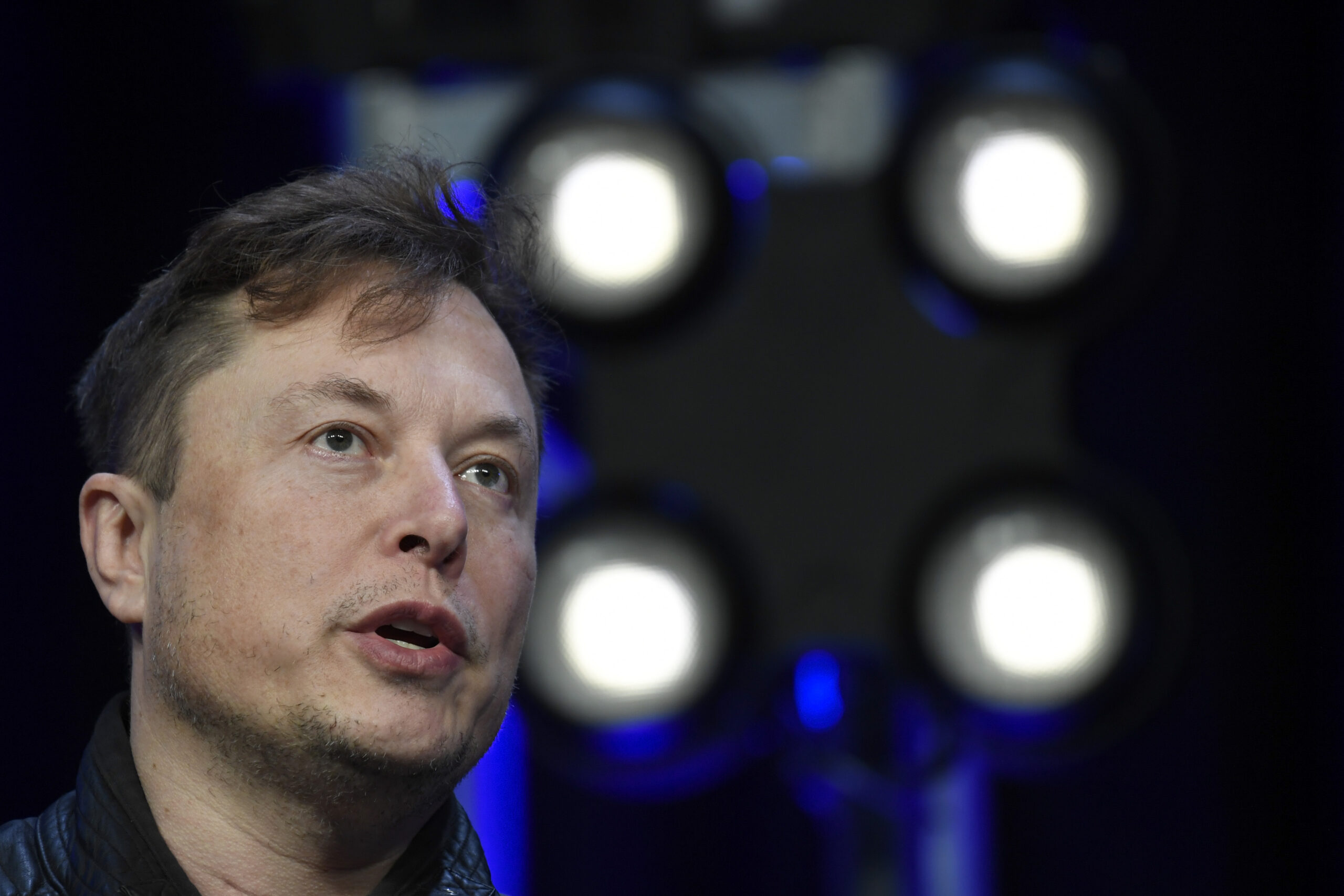
Elon Musk is at it once again. The world’s richest person quietly purchased APR Energy on July 14, a Jacksonville-based power company specializing in rapidly deployable, modular power generation, the Florida Times-Union reported.
The deal, which is thought to be worth at least $1 billion, gives Musk what APR Energy’s website describes as “one of the world’s largest mobile gas turbine fleets,” with solutions that scale from 20 megawatts (“MW”) to 500 MW. APR Energy has delivered more than 50 terawatt-hours of power to more than 35 countries.
Most importantly, the company claims it can “deliver reliable energy in 30 to 90 days.”
And that’s exactly what Musk – and every other data-center operator and hyperscaler in the world – desperately wants and needs. Plenty of power… and fast.
In early June, my colleague Steven Longenecker wrote an article explaining why Elon Musk was buying up gas turbines across America. In it, Steven stated:
Elon Musk will be one of the world’s top buyers of gas turbines over the next few years…
SpaceX has committed to spending more than $2.8 billion on these turbines for its artificial intelligence (“AI”) build-out, the company recently revealed in its initial public offering (“IPO”) filing…
In March, SpaceX agreed to buy $805 million worth of turbines from an unnamed supplier, with deliveries running through 2029. Then in late April, the company struck a separate, still-pending deal for roughly $2 billion worth of mobile gas turbines and related equipment from another vendor.
The Current U.S. Power Grid Can’t Handle AI Power Demands
A month before Steven wrote his article about Musk scooping up natural gas turbines throughout the country, he penned a must-read piece about Professor Joel Litman and his “Dark Energy” AI prediction.
From Steven’s article:
Dark Energy is Joel’s term for on-site, natural gas power generation built around a specific kind of turbine. It’s the first choice of AI data centers and hyperscalers for an uninterrupted source of off-grid electricity.
Joel has been following this developing story closely. As he wrote last year…
Without reliable, cheap power, AI infrastructure can’t scale. And right now, the only energy source that can fill that gap quickly is natural gas.
For investors who missed the early AI boom, this is a chance to own an overlooked part of the foundation.
It sure sounds like Elon Musk and SpaceX (SPCX) are all in on this theory, given his turbine-shopping spree. And it makes sense.
Let’s go back to Steven’s Dark Energy article to understand why.
As Joel noted [in March], the AI boom is putting immense strain on America’s electric grid…
Utilities in major cities are rationing power. Some have stopped taking requests for additional data-center projects until 2030 and beyond.
Our energy supply – and, therefore, energy prices – have been fairly stable for decades. But that’s changing fast.
Joel detailed how data centers alone are expected to demand another 220 gigawatts (“GW”) of power in the coming years.
To put 220 GW in perspective, the entire installed capacity of the U.S. grid runs around 1,200 GW. AI data centers alone could add the equivalent of nearly 20% of total U.S. electricity capacity in just a few years.
As a result, things are starting to break. As Joel’s exclusive video details:
In central Ohio, American Electric Power says the biggest power line in the Midwest will run out of transmission capacity by 2028.
In Virginia (the world’s largest data center market), Dominion Energy is rationing power.
In Santa Clara, California, Silicon Valley Power has stopped taking requests for additional data-center service until the early 2030s.
In Salt Lake City, there’s now a blanket pause on large data-center projects.
Put simply, the American power grid is outdated and over-regulated. It has largely been ignored for decades. But it can’t be ignored anymore, thanks to AI. And now it’s too late to redesign the power-grid infrastructure to accommodate the hundreds of gigawatts that data centers across the U.S. need to operate.
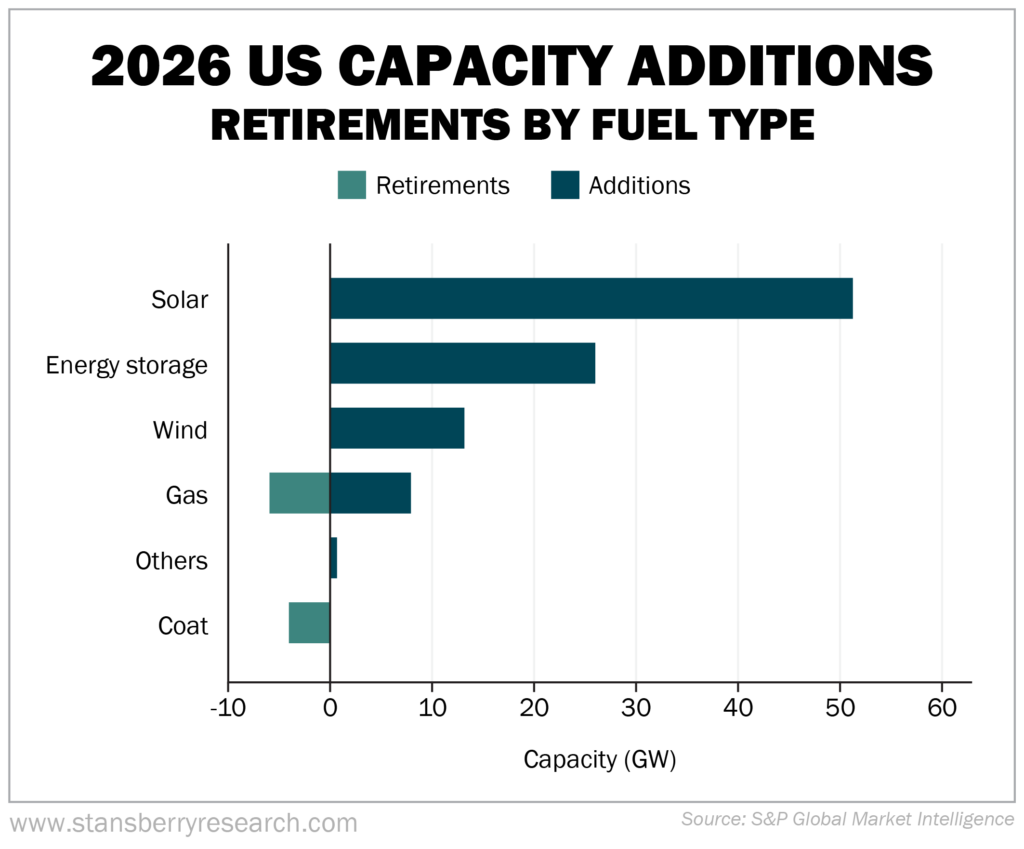
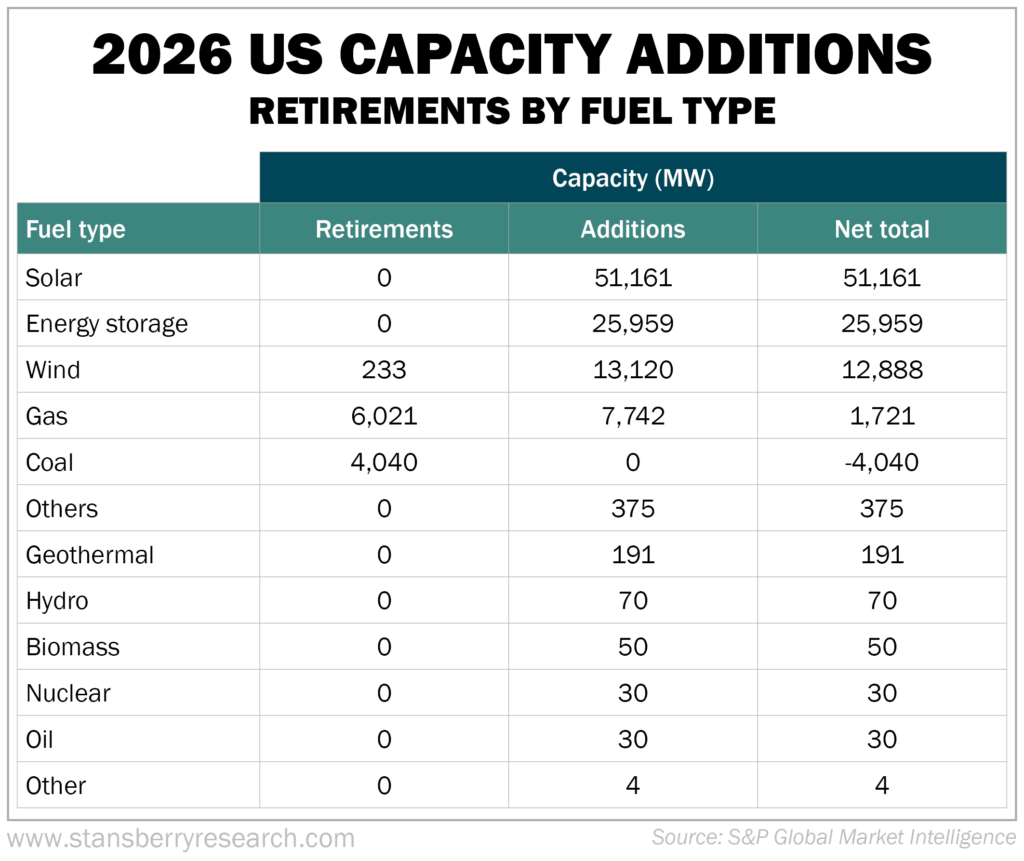
That’s why alternative energy source projects are exploding right now. According to S&P Global Market Intelligence data, 51 GW of solar energy, 26 GW of energy storage, and 13 GW of wind resources could be added this year alone.
Those three types of renewable energy have led capacity additions in 2026, far outpacing all other sources.
Importantly, however, President Donald Trump and his administration are not fans of clean, renewable energy.
Trump’s One Big Beautiful Bill Act eliminated tax credits for wind and solar facilities as well as the residential clean energy tax credit. The Department of Energy canceled or delayed nearly $83 billion in investments in more than 200 clean energy projects, according to Reuters.
The administration also added new regulations for wind and solar development on federal lands, slowing down the review process. And, of course, Trump has loudly pushed for increased fossil fuel production.
Though legal intervention has allowed some clean energy projects to resume, the Trump administration’s mission to deemphasize solar and wind energy production puts those initiatives at great risk. And that’s why natural gas becomes more important.
Why Natural Gas Turbines May Be the AI Energy Solution
From Steven’s May 6 article explaining Dark Energy:
This is where Joel’s “Dark Energy” prediction comes in… He’s referring to an on-site solution perfectly suited for the companies going “behind the meter” to generate their own data-center power.
Dark Energy is a clean, reliable power source. Specifically, it’s a class of natural gas turbines… essentially a jet engine adapted into an electric generator. They start in minutes, run on natural gas instead of jet fuel, and can produce tens of megawatts of power per unit. Stack enough of them together, and you have a private power plant.
Going back to Musk, he has now purchased multiple gigawatts’ worth of natural gas turbines for this precise reason… to build SpaceXAI its own private power plants, off the grid, to power the company’s massive data centers.
And there’s plenty of logic behind that rationale. As APR Energy noted, the company can have one of its natural gas turbine setups running in less than three months. Building a full natural gas plant can take anywhere between one and four years. That’s simply not fast enough, which makes natural gas turbines that much more appealing as an option to power data centers.
But there’s a major issue.
New Natural Gas Turbines Are Sold Out for Years
Natural gas turbines are not exactly a well-kept secret. As soon as hyperscalers and data-center operators realized the many benefits of powering their AI factories with the turbines, supply fell. And then it disappeared completely.
As of February, the expected wait time for a new turbine to be built and delivered was anywhere between one and seven years. And the whole supply-demand thing sent natural gas turbine prices skyrocketing. The cost for a gas turbine could reach $600 per kilowatt by the end of 2027, an increase of 195% since 2019.
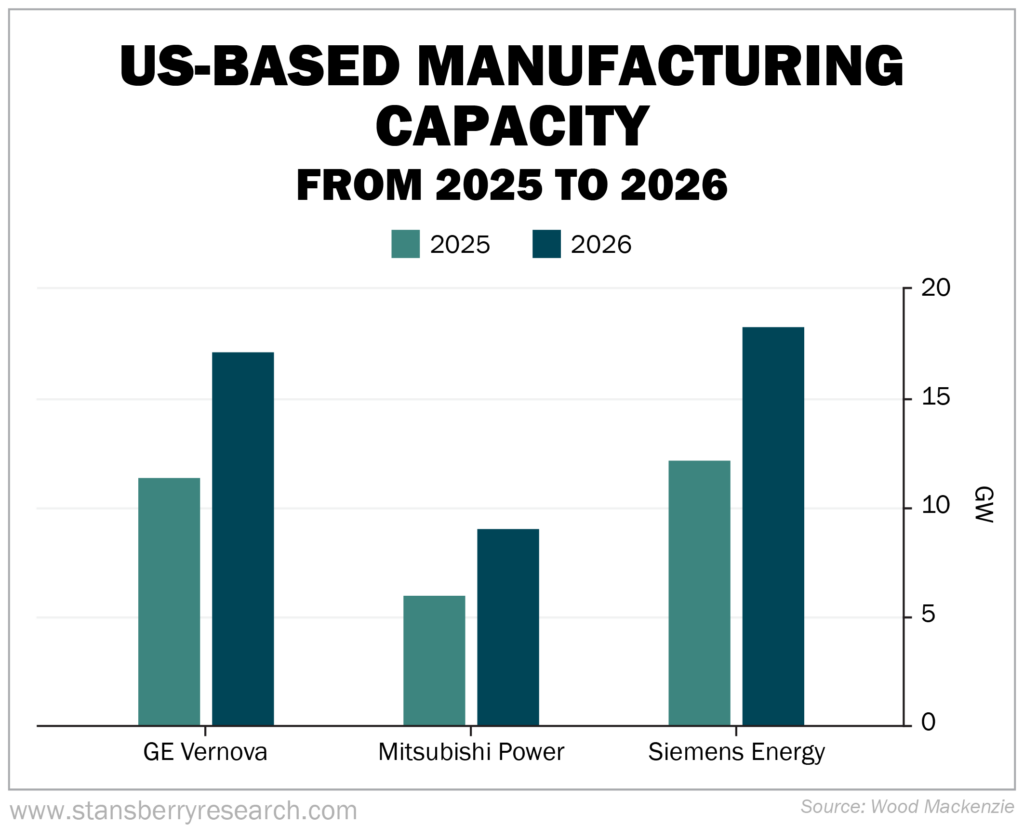
Gas turbine manufacturers are trying to keep up with the demand, but there’s a limit. According to a spring 2026 report by Wood Mackenzie, GE Vernova (GEV) is pouring more than $160 million into ramping up production from its typical 50 large-frame turbines per year to between 70 and 80 by the end of this year.
Siemens Energy has invested $1 billion to increase production and is even keeping some manufacturing facilities open 24/7 to try to meet demand. And Mitsubishi Heavy Industries is attempting to double its output by 2028.
As you can see in the chart below, these companies have already significantly increased gas-turbine capacity year over year. But, again, it’s just not enough.
The lack of availability leaves AI businesses scrambling for energy sources to power their data centers.
That is, unless you’re the wealthiest person on the planet.
If you essentially have unlimited spending ability, like Elon Musk, you simply buy individual power companies and their fleets of natural gas turbines. The result: no wait for new turbines to be built and delivered, and no price-per-kilowatt negotiations.
Of course, no one else has as much money as Musk, so it’s not such an easy task. That said, the hyperscalers – like Amazon (AMZN), Microsoft (MSFT), Alphabet (GOOGL), and Meta Platforms (META) – have used similarly creative approaches to sourcing power.
While these businesses didn’t outright buy an entire power company, they forged partnerships and deals to acquire more energy.
- In 2024, Amazon purchased a large 960 MW data-center campus in Pennsylvania from Talen Energy (TLN). The campus sits adjacent to the Susquehanna nuclear power plant and provides Amazon Web Services with direct access, behind the meter, to nuclear energy.
- In September 2024, Microsoft and Constellation Energy (CEG) partnered on a deal in which Constellation will restart the Unit 1 reactor at the infamous Three Mile Island nuclear power plant in Pennsylvania and sell the power to Microsoft for its AI data centers.
- Last June, Meta agreed to a 20-year deal with Constellation Energy for its nuclear power.
Those are helpful solutions, but Meta, Amazon, and Microsoft are still contracted with the energy companies. Musk, on the other hand, has no such constraints. APR Energy is available to use at his discretion, for Tesla (TSLA) Energy and its Megapack battery storage operations, as well as SpaceXAI’s data centers.
What Musk’s Energy Company Purchase Means for Investors
Having the ability to purchase your own power source – like Musk just did for SpaceXAI – is a significant advantage. And right now, stock-wise, SpaceX needs all the help it can get as it has been on a pretty steady downward trajectory since its June IPO.
So, this should wind up being a positive development for SpaceX investors. Another big winner here is GE Vernova. The surging demand for natural gas turbines has sent its stock soaring by 85% in the past year, as of July 16.
And considering the years-long backlog on new orders, it’s safe to say GE Vernova (as well as Siemens Energy and Mitsubishi Heavy Industries, which trade on international exchanges) can count on steady revenue for the foreseeable future.
It’s worth repeating that Musk, with his ludicrous level of wealth, has the upper hand over other data-center operators and hyperscalers as they search for as much energy as possible. It’s clear that much of that energy will not be coming from power grids. They’re overloaded, and the independent system operators across America simply can’t secure enough power quickly enough for AI’s needs.
Solar and wind are options, but government policy shifts leave these resources vulnerable to quotas and strict regulations.
What’s left? Building your own private power plants behind the meter, which is exactly what Elon Musk is doing.
Now, it’s important to know that Musk is facing some legal hurdles, which Steven discussed in his June 5 article:
The NAACP, joined by local environmental groups, sued the company for its operation of gas turbines at its AI data centers. As TechCrunch reported:
At issue is the “mobile” nature of the turbines. The Southern Environmental Law Center, which filed the lawsuit on behalf of the NAACP, says the turbines are being operated in violation of federal law, which states that power plants mounted on a trailer can still be considered stationary and subject to air-pollution regulations.
So far, the company has been granted permits for just 15 turbines… while operating up to 46.
Legal issues or not, Musk is forging ahead with acquiring natural gas turbines, as evidenced by the APR Energy deal. And it reinforces Joel’s thesis that Dark Energy is the next stage of the AI boom.
Just watch Joel’s Dark Energy interview to hear it for yourself.
Regards,
David Engle
Editor’s Note: A new “dark energy” is being rolled out as we speak… It completely bypasses our need for foreign oil. And it’s not nuclear or solar or wind or anything you would expect.
This new potential $10 trillion technology is already seeing investment by early backers of Microsoft, Google, Amazon, and more… Most important, these dozens of billionaires can’t make this tech themselves. They have to go through obscure “supplier” companies.
And in the coming months, this new “dark energy” could send three little-known stocks soaring… while wiping out 10 of the most popular stocks on the market. Learn more about this dark energy opportunity by clicking right here.