
Image Credit: Associated Press
The largest private AI energy project in the world is five hours from the nearest major airport, surrounded by 7,500 acres of Texas Panhandle scrubland.
When construction is finished, the site will generate 17 gigawatts of electricity. That’s enough to light up more than 8 million homes…
Yet, none of that power will reach a single American city. It won’t be “on the grid” at all. Every watt will go toward the artificial intelligence (“AI”) models being built by OpenAI, Microsoft (MSFT), Oracle (ORCL), Meta Platforms (META), Alphabet (GOOGL), and Elon Musk’s xAI.

You see, most folks will never know that places like this even exist. Or that this opportunity is so massive. But Joel is an industry insider… and a senior advisor to Fermi America, the developer behind this Dark Energy project.
He has consulted for the Department of Defense and the Marine Corps War College, lectured at Wharton and Harvard Business School, and sells his stock-market ideas to hedge funds for as much as $100,000 per month. As he says on camera:
I’m confident this new tech could soon become worth $10 trillion or far more – bigger than any single stock on the market today.
Already, the smartest tech investors in the world… the same billionaires who funded Uber Technologies (UBER), Airbnb (ABNB), Stripe, Nvidia (NVDA), and Coinbase (COIN)… are pouring money into the small group of companies supplying this technology. So are the largest AI hyperscalers.
And today, Joel has uncovered how any investor can join them in backing this technology… straight from a regular brokerage account. But he does have a warning:
Even at our private energy project here in Texas… which is called a “Hyper Grid” because we’re the largest private energy project in the entire world… we can’t just make “Dark Energy” on our own.
We have to go through niche supplier companies, which specialize in building the device that makes it possible.
This single device unlocks trillions of dollars in opportunity…
But without the device, nothing happens.
He says that the small companies that supply this Dark Energy technology could become the next Nvidia (NVDA), ASML (ASML), or Lam Research (LRCX)… names that turned $1,000 investments into as much as $3 million for folks who got in early.
On this page, we’ll go deep into Joel’s “Dark Energy” prediction. We’ll unpack the technology… share why it’s exploding right now… and even explain how Joel’s research firm finds its Dark Energy early-stage opportunities.
Table of Contents
What You Should Know About Joel Litman’s ‘Dark Energy’ Prediction
The big problem… and our opportunity with Dark Energy… is that the U.S. power grid can’t keep up with AI’s electricity demands.
Mainstream publications like the Wall Street Journal and the Washington Post have called the current U.S. grid “archaic” with “onerous and outdated” regulation and years of underinvestment.
The North American Electric Reliability Corporation (“NERC”), the body responsible for ensuring grid reliability, has warned of growing risks of widespread blackouts. The Department of Energy is also projecting sharp increases in blackout risk by 2030.
Meanwhile, AI demand is soaring. As my colleague Jim Royal has noted, AI investment from the hyperscalers is set to soar some 71% this year… rising from about $380 billion in 2025 to an estimated $650 billion in 2026. And the sheer amount of money being spent on AI is incredible, as Jim goes on to write:
Key players – Microsoft, Amazon, Alphabet, Meta Platforms, and Oracle (ORCL) – are expected to spend in aggregate about 90% of their operating cash flow on capex in 2026, according to Bank of America. That’s up from 65% in 2025.
Frankly, Big Tech can’t afford to wait for the grid to catch up…
This is where Joel’s “Dark Energy” prediction comes in… He’s referring to an on-site solution perfectly suited for the companies going “behind the meter” to generate their own data-center power.
Dark Energy is a clean, reliable power source. Specifically, it’s a class of natural-gas turbines… essentially a jet engine adapted into an electric generator. They start in minutes, run on natural gas instead of jet fuel, and can produce tens of megawatts of power per unit. Stack enough of them together, and you have a private power plant.
These devices have been around for decades. They’ve powered tanks, ships, and remote oilfields.
But until recently, no one was using them at scale to power the world’s most advanced AI labs. Now that they are, the suppliers building them are sold out for years.
And that’s why the companies that supply this technology… the ones building the turbines, the small modular reactors, the cooling, the switchgear, and everything else needed to make a private power campus run… are positioned to deliver incredible returns reminiscent of past tech booms. For example:
- PC chip-equipment suppliers like Lam Research, which soared more than 390,000% since its early days.
- Or take semiconductor toolmakers like Applied Materials (AMAT), which helps build a key piece of Tesla (TSLA) cars… the stock is now up as high as 590,000%.
- And perhaps the most famous supplier example, Nvidia (NVDA), is up as much as 661,000% since it was founded to supply graphics cards for gamers and ultimately fuel the AI boom.
Each time, the obscure suppliers earned the biggest gains. Their products were necessary to make the technology work. But most folks didn’t hear about them until after the boom was well underway.
Let’s dive deeper into each of these key points…
AI Is Breaking the U.S. Power Grid
Electricity demand in the U.S. was practically flat for years…
Even as gross domestic product (“GDP”) rose, the population grew, and the country gained millions of devices and gadgets, total power use barely moved. Energy efficiencies offset all the extra iPhones and electric cars.
Then came AI. As Joel noted last month, the AI boom is putting immense strain on America’s electric grid…
Utilities in major cities are rationing power. Some have stopped taking requests for additional data-center projects until 2030 and beyond.
Our energy supply – and, therefore, energy prices – have been fairly stable for decades. But that’s changing fast.
Joel detailed how data centers alone are expected to demand another 220 gigawatts (“GW”) of power in the coming years.
To put 220 GW in perspective, the entire installed capacity of the U.S. grid runs around 1,200 GW. AI data centers alone could add the equivalent of nearly 20% of total U.S. electricity capacity in just a few years.
As a result, things are starting to break. As Joel’s exclusive video details:
In central Ohio, American Electric Power says the biggest power line in the Midwest will run out of transmission capacity by 2028.
In Virginia (the world’s largest data center market), Dominion Energy is rationing power.
In Santa Clara, California, Silicon Valley Power has stopped taking requests for additional data-center service until the early 2030s.
In Salt Lake City, there’s now a blanket pause on large data-center projects.
Meanwhile, folks are getting angry about higher monthly electric bills. A recent Bloomberg analysis revealed that electricity now costs as much as 267% more than it did five years ago in areas near data centers. Just take a look:
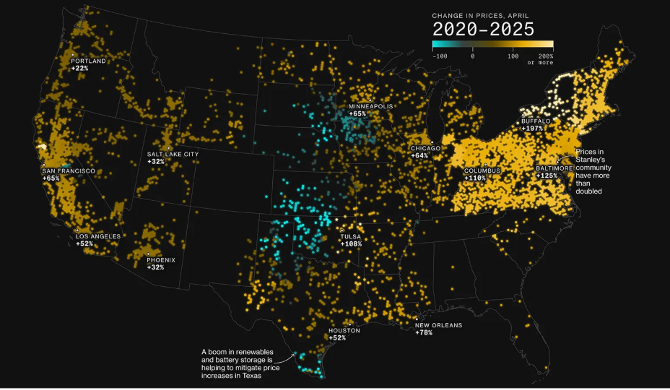
The article goes on to note that if data centers were a country, “they’d rank fourthin energy use, behind only China, the US and India.”
The article also quoted David Crane, CEO of Generate Capital and a former federal energy official: “Without mitigation, the data centers sucking up all the load is going to make things really expensive for the rest of Americans.”
Already, public hearings about data centers regularly devolve into shouting matches between residents, regulators, and developers. I covered some of this fallout in my own article about the AI data-center rebellion…
According to Data Center Watch, a research firm tracking the backlash, at least 142 activist groups across 24 states are now organizing to block data center construction.
Over the past two years, residents have blocked or delayed a staggering $64 billion worth of data-center projects. And roughly 55% of the elected officials who have spoken out against data centers are Republicans, not Democrats.
The backlash here isn’t along the usual political fault lines.
It’s widespread… made up of regular folks worried about their water, their electric bills, their property values, and whether their elected officials are cutting deals behind closed doors.
But as the AI data-center backlash grows, it risks stalling out the AI race. And potentially, leading to a massive economic collapse…
Consulting firm Oliver Wyman has estimated that an AI infrastructure stall could destroy as much as $33 trillion in market value. That’s larger than the annual GDP of the U.S., and it roughly echoes my own warning about what I’ve been calling a potential “AI doom loop”…
[W]e would expect the broader S&P 500 to ultimately decline somewhere between 30% and 50% over time… a $20 trillion to $35 trillion loss.
Investors are shellshocked. The wealth effect reverses… hard. People who felt like they were doing just fine six months ago are suddenly terrified.
And frankly, even if folks were just fine with higher electric bills, the fact is that the U.S. power grid – in its current form – was built for a different era.
It was designed for slow-and-steady demand growth. It didn’t anticipate single, massive buildings demanding upward of 1 GW of constant 24/7 power. And it didn’t account for the rate of increase that AI introduces.
And the grid can’t be fixed quickly. It can take 10 years or more to permit and build a new high-voltage transmission line. Permits, environmental reviews, and right-of-way disputes routinely stretch projects past the decade mark.
That leaves America with a hard choice. Either we radically accelerate new domestic power generation, or we accept that AI itself will stall… taking down trillions of dollars in projected economic value, and likely America’s lead in the global AI race.
That’s why Joel’s “Dark Energy” prediction matters so much… and why it has so much upside for investors…
What ‘Dark Energy’ Really Is
Dark Energy is Joel’s term for on-site, natural gas power generation built around a specific kind of turbine. It’s the first choice of AI data centers and hyperscalers for an uninterrupted source of off-grid electricity.
Joel has been following this developing story closely. As he wrote last year…
Without reliable, cheap power, AI infrastructure can’t scale. And right now, the only energy source that can fill that gap quickly is natural gas.
For investors who missed the early AI boom, this is a chance to own an overlooked part of the foundation.
The Fermi America project, where Joel is a senior advisor, uses these Dark Energy natural gas turbines. They look like this:
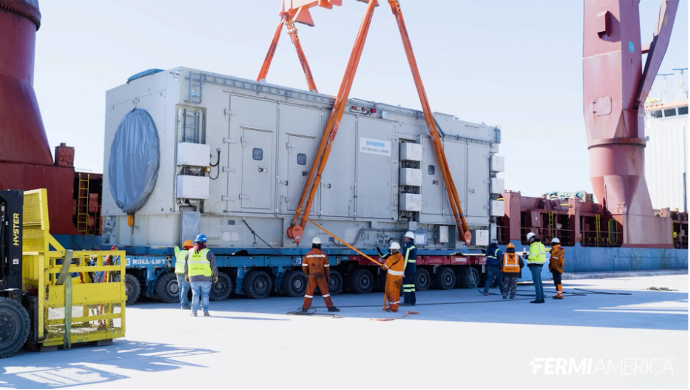
Essentially, they’re a modified jet engine – like what you’d find on a commercial airliner. But instead of pushing a plane through the air, they spin a generator on the ground, creating electricity.
The military, oil and gas operators, and emergency response crews have used these types of turbines for decades. And as Tom’s Hardware reported last year, the GE LM6000 turbine – now widely deployed at AI sites – is essentially a CF6-80C2 engine that once propelled Boeing 767 and Airbus A310 aircraft. Each refurbished unit can produce up to 48 megawatts of electricity.
That’s enough power for tens of thousands of homes… or a midsized AI cluster. Stack 30 of them at one site and you have a roughly 1.4-gigawatt power plant that can be turned on in minutes rather than years.
And AI data centers are buying as many of these turbines as they can. Joel quoted one energy insider in his interview saying, “you can’t build these turbines fast enough” right now.
Many suppliers are sold out for years in advance. One just doubled its net profit in three months, thanks to a record number of orders for its Dark Energy turbines. And even as Mitsubishi Heavy Industries is doubling its production capacity for these turbines… it’s still nowhere near enough to meet demand.
AI data centers and hyperscalers are focusing on these Dark Energy turbines for a few big reasons…
- Speed. While a new natural gas plant can take several years to build from a permitted site, these Dark Energy turbines can be installed in months. And once they’re ready to go, they can begin producing power almost immediately.
- Reliability. Joel cites a 99.7% uptime figure on these units. Industry data confirms that aeroderivative turbines have very high availability rates and can run for years between major maintenance overhauls. Compare that to solar, which depends on the sun, or wind, which depends on the weather.
- Scale. These units are big… upward of 25 to 50 megawatts each is typical, with some ranging higher. That’s an order of magnitude or two larger than the diesel backup generators that are more commonly used in hospitals or office buildings. Stack a few dozen of these turbine generators, and you can match the output of a small nuclear plant.
These Dark Energy turbines are about the only way AI labs can get power now, rather than in five to 10 years.
And for investors looking for significant potential profits, the companies behind this trend are still relatively unknown…
Why a Small Group of Dark Energy Supplier Stocks Could Soon Soar
The biggest investing winners aren’t always the “headline names” when a new technology hits the market. Often, they’re obscure suppliers… companies that are able to take advantage of bottlenecks in a new technology build-out.
Joel explained that these kinds of stocks can go from unknown to high-profile, virtually overnight. As he explains in his Dark Energy interview…
When you have a string of key suppliers all built around a single technology, you often see multiple stocks soar around the same time.
This is what happened with computer chip stocks – and the obscure stocks related to them.
And the potential profits for early investors are some of the highest on record. Joel ran through a number of examples of past supplier stocks that soared much higher than practically anyone thought possible…
- Synopsys (SNPS) supplies a product critical to firms like Nvidia, Intel, and AMD… It’s up more than 11,000%.
- Cadence Design Systems (CDNS) supplies critical software to companies like Tesla… It’s up more than 43,000%.
- KLA Corporation (KLAC) supplies key parts for video-game consoles… It’s up more than 49,000%.
These aren’t stock tickers you’ve likely discussed at a dinner party. Most investors still have never heard of them, despite their massive runs. But each one was indispensable as a supplier to a major, well-known product that investors have heard about…
That same setup is playing out right now with the companies supplying the Dark Energy build-out for AI data centers. As Joel says:
Every major billionaire investor is now putting their own money behind this.
That includes geniuses who were early backers of stocks like Nvidia, Microsoft, Amazon, and Meta.
That includes Sam Altman, the CEO of OpenAI.
And that includes Elon Musk.
Jensen Huang, CEO of Nvidia, said directly that this energy source is the immediate answer to the grid problem.
Larry Ellison, the billionaire founder of Oracle, says this energy source is our only hope of winning the AI race against China.
And unlike previous early investments that were only accessible to hedge funds and venture capital… you can buy the stocks that are controlling the supply of Dark Energy right from your regular brokerage account.

Joel has written down everything you need to know, step-by-step, in a special report for his subscribers. It’s called Dark Energy: Stocks That Could Soar as AI Goes Off the Grid. And it contains the names and tickers of the supplier stocks that hold the key to this boom, personally vetted by Joel and his research team.
Out of respect to Joel’s paid subscribers, we can’t share those specific names here. But you can get access immediately by clicking here to go directly to a special order form, without watching a long video.
The core idea is simple: AI needs power. The grid can’t deliver it fast enough. And this special group of supplier companies is positioned at the heart of this build-out… and is seeing the kind of demand that historically has produced massive stock-market winners.
What Is Financial Publishing Firm Altimetry?
Altimetry is a world-renowned financial research and publishing firm founded by Professor Joel Litman. It publishes research products, newsletters, and software for individual investors.
Joel spent more than 30 years in finance, both on and off Wall Street, working at firms like Deloitte, Credit Suisse First Boston, and PricewaterhouseCoopers. He saw firsthand how Wall Street “experts” hoard their favorite moneymaking opportunities, making them seem too complex, expensive, and technical for regular people to understand… let alone profit from.
So he left it all behind and ultimately launched Altimetry… to give regular, everyday folks the edge Wall Street will never offer.
Instead of using traditional Wall Street analysis, Joel and his team start by deconstructing the data. Then they reassemble it using their own Uniform Adjusted Financial Reporting Standards (“UAFRS”) – or Uniform Accounting, for short.
Uniform accounting aims to solve the distortions and inconsistencies that are common in financial statements that public companies file under U.S. Generally Accepted Accounting Principles (“GAAP”).
For example… under GAAP, different industries account for things differently. Acquisitions can dramatically change the look of a balance sheet without changing the underlying economics of a business. Stock-based compensation, research and development (R&D) capitalization, leases, and pension accounting are all areas where GAAP can muddy the picture.
Altimetry’s research process recasts company financials to strip out these distortions. The goal is to produce a single, apples-to-apples view of return on assets, asset growth, and valuation across thousands of companies.
This process shows them the true picture of a company’s potential… and can help spotlight situations where the real picture is meaningfully different from what the market believes.
Then, they combine Uniform Accounting with deep forensic analysis to find mispriced companies poised for massive growth.
This level of research is why Joel’s work is followed by all 10 of the world’s largest asset managers… along with the FBI, the Pentagon, and more than half of the biggest elite hedge funds and money managers in the world.
The firm’s flagship Hidden Alpha newsletter targets large-cap stocks where Uniform Accounting reveals hidden value. This is where Joel explains his Dark Energy prediction in full… including at least five behind-the-scenes suppliers that sit at the perfect intersection of AI-power tailwinds as detailed in Dark Energy: Stocks That Could Soar as AI Goes Off the Grid.
New subscribers immediately receive Joel’s full research report on those specific Dark Energy supplier stocks he recommends you buy immediately, plus three additional bonus reports…
- Dark Energy, Phase 2: How to Profit as America Goes Nuclear. This is all about the small modular reactors (“SMR”) boom that will come in the coming years to fuel the next stage of the AI build-out.
- The Game Changers: Unbeatable Advantage Stocks to Buy Today. This report is focused on broader stocks that could soar as AI sweeps through an increasingly “split” economy… with big winners, but even bigger losers.
- 10 Widely Held Stocks You Should Sell Immediately. Since 2008, of the 57 companies Joel has publicly exposed as significant risks to investors, an incredible 50 have indeed collapsed.
You can learn how to subscribe to Hidden Alpha by clicking here to go straight to the order form. (This link does not go to a long video.)
Who Is Joel Litman?
Professor Joel Litman is the founder and chief investment officer of Altimetry.
He’s a forensic accountant by training, with a Bachelor of Science in accounting from DePaul University and an MBA from the Kellogg Graduate School of Management at Northwestern University. He’s also a certified public accountant and a member of both the CFA Institute and the Association of Certified Fraud Examiners.

Journalist Alice Lloyd profiled Joel several years ago for American Consequences magazine…
[W]hat if one day, an accountant took a look around at his rule-following colleagues, stood up from his desk piled with financial statements that the rules of his trade had left him no choice but to mangle – and said, “Enough is enough!“
Well, that’s basically what Litman did.
After most of a decade on Wall Street, he’d developed an even greater distaste for the way capital markets are reported. He published a case study in the Harvard Business Review, “Give My Regrets to Wall Street,” about a company weighing whether to go public or stay private. Its assessment of the downsides of leaping into the wild (and, Litman emphasizes, meaningless) world of public valuations was uncomfortably honest.
His career spans consulting, finance, and academia… including past stints at American Express, Deloitte, PricewaterhouseCoopers, and Credit Suisse – where Joel helped build the bank’s HOLT University training program.
He has taught or guest-lectured at Harvard Business School, University of Chicago Booth, Wharton, LBS, SAIF Jiao Tong, and others. And he conducts seminars regularly for financial and industry conferences around the world, such as CFA and CPA chapters. And he chairs the UAFRS Advisory Council, which spearheads Uniform Accounting usage across the globe.
Joel’s reputation among professional investors comes largely from a string of high-conviction market calls he has made over the years…
In particular, he has been credited with predicting both the 2008 financial crisis and the early 2020 market crash months ahead of time. He has also published “Do Not Buy” lists of overvalued or accounting-troubled companies that subsequently collapsed.
And as we’ve mentioned earlier, Joel also regularly consults with the FBI, the U.S. Marine Corps War College, and the Pentagon on financial intelligence matters.
And when it comes to Joel’s Dark Energy prediction, as senior adviser to the Fermi America executive team, he’s not just researching from a distance… He’s directly involved in one of the largest private AI energy projects anywhere in the world. As he noted in his recent interview:
My biggest advantage is that I’m “in the room,” so to speak…
It’s one thing to research Dark Energy on Google… or ask ChatGPT about it.
It’s another thing to be out here, living it.
I know about “Dark Energy” because I can see it with my own eyes.
Frequently Asked Questions
Question: What exactly is “Dark Energy”?
Answer: “Dark Energy” is the term Professor Joel Litman uses to describe a category of on-site, behind-the-meter power generation being deployed to support AI data centers.
It primarily refers to natural gas turbines – in particular, specific jet-engine cores adapted for stationary power generation. The term reflects the fact that this build-out has been happening largely off the public radar, “in the dark.”
Question: Is Joel’s “Dark Energy” prediction related to the cosmological concept of dark energy?
Answer: Nope. Dark energy is also a scientific term in physics for a theorized but not proven force that drives the expansion of the universe. It’s fascinating reading, but the Dark Energy opportunities that Joel is focused on refer strictly to private, behind-the-meter power generation for AI data centers.
Question: Why are big tech companies building their own power plants instead of using the grid?
Answer: The U.S. power grid simply can’t keep up with AI’s demand growth. Grid interconnection queues now stretch five to seven years in many regions, and AI data centers can’t wait that long.
So companies like xAI, OpenAI, Microsoft, and Meta are bypassing the grid entirely by building behind-the-meter power plants on or near their data center sites. This is sometimes called the “Shadow Grid” or “Bring Your Own Generation” model.
Question: Is “Dark Energy” the same as natural gas?
Answer: For now, yes – the dominant fuel for these Dark Energy opportunities is natural gas. Looking ahead, the next big power source for America will take it a step further – with mini-nuclear reactors that will add an extra element to the “dark energy” boom. As noted last year in the Altimetry Daily Authority e-letter:
In the long term, nuclear energy is a likely candidate to power much of the AI boom. But natural gas is ready now.
The commodity already supplies about 40% of data-center power demand… which is projected to grow from 11 gigawatts (“GW”) to 42 GW by 2030.
And natural gas is expected to power most of the new data-center projects through the same year.
Joel highlights the best nuclear player he recommends investors buy in his special report titled Dark Energy, Phase 2: How to Profit as America Goes Nuclear.
Question: How is Dark Energy better than solar and wind?
Answer: Solar and wind are intermittent… They produce power when the sun shines or the wind blows, but it’s not constant. AI data centers need 24/7, always-on power with very high uptime. Gas turbines and nuclear reactors are the winners here.
Question: What is Elon Musk’s role in this story?
Answer: Elon Musk’s xAI is one of the most aggressive deployers of behind-the-meter natural gas power. At an xAI site where Elon quietly built one of the most powerful supercomputers on Earth, he brought in a fleet of Dark Energy natural gas-powered turbines to generate enough power to run the graphics processing units (“GPUs”).
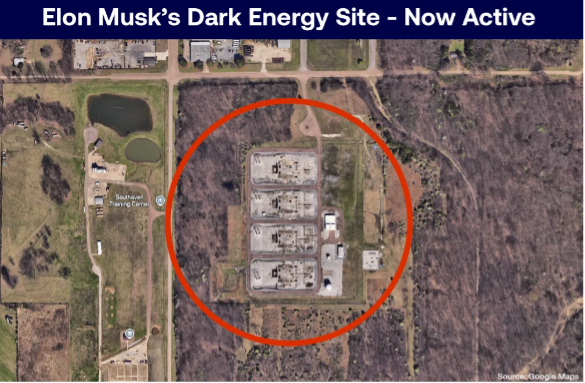
Nvidia CEO Jensen Huang said the build was “superhuman,” noting it took Musk’s team 19 days to do something that normally takes years. But Musk wouldn’t have been able to move at anywhere near that speed if he had waited to hook up to the grid.
Question: What is Fermi America, and how is Joel involved with it?
Answer: Fermi America is a private AI energy developer based in the Texas Panhandle. It’s building what it calls the world’s largest “HyperGrid” campus, intended to provide up to 17 GW of power to AI hyperscalers.
Cofounders include Toby Neugebauer and former U.S. Energy Secretary Rick Perry, while Joel serves as a senior adviser to the executive team.
It’s important to note, however, that Fermi America is not an Altimetry recommendation.
Because Joel is an insider, he’s not allowed to make any sort of recommendation about the company. And because the company is not yet generating revenue, it’s simply not the kind of company that he recommends at Altimetry.
Question: How much does Hidden Alpha cost?
Answer: The normal price for a year of access to Hidden Alpha, Altimetry’s flagship research service, is $499 a year.
Question: Is there a money-back guarantee for new Hidden Alpha subscribers?
Answer: Absolutely. New subscribers receive a 30-day, no-risk trial to Hidden Alpha. Read Joel’s special reports, look at his full model portfolio, and get Joel’s next recommendation as soon as it hits your email inbox…
If at any point in that period you realize that Joel’s research just isn’t for you, no problem. You can contact Altimetry’s U.S.-based member services team and receive a full refund.
What Investors Should Do Next
Electricity demand is surging in the age of AI. And it has become an expensive gamble for data-center operators to wait for the grid to catch up.
That’s why many are taking matters into their own hands… by building around the bottleneck.
This is the core of Joel’s “Dark Energy” prediction… that by securing their own power generation, backup systems, and energy infrastructure, these companies are creating a major opening for suppliers.
Every time AI gets smarter, it needs more power. And if an AI company doesn’t want to wait years to get “on the grid,” its only choice is Dark Energy. As Joel puts it:
If you buy the right “Dark Energy” stocks today… you’ll secure your piece of this boom.
And every time you hear about AI passing some new test… you can feel excited – instead of uneasy.
Because, if you become an early backer of “Dark Energy” today, the smarter AI gets… the more your investments stand to grow.
Again, you can hear Joel’s full interview about his Dark Energy prediction by clicking here.
Or if you’re ready to see Joel’s research and recommendations for yourself, click here to go directly to the Hidden Alpha order page.
That page will confirm your special price, detail the four reports you’ll receive immediately, and it even includes several more exclusive bonuses I didn’t have time to mention here.
These Dark Energy suppliers are a $10 trillion opportunity. And investors who act now will see the biggest potential gains.