Image Credit: Associated Press
Listen to the audio version of this article (generated by AI).
Key Points
- Dell has evolved from a PC manufacturer into a leading AI infrastructure company, driven by its partnership with Nvidia and growing demand for AI-optimized servers and enterprise AI solutions.
- Strong financial results continue to support the investment case, with $24.4 billion in AI orders, a record $51.3 billion AI server backlog, and a raised fiscal 2027 AI server revenue outlook of $60 billion.
- Despite valuation concerns and near-term risks, analysts remain bullish as Dell benefits from accelerating enterprise AI adoption, strong earnings growth, and shareholder-friendly capital returns.
My, how times have changed for Dell Technologies (DELL). If you’ve been around for a while like me, then you probably remember Dell’s genius personal computer (“PC”) marketing campaign from the early 2000s. It revolved around a character named “Steve,” who used to tell people in commercials, “Dude, you’re getting a Dell.”
Roughly 25 years later, Dell still sells PCs like the ones Steve was hawking. But today, it’s also considered one of the strongest artificial-intelligence (“AI”) infrastructure businesses in the world. What’s even more impressive is that Dell achieved that status in just a few years.
Between increased earnings, strong demand for its AI servers, and smart enterprise-AI spending, Dell is a rising AI star. And its stock performance has reflected that boosted status over the past few months.
Can Dell extend its AI-driven run higher? Here’s what investors need to know about Dell’s outlook.
Dell’s Quick Transition From PC Maker to AI Titan, With Help From Nvidia
Long known as a successful computer retailer, Dell first got into the AI game in March 2024 when it partnered with chip bellwether Nvidia (NVDA) to create the Dell AI Factory with Nvidia.
The Dell AI Factory is an end-to-end enterprise-AI solution with Nvidia that offers “a portfolio of products, solutions, and services tailored for AI workloads from desktop to data center.” This includes agentic AI, modular AI architecture, and infrastructure products such as AI desktop PCs and laptops, rack servers, data storage, Nvidia graphics processing units (“GPUs”), and switching systems.
It also offers the Nvidia AI Enterprise software platform, Nvidia NIM microservices, and the Nvidia Omniverse platform of services designed to support developers in building AI systems.
In a little more than two years (March 2024 to July 2026) of operation, the Dell AI Factory with Nvidia has been a huge success and a key revenue driver.
Dell’s AI orders hit $24.4 billion and reached $16.1 billion of AI-optimized server revenue in the first quarter of fiscal year 2027. And the company projects full-year AI-server revenue to reach $60 billion.
Beyond earnings, however, Dell AI is making a tangible global impact.
For example:
- Dell, Nvidia, and the National Energy Research Scientific Computing Center are building a supercomputer for the U.S. Department of Energy using Dell PowerEdge servers and Nvidia’s Vera Rubin NVL4 platform. This supercomputer will be used to advance all types of sciences.
- The Wellcome Sanger Institute in the United Kingdom is using Dell PowerEdge servers with Nvidia GPUs to decode DNA at previously unseen magnitudes and store immense amounts of genetic data on site.
- Monash University in Australia partnered with Dell and Nvidia to create and deploy MAVERIC, a supercomputer that “will deliver unprecedented AI capability for research in areas from cancer detection to climate action,” according to the university.
- The Guthrie Clinic, which serves rural areas in New York and Pennsylvania, saw a nearly 70% reduction in patient falls that result in injuries as well as $7 million in operational savings in 2023 using monitoring and logistics tools powered by the Dell AI Factory with Nvidia.
In just a few years, Dell has undeniably positioned itself as an AI pillar that can stand with the giants of the industry, wisely leveraging Nvidia’s innovation along the way.
But can investors expect it to last?
Here’s How Dell Can Sustain Its AI Momentum
There’s no reason to think Dell can’t continue growing its AI business. For one, there’s the $24.4 billion in AI orders and $16.1 billion in AI-server revenue in the first quarter of fiscal 2027 that I previously mentioned. Even Dell’s traditional server revenue grew roughly 92% year over year.
On top of that, Dell has an impressive existing AI-server backlog of $51.3 billion, which guarantees future revenue. That’s one reason why Dell raised its full-year 2027 server revenue guidance to $60 billion – a roughly 2.4 times year-over-year increase.
It’s also impossible to overstate the importance of Dell’s partnership with Nvidia when looking at Dell’s AI prospects. The Dell AI Factory with Nvidia gives Dell the notable advantage of priority access to Nvidia’s state-of-the-art chips.
It can then combine Nvidia’s chips with its own servers, data storage, and software to create a powerful integrated stack – all the AI technology a business needs in one convenient package.
The advantages are many: Nvidia’s advanced chips, Dell’s integrated cooling systems, secured data that never leaves the building, a simple setup, and the Nvidia AI Enterprise software ecosystem.
It’s a tough combination to beat, which is exactly why Dell has flourished alongside the other top AI infrastructure giants. Dell’s stock has skyrocketed nearly 220% over the past year.
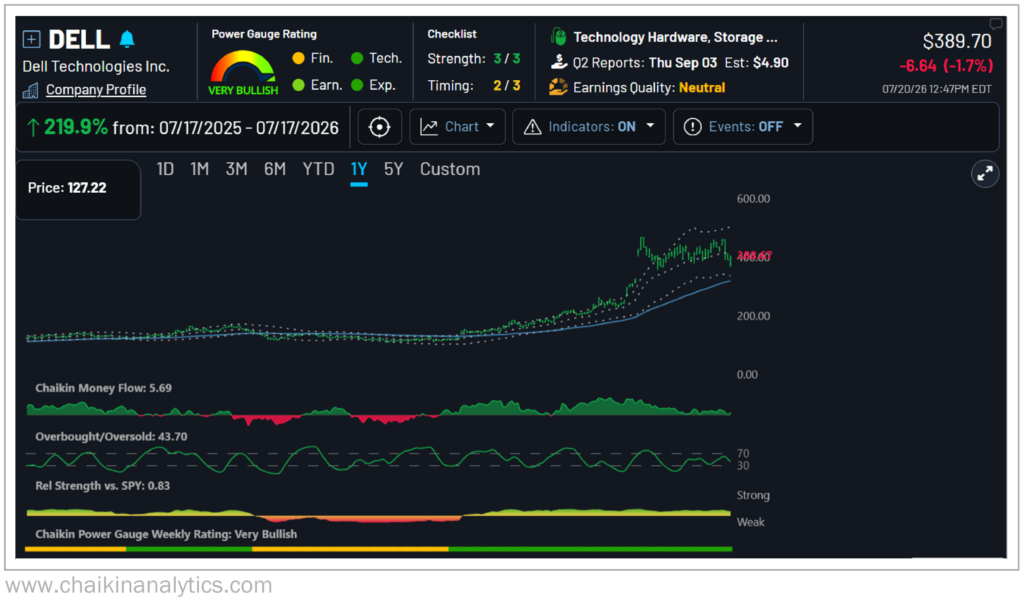
Given its resounding success as an AI-infrastructure player and massive server backlog, it’s difficult to envision Dell not sustaining this momentum.
Is Dell a Good Stock to Buy Right Now?
Dell registered its all-time closing high of $465.96 on June 1. Although it has dipped a bit since, it’s still trading around $400 as of July 21 – a massive jump from just two months ago, when it traded at roughly $243 on May 20.
So, does Dell look like a good investment at around $400? Analysts certainly think so. As of July 20, Dell’s average price target was $505, which suggests there’s still plenty of room for Dell to run. Add in more than 32.24% upside to its average price target based on its July 17 closing price of $381.88.
Dell’s financials back up the bull case. Along with the numbers I previously mentioned, Dell reported a record first-quarter cash flow from operations of $4.1 billion. Its Infrastructure Solutions Group, which includes Dell’s AI businesses, saw revenue increase 181% year over year. And first-quarter fiscal 2027 was the eighth straight quarter of double-digit year-over-year growth within that group.
Even Dell’s Client Solutions Group, which includes consumer and corporate sales of personal computers, printers, monitors, and other devices, reported a 17% year-over-year revenue increase.
More importantly for investors, Dell returned $2.1 billion of capital to its shareholders in the first quarter, including roughly $1.6 billion in share repurchases and $464 million in dividends.
But is Dell a guaranteed success? Of course not. There are always risks. For example, within the past couple of months, Dell stock received downgrades from both UBS (from buy to neutral) and GF Securities (from buy to hold) because of overvaluation concerns.
Analysts also worry that hyperscaler overbuilding could impact future server orders, driven by the recent news that Meta Platforms (META) plans to sell its extra AI compute capacity.
This prompted a brief sell-off, but despite those minor bumps in the road, Dell sees a bright immediate future ahead.
Its fiscal year 2027 guidance includes:
- Roughly $167 billion in revenue, up about 47% over fiscal 2026.
- $17.90 non-GAAP (generally accepted accounting principles) diluted earnings per share (“EPS”), a roughly 74% year-over-year increase.
- Infrastructure Solutions Group revenue growth of roughly 80%.
- Client Solutions Group revenue growth percentage in the low teens.
- Non-GAAP operating income growth of more than 55%.
Longer term, the company anticipates even more prosperity, expecting 7% to 9% revenue growth, more than 15% diluted EPS growth, an 80% target return of adjusted free cash flow to shareholders, and a more than 10% dividend growth rate for fiscal years 2026 through 2030.
That’s the guidance of a very successful and very confident company… one that isn’t resting on its laurels and is anticipating an even stronger future. And that’s something investors can get behind. They might not say it out loud, but they’re probably thinking, “Dude, you’re getting Dell.”
Regards,
David Engle
Editor’s Note: Could a major AI company’s “silent IPO” end up overshadowing both SpaceX and Anthropic?
According to Marc Chaikin — the 60-year Wall street legend who called Nvidia before it shot up 45,000% — a tech firm that been called “the unseen winner of the AI race” could soon break itself up into three separate companies.
If it does, the next Netflix… the next Tesla… and the next Amazon are all poised to spin off just from this one stock. That means, if you simply make one trade today, you could could automatically get your hands on shares of all these potential spinoff IPOs with no more work on your part.
Click to see how you can get in on this “silent IPO” before it’s too late…