
Image Credit: Associated Press
Listen to the audio version of this article (generated by AI).
Key Points
- Starbucks is aiming to reduce the $400 million it spends annually on software and is laying the groundwork for developing in-house AI tools.
- Starbucks currently relies on Microsoft and IBM for inventory management software and maintenance, so this move is a direct threat to software makers.
- The AI story is constantly changing. The companies that can quickly adapt to these changes will be the big winners.
For investors, the potential $725 billion in artificial intelligence (“AI”) spending for this year no longer looks preposterous. Add that figure to the tab of what the biggest hyperscalers have already spent, and we’re talking about trillions of dollars in future spending.
This has become a “must-have” strategy to benefit from the massive AI boom.
If giants like Microsoft (MSFT) and Alphabet (GOOGL) are right, we’ll look back at all the money spent and see how it was obviously the smart bet.
This has investors zeroed in on the big AI investments…
The thought is that any signs of a pullback in hyperscaler spending could be disastrous for the AI story. But that’s not the main thing investors need to pay attention to right now.
At least, that’s not where the signal is for whether the AI trade is working (or not)…
Instead, a tech transformation at America’s largest coffee chain could spark a major shift in the AI story – and it may mean serious trouble for some of the biggest players in enterprise-technology products and services.
Starbucks’ Plan to Break Away From the AI Giants
Starbucks (SBUX) is in the midst of a turnaround. CEO Brian Niccol took over in 2024 and immediately faced several headwinds.
Earnings were falling, certain stores were underperforming, and costs were rising.
That’s why he made a plan to cut $2 billion in annual spending by the end of 2028. A good portion of that cost-cutting will come from lowering headcount, reducing available menu items by 30%, and changing future store models to a smaller footprint.
All of this can help Starbucks return to growth. But a small portion of that $2 billion could do more than just help the coffee maker thrive in the future. Around $400 million will go toward reducing the company’s reliance on Big Tech.
Right now, Starbucks relies on software from Microsoft and IBM (IBM) for inventory management and maintenance.
Microsoft provides the inventory-management software, and IBM handles maintenance. It’s easy money for those companies to collect. And before AI models started popping up, Starbucks likely wouldn’t even consider getting rid of these legacy partnerships.
The cost would be too great to replicate in-house. That was the backbone of the software companies’ value proposition for years: It’s easier and cheaper for you to let someone else do it.
But now, that story is changing…
Starbucks wants to use AI to develop its own inventory-tracking and maintenance system.
The company believes its engineers can do it and has set a target date for the end of next year to complete the initial rollout.
If successful, Starbucks would save up to $400 million. More importantly, though, any large retailer can try to copy its new model.
It would be proof that AI can scale across global businesses to reduce costs, and it could pose a major problem for software giants like Microsoft.
Now, before you go dumping your shares of the AI giants, this won’t be a “wave the wand for success” type of change.
Starbucks’ Previous Attempt to Integrate AI Was a Failure
This isn’t the first time Starbucks has tried to use AI to improve its inventory situation. In September 2025, it implemented an AI program across its North American stores.
The company was using an AI system from NomadGo. It involved lidar sensors, cameras, and augmented reality to count inventory.
Starbucks has been dealing with shortages for years. And the CEO was hoping AI would help solve that issue.
NomadGo claimed 99% accuracy and 8 times the speed of standard inventory counting. But that didn’t work out when put to the test.
According to Reuters, Starbucks canceled the program at more than 11,000 locations in May after the app kept miscounting inventory or mislabeling certain products.
It couldn’t tell the difference between oat milk and regular milk. Employees had to go behind the system and recount inventory. And it would miss some products on the shelf altogether.
NomadGo’s AI program turned out to be a failure for Starbucks. It’s also unclear if its in-house AI system will be able to replace Microsoft and IBM.
What we do know is that Starbucks, like every other major company right now, is focusing on how to best use AI to reduce costs and become more efficient. It’s also worth wondering whether investing in AI will be worth it.
That trend isn’t likely to stop anytime soon.
Microsoft’s 6,000-Member Frontier Army
Consulting firm McKinsey hit a nerve with this megatrend. It released a report in November 2025 stating that roughly 9 out of 10 businesses were using AI in at least one business segment.
Yet, 94% of those companies reported no material benefit from AI spending.
Now, the end of 2025 is essentially a millennium ago in the AI story. Since then, we’ve seen models like Anthropic’s Claude include memory functions. And large language models keep improving.
Nonetheless, if the hyperscalers are going to win, they must solve the puzzle of how to make money for clients. They know it and are doing everything they can to make their and their clients’ investments worthwhile.
That’s why we’re seeing OpenAI, Anthropic, Amazon (AMZN), and now Microsoft enlist tech armies to solve this problem.
Each company is sending teams of engineers to help clients integrate AI faster and more efficiently to improve their businesses.
In June, Amazon announced that it’s spending $1 billion to build a team of thousands of Amazon Web Services (“AWS”) engineers to help its customers deploy agentic-AI solutions. The team operates under the name Forward Deployed Engineering.
Microsoft is also spending $2.5 billion on a 6,000-member army under the Microsoft Frontier Company name. The goal is clear (and obvious)… to demonstrate the value of Microsoft’s services and make money for its clients.
This all leaves us with two important things to watch for in the next 12 to 18 months…
The first is Starbucks achieving complete success with its in-house AI system and eliminating Microsoft and IBM.
In this case, look for AI adoption to bear fruit across the business world. Some major software players will be at risk of losing business.
The second is Microsoft’s army of engineers actually managing to make clients money. The company becomes stickier as businesses recognize the value of its services.
What This Could Mean for Starbucks and Microsoft Investors
For Starbucks, the company’s turnaround plan is working.
It beat earnings estimates in the latest quarter. And it’s climbing out of a period of falling earnings while also raising guidance for 2026.
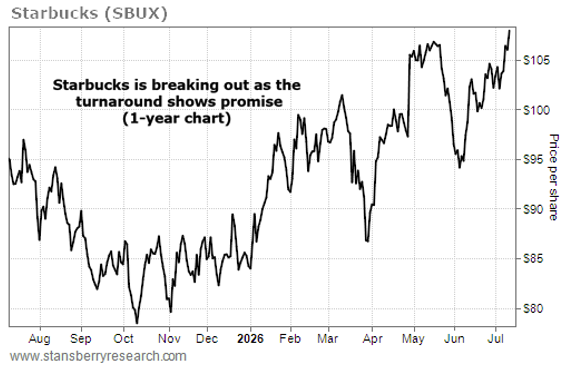
If it can get AI to further reduce costs, this will likely send the stock even higher. Starbucks recently broke out to its highest price in more than a year.
The company also has a “B” grade from our Stansberry Score. This rates a company based on financials, capital efficiency, and valuation. Then it combines those scores to give an overall grade.
Starbucks has an “A” in financials, an “A” in capital efficiency, and a “C” in valuation…
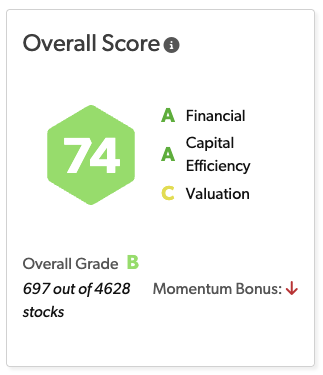
This puts Starbucks in the top 20% of stocks in the Stansberry Score universe.
As for Microsoft, the company is fighting to prove that it can remain dominant even as AI threatens to replace certain software packages.
So far, the future threats remain just that – threats. Microsoft’s business is still strong. The company brought in $73 billion in free cash flow (“FCF”) over the 12 months ending in March.
It also grew revenue 17.9% over that period. And earnings per share climbed 22%.
That’s why it’s no surprise that Microsoft has a similar rating to Starbucks, according to our Stansberry Score.
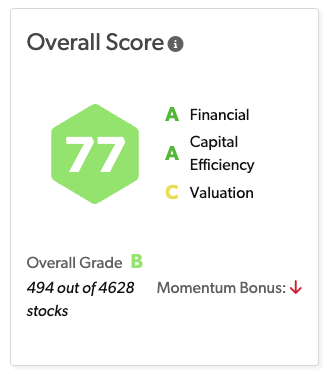
Microsoft has an “A” for financials, an “A” for capital efficiency, and a “C” for valuation. Its overall grade is a “B.”
Put simply, the death of Microsoft is far from written in stone. In fact, it has the money and the elite team to tackle the problems it faces today.
The AI story is constantly changing. The big winners will be the ones who can adapt to these changes quickly.
Starbucks is adapting by using AI to improve its systems at a lower cost. And Microsoft is evolving in order to remain a tech giant for decades to come.
Microsoft even has its own AI services, such as Copilot, Azure AI – a platform for building and managing AI applications – and data centers.
Savvy investors will pay attention to the coming months and years, as they’ll play a pivotal role in deciding where both companies are positioned for the future.
– Chris Igou
Editor’s Note: One company quietly beat Apple, Amazon, and the S&P 500 — combined. Over the long run it has returned more than 8,300%… enough to turn $10,000 into $830,000. Yet most investors have never heard of it. Former fund manager Whitney Tilson says right now it’s trading at a rare discount — and he’s revealing the name and ticker, free of charge. Click here for the details…