Image Credit: Associated Press
Listen to the audio version of this article (generated by AI).
Key Points
- NRG Energy is expanding its power-generation business through new natural-gas plants, the acquisition of LS Power, and smart-home initiatives to meet rising AI-driven electricity demand.
- Texas has become one of the world’s fastest-growing AI infrastructure hubs, with hundreds of proposed data centers driving unprecedented demand for reliable power.
- Despite mixed recent earnings, NRG is well positioned to benefit from the long-term AI buildout as electricity generation becomes a key investment theme.
When it comes to data center and AI infrastructure growth, everything is bigger in Texas.
Thanks to its ample land and abundant natural resources, Texas has suddenly become one of the country’s largest and most important AI infrastructure energy hubs. It may soon become the world’s unofficial data-center capital as well.
That’s why the demand for power sources in Texas has never been greater. And Houston-based NRG Energy (NRG) is capitalizing on that demand. The company has nearly doubled its energy capacity in just this year alone.
The first step was the acquisition of LS Power and its 18 natural gas power plants, which total roughly 13 gigawatts (“GW”) of capacity. That acquisition alone nearly doubled NRG’s fleet.
Then NRG opened its first new power plant in Texas in over a decade. This natural gas plant, located at the TH Wharton Generating Station in Houston, is a 456-megawatt (“MW”) facility that delivers enough energy to power more than 100,000 homes in Texas during peak demand.
NRG also has two new Texas facilities lined up (Cedar Bayou and Greens Bayou) that will add roughly 1.2 GW of capacity in 2028, .
NRG has also partnered with GE Vernova (GEV) to reserve 5.4 GW of natural gas-fired turbines to power data centers across two huge markets. The Electric Reliability Council of Texas (“ERCOT”) serves roughly 27 million customers in Texas while PJM counts roughly 67 million customers across 13 states and Washington, D.C. The first 1.2 GW will come online in 2029, while the remaining 4.2 GW will roll out through 2032..
But just as important to NRG’s resurgence is its dedication to grid efficiency through new, smarter technology.
NRG Energy’s growth and commitment to help power the AI boom in Texas have produced mixed results thus far. But the company has momentum and is positioning itself to be a big winner in Texas’ AI build-out.
The AI Boom Has Arrived in Texas
In the first quarter of 2026 alone, nearly 200 proposed data centers and other large energy users requested connections to Texas’ power grid. Those requests totaled 438 gigawatts (“GW”) of power.
That number is more than five times the amount of power used by the entire state during its August 2023 record-breaking energy demand. And it’s roughly one-third of all the power generated in the U.S.
According to the Texas Tribune, around 90% of that power would be used for data centers, most of which are hoping to operate by 2030.
Why the sudden desire to connect to Texas’ power grid?
For one, there’s a ton of open, rural land in Texas. And it’s cheap. This is exactly the type of land developers salivate over when determining where to build large data center campuses and AI factories.
Second, Texas’ power market is deregulated, meaning developers can come into the state, build their facilities, and quickly connect their own power generation. Wind, solar power, and natural gas are abundant in the western and northern parts of the state. In fact, Texas is the country’s largest producer of natural gas. This gives developers ample access to the energy they need to power their facilities.
Texas already boasts several thousand miles of fiber-optic lines, giving it the infrastructure tech companies – and data centers – need to operate.
Finally, Texas is a notably business-friendly state and offers attractive tax breaks and incentive packages to back up that reputation.
Tesla (TSLA), SpaceX (SPCX), Microsoft (MSFT), Samsung, Meta Platforms (META), Amazon (AMZN), and Alphabet (GOOGL) are just some of the major tech players benefiting from Texan hospitality and setting up shop in the state.
Right now, Texas is the fastest-growing data center market in the country, with the potential to surpass Virginia as the data-center capital of the world by 2030. By the end of last year, Texas was right on Virginia’s heels.

The Electric Reliability Council of Texas, which manages electricity flow to more than 25 million Texan customers and represents roughly 90% of the state’s electric power load, stated in April that energy demand in the state could hit roughly 368 GW by 2032. That’s enough to power more than 73 million homes during peak season.
But one question remains: Does Texas have enough energy capacity to support all these data centers, as well as those scheduled to be built during this AI boom?
NRG Energy Is Seizing New Energy Opportunities in Texas
Just as important to NRG’s resurgence as its new power-plant and capacity acquisitions is its dedication to grid efficiency through virtual power plants (“VPPs”) for both residential and commercial customers.
According to NRG, VPPs “turn homes into energy resources by intelligently managing and connecting smart thermostats, batteries, and other devices. These networks help reduce energy costs, ease grid strain, and support a cleaner, more reliable energy future without sacrificing comfort or control.”
In other words, participation in a VPP can help create a more stable grid, prevent power outages, and save energy and money.
For businesses, the aim is the same. By reducing electricity usage during periods of high demand, businesses can earn financial incentives from NRG, ease grid pressure, and improve sustainability.
The LS Power acquisition – specifically its CPower demand-response platform for commercial and industrial (C&I) customers – has played a significant role here. With the purchase of LS Power came its 6 GW of capacity from more than 2,000 C&I customers.
NRG, partnering with Renew Home and Google Cloud, aims to create a 1 GW VPP by 2035. NRG is well on its way to achieving that goal. Last year, the company hoped to secure 20 MW of VPP power. It hit 200 MW instead, evidence that the VPP plan has been a major success so far.
The timing of all these initiatives is important because with hundreds of data centers potentially on the horizon, Texas will need all the power it can get. Especially during the brutally hot Texas summers.
But if the state plans to accommodate anywhere near the 582 operating and planned data centers across Texas, it’s going to need much more than a few new power plants. Even the VPPs won’t be enough.
The state’s AI boom is going to need some Texas-sized reinforcements – as in 30 nuclear power plants’ worth of electricity by 2030, according to ERCOT – to accommodate the data-center expansion.
ERCOT, however, isn’t quite sold on the high-end projections of data center expansion in Texas, which ERCOT says totals 175 GW worth of capacity. Rather, the council is forecasting a number closer to 24 GW of data-center power capacity by 2031. That’s far short of 175 GW, but it’s still enough to power an area the size of Houston and its suburbs.
To spur that growth, Governor Greg Abbott introduced the Texas Energy Fund Loan Program (“TxEF”), which provides low-interest grants and loans to power generators as an incentive to build power plants across the state.
NRG is taking advantage of the TxEF program, having secured more than $1 billion in state loans to develop 1.5 GW or more of new natural gas generation in the ERCOT market by 2028.
Analysts and investors have taken notice.
Despite Mixed First-Quarter Results, NRG Energy Has Momentum on Its Side
It has been an up-and-down year for NRG to this point. There were some clear highlights, such as the opening of the new Houston power plant in late May, the 13 GW (roughly $12 billion) acquisition of LS Power in late January, the appointment of new CEO Robert Gaudette in April, and the continued success of the VPP plan.
On the other hand, NRG’s first-quarter financials, reported in early May, were a disappointment.
Comparing the year-over-year results:
- Adjusted net income was down $223 million.
- Adjusted EBITDA (earnings before interest, taxes, depreciation, and amortization) dropped by $46 million.
- Adjusted earnings per share (“EPS”) plunged from $2.68 to $1.49.
- GAAP (generally accepted accounting principles) net income nosedived by $625 million.
- Free cash flow before growth investments plummeted from $293 million to negative $66 million.
The company attributed the missed analyst expectations to an unusually mild Texas winter and market volatility. It’s also worth noting that the company’s interest expenses grew from $163 million to $285 million year over year. Much of that was related to the LS Power acquisition. And NRG’s operating expenses skyrocketed by more than 33%.
But the news certainly wasn’t all bad. NRG’s $10.26 billion in revenue was a 19.5% year-over-year increase. More importantly for investors, NRG brass maintained its full-year guidance, as the company expects to continue its growth through the partnerships and initiatives we covered.
Plus, NRG continues to reward its investors. It’s aiming for $1 billion in capital returns this year through stock buybacks and another $407 million paid through dividends.
NRG Energy’s Recent Stock Performance and Outlook
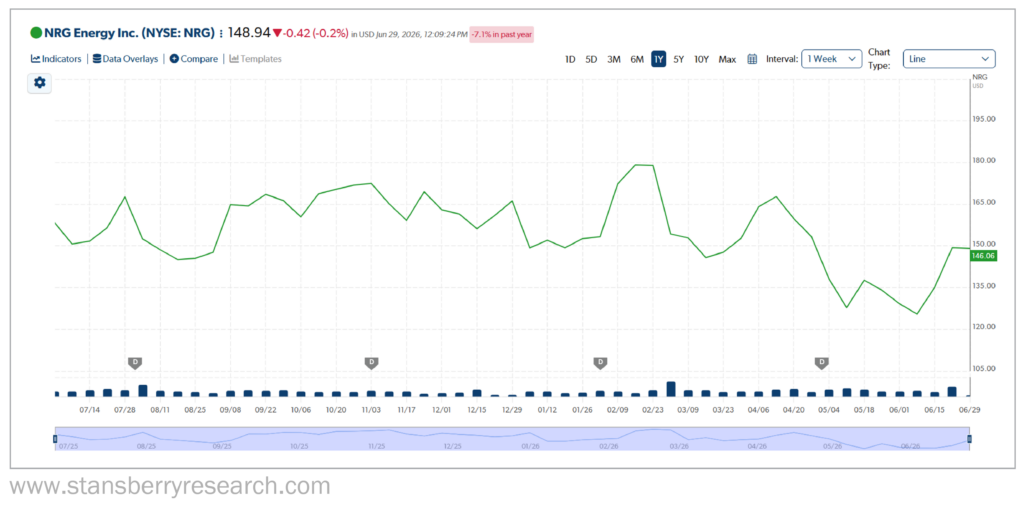
Despite being considered something of a darling on Wall Street for its approach to data-center expansion, NRG Energy’s stock has been on a bit of a roller coaster ride.
Based on its June 30 closing prices from 2025 and this year, NRG is down around 9% over that time.
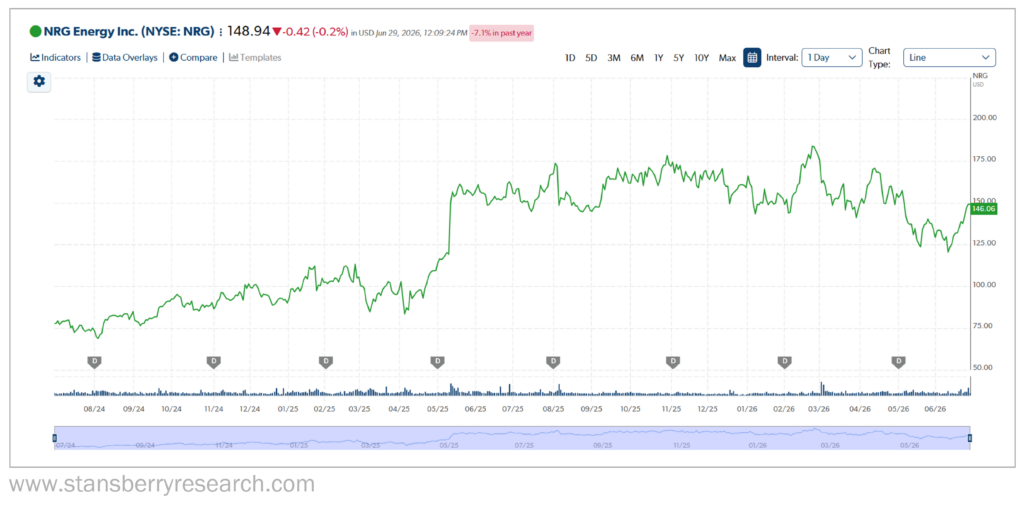
But over a two-year span, NRG rose by an impressive 87.6%.
NRG Energy’s Stansberry Score, a tool that helps determine the quality and long-term value of thousands of stocks, presents more of a bear case. The stock grades out as middle-of-the-road in both the Financial and Capital Efficiency categories (“C”), while NRG’s Valuation grades poorly (“D”).
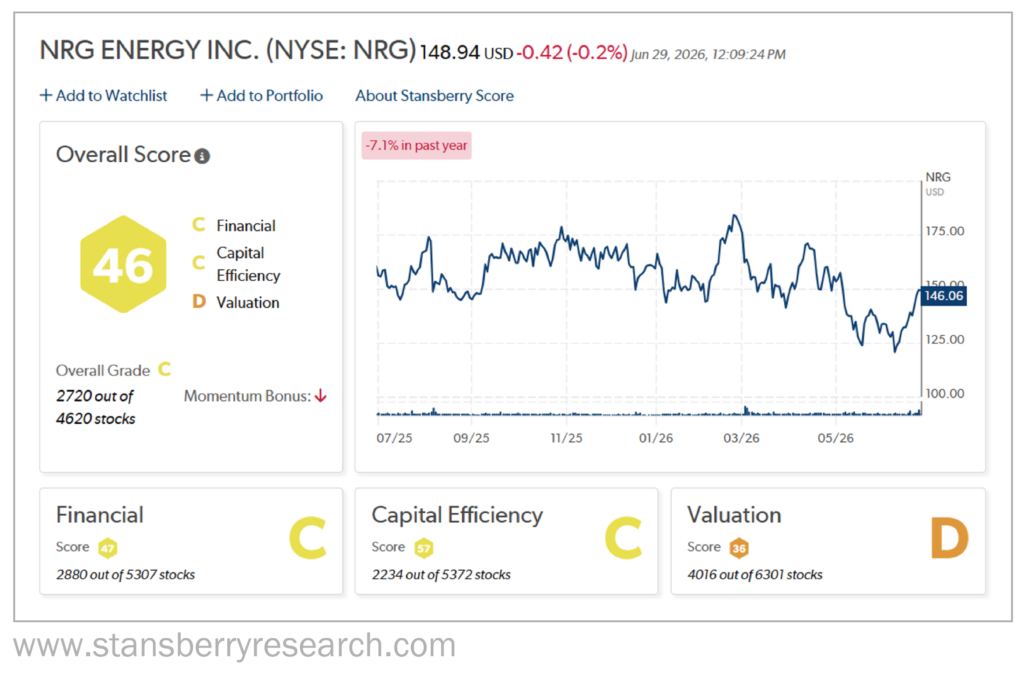
This isn’t the consensus by any means, however. In fact, there’s some sentiment that NRG may be undervalued relative to its fair value and average price target, suggesting that its earnings potential hasn’t yet been reflected in its price.
Of course, this is all relative and dependent upon which metrics you prefer. Some analysts see NRG as having a fair value of roughly $200. Using those numbers, NRG is trading around 27% below its target value and offers 36% potential upside.
That supports the argument that NRG is a solid bargain at its current price.
If you’re on the fence, keep in mind that NRG is a fairly volatile stock. As of June 30, its average five-year beta was 1.22 times, indicating it has been roughly 22% more volatile than the broader market. Considering the average five-year beta for the utilities sector is 0.59 times, NRG is a somewhat riskier bet.
But NRG also offers plenty of upside given the AI data-center explosion in Texas, which may well continue for at least the next decade.
The bottom line is that AI isn’t likely to slow down anytime soon, and NRG is right in the middle of the country’s biggest data-center boom. If Texas becomes the world’s data-center capital by the end of the decade, as many are predicting, NRG and its investors will be in a prime position to benefit.
Regards,
David Engle
Editor’s Note: A highly secure site in West Texas now houses an emerging potential $10 trillion technology backed by Elon Musk and Sam Altman. This breakthrough could completely replace our need for foreign oil – and send one small group of stocks soaring in the process. Click here to learn how you can invest in Elon’s next $10 trillion move.