

Image Credit: AI-generated illustration for editorial purposes.
AI data centers have an insatiable thirst for energy and power.
PJM Interconnection is a regional transmission organization that manages the flow of wholesale electricity across a large part of the eastern U.S. Its 2025 Long-Term Load forecast projected 32 gigawatts (“GW”) of growth. But entering 2026, PJM’s aggregated requests have more than doubled the previous 2025 forecast to 70 GW in the next 15 years.
That’s roughly equal to adding the power used each year by Texas or California.
According to Deloitte analysis, the power demand from AI data centers alone could increase more than 30 times in the U.S., going from 4 GW in 2024 to 123 GW by 2035. That’s enough to electrify nearly every household on the East Coast, or 100 million homes.
The report noted that AI only accounted for 12% of the 33 GW U.S. data-center power demand in 2024… a figure set to grow to 70% in 10 years.
Globally, the amount of electricity consumed by data centers is estimated to rise from around 2% to between 11% and 15% by 2030.
Existing power grids weren’t designed to handle that type of energy demand. These grids were built to support the predictable, consistent electricity demand from homes and businesses.
Data centers require energy well beyond that capacity.
AI data centers consume as much electricity as tens of thousands of homes. And that energy usage often spikes suddenly, going from idle to full throttle in just seconds. Plus, data centers operate 24/7.
Today, America simply does not generate enough power to meet the expected demand of data centers. As the country’s energy leaders work to solve this challenge, one thing is clear… natural gas will be the energy source that helps fuel the AI boom, at least in the near term.
In fact, the U.S. is the largest net producer of dry natural gas (meaning it has been processed and purified). A 2024 North American Energy Inventory report revealed that the U.S. has more than 4 quadrillion cubic feet of recoverable natural gas.
To put that number into perspective, it’s enough natural gas to fuel more than 100 million homes for more than a century, depending on electricity generation and household usage.
And that amount of natural gas is already supported by a vast pipeline network spanning more than 3 million miles.
Of course, it’s not all roses and sunshine…
Four Bottlenecks Across the Natural Gas Industry
While the U.S. has an existing infrastructure for natural gas power, there are a few bottlenecks. These include…
Grid interconnection delays: Before any new power plant can provide electricity, regional grid operators require an interconnection study to confirm safety and reliability. This job falls to companies like PJM Interconnection, but it takes them between three and five years to complete these analyses.
Currently, the backlog is so significant that several projects entering the interconnection queue are unlikely to be connected before 2030.
Gas pipeline capacity: Again, the gas infrastructure exists… but it was not designed to handle the demand AI data centers and power sources require, especially in highly populated regions and areas where data centers are being built.
The infrastructure is already strained, and the only solution to this bottleneck is the construction of new pipelines… a very lengthy process.
Supply-chain limits: Increased demand for natural gas power is positive news for equipment manufacturers and suppliers. The only problem is that these businesses can’t keep up with the volume of new orders.
GE Vernova (GEV), for example, announced it has effectively sold out its gas turbine production slots through 2029, leaving latecomers scrambling. Mitsubishi and Siemens Energy are looking at multiyear backlogs with delivery dates stretching into 2028.
Unfortunately, new natural gas power plants require these turbines – as well as transformers, also backlogged – and they can’t be built until they have these critical components.
Any new orders placed now are likely looking at a delivery date of 2030… if not later.
Geographic concentration: Only a few regions in the U.S. hold nearly half of the country’s data-center capacity. By 2030, just nine states will host 70% of that capacity. Virginia and Texas alone project to represent 34% of the country’s data-center capacity in 2030. This concentration puts a major strain on local infrastructure.
These bottlenecks present opportunities in infrastructure expansion. And investors should monitor these potential solutions closely, because they create substantial revenue streams for the companies that participate in this expansion.
Let’s look at some of these solutions…
Fueling the Off-Grid/Behind-the-Meter Shift
Rather than wait in a yearslong grid interconnection queue, many tech companies are partnering with utilities to build off-grid, natural gas-powered facilities directly on data-center sites, as well as behind-the-meter (“BTM”) systems that are physically connected to the grid but mainly serve onsite loads.
Examples include:
- GE Vernova, Chevron (CVX), and Engine No. 1 are collaborating to build off-grid natural gas power plants co-located with AI data centers. The initiative is expected to deliver up to 4 GW of reliable, affordable energy, with initial service projected by the end of 2027.
- Oracle (ORCL) and Project Stargate will build and operate large-scale data centers to support OpenAI’s next-generation models. This includes a multibillion-dollar agreement to develop 4.5 GW of AI data-center capacity, powered by a dedicated onsite natural gas facility in Abilene, Texas.
Oracle isn’t stopping at its massive Texas site either. In early January 2026, reports confirmed the Stargate project is expanding to Saline Township, Michigan, with a 1.4 GW hyperscale facility that will consume as much power as a major city.
- CloudBurst Data Centers and natural gas producer Energy Transfer (ET) signed an agreement for a 1.2 GW off-grid power supply involving a newly constructed, dedicated lateral pipeline directly to its data center.
- Nvidia (NVDA)-backed Poolside is partnering with CoreWeave (CRWV) to build a 2 GW AI campus called Horizon in the Permian Basin. The facility will generate its own electricity onsite using natural gas, completely bypassing the Texas grid.
- And Brookfield Asset Management (BAM) is investing up to $5 billion to deploy Bloom Energy’s (BE) natural gas fuel cell technology for its AI data centers globally. This will provide reliable onsite power that avoids delays from legacy grids.
Behind-the-meter natural gas facilities, while physically connected to the grid, are designed to serve onsite power requirements while bypassing the grid itself. This reduces reliance on the grid and allows data centers to still control their power supply onsite.
Some examples include:
- Elon Musk’s xAI facility installed natural gas turbines on site to power one of the world’s largest AI data centers in Memphis, TN. The system was deployed in just 122 days.
- AI data centers in the Phoenix, Arizona area are installing more natural gas turbines on site to meet rising demand.
But building onsite power plants and behind-the-meter systems is only half the equation – fuel delivery is the other. That’s where natural gas pipelines come in.
Pipelines as Enablers
Natural gas pipelines are emerging as a critical enabler of decentralized power generation for AI infrastructure. By delivering fuel directly to onsite power facilities – whether entirely off-grid or behind-the-meter – pipelines allow data centers to bypass grid congestion and bring power online in months instead of years.
Midstream operators are expanding capacity by building lateral pipelines off main lines to serve AI data centers directly. This setup allows development on cheaper, more remote land, far from traditional power corridors.
Developers are increasingly partnering with upstream gas producers, especially in states with strong infrastructure, lower costs, and fewer permitting hurdles.
Key states leading this trend include Texas – the nation’s leading gas producer, anchored by the Permian Basin, the most active natural gas hub in the country – New Mexico, Utah, Colorado, Louisiana, and parts of the Midwest.
Texas has emerged as a top off-grid AI hub by offering abundant gas, land availability, and favorable tax policies – including no state income tax, property tax incentives for energy and tech investments, and local economic development grants and abatements.
Clearly, the opportunities to invest profitably in the use of natural gas – and its infrastructure expansion – are promising. So, here’s how to play this…
Five Natural Gas Stocks Powering the AI Boom
1. The Williams Companies, Inc. (WMB)
Williams is a pipeline giant that leverages its massive infrastructure to deliver natural gas power directly to data centers.
The company’s pipelines are strategically located in regions of the U.S. where AI data centers are increasingly being developed.
Because many of WMB’s data-center projects involve adding capacity along established pipelines, significantly less restrictive permitting is necessary. This expedites project timelines.
What might be most exciting about the future of WMB, however, is that the company is evolving from a traditional midstream operator to a power provider for data centers. This evolution involves WMB leveraging its natural gas pipeline network to construct on-site power plants for data centers, a powerful growth driver.
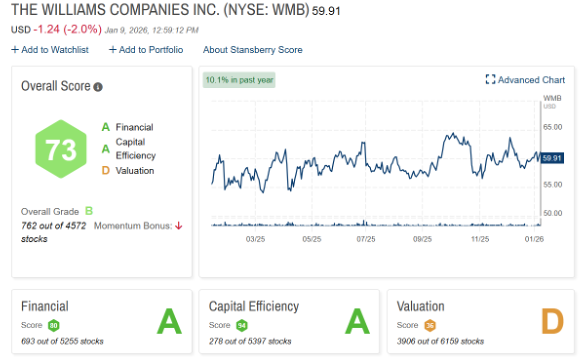
Our proprietary Stansberry Score rates WMB stock with a solid B grade. It gets an A in financials and capital efficiency thanks to its $70 billion-plus market cap and consistent revenue growth… though earnings have declined recently.
That may raise a red flag among investors. But its strong financials and the growing demand for the company’s services help to alleviate those concerns.
2. Kinder Morgan (KMI)
Kinder Morgan has long been known as a conservative stock… one that investors turned to for stability and moderate growth. That was the Kinder Morgan of old…
Today, Kinder Morgan is all-in on AI demand. The company is currently constructing the Trident Intrastate Pipeline, a huge $1.7 billion gas line in Texas specifically designed to transport large volumes of gas for liquefied natural gas export terminals and data centers.
Where Kinder Morgan has an advantage is its direct exposure to AI demand. The company already has the infrastructure… they simply need to flow more gas through its pipelines as well as the new Trident line upon completion.
This means that Kinder Morgan is basically a toll collector. Every time a data center uses power, KMI charges for the use of its pipeline infrastructure… much like toll road operators charge for vehicles to use their roads.
What Kinder Morgan is capitalizing on is that some of the major energy bottlenecks are not only caused by limited power grid capacity, but also pipelines that supply the gas that provides the energy to power AI data centers.
Kinder Morgan already moves 40% of all U.S. gas, making it the largest natural gas transmission network in North America. With that in place, they’re often where data centers turn to for fast connections to fuel supplies.
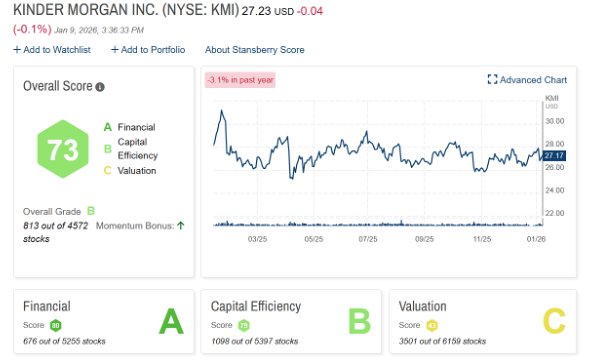
And it’s paying off. Entering 2026, Kinder Morgan’s project backlog is more than $10 billion. And 93% of the backlog is related to natural gas. Our Stansberry Score gives KMI a strong B grade overall, driven by a 2026 EBITDA guidance hike to $8.7 billion and a 4.31% dividend yield.
3. EQT (EQT)
The next stock to consider is EQT, the country’s leading natural gas producer.
Toby Rice, EQT’s CEO, has spearheaded a strategic campaign that emphasizes natural gas as the most reliable, scalable, and affordable power source to fuel the coming AI revolution, noting that natural gas will “take the lion’s share” of this demand for power, especially in the short term.
A prime example: In July, EQT announced a partnership to be the exclusive natural gas supplier of a new 4.4 GW power facility at the Homer City Energy Campus in Indiana County, Pennsylvania.
The company acquired Equitrans Midstream with expansion in mind.
EQT also bought data-center provider EdgeConneX, a significant player in hyperscale data-center solutions, illustrating the company’s commitment to the sector.
With control of the Mountain Valley Pipeline, a 303-mile natural gas pipeline that runs from West Virginia to Virginia, EQT is likely to seize the opportunity to satisfy growing energy demand in the Southeastern U.S.
Its operation in the Appalachian Basin focuses on the natural gas-rich Marcellus and Utica shale formations across Pennsylvania, West Virginia, and Ohio, taking full advantage of the region’s approximately 26 trillion cubic feet of natural gas resources.
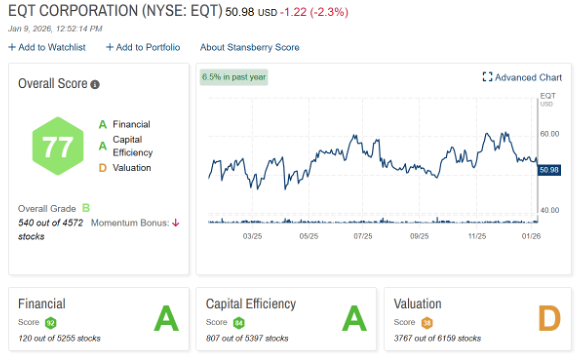
There is plenty to love about EQT stock. Our Stansberry Score agrees, rating it a very strong overall B with Momentum Bonus.
EQT is undervalued, making it a smart buy during the early stages of the AI boom.
4. Baker Hughes (BKR)
Next is Baker Hughes, the equipment maker traditionally known for designing and building innovative oil and gas products. Baker Hughes has evolved into a full-service energy technology company, which bodes well for the company in the age of AI.
It already plays a significant role by providing crucial power and cooling infrastructure to data centers. Its NovaLT gas turbines deliver efficient onsite, off-grid power for data centers. And strategic partnerships have helped expand its supply chain for American data centers.
BKR consistently performs and generates significant free cash flow, which leads to reliable dividend payouts (39 consecutive years) to shareholders.
During the first two quarters of 2025, Baker Hughes reported increased revenue, and its first quarter earnings before taxes, interest, depreciation, and amortization outperformed Wall Street expectations by 2%.
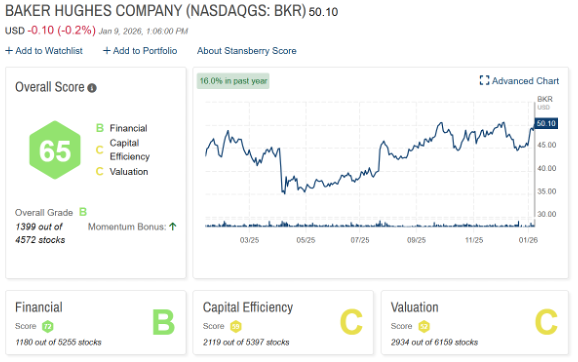
With solid financials and above-average capital efficiency, our Stansberry Score rates BKR with a B grade.
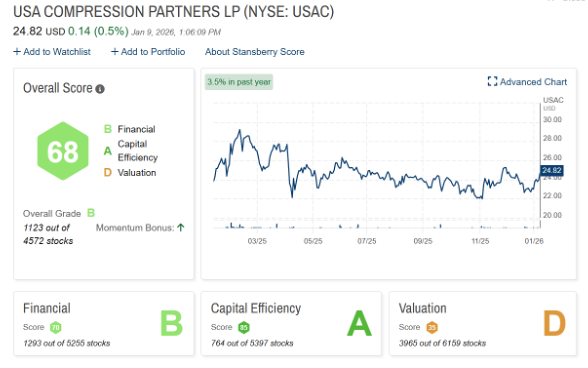
5. USA Compression (USAC)
Finally, USA Compression (USAC) is a stock that should benefit from the AI data-center energy boom.
The Dallas-based company provides both the gas compression services and equipment necessary to maintain the right pressure of the natural gas, so it flows smoothly through the pipelines.
USAC’s use of dual-drive technology – a hybrid system that powers a natural gas compressor with either an electric motor or a natural gas engine – is unique in the industry. And it offers a variety of benefits – including decreased operating costs, continuous service, and reduced emissions – that help USAC stand apart from its competitors.
The company’s role is a pivotal one as it ensures proper natural gas delivery to the power plants that supply electricity to data centers.
Naturally, as the demand for AI data-center energy grows, so does USAC’s business.
USAC already has a solid history of offering attractive dividend yields, making it a reliable bet for income-focused investors.
Its Stansberry Score, a solid B, reflects USA Compression’s steady growth and consistent performance.
A Warning for Investors…
Like any industry, natural gas presents investors with some risk.
Beyond the interconnection issues and permitting delays I mentioned earlier, there’s also gas-price volatility to be aware of and regulatory risks related to the Environmental Protection Agency.
When investing in the natural gas space as the AI boom lifts it to new heights, be sure to diversify adequately and don’t invest more than you can afford to lose.
Bottom Line: How to Approach Natural Gas Investing in the AI Boom
For investors, getting in now on those businesses is a solid bet with marginal risk.
AI data centers are not going anywhere… they’re just getting started.
As unfold throughout the country, the demand for natural gas, pipelines, gas turbines, electricity-grid interconnections, and utility providers will increase.
Now is the time to invest in natural gas-related stocks… the yields may not always be high, but the growth forecast looks solid and stable.
Regards,
David Engle
Learn more in Whitney Tilson’s special Amazon Helios briefing — where he reveals:
- How Amazon’s “Helios” initiative is set to ignite a historic energy boom, fueling one of the biggest new sources of power demand in U.S. history.
- How and why AI data centers require massive amounts of power, and how that need can benefit investors.
- And the name and ticker of a single natural gas stock he believes is perfectly positioned to soar as Amazon’s Helios project takes shape.
Whitney believes this could rival investing in natural gas before the fracking boom – a once-in-a-generation setup for investors who act early.