Image Credit: Associated Press
Key Points
- The U.S. blockade of the Strait of Hormuz, where ~20% of global oil flows, has driven oil prices above $100/barrel and caused extreme spikes in shipping costs and market volatility.
- Energy stocks, fertilizer companies, and tokenized commodities are benefiting, but the situation is unstable, and prices could drop quickly if the geopolitical situation resolves.
- Reduced oil supply and rising prices may increase inflation and cut global GDP growth, leaving central banks with no clear policy response.
- Outcomes range from rapid de-escalation (lower oil prices) to military conflict (much higher prices), meaning investors must focus on risk management rather than making one-sided bets.
President Donald Trump announced a U.S. naval blockade of the Strait of Hormuz last Sunday.
It’s a strategic move… one which Trump hopes will finally force Iran to back down. The strait is one of the most critical choke points, with roughly 20% of the world’s oil passing through the channel.
But the U.S. naval blockade of Iranian ports is not a geopolitical abstraction. Blockades have been used throughout history to end conflicts and accelerate negotiations.
This blockade, though, is a live experiment in how far a great power will go to get what it wants.
And markets are already reeling… with the price of oil above $100 a barrel and supertanker rates at all-time highs.
The next move in this situation is not obvious. Even the U.S. Federal Reserve has no idea what to do.
What is obvious is that, as an investor, getting this oil crisis wrong could cost you…
The Strait of Hormuz Blockade Is Already Breaking Oil Markets
West Texas Intermediate (“WTI”) crude – the U.S. oil benchmark – surged roughly 8% to $104 a barrel the morning the blockade was announced. Brent crude – the international benchmark – crossed $102 per barrel, up roughly 7%.
And these aren’t spikes from “normal” prices. Brent is up 40% since the Iran war began, while WTI is up more than 50%.
Daniel Yergin, vice chairman of S&P Global, put it plainly…
This is a historic disruption to world oil. There has never been anything of this scale. Even the oil crises of the 1970s, the Iran-Iraq war of the 1980s, Iraq’s invasion of Kuwait in 1990 – none of those come close to the magnitude of this disruption.
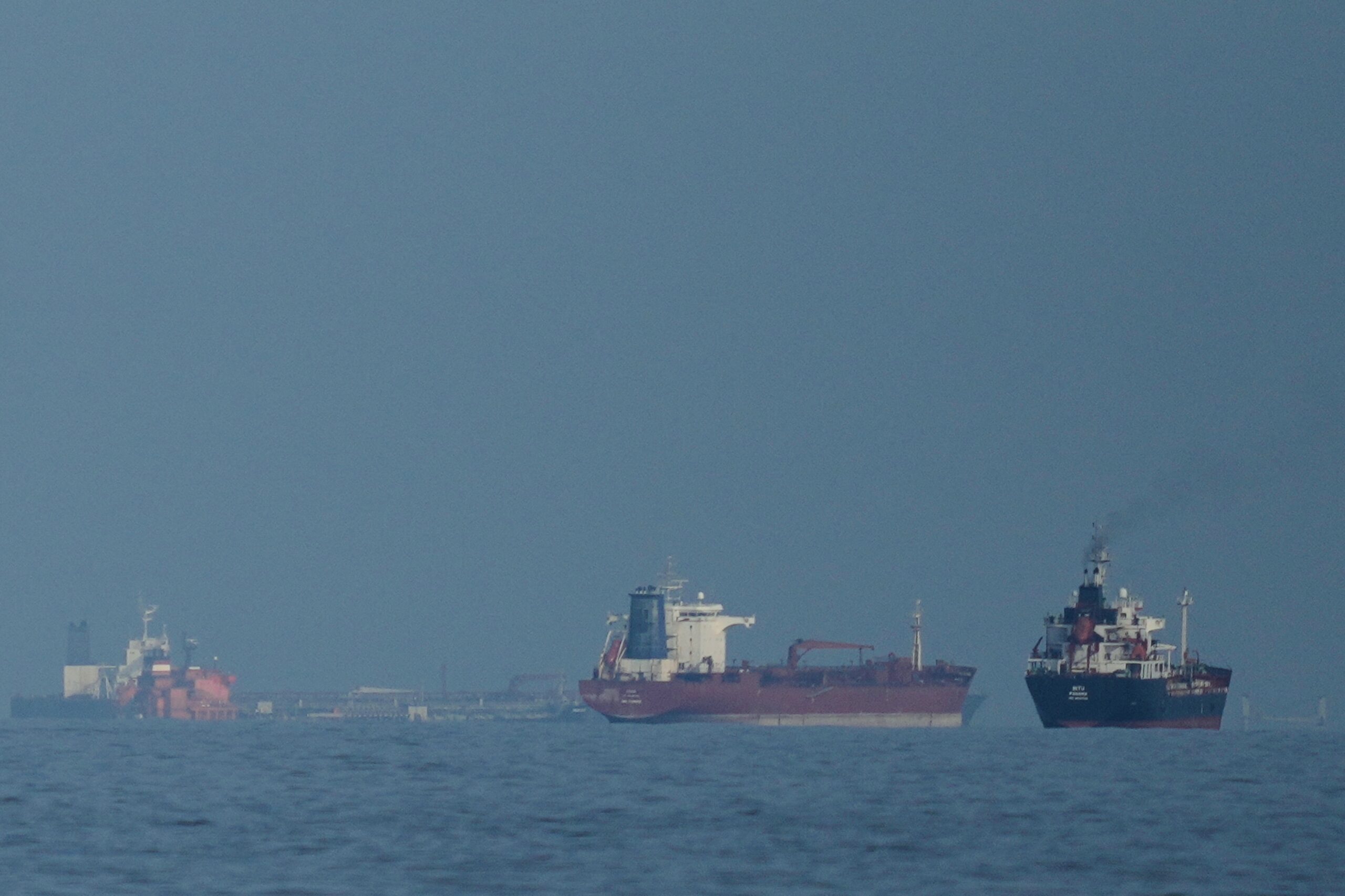
About 1,100 vessels, representing roughly $30 billion in cargo value, are stranded inside the Persian Gulf.
The shipping market is already priced for catastrophe. The rate for supertankers carrying oil from the Middle East to China hit $423,736 per day on Monday. That’s up more than 90% from Friday.
Meanwhile, South Korea’s Sinokor – a major shipping and logistics company – is now charging roughly $20 per barrel to move oil from the region to China. A year ago, it would have cost just $2.50.
Here’s what all this means for investors…
How the Hormuz Blockade Is Rewiring Oil Markets (and Your Portfolio)
The obvious trade is long energy.
Oil giants Shell (SHELL) and BP (BP) both jumped about 5% in pre-market trading on the announcement.
Fertilizer, which is produced using natural gas, is also getting a boost. Fertilizer producers CF Industries (CF) and Nutrien (NTR) are up 40% and 20%, respectively, since January, as Middle Eastern fertilizer is now locked out of global markets.
And tokenized commodities (i.e., blockchain tokens that represent real-world commodities) are already seeing inflows from institutional allocators who want exposure to rising prices without the risk of a tanker in a conflict zone.
But here’s where it gets tricky: A blockade that actually works economically – either American or Iranian – might kill the very prices that make energy stocks attractive.
For instance, China buys the majority of Iran’s exported oil. If Iran’s economy collapses fast enough, China has every incentive to lobby Iran to stand down. In this case, an Iranian economic collapse could mean the strait closure ends sooner rather than later, and Brent falls instead of rises.
That means the current $20 to $30 of geopolitical oil premiums could evaporate overnight… and every consumer-facing stock that has been hammered by $4-a-gallon gas may rally hard.
This is a genuine two-way trade. That’s why investors need to think clearly instead of reactively. Don’t let yourself believe there’s only one side to this story.
Could the Crisis in the Strait of Hormuz Cause a Global Recession?
Yes, and the math isn’t subtle.
A Federal Reserve Bank of Dallas simulation found that a nine-month disruption removing roughly 20% of global oil supply would lower global real GDP growth by an annualized 2.9 percentage points in the second quarter alone.
Meanwhile, the International Monetary Fund estimates every 10% increase in oil prices raises global inflation by 40 basis points while cutting output by 0.1% to 0.2%.
But we all know oil prices could rise much more than 10%.
The Federal Reserve has no good options here. The benchmark interest rate sits at 3.5% to 3.75%, headline inflation is tracking toward 4%, and rate cuts are off the table until at least mid-2027.
Chicago Fed President Austan Goolsbee described it as “a stagflationary-direction shock that is making employment worse, while at the same time making inflation worse.” He continued, “That’s the most uncomfortable thing for a central bank to have to face, because there’s no obvious playbook.”
The central bank can’t cut into $100 oil. And it can’t hike rates in a slowing economy.
It’s stuck.
Wall Street analysts are running scenarios of oil at $200 a barrel. At $170, the stagflationary shock roughly doubles in severity. That’s the tail risk nobody wants to say out loud.
The Flashpoint Nobody Is Pricing Correctly
Here’s what oil prices don’t fully capture yet…
The blockade is legally contested. International law experts say the U.S. has no authority to suspend transit passage through an international strait. Britain and France have already refused to participate. Britain’s prime minister said publicly his focus is keeping the waterway open, not closing it.
So what happens when a Chinese tanker tests the blockade? The U.S. Navy either stops it… or it doesn’t.
If it stops it, you have a direct confrontation with Beijing over energy access. If it lets it through, the blockade is meaningless.
Neither option is good.
U.S. Navy officials previously described the strait as an Iranian “kill box” loaded with anti-ship missiles, drones, fast-attack boats, and mines. A single incident involving a civilian vessel under a major flag could spook stock investors and wipe out trillions of dollars in market value.
India adds another layer. Its flagship Chabahar port project in Iran, the Shahid Beheshti terminal, has operated under a U.S. sanctions waiver that expires April 26. That means its most important regional infrastructure investment sits inside an active blockade zone, and the waiver clock is running.
If the blockade stands and the waiver expires… do America and India find themselves as adversaries?
If America carves out an exception for India to continue business as usual from their Iranian port… will our blockade have any teeth?
And imagine the black swan situation where the negotiations to extend the waiver fail and India opts to run the blockade?
Is your portfolio prepared for this possibility?
How to Position for the Hormuz Oil Crisis Now
The energy trade has legs as long as the strait stays closed. Non-Middle Eastern oil producers, fertilizer companies locked out of competing imports, and upstream oil are the direct beneficiaries.
But position size matters more than direction right now. Oil could run from $75 on a fast diplomatic resolution to $200 on a military escalation. That’s not a spread you size aggressively in either direction.
The blockade is a risk-management problem dressed up as a trading opportunity… And the market is still in the early stages of figuring that out.
So watch whether allied ships attempt to run – or respect – the blockade. That’s the signal everything hinges on.
Good investing,
Eric Wade
Editor’s Note: One group of Americans is quietly building extraordinary wealth right now, while another is falling further behind with every passing month. Whitney Tilson — the hedge fund legend CNBC called “The Prophet” — says we’ve hit the “Ripping Point,” and the split is accelerating fast. He’s sharing what he believes everyone needs to do immediately (including two free stock picks) in this urgent free presentation.