Image Credit: Associated Press
Key Points
- Record U.S. exports of crude oil, gasoline, diesel, and liquefied natural gas have surged as Iran-war-related supply disruptions boost global demand for American energy.
- ExxonMobil, Chevron, and other major energy producers are benefiting from higher oil prices and export demand, while U.S. consumers face sharply higher fuel costs.
- Strong exports are lifting energy-company profits and government revenues, but limited domestic supply growth and opposition to export restrictions could keep gasoline and diesel prices elevated.
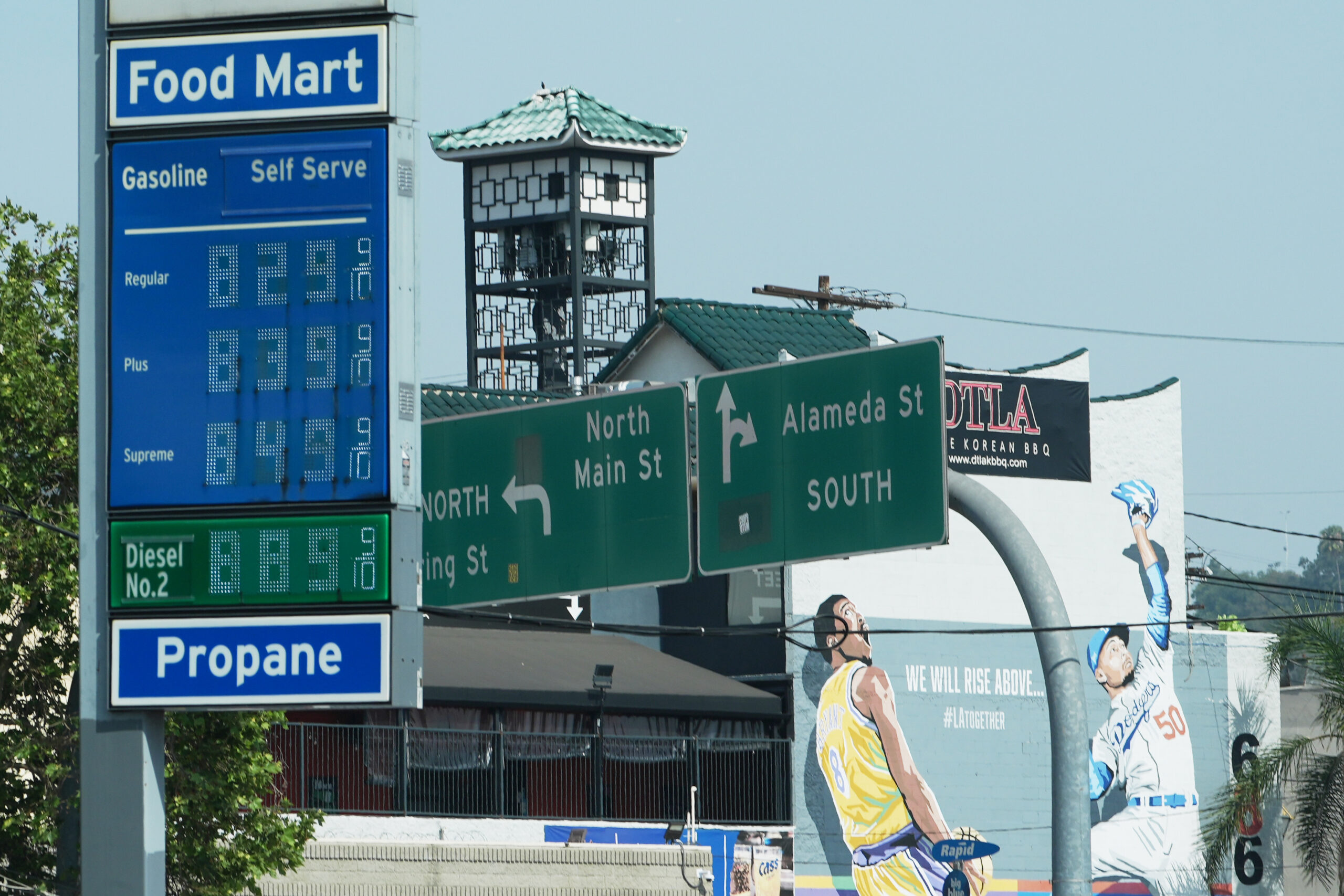
As the war in Iran continues into its third month, oil and gas prices remain high in the U.S. On May 19, the country’s average per-gallon price of regular gasoline sat at $4.53. That’s nearly 50 cents higher than the previous month and $1.35 more per gallon than this time last year.
Diesel is even worse. Its $5.65-per-gallon average price on May 19 was about $2.10 higher than last year’s price.
The bright side? American energy exports have soared to record levels thanks to the global oil and petroleum supply disruptions caused by the closure of the Strait of Hormuz in the Persian Gulf.
The Wall Street Journal reported that crude oil and petroleum exports hit a record of roughly 12.9 million barrels per day (“bpd’) in mid-April. American liquefied natural gas (“LNG”) exports also set records in March at 11.7 million metric tons.
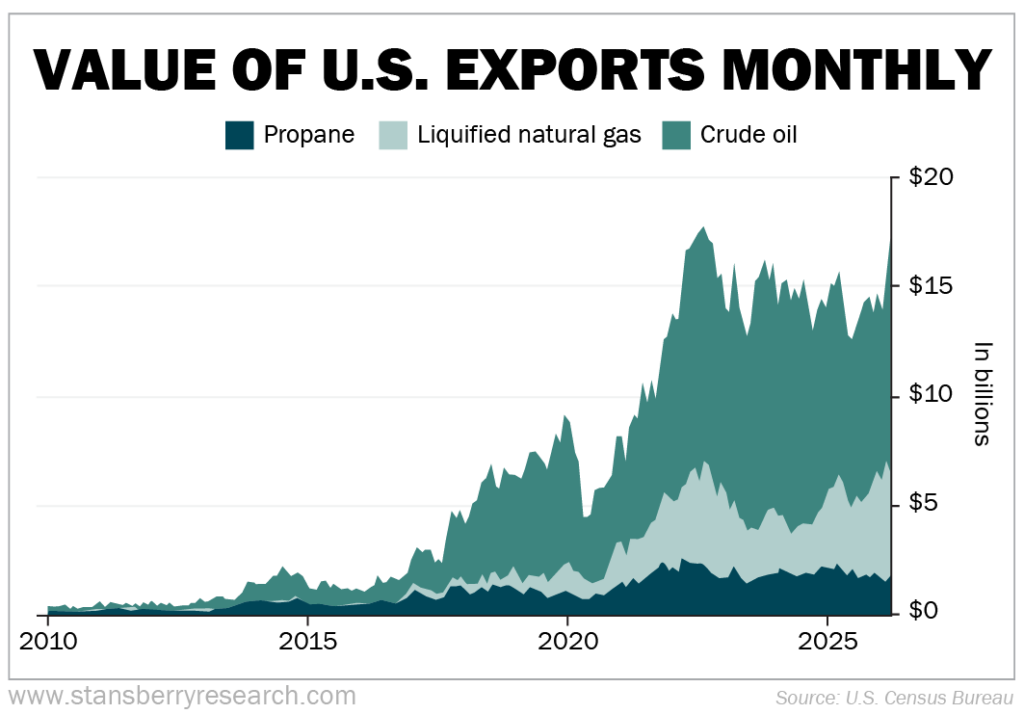
And with roughly 20% of the world’s oil supply no longer traveling through the strait each day, the gap must be made up somewhere else. So, it has been America to the rescue.
Of course, that’s just the start. Gasoline, crude oil, diesel fuel, LNG, ethane, and jet fuel… U.S. export records are being set for all these resources as the conflict in the Middle East shows no real signs of ending anytime soon.
This setup fuels American energy-company profits, as they export more critical resources than ever to fill the global supply gap.
On March 12, the White House reposted a Truth Social post from President Donald Trump on its official X (formerly Twitter) account. Read the first sentence:
We, meaning American oil and energy companies? Yes.
We, meaning the federal government? Yes.
We, meaning everyday Americans? No.
Record Exports Are Fantastic News for American Energy Companies and the Government
In January, crude oil exports reached roughly 3.92 million bpd. By April, that jumped to 5.44 million per day, per Kpler commodity analysts. That number is expected to rise to roughly 5.48 million barrels per day in May.
As a result, East Coast ports in places such as New York City, Philadelphia, and Albany have been exporting more than 200,000 barrels of gasoline and diesel per day – more than 10 times the amount from the same period last year, and their highest monthly output since 2017.,
Meanwhile, the port of Corpus Christi, Texas, which exports roughly half of all U.S. crude oil at 2.5 million bpd, continues to expand its capacity to accommodate fully loaded tankers.
In April, the port’s CEO, Kent Britton, said “March was the busiest month in the history of the Port of Corpus Christi. And by all accounts, April is actually going to be even busier.”
All in an attempt to fill the void of oil that is blocked from passing through the closed Strait of Hormuz.
Data from the U.S. Energy Information Administration (“EIA”) shows us that total crude oil plus petroleum-product exports reached between 12.7 and 12.9 million bpd in mid-April, the highest ever. By the end of the month, that number was closer to 14.2 million bpd.
Kpler also noted that clean energy product exports reached an all-time high of roughly 3.11 million bpd by March, with April forecasted to hit 3.59 million.
LNG is a story on its own. The strait closure has cut off roughly 20% of the global LNG supply. The U.S. is also attempting to fill that gap.
U.S. natural gas exports are expected to grow by nearly 30% by 2027, according to the EIA. The EIA is forecasting net exports of U.S. natural gas to grow 18% to 18.7 billion cubic feet per day (Bcf/d) this year. The administration predicts another 10% increase in net exports to 20.5 Bcf/d in 2027.
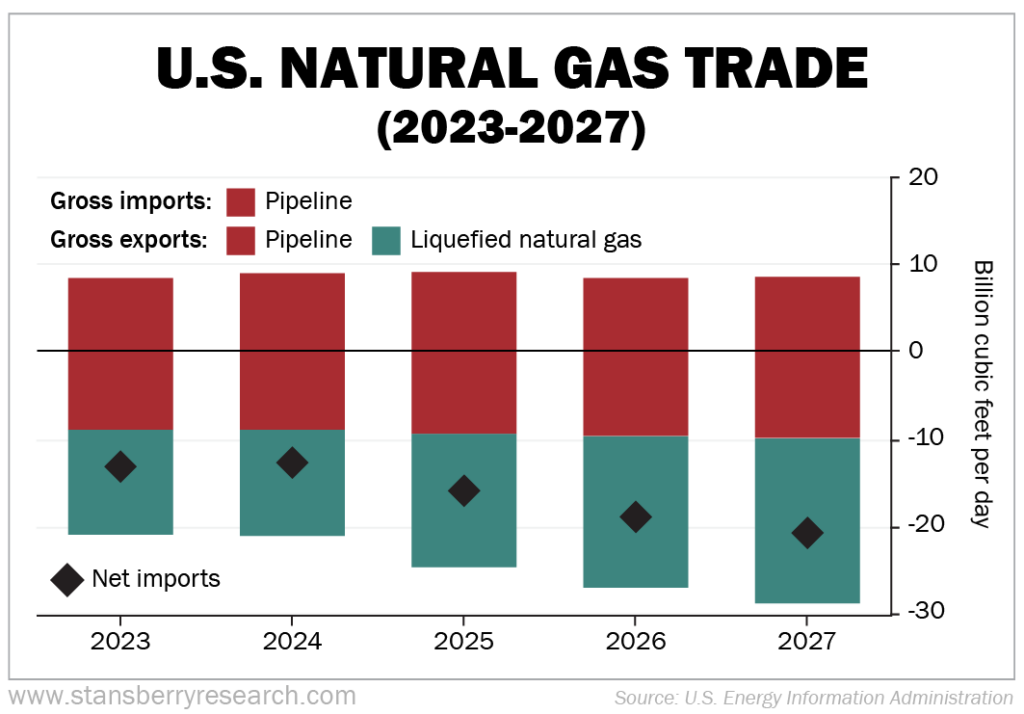
The issue here is that, according to the EIA, current U.S. peak export capacity is 18.3 Bcf/d. So, those projections are beyond the country’s capacity for LNG exports.
To accommodate that growth, LNG export expansion projects will be popping up along the Gulf Coast in Texas this year and next.
- Natural gas company Cheniere (LNG) is expanding its export capacity in Corpus Christi, adding 0.6 Bcf/d capacity.
- Golden Pass LNG will build another 2.1 Bcf/d in total capacity.
- Port Arthur LNG Phase 1 will add 1.6 Bcf/d capacity.
- Rio Grande LNG’s expansion will add another 1.4 Bcf/d of capacity.
- Plaquemines LNG and Elba Island LNG will increase their exports by 0.5 and 0.1 Bcf/d, respectively.
Additionally, U.S. jet-fuel exports have surged 82% since the war in Iran began, according to Reuters.
This news is a boon for American energy companies.
According to analysis by The Guardian using Rystad Energy’s UCube database, from March (the start of the war) through December 2026, using a $100 average per-barrel price of oil:
- ExxonMobil (XOM) will make $11 billion in profit from the war this year.
- Chevron (CVX) will bring in an additional $9.2 billion.
That’s just from selling more oil. And considering West Texas Intermediate and Brent crude oil prices are hovering between roughly $104 and $111 per barrel as of May 19, those figures could go even higher.
Factoring in soaring stock prices at the onset of the war, ExxonMobil boosted its market cap value by nearly 30% to $643 billion during the first two weeks in March. Meanwhile, Chevron gained more than 30% to hit a market cap of nearly $400 billion during that same period.
This chart shows share prices rising from market close on February 27 (the day before the war started) to March 31.
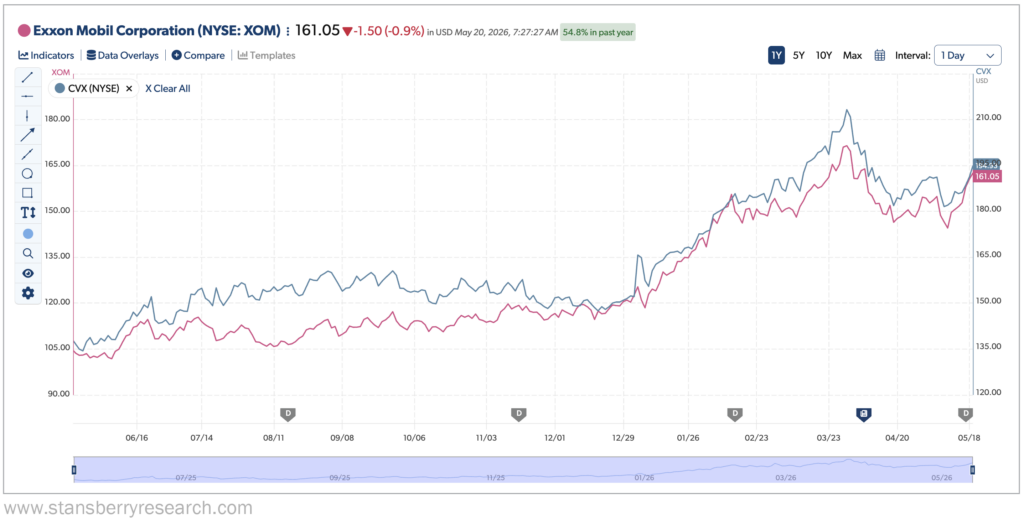
The trajectories are eerily similar, as are the monthly gains – roughly 11.3% for ExxonMobil and nearly 11% for Chevron.
Again, this helps American energy exporters. But what about the average American citizen?
Record U.S. Exports Benefit Energy Companies While American Consumers Feel the Pinch
For energy exporters, the market conditions created by the war in Iran and the closure of the Strait of Hormuz have been extremely profitable.
Some have voiced their concerns, like Chevron CEO Mike Wirth did when speaking to CNBC in early May:
If we don’t get supply reestablished, demand will have to come down across different sectors of the economy. And that’s I think the big concern that everybody has.
What Wirth didn’t mention was that he earned $104 million by selling Chevron shares between January and March, just before the war began. But he wasn’t the only one. According to the Wall Street Journal, oil executives sold $1.4 billion worth of stock during the first quarter of the year.
Meanwhile, consumers continue to deal with soaring fuel costs, with many barely able to afford to fill up their gas tanks.
Why? These record-high energy exports are sapping American crude oil, gasoline, diesel, and LNG supplies.
With a significant amount of the world’s oil stuck in the Persian Gulf, the U.S. has become the de facto global supplier.
There is a possible solution, however. American energy exports could be limited or regulated to help stabilize the domestic energy supply and lower fuel prices.
Despite the option to regulate exports, Trump and his administration have said there are no plans to do so.
President Trump stated that “we don’t need [limits]. And we have tremendous amounts of oil.”
Energy Secretary Chris Wright and Interior Secretary Doug Burgum doubled down on Trump’s sentiment in identical X posts, both of which read, “To be clear, the Trump administration has no plan to implement restrictions on oil and gas exports.”
Does this all sound like “war profiteering”? You can be the judge. Corporations benefit from higher prices and margins, yet the war also inflicts massive supply disruptions and higher costs.
Other American energy companies have seen stock prices spike since the war started at the end of February.
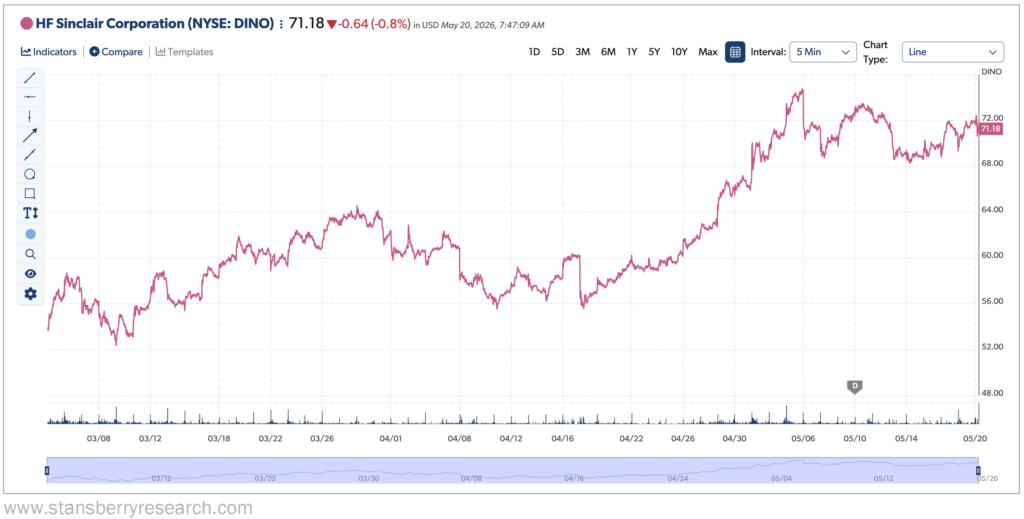
HF Sinclair (DINO) has soared nearly 37% since the end of February.
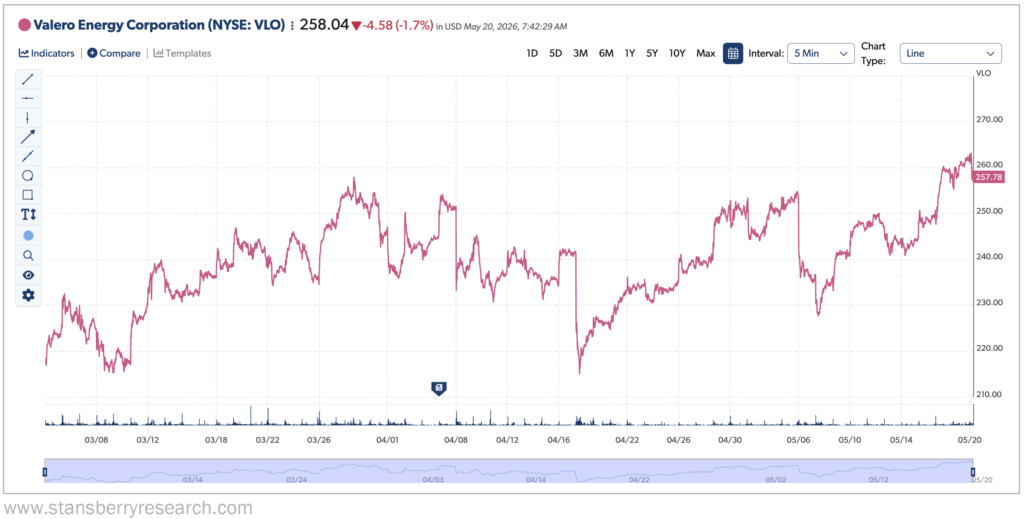
Valero Energy (VLO) has gained almost 18% since the war began.
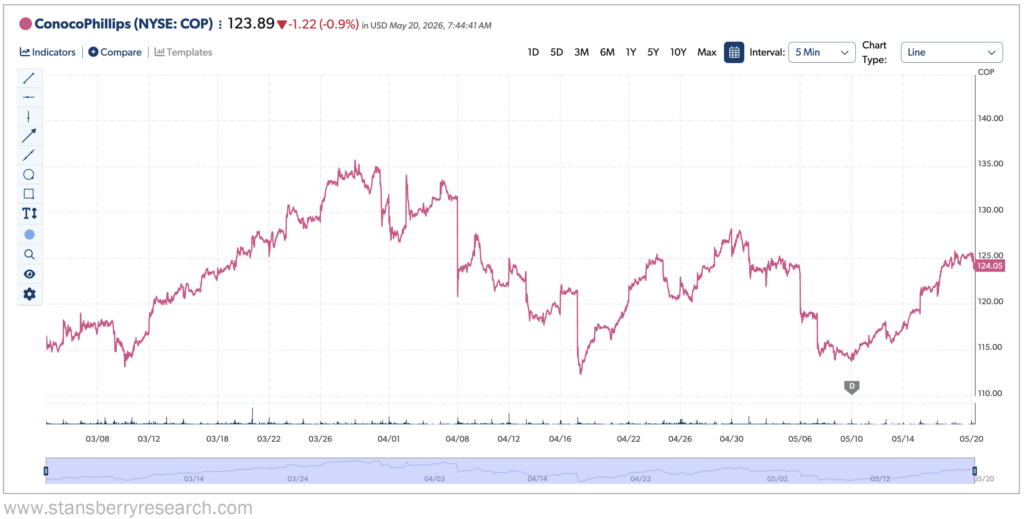
And ConocoPhillips (COP) is up more than 6%.
If you’ve been investing in American oil and gas companies, your portfolio is likely performing pretty well today.
But if you don’t think the situation passes the smell test, you’re far from alone. Trump and his administration have long been proponents of fossil fuels and Big Oil. The president’s cabinet is full of fossil fuel backers and former oil executives, including Wright, Burgum, EPA Administrator Lee Zeldin, and Secretary of Agriculture Brooke Rollins.
To be clear, this isn’t a new development. Administrations throughout our country’s history, from both parties, have appointed like-minded officials who pledge to advance the president’s agenda. That’s their right as the elected leader of the country.
But the administration’s close ties to the oil industry offer fuel to critics who suggest that there’s a strong appearance of conflicting priorities as consumers face increasing energy costs.
U.S. Energy Export Outlook
The war in Iran has been highly unpredictable to this point. There have been ceasefires, pauses to ceasefires, naval blockades, and both full and partial closures of the Strait of Hormuz. So, it’s difficult to predict what will happen next.
What we do know is that if the strait remains closed, the global oil supply will continue to be disrupted. That means the U.S. will benefit by growing exports of our own oil and gas resources.
What we don’t know is how long the domestic oil supply will last. It won’t run out overnight, but the EIA reported a 24.1 million-barrel weekly decline in oil and oil-product supplies for the week ending April 24. Just a week before, the weekly decline was less than 6 million barrels.
That’s concerning. Especially considering summer is peak fuel-usage season. Any supply shortage is expected to raise fuel prices further. We could be looking at an average of $5 per gallon of gasoline this summer. California may see an average per-gallon price of $7.50, and it could even hit $10 per gallon in some areas.
Critics argue that the administration has little economic incentive to curb exports while elevated energy prices continue benefiting domestic producers.
Trump’s current approach certainly appears to prioritize energy profitability and export growth over relief at the pump. That was made especially clear when Trump said this to Fox News’ Sean Hannity last week:
So I don’t want to say we’re making a fortune, you understand that? Because if I say that, they’re going to say “oh, he forgets about the little man with the $4 gasoline.”
That’s actually $4.50 gasoline, Mr. President. But that’s kind of beside the point.
It’s great that the country is providing the world with the oil it needs, while also growing profits. But when will average Americans see lower pump prices? According to Trump, the rising prices are merely “peanuts” and says that we’ll have to get used to “putting up with it for a little while.”
Unfortunately, higher pump prices are a harsh reality for most Americans, who are growing more concerned by the day. And it certainly doesn’t appear there’s an end in sight.
Regards,
David Engle
Editor’s note: “Get me out.” That’s how one trader described the recent panic that has gripped the market. And not just because of the war in Iran, which has brought huge volatility to every corner of the markets.
No… a much bigger, permanent shift is playing out, driving some stocks down by 80% even as some hedge funds make billions in profits. And it’s about to turn the stock market upside down, with huge consequences. See how it affects you here.