
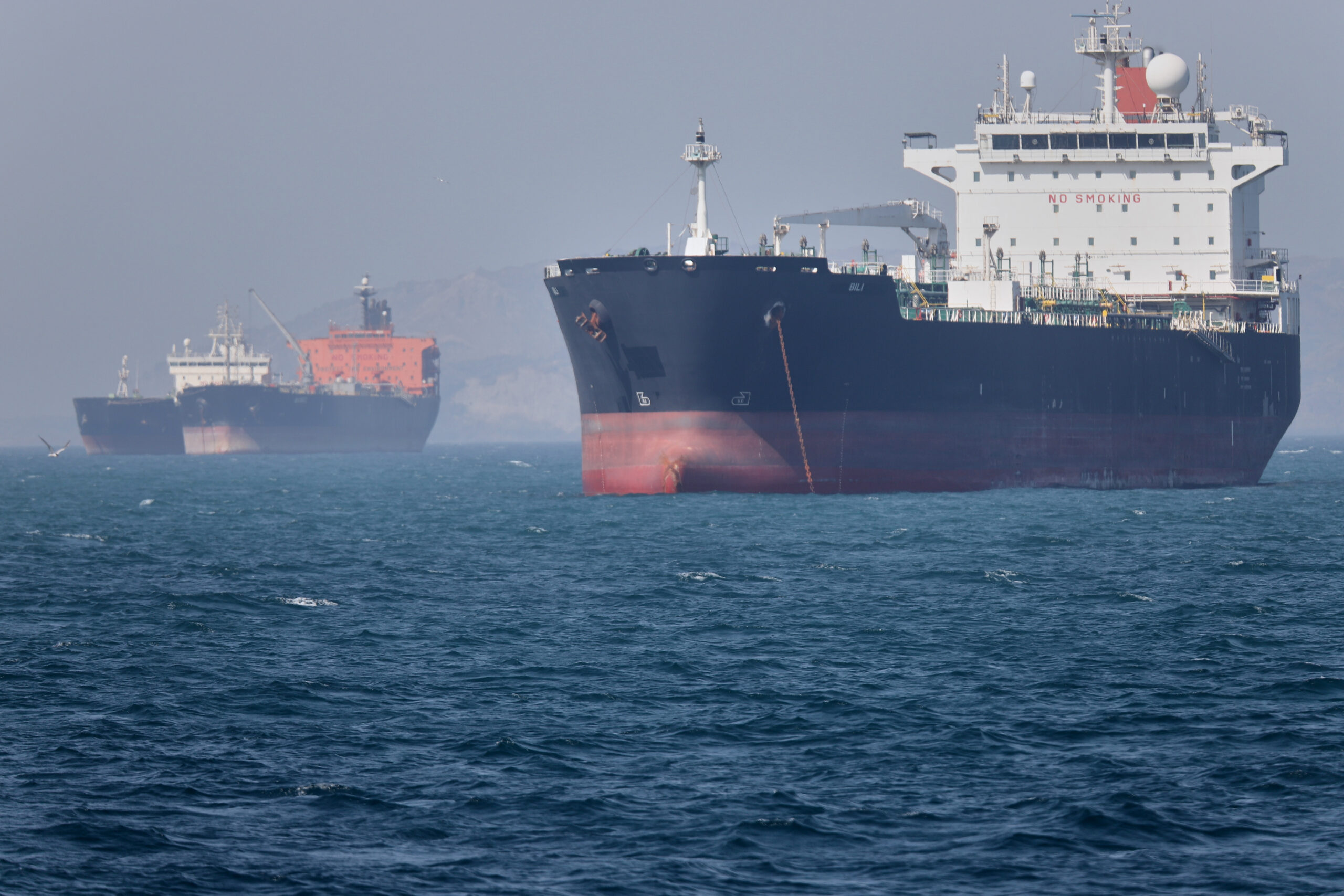
Image Credit: Associated Press
Key Points
- Oil supply remains constrained due to the Strait of Hormuz blockade amid the ongoing Iran war, putting pressure on global markets.
- Because of oil’s central role in the global economy, its price can react unpredictably to shifts in supply.
- The bullish case points to sustained high prices from tight supply and rising production costs, while the bearish case hinges on the strait reopening and weakening demand driving prices lower.
Roughly 20 million barrels of oil per day passed through the Strait of Hormuz in 2025. Now, due to the ongoing Iran war and the strait’s blockade, oil traffic has fallen to a trickle.
Just 5% of prewar average shipping traffic has made it through the Strait of Hormuz in recent months.
As Daniel Yergin, vice chairman of S&P Global, said in March:
This is a historic disruption to world oil. There has never been anything of this scale. Even the oil crises of the 1970s, the Iran-Iraq war of the 1980s, Iraq’s invasion of Kuwait in 1990 – none of those come close to the magnitude of this disruption.
Of course, in times of geopolitical crisis, oil has historically acted as a safe haven. That’s what has so many investors conflicted today.
Oil is unlike any other commodity. It occupies a position in the global economy that no other raw material matches. And its price – and supply – doesn’t always respond the way textbooks suggest it should. Understanding why is the difference between a simple “do I buy or sell?” trade and a lasting bull or bear market thesis.
Why the Strait of Hormuz Matters for Oil Prices
Just 21 nautical miles wide at its narrowest point, the Strait of Hormuz is a crucial Middle Eastern waterway for transporting oil.
Importantly, there’s no viable substitute.
On paper, Saudi Arabia’s East-West pipeline and the Iraq-Turkey pipeline total roughly 8.5 million barrels per day, or about 43%of normal Hormuz flows. But that overstates what can actually be rerouted: the International Energy Agency (“IEA”) estimates practical available bypass capacity at only 3.5–5.5 million barrels per day, and Iraq-Turkey flows remain limited.
In early April, shipments through the Strait of Hormuz averaged just 3.8 million barrels per day compared with the prewar baseline above 20 million, according to a report from the IEA.
In March alone, global oil supply dropped by 10.1 million barrels per day. The IEA called it the “largest disruption in history.”
Warren Patterson, head of commodities strategy at ING, recently said, “The lack of progress means the market is tightening every day, requiring oil prices to reprice at higher levels.”
Brent crude – the international standard – topped $109 per barrel after the second round of U.S.-Iran peace negotiations collapsed on April 26 and 27.
In other words, the oil market isn’t just pricing in risk. It’s pricing in a massive shortfall in oil supply.
The Bullish Case for Higher Oil Prices
There are two big reasons why oil is genuinely different from commodities like copper, wheat, and natural gas… and why many believe prices will continue higher from here.
1. Oil Demand Is Layered in Ways the Market Doesn’t Fully Understand
According to the IEA, global oil demand has slowed remarkably in recent years due to the rise of electric vehicles, green-energy initiatives, and a slowdown in manufacturing, among other reasons.
However, while electric vehicles do reduce gasoline consumption, they don’t reduce the nylon in your running shoes or the foam in your couch…
Roughly 12% of global oil demand comes from petrochemical feedstock – the raw material used for plastics, synthetic textiles (like polyester and nylon), fertilizers, and pharmaceuticals. And that demand floor isn’t going anywhere.
The IEA projects that petrochemicals will account for more than a third of oil demand growth through 2030 and nearly half through 2050.
2. Supply Inelasticity Is Structural, Not Temporary
When copper prices rise, miners can expand existing operations within months. When wheat prices go up, farmers tend to plant more for the next season. Oil doesn’t work that way.
New oilfield development takes years. Infrastructure doesn’t materialize because a futures contract went up 40%. So, to restore balance, the market must learn to ration the limited supply.
The U.S. Energy Information Administration (“EIA”) has documented this explicitly. Both production capacity and the amount of petroleum-consuming equipment are relatively fixed in the near term.
The only way to deal with this supply shock is through large price moves that force the world to use less.
The supply cost curve (which tells us the minimum amount a company will sell its goods for) makes this even more evident.
That’s because each region has different production costs, and therefore each oil company may break even and profit at different prices.
For example, when oil trades for around $27 per barrel, an onshore Middle Eastern oil company starts to break even. Above that price, they’re in the profit zone.
When oil is about $37 per barrel, an offshore Middle Eastern oil company starts to break even. Above that price, they profit.
North American shale producers don’t break even until oil is $45 per barrel. Of course, new shale wells aren’t profitable until oil is trading for $62 to $70 per barrel because of how much capital it takes to start a new well. But that’s today.
However, according to Alex Ljubojevic, an analyst from energy data provider Enverus, “As core shale oil inventory in the U.S. depletes, the industry is entering a new era of higher costs and more complex development.”
Enverus projects that new shale wells won’t be profitable until the market hits $95 per barrel by the mid-2030s.
That means adding more production isn’t automatically a quick fix because the production costs keep rising.
So, the marginal barrel of oil (the next barrel produced) is getting more and more expensive, and the price floor for new supply is rising, not falling.
Think about what that means. Before the current crisis, the EIA and JPMorgan were forecasting that structural oversupply would push prices toward $58 per barrel. Shale investors weren’t drilling aggressively at $72. Instead, they were returning cash to investors. But after the strait closed, the spare capacity that was supposed to absorb any shock was sitting idle inside a naval blockade.
MORE: Best Oil ETFs: 7 Top Funds for Soaring Oil Prices
The Bear Case for Oil Deserves Attention
It’s worth the time to consider the other side of the coin… the potential for lower oil prices.
Demand for oil is already falling due to higher prices. According to Barclays, as of April, American drivers are consuming 5% fewer gallons of gasoline than they did a year ago.
Frederic Lasserre, head of global research and analysis at Swiss energy-trading giant Gunvor, says that if the strait stays closed for three or more months, the macro picture shifts from energy supply shortage to global recession. And recession kills demand faster than any OPEC decision.
There’s also the potential for a peace deal. Rory Johnston, founder of oil-research website Commodity Context, estimates an immediate per-barrel drop of $10 to $20 in the price of crude on the strait reopening.
Meanwhile, UBS expects Brent to trade in the $80 to $90 range rather than return to pre-crisis lows if the conflict were to resolve.
When the strait fully reopens and traffic picks back up, Gulf producers can simultaneously restart roughly 9 million barrels per day of shut-in capacity. That’s a wall of supply.
And shale’s response is constrained not just by geology, but by capital discipline. Investors burned by the 2014 to 2016 oil bust demanded returns over growth. That could be the case this time around as well.
The shale industry has learned, somewhat painfully, that the market rewards discipline more than production records.
There’s also backwardation to consider. Backwardation in the futures curve occurs when current prices are above future prices. That can happen when investors think current problems are temporary.
If that’s the case with today’s oil shock and investors are right, then the bear case of lower prices comes true. This pattern discourages new drilling, even at $100 crude.
Is Oil a Good Investment During a Geopolitical Crisis?
During a geopolitical crisis, oil is a strong hedge. But entry and exit points, as well as staying disciplined, matter here.
The structural case for oil above $80 is durable regardless of how this specific crisis resolves.
The marginal cost of new supply continues to rise. The feedstock demand floor is real. And spare capacity was already thin before the war began in February.
UBS’s $90 price floor on Brent, even in a peace scenario, is conservative… not aggressive.
The tactical case for $110-plus crude depends entirely on whether the strait remains closed. If it does, the market will keep tightening. If a deal to open the strait lands, the speculative premium unwinds fast, and the structural thesis reasserts itself at a lower number.
The lesson from the 1973 and 1979 oil shocks is the same one that applies now: When big news breaks, oil prices usually respond to the panic and jump higher than they should. When things calm down, prices drop back to reality, which hurts anyone who bought in late.
The real winners aren’t the ones chasing today’s headlines. They’re the ones who invested early because they saw long-term supply shortages coming.
Good investing,
Eric Wade
P.S. There’s one last aspect of this I want to mention, and that’s tokenized commodity trading.
Tokenized commodities are blockchain tokens that represent real-world commodities, like oil. They allow investors to get exposure to rising prices without the risk of a tanker in a conflict zone. And today, inflows into these assets are surging.
Our research at Crypto Capital shows that the market for tokenization could grow to trillions of dollars in the next five years.
Eventually, the Strait will reopen, and we’ll see some sort of resolution with Iran. But the cost curve for oil and the growing appetite for this technology won’t diminish any time soon. Neither will the opportunity for those who are positioned correctly.
Click here to subscribe to Crypto Capital and see how we’re trading tokenized oil today.