Listen to the audio version of this article (generated by AI).
Today’s issue in preview:
-
Owning this stock gets Donald Trump massively on your side
-
A key indicator is flashing “BULLISH” for the U.S. economy
-
A great technology business that hasn’t skyrocketed? Yes, it exists… and you can buy it today
-
Learn our Top Themes to buy now
Owning this stock gets Donald Trump massively on your side
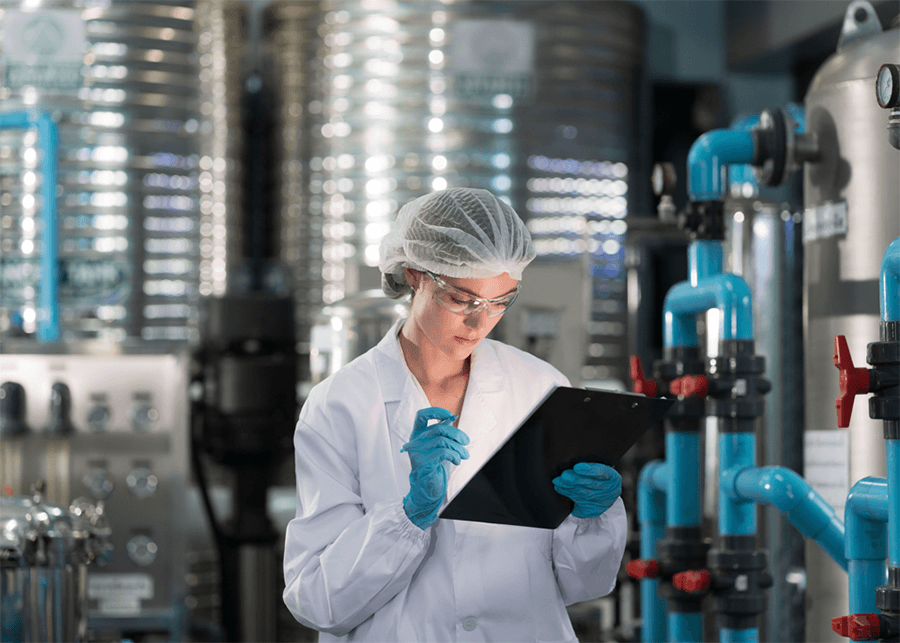
Credit: Amorn Suriyan
This week, automotive giant Toyota (TM) announced it is investing $3.6 billion to expand its San Antonio, Texas manufacturing plant. The move will transfer production of its popular Tacoma pickup from Mexico to the Lone Star State.
Toyota said in November it planned to invest as much as $10 billion in the United States over the next five years.
This news is the latest piece of evidence that the “Made in America” megatrend is alive and well… and one of the market’s most compelling investment themes.
Back in January, I made the case for investing in companies that supply critical equipment and services for building and operating high-tech, highly automated “smart factories.” The bull case here is simple…
President Donald Trump – along with many business and military leaders – believes that the U.S. has outsourced far too much of its industrial capacity to China over the past 25 years. We outsourced significant portions of our semiconductor, appliance, medicine, weapons, and machinery production. We outsourced the capacity to produce and process critical resources, such as rare earth elements.
The COVID-19 pandemic showed that depending on other countries for critical economic inputs makes the U.S. economy less safe and secure. To put it bluntly, it is very stupid to not make products critical to national security like AI semiconductors within our own borders.
Trump has staked his legacy and reputation on expanding our industrial base… and he’s working with business leaders to invest trillions to pursue this goal. Apple (AAPL), for example, has committed to invest $600 billion in U.S.-based manufacturing over the next four years. Nvidia (NVDA) says it will invest $500 billion in U.S.-based manufacturing over the next four years.
In Money & Megatrends, we’ve capitalized on this “Made in America” megatrend with strong returns in robotics, factory automation, and machine component makers such as Cognex (CGNX), Ouster (OUST), and RBC Bearings (RBC).
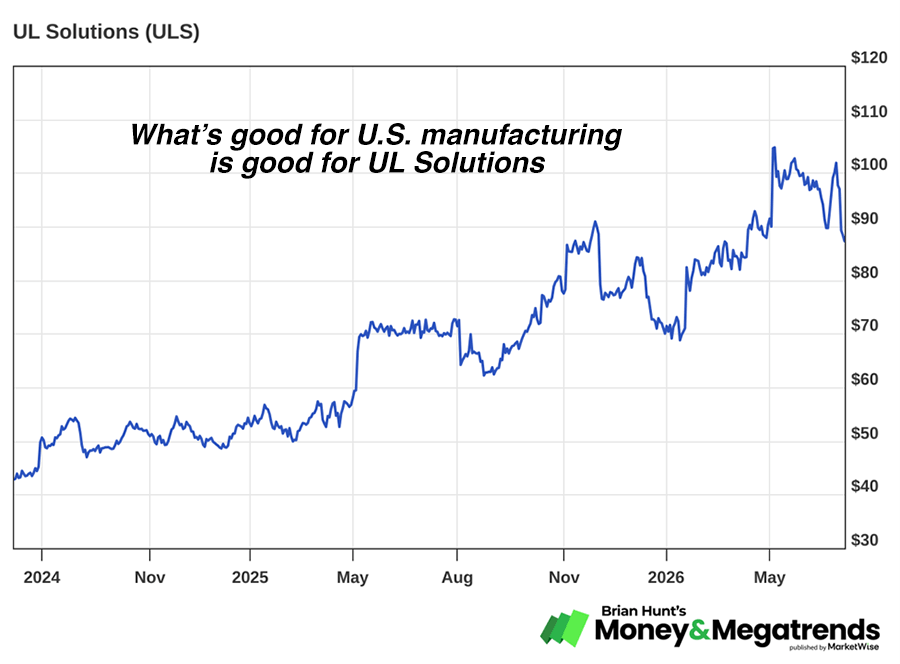
Today, we point out that this megatrend is also bullish for UL Solutions (UL) – one of the most important manufacturing firms you’ve probably never heard of.
UL Solutions is one of America’s largest manufactured product testing and certification firms. Although most people have never heard of the company, it is a $17.4 billion giant in the field.
UL analyzes and tests manufactured products to ensure they are safe, reliable, and meet regulatory standards. A manufacturing firm might design a new EV battery, medical device, household appliance, or piece of electrical infrastructure, but many customers, regulators, and insurers want an outside expert to verify that it performs safely and reliably. That’s where UL Solutions comes in.
UL tests products in specialized laboratories, certifies those that meet applicable standards, and allows manufacturers to display the familiar UL Certified mark.
For example, UL may certify a home’s electrical panel to ensure it can safely handle high currents, test lithium-ion batteries used in electric vehicles and power tools for fire risks, or verify that data center equipment meets electrical safety requirements.
Beyond testing, UL Solutions also provides inspection, software, and advisory services that help companies navigate complex safety requirements throughout a product’s life cycle.
UL’s entrenched positions in many industries have allowed it to steadily grow revenue from $2.5 billion in 2022 to $3.05 billion in 2025. Operating margins are consistently over 16%.
UL’s excellent financial metrics are poised to grow even more excellent as large manufacturers invest trillions of dollars into U.S. factories over the coming decade. More cars, batteries, appliances, data center equipment, power grid equipment, and factory automation equipment produced in America means growing demand for testing and certifying that equipment.
The “Made in America” megatrend is bullish for UL Solutions.
Recommended Link:
Get a piece of OpenAI pre-IPO

There’s a single ticker that gives you a stake in both OpenAI and Anthropic… You don’t have to wait for these revolutionary AI companies to go public. You can get in today, from any regular brokerage account, for less than $100. We’ll give you the ticker symbol, completely free. No subscription required. Click here to get the free ticker.
A key indicator is flashing “BULLISH” for the U.S. economy
Credit: krblokhin
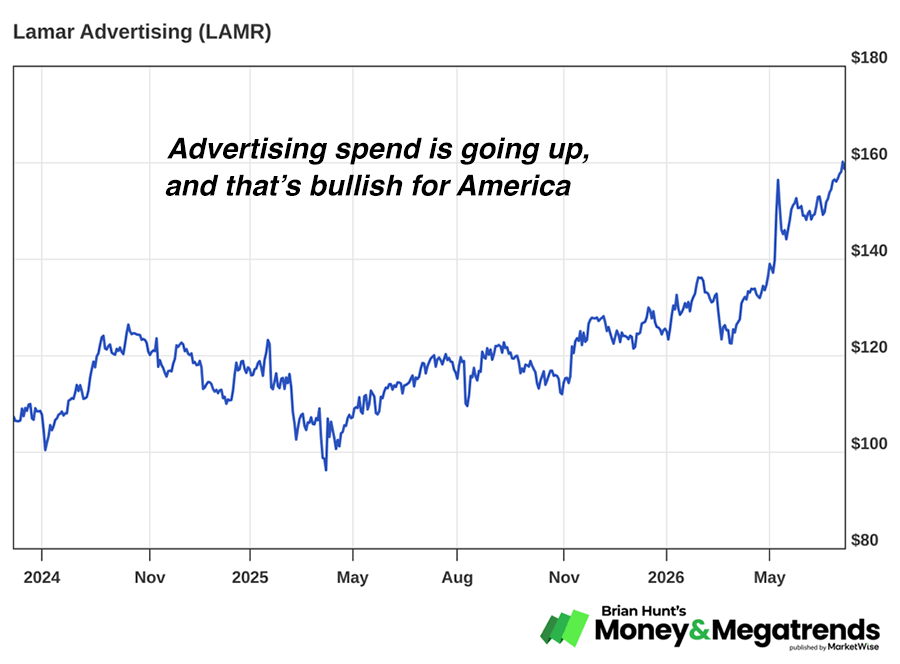
This week, Lamar Advertising (LAMR) reached a new all-time high, a reflection of its booming business. It’s the most important bullish financial news you’re not seeing in the mainstream media.
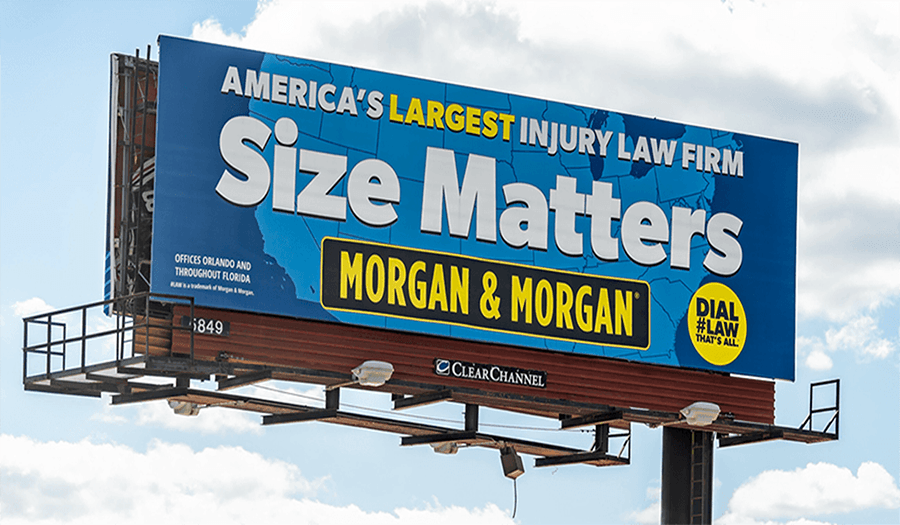
Lamar is America’s largest billboard advertising company. It operates over 360,000 outdoor displays across the U.S. and Canada. It’s a simple and excellent business. Lamar owns or has the rights to valuable advertising space which it rents out. The company turns a profit and pays a dividend.
While Lamar is happy to rent space to big Fortune 500 firms, the bulk of its business is local advertising.
We’ve all seen the billboards: Lawyers urging you to sue. Smiling realtors. The local all-you-can-eat buffet. Your local State Farm agent. HVAC services. New neighborhoods with home prices starting in the 400s. You’ve seen a million of Lamar’s billboards.
Lamar prospers when local businesses have both the money and the confidence in the future to buy advertising. This means the company’s fortunes rise and fall along with economic growth. What’s good for America is good for Lamar. And right now, the company is booming.
Lamar is an important member of our “real world economic indicators” group. Here’s how this critical group of stocks works…
Many investors fixate on government data such as unemployment figures, job hirings, and the Consumer Price Index. I like to know that data as everyone else does.
However, when I want a read on what’s really happening in the economy, I place far greater focus on what’s happening in the real world. I look at the stock price action of companies that play important roles in our economy. In doing this, I listen to the judge, jury, and executioner of any thesis, any trend, and any claim: The market. The market knows a hell of a lot more about the economy than any economist or financial guru. You’re wise to listen to it.
Over the past four months, I’ve written over a dozen research notes that analyzed the soaring share prices of highly economically sensitive industry groups such as trucking stocks, regional banks, manufacturing stocks, diesel engine makers, steelmakers, shopping mall operators, and hotel chains.
At the end of each note, I pointed to their soaring stock prices and told readers that the U.S. economy is doing much better than most people think.
This exceptional price strength in key components of America’s economic machine means the economy is doing much better than the news you hear from the mainstream media.
The stock market is one of the world’s greatest forecasting mechanisms. It tends to look ahead 6-12 months. When an industry is in a recession, its stock prices will rise before the news media says it is recovering. When an industry seems to be doing well, its stock prices will decline before the news covers its downturn. This is often called “discounting the future.”
The new highs for Lamar advertising and many other key industry groups are bullish for America’s future. They tell us to expect to see reports of strong economic activity about six months from now. Manage your financial affairs accordingly!
A great technology business that hasn’t skyrocketed? Yes, it exists… and you can buy it today.

Credit: Ceri Breeze
Over the past 3.5 years, the S&P 500 has returned 98%. It has strung together an exceptional three consecutive years of 15%+ gains.
Since the broad market is up so much since 2023, finding good companies at bargain prices is a tough assignment. Almost all the good ones have soared in value over the past three years.
Any investor looking to put new money to work in the technology world finds it difficult to find stocks that haven’t skyrocketed… that are not trading at high valuations.
Given the giant recent rally, has any tech leader not already skyrocketed?
Look at Uber (UBER).
Uber is the world’s largest ride-sharing technology platform. It connects people who need rides or things delivered with people who want to earn money as drivers. Uber does not own a fleet of vehicles. Instead, it connects drivers and customers and gets a cut of every transaction.
Most people are surprised to learn that Uber has diversified far beyond ride-sharing in the U.S. Delivery of restaurant food, groceries, alcohol, and prescriptions makes up about 33% of the company’s revenue. And Uber services outside of the U.S. make up about 46% of the company’s revenue. In other words, Uber is a ride-sharing, food-delivering international giant.
Like most well-known technology companies, Uber burned through venture capital dollars and lost money during its early years of development and expansion. However, the company is now a cash-producing machine. Over the past 12 months, Uber has generated nearly $10 billion in free cash flow. Uber’s free cash flow in 2025 was 42% higher than the same figure in 2024.
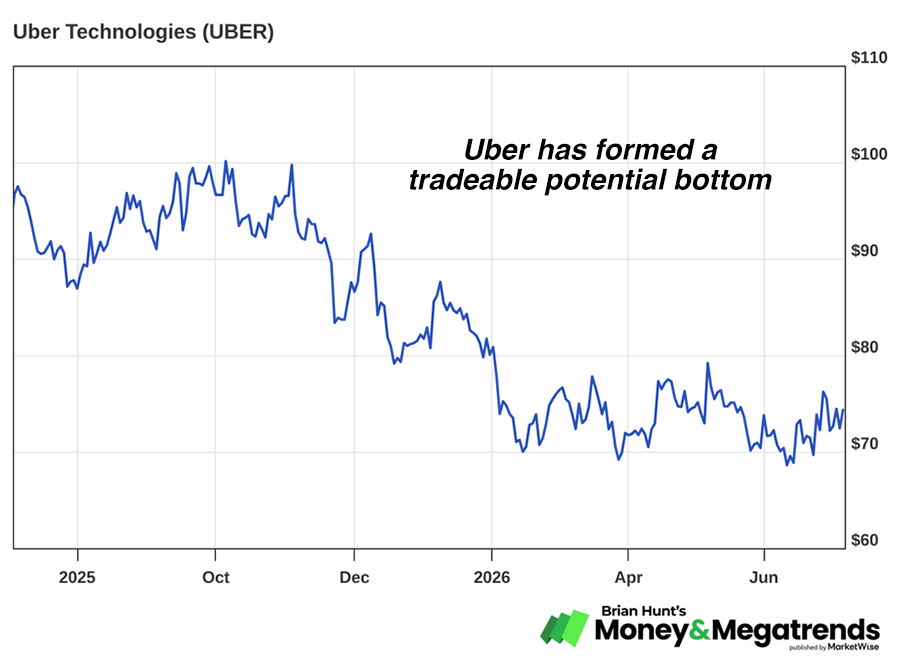
Concerns that autonomous vehicles will harm Uber’s competitive position have depressed Uber’s stock price. Shares are down 25% over the past 12 months. Bulls on the stock – such as high-profile investor Bill Ackman, who owns a huge Uber stake – say autonomous vehicles will likely help, not hurt the company… and that Uber is a high-quality business with the potential to grow much larger over many years. Plus, Uber’s price-to-free cash flow multiple is below 20, which makes it a relative bargain in today’s strong technology market.
Importantly, the stock’s recent price action has created a good “golden ratio” trade setup. The “golden ratio” is my nickname for trades where the difference between potential upside and downside is large, in the upside’s favor.
The higher this ratio is, the greater your potential reward relative to your risk. Most of the market’s consistently successful traders look for trades that can give them at least $4 of upside for every $1 of downside.
Successful trading – the kind that can make you serious money – isn’t about being right all the time. An obsession with a high win rate is a loser’s mentality. Instead, successful trading is about finding and structuring trades that offer golden ratios, executing such trades, and then repeating the process as many times as possible. Doing all this lets you make a lot of money using basic math.
As you can see in the chart below, Uber stock has put in a potential bottom in the $70-$73 area. Traders can enter near recent lows, set a stop near those lows, structure a “high upside, low downside” trade… and potentially make money on one of the few bargains left in the technology sector.
Market Notes
-
Oil refining giants Valero (VLO) and Marathon Petroleum (MPC) reached new one-year highs today thanks to the resumption of armed conflict in Iran.
-
Automotive giant Stellantis (STLA, maker of Jeep, Ram, Chrysler) reached a new one-year low today.
-
Robotics-powered oilfield services firm Oceaneering (OII) reached a new all-time high today.
Top Themes to Buy Now
🧬 The Biotech Sector Powers to New Highs, Displaying Phenomenal Strength in a Weak Market
🦾 Six ways to invest in the biggest product of all time
⛏ How to partner with the U.S. government and make hundreds of percent returns
Regards,


Brian Hunt
Editor, Money & Megatrends
An urgent message from our colleagues:
Elon Musk Just Did Something He’s Never Done Before

This February, Elon spent millions to send a message to 125 million Americans. Most people ignored it. But Wall Street veteran Whitney Tilson couldn’t stop thinking about it, and says what Elon was really saying explains everything about what’s unfolding in America’s economy right now.
He’s sharing his full analysis, free, here.