
Image Credit: Nebius
Listen to the audio version of this article (generated by AI).
Key Points
- CoreWeave’s $104 billion backlog highlights massive neocloud demand, but its $35-plus billion debt load and rising interest expenses raise questions about how it will finance continued AI infrastructure expansion.
- Nebius is taking a different approach, using customer prepayments to fund as much as 50% to 60% of the capital expenditures tied to major contracts and reducing its reliance on debt.
- Iren and TeraWulf are also embracing customer-funded strategies, making how neocloud companies finance their massive AI buildouts an increasingly important consideration for investors.
CoreWeave (CRWV), the world’s largest neocloud company, reported a $626 million GAAP (generally accepted accounting principles) net loss during its second-quarter earnings call on Tuesday, August 11.
But its stock surged 19% by August 13 anyway. Why? CoreWeave’s backlog (customer spending commitments that haven’t yet been delivered or billed) reached $104 billion in the second quarter, not even counting the $25 billion in new customer agreements for the third quarter.
Here’s what stands out: Roughly 50% of that backlog runs beyond four years, and 21% of that portion likely won’t be recognized as revenue until 2030 at the earliest.
Meanwhile, it just increased its capital expenditures (“capex”) for the year to a range of $35 billion to $39 billion.
That raises a critical question: Who is funding that capex over the next four-plus years while CoreWeave waits on half its total backlog to become revenue?
Neocloud rival Nebius (NBIS), whose earnings obliterated Wall Street expectations, may have the answer. And Nebius is funding its growth in a much different way than CoreWeave.
Key Difference Between CoreWeave’s $104 Billion and Nebius’ $40 Billion Backlogs
Here are a few highlights from CoreWeave’s and Nebius’ impressive second quarters:
- CoreWeave: $2.58 billion in revenue (up 112% year over year), $104 billion backlog (up from $99.4 billion in the first quarter), full-year revenue guidance of $12.4 billion to $13.2 billion (up from $12 billion to $13 billion).
- Nebius: $582 million in revenue (up a mind-blowing 454% year over year), a $257 million gain in adjusted earnings before interest, taxes, depreciation, and amortization (“EBITDA”) , more than $40 billion in total customer commitments.
CoreWeave’s total $104 billion backlog is more than twice that of Nebius’. But around half of that backlog won’t become revenue for at least another four years. That’s four or more years of taking on more heavy debt before the money comes.
Nebius, on the other hand, has a smaller total backlog… but among that backlog are four “landmark” deals that average $1 billion each. The key here is that Nebius negotiated to receive upfront payments (prepayments) that cover 50% to 60% of the capex for those deals.
In fact, 70% of Nebius’ signed deals include customer prepayments. So Nebius is receiving money up front – $9 billion in customer prepayments in 2026 alone – to fund its infrastructure expansion, reducing some of the significant risk associated with neocloud spending on build-outs.
This was a brilliant and potentially game-changing negotiating strategy by Nebius. While CoreWeave waits nearly half a decade for half its backlog to become actual money – all while amassing more debt – Nebius gets a substantial portion up front and nullifies much of the capex it would have otherwise spent.
Who Is Actually Paying for AI Infrastructure Expansion?
Nebius and CoreWeave demonstrated two ways to fund similar AI-infrastructure build-outs: prepayments and leverage. Prepaid, which is the approach Nebius is taking, is fairly self-explanatory. And we explained above how Nebius is using customer prepayments to its advantage.
CoreWeave is taking the leveraged route. Roundhill Investments, an investment adviser focused on exchange-traded funds (“ETFs”), summarized this approach:
Many neoclouds sign multi-year, take-or-pay contracts, in which a customer commits to a fixed amount of GPU capacity at a fixed price for years, whether or not it uses every hour. That structure gives these companies something rare for a young, capital-intensive business: years of contracted revenue visibility. The trade-off is that building the capacity requires staggering amounts of upfront capital, most of it borrowed against the GPUs themselves and the future revenue those contracts promise.
So, while Nebius’ customers are funding at least half the company’s build-out expenses by using prepayment, CoreWeave is carrying at least $35 billion in debt (as of June 30). What makes this even worse is that the company’s net interest expense in the second quarter soared to $640 million – more than double last year’s $267 million interest bill.
Put another way, CoreWeave’s second-quarter net interest expense grew at a significantly higher rate (almost 140%) than its revenue did (112.8%) compared with 2025’s second quarter. All due to massive AI-driven capex.
Back to the original question: Who is paying the upfront costs for each company’s infrastructure expansion, including expensive components like advanced AI chips and clusters, networking equipment, thermal management, data-center rent, and energy costs?
For Nebius, customers contribute more than half of these expenses through prepayments. For CoreWeave, it’s their lenders who are financing the infrastructure costs through equity and debt, such as loans and graphics processing unit (“GPU”)-backed credit lines.
Comparing the Top Neocloud Stocks
Here, we’ll examine four of the top neocloud stocks, each grouped by how they’re funded – by customers and by lenders.
Customer-Funded: Nebius, Iren, and TeraWulf
First is Nebius, the Amsterdam-based AI cloud company that builds full-stack infrastructure for AI development. We’ve already looked at it in some detail.
As I noted earlier, Nebius has negotiated 70% of its signed deals to get upfront payment from customers. In some cases, those prepayments cover at least half of the associated capex, easing the financial burden and helping contain debt. So far this year, Nebius has received $9 billion in customer prepayments from contracts to put toward capex.
There’s a strong bull case for Nebius… its 454% year-over-year second-quarter revenue makes that crystal clear. But the company’s AI business also boasts a very solid 50% adjusted EBITDA margin and an annualized revenue run-rate of $3 billion. Plus, its stock has gained an astounding 242% in the past year (as of August 18).
And, of course, there’s Nebius’ $40 billion-plus backlog of customer commitments. But Nebius has secured the power it needs – raising its contracted power guidance to 5 gigawatts (“GW”) – to continue its AI infrastructure build-out.
Chaikin Analytics, the investment-research platform founded in 2009 by legendary 60-year Wall Street veteran Marc Chaikin, rates Nebius “neutral-” in its Chaikin Power Gauge, a 20-factor stock-rating system that scans more than 5,000 stocks and 2,300 exchange-traded funds.
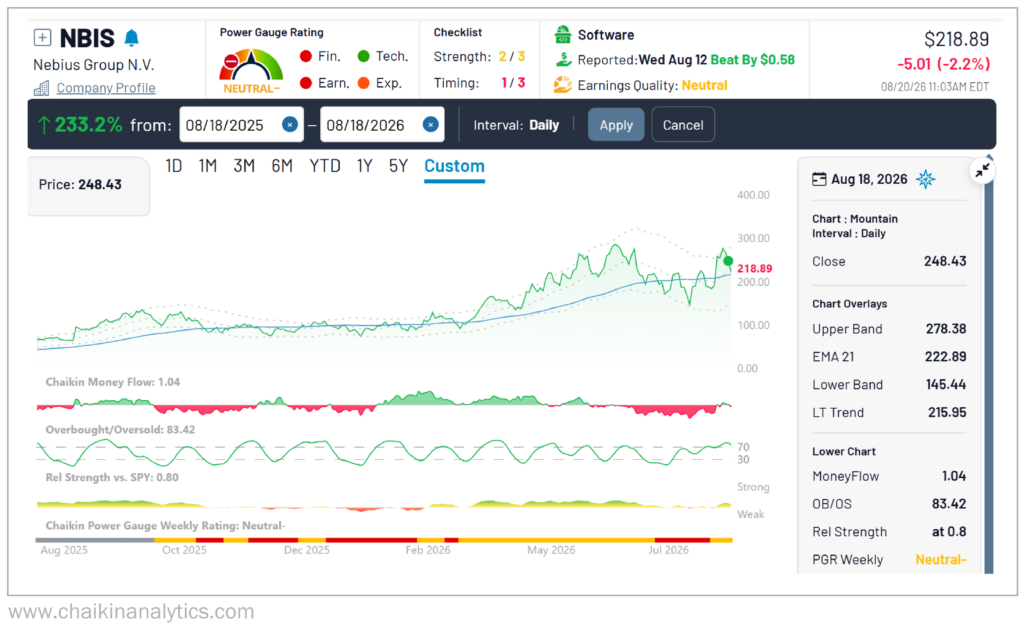
The tool points out that while Nebius’ price/volume activity is very strong, the company’s financial metrics suffer from a high price-to-sales ratio. That said, Nebius has moved above its long-term trend, keeping it out of bearish territory.
Iren Limited (IREN), formerly Iris Energy Limited, is another customer-funded neocloud company to watch. Originally a bitcoin-mining business, Iren moved into AI-cloud services and infrastructure by operating data centers and renting out high-performance GPU clusters to major tech companies, including Microsoft (MSFT) and Nvidia (NVDA).
Like Nebius, Iren has negotiated its contracts to include customer prepayments – up to 45% to cover GPU capex. And those contracts have made this under-the-radar neocloud company a legitimate player in the space.
Its five-year, $3.4 billion cloud services contract with Nvidia calls for Iren to provide Nvidia with managed GPU cloud services – using Nvidia’s Blackwell systems – at its campus in Texas.
The deal also includes deploying up to 5 GW of Nvidia AI infrastructure across Iren’s data centers. As part of the partnership, Iren issued Nvidia a five-year right to invest up to $2.1 billion through the purchase of up to 30 million shares of ordinary stock at $70 per share.
The company has momentum thanks to its deals with Nvidia and Microsoft, as well as the prepayments that help Iren manage its capex. Its stock has exploded over the past year (as of August 18), up roughly 103% in that span.
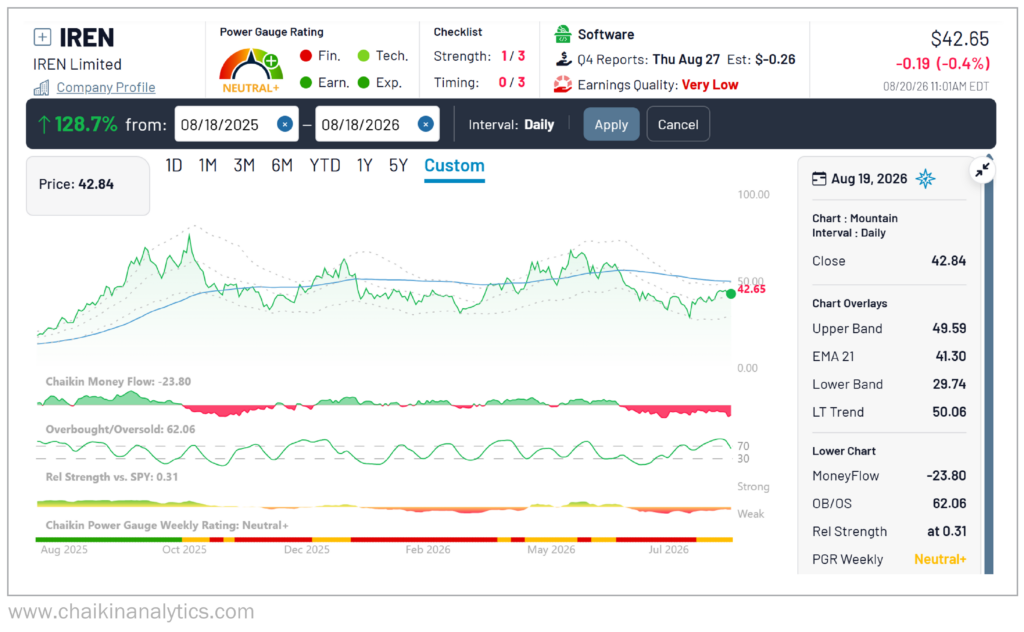
But the Chaikin Power Gauge Rating for Iren is “neutral+” because of the company’s high long-term debt-to-equity ratio, driven primarily by its pivot toward AI infrastructure and the exorbitant costs associated with it. Iren also reported negative free cash flow and a net loss of $247.8 million in its fiscal third quarter.
Still, there are reasons to be bullish on Iren. For one, it controls a huge 5.8 GW power and data-center infrastructure pipeline that paves the way for a substantial build-out. And major planned GPU fleet expansions have pushed Iren’s expected cloud annualized revenue run-rate to more than $4 billion.
Plus, Iren continues to mine bitcoin, which delivers supplemental revenue that can also help finance its cloud infrastructure business.
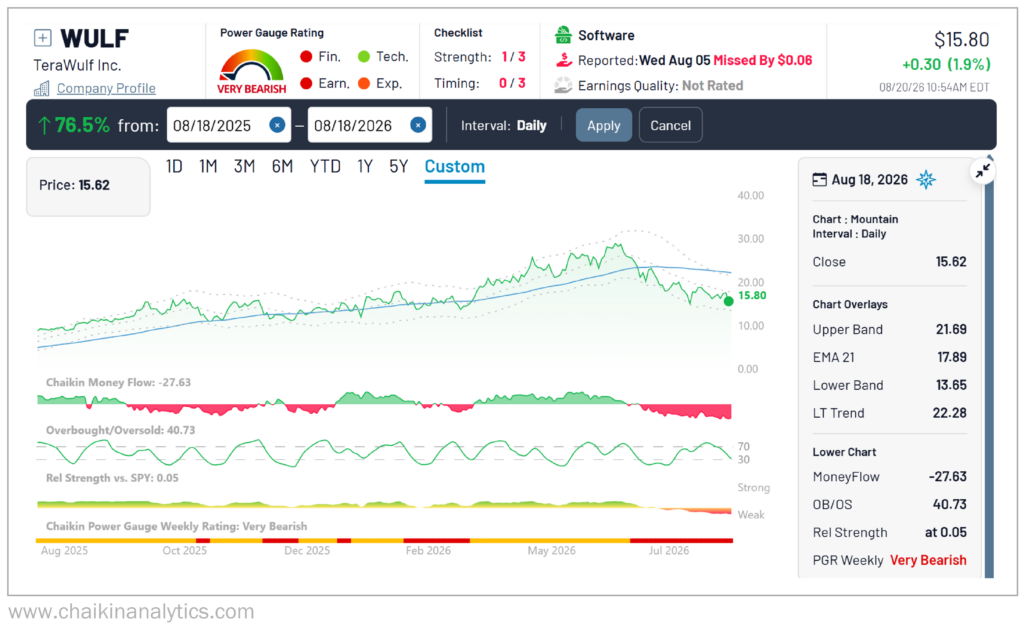
Finally, there’s TeraWulf (WULF), a builder and operator of data centers primarily powered by nuclear energy and hydropower, among other clean energy sources. The company made a splash in July when it partnered with AI giant Anthropic on a massive 20-year, $19 billion deal to lease TeraWulf’s data-center space in Kentucky and roughly 401 megawatts (“MW”) of IT load.
A year before the Anthropic deal, TeraWulf and neocloud platform Fluidstack agreed to a 10-year, 200-plus MW AI-hosting contract valued at roughly $3.7 billion (up to $8.7 billion if multiyear extension options are exercised). Key to this deal is that Google is financially backing up to $1.8 billion of Fluidstack’s lease and debt obligations.
And, like Nebius and Iren, TeraWulf has worked customer prepayments into its major deals. The most significant is likely its 10-year, 72.5 gross MW agreement with G42 (a subsidiary of global sovereign AI leader Core42), which TeraWulf expects to generate $1.1 billion in high-margin revenue. As part of this deal, Core42 paid TeraWulf $90 million up front to ease capex concerns.
In its second-quarter earnings report, TeraWulf disclosed a $27 billion backlog and a 2.1 GW pipeline across its sites. That sets the company up well for the foreseeable future.
TeraWulf stock has taken off over the past year, up by more than two-thirds since last August 18. But the Chaikin Power Gauge suggests investors proceed with caution. The stock is rated “very bearish” due to its weak earnings and financial metrics, as well as its high debt-to-equity ratio.
Lender-Backed: CoreWeave
We’ve already covered CoreWeave’s recent highlights and challenges. To be clear, CoreWeave has a solid bull case. Its 112% year-over-year revenue increase, $100 million-plus jump in operating income, 1.5 GW of active power, and $104 billion backlog – which doesn’t count the $25 billion in commitments secured so far in the third quarter – tell a powerful story.
The big issue is CoreWeave’s debt. The company continues to build out its infrastructure with the future in mind, but it’s piling up a massive amount of debt (at least $35 billion as of June 30) in the process.
When considering whether to invest in CoreWeave, it’s difficult to look past these facts that I mentioned earlier:
- $640 million net interest expense in the second quarter of 2026 versus $267 million the year before.
- Net interest growth rate of 140% versus revenue growth rate of 112%.
Until those results improve, it’s tough to have full confidence in CoreWeave as anything other than a high-risk, high-reward investment. The Chaikin Power Gauge seems to agree with that sentiment, rating the stock as “very bearish” in large part because of its debt.
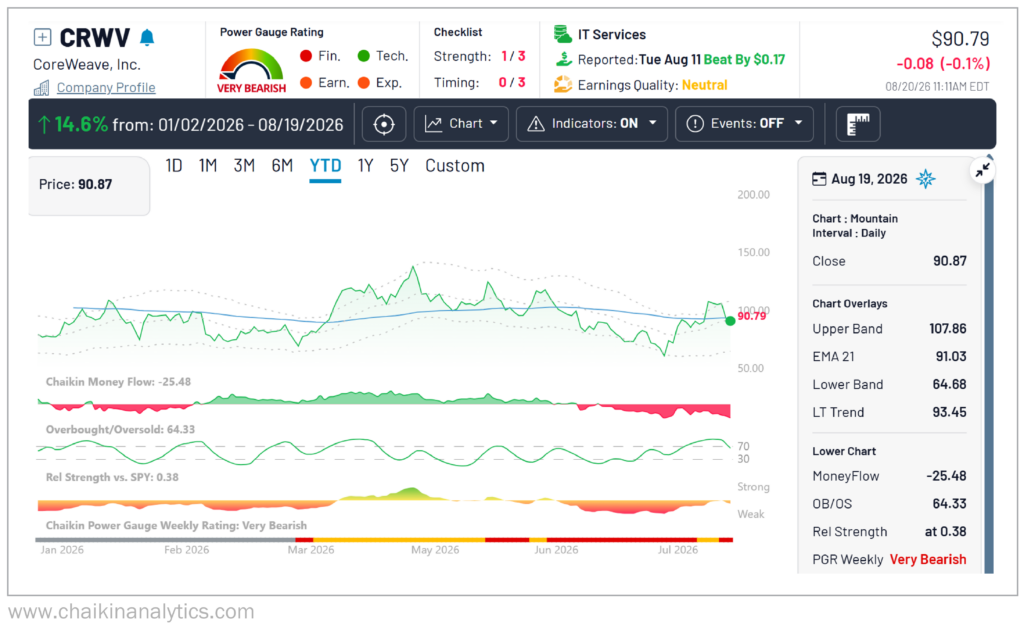
All that said, the stock is up 53% since late July and roughly 17% year to date (as of market close on August 18), which makes a strong case for taking profits.
Bottom Line on Neocloud Stocks
The demand for neoclouds isn’t in question. Massive backlogs at CoreWeave and Nebius prove that. What remains in question, however, is the funding needed to keep neocloud companies and their operations running.
The industry requires massive upfront capex to buy the hardware and power the data centers before a neocloud company ever sees a penny in revenue. The two neocloud giants – CoreWeave and Nebius – have clearly taken very different paths toward funding their build-outs. And upstarts like Iren and TeraWulf have followed the Nebius playbook.
The rest of the year will shed important light on these neocloud companies and whether they can execute their backlogged contracted projects and turn them into flowing cash without incurring substantially more debt.
Customer prepayment contract stipulations should help Nebius, Iren, and TeraWulf avoid that fate. But CoreWeave, though it generates plenty of revenue, is already deep in debt and doesn’t seem to mind adding more to the pile if that will accelerate its infrastructure expansion.
Investors should circle these dates on their calendars: August 27 (Iren full fiscal-year 2026 earnings) and November 9 (TeraWulf third-quarter earnings). CoreWeave and Nebius are expected to report earnings in mid-November. At that point, we’ll have a better idea of how each funding approach is impacting the bottom line of these top neocloud stocks. So, while the billions in backlogs are impressive, it’s the debt numbers that may ultimately matter more.
Regards,
David Engle
Editor’s Note: “Frontier AI” is a point of no return when AI surpasses human intelligence and gains free will. Elon Musk warns this moment could hit by the end of 2026. When it happens, 60-year Wall Street legend, Marc Chaikin, predicts Frontier AI could soon become the only thing that determines which stocks make money and which grind to a halt. That’s why he’s giving away a list of stocks to buy and sell absolutely FREE to help you position your money for a virtually unrecognizable world driven by Frontier AI technology. Get Marc’s Frontier AI Hotlist of stocks right here…