
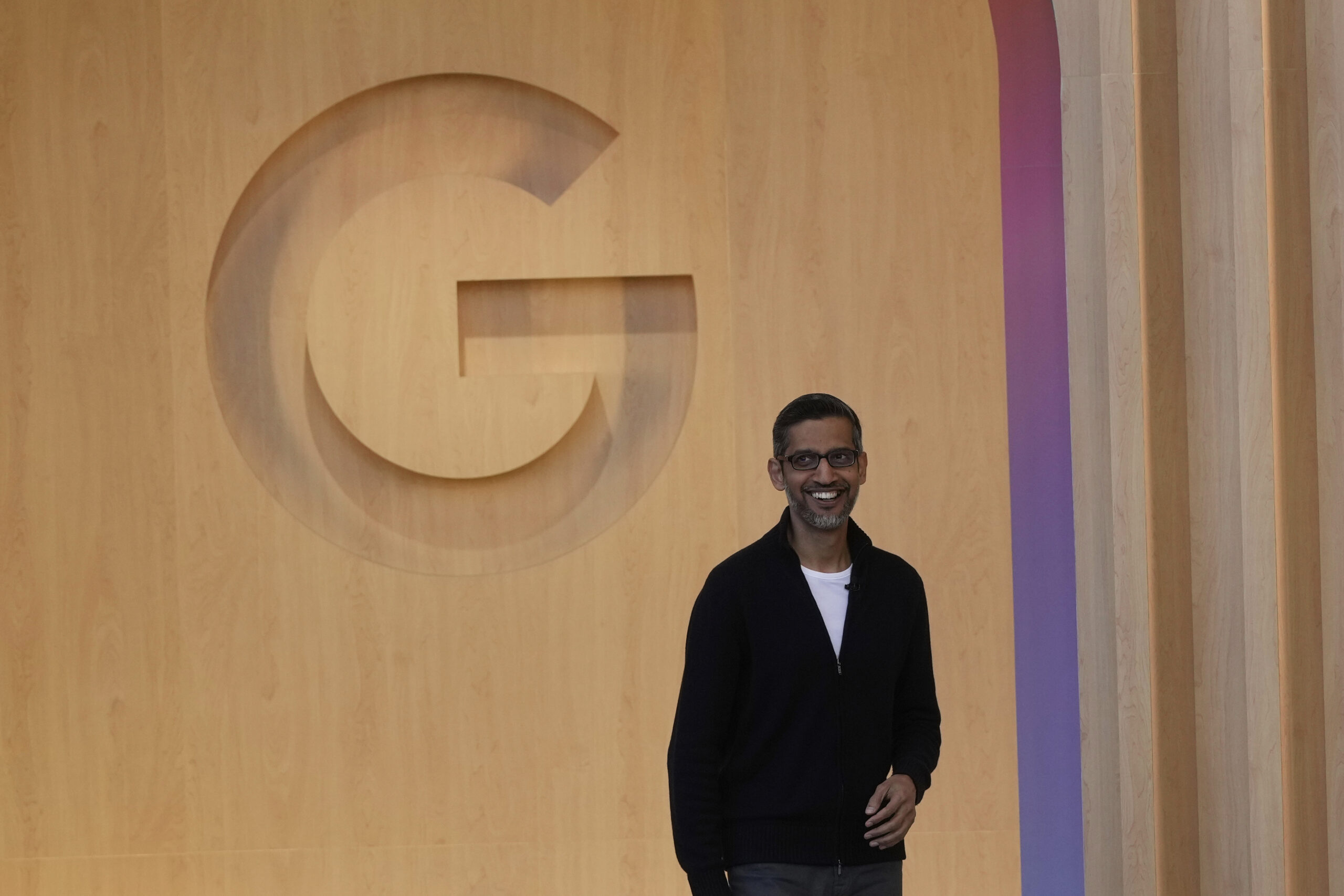
Image Credit: Associated Press
Key Points
- Alphabet is undertaking the largest equity issuance in history to help fund its rapidly expanding investment in AI data centers and infrastructure.
- Berkshire Hathaway participated in the offering, purchasing $10 billion of the stock at a 6.5% discount to the recent market price.
- Despite doubling over the past year, Alphabet shares still appear reasonably valued based on projected 2026 earnings.
Alphabet (GOOGL) is setting the record for the largest equity capital transaction ever, as it sells $80 billion in stock – including a slug of $10 billion to Warren Buffett’s Berkshire Hathaway (BRK-B) – to fund investments in artificial intelligence (“AI”) data centers.
The offering, which includes common stock and convertible preferred stock components, tops the $70 billion equity offering by Brazilian oil producer Petróleo Brasileiro (PBR) in 2010. It also tops the estimated $75 billion capital raise from the SpaceX (SPCX) IPO planned for mid-June.
Alphabet’s sale of stock consists of a few components:
- A $40 billion “at-the-money” offering that allows the company to sell shares over a period of time when pricing is attractive.
- A $15 billion sale of common stock
- A $15 billion sale of mandatory convertible preferred stock
- A $10 billion private placement with Berkshire Hathaway
Alphabet’s decision to finance investments such as AI data centers with stock is a major shift. The biggest players in AI data centers – hyperscalers such as Meta Platforms (META), Microsoft (MSFT), and Amazon (AMZN) – have typically opted to issue debt to fund their capital spending.
So, Alphabet’s massive equity sale should make investors curious as to why it went in this strategic direction – and expect that other hyperscalers may soon follow its lead.
Here’s Why Alphabet Is Issuing $80 Billion in Stock
Alphabet last issued equity in 2006, a minor $2.1 billion issuance, according to Bloomberg. At the end of March 2026, the company held nearly $127 billion in cash and equivalents after $85 billion in debt issuance in the past 12 months. So why is Alphabet selling more expensive equity now?
There are at least two key reasons:
First, it helps the company’s balance sheet avoid becoming overburdened with debt, and since the company is expected to make massive AI investments, stock financing gives it greater flexibility and safety.
Usually, debt financing is cheaper than equity financing, and interest expense can be written off for taxes. In contrast, equity financing tends to be more expensive, given the higher returns that investors demand from stock.
But stock is a safer alternative than debt, since it doesn’t require the company to make any payments, and it may be preferable if the firm already has a lot of debt.
Companies with skilled capital allocators typically issue stock when the potential return exceeds the hurdle rate on the stock or when additional debt might create further risk.
And second, the hyperscalers’ capital spending plans are ratcheting up even faster than they expected. At the start of the year, the four big hyperscalers – Alphabet, Microsoft, Amazon, and Meta – were expecting about $650 billion in investment for 2026. Just months later, their estimates had already ballooned to a whopping $725 billion.
The 2026 spending is set to consume 94% of their operating cash flow, according to PIMCO, so they’ve turned to bond markets. They’ve been issuing hundreds of billions of dollars to pay for that higher AI spending. Besides last year’s new debt, they’re on pace to issue more than $200 billion this year, according to analysts from Barclays, and they’ll likely continue more debt financing in 2027.
Alphabet projects capital expenditures of $180 billion to $190 billion this year, and plans to increase that further in 2027. Issuing stock now – while it’s not far from an all-time high – offers low-cost financing, reduces the risk of further debt, and gives the company flexibility later on.
Berkshire Investment in Alphabet Is a Vote of Confidence
Berkshire’s investment in Alphabet offers a vote of confidence in Alphabet, but it remains a bit of a head-scratcher. Berkshire’s $10 billion investment in Alphabet’s Class A and Class C stock was priced at a 6.5% discount to their respective closing prices on the day the deal was announced.
While it’s typical for an investor in a private placement to receive a discount as an inducement to participate, it’s atypical for Berkshire to invest in a tech stock in any size at all. Of course, with legendary investor Warren Buffett no longer in the CEO role, Berkshire will operate differently under Greg Abel’s leadership.
Nevertheless, it doesn’t seem like the most obvious move for a value investor, even if Berkshire’s massive size limits its investment options to only the largest companies.
On the one hand, Berkshire has been clearing out its position in Apple (AAPL) and has notably been a net seller of stocks for the past few years, too. Under Buffett, Berkshire was amassing hundreds of billions in cash. Under Abel, Berkshire reported $397 billion in cash and equivalents in the first quarter of 2026 that was otherwise uninvested.
In other words, it certainly looked like Berkshire was not that interested in owning much.
That said, Berkshire did own about $6.6 billion in Alphabet at the end of the fourth quarter, but it was a much cheaper stock at the time, still rebounding from last year’s low.
On the other hand, 2026 earnings estimates on big tech stocks such as Alphabet have risen markedly in the past few months, leaving them trading at lower, albeit not cheap, multiples.
For example, the average estimate of Alphabet’s 2026 earnings per share rose from $11.46 just 60 days ago to $14.22 now, according to Yahoo Finance. That puts the forward price-to-earnings ratio at just above 25 times – not absolutely cheap, though it’s a reasonable price for a high-quality stock such as Alphabet. Plus, don’t forget Berkshire’s 6.5% discount to that price.
Still, the stock is not all that far from its all-time high, in part due to uber-bullish AI optimism, and the uncertain economics of AI mean that Alphabet is not the kind of “all-weather” stock that Berkshire has long fancied. Companies are finding that AI is not saving them as much money as they had assumed it would, according to a recent Bain & Co. survey of large organizations.
Similar reports have emerged questioning the return on investment offered by AI, with some companies scaling back employees’ daily use of AI tools. Uber (UBER) said that the ride-hailing company has found it difficult to link its use of AI with the creation of customer-serving features.
Does Berkshire’s Investment Make Alphabet a Good Buy?
It’s rarely a good idea to buy a stock just because a big investor is acquiring shares, though it’s a great idea to follow what these investors are doing so you can get leads for your own stock analysis.
Alphabet is a great example of the latter. With a strong competitive position trading at a reasonable value, Alphabet looks like an attractive purchase, even if the stock has already doubled over the past 52 weeks. With AI optimism in full swing and Alphabet one of the market leaders, it looks poised to continue that position if AI works out as well as bulls expect.
Regards,
James Royal, PhD
Editor’s note: Greg Abel’s first letter to Berkshire shareholders pointed out how much Warren Buffett had been influenced by baseball legend Ted Williams. It fascinated me because Altimetry’s Rob Spivey referenced the very same player in his recent investigation into why Buffett has chosen 2026 to step down. If you haven’t seen it yourself, you should take a look — it could have huge implications for the market this year.