
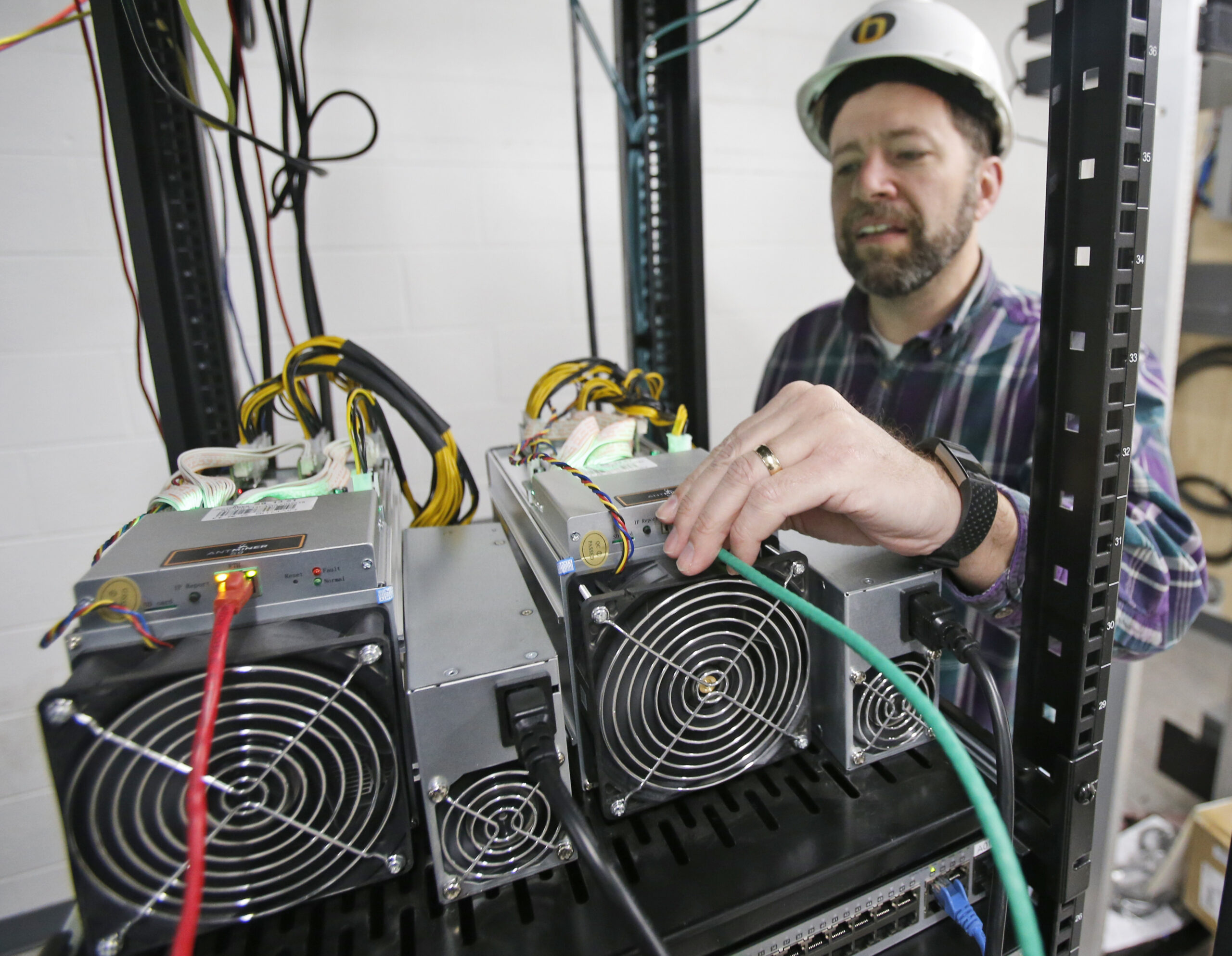
Image Credit Associate Press
Key Points
- Bitcoin has struggled in 2026, but many bitcoin-mining stocks have outperformed as investors focus on their expanding role in AI infrastructure.
- Several miners are shifting from cryptocurrency production toward supporting AI data centers and power-generation projects.
- Six companies making the AI transition appear particularly well positioned, with backing from hyperscalers such as Alphabet and Microsoft and billions of dollars in contracted energy projects.
Bitcoin briefly broke below $60,000 for the first time since 2024 last week.
On June 5 alone, more than 300,000 traders got liquidated. Roughly $1.6 billion in leveraged positions was gone in a day.
Michael Saylor’s Strategy (MSTR) — the company that spent six years telling the world it would never sell a single coin — filed paperwork showing it sold some coins. For many, this was the “tell.”
The bad news wasn’t over. Spot bitcoin ETFs bled more than $4 billion over a record 13 straight sessions of outflows. Meanwhile, the Bitcoin Fear & Greed Index printed at a 10, indicating an extreme level of fear in the crypto markets.
I spent nearly three decades trading on the floors in Chicago, and I can tell you this smells like a washout.
But that’s not the story I want to write about today.
Rather, it seems that nobody screaming about the crash can answer this one question.
If bitcoin is collapsing, why are bitcoin mining stocks up more than 50% this year?
That’s not a typo. A May 28 analysis by 10x Research showed Bitcoin was down more than 17% in 2026. Meanwhile, a tracked basket of publicly traded crypto mining stocks was up 56% over the same period. (Bitcoin has declined even further since then, now down by nearly 30% on the year.)
The companies built to produce the asset (crypto) are now the ones helping to demolish it.
When I see a divergence that wide, I don’t ask who’s wrong. I ask what changed. And in this case, what changed is the entire business these companies are in.
They Stopped Selling Hash and Started Selling Power
Mining was always a meat grinder. Difficulty ratchets up forever, the halving chops your revenue in half on a schedule, and your entire income statement is chained to one volatile price. Earlier this year, public miners were reportedly losing about $19,000 per coin they pulled out of the ground.
Then the AI buildout ran into a wall — and that wall wasn’t chips.
Nvidia can make GPUs faster than America can energize buildings to house them. The scarce thing in AI right now is power: grid interconnects, substations, transformers, cooling – all permitted and live. This takes years of lead time if you’re starting from a cornfield.
Now, who already owns enormous, energized, grid-connected industrial sites all over the country? Bitcoin miners.
Wall Street firm Bernstein boiled the whole trade down to three words: follow the gigawatts. Listed miners control more than 27 gigawatts of planned power capacity. Announced AI deals so far cover about 3.7 of those gigawatts — call it 14% spoken for. Nearly $90 billion in AI partnerships have already been signed, and Bernstein sees the sector’s AI revenue growing roughly ninefold by 2030, from $1.2 billion to over $10 billion.
And here’s the part that gets my attention as a trader… Even after this rally, Bernstein figures miners still trade at something like a 90% discount to established data center operators on certain metrics.
Same substation. Same transformer. Different tenant. The market pays a fortune more for a megawatt feeding Nvidia GPUs than one feeding bitcoin ASICs, and the companies making that switch are getting re-rated from “speculative hash factory” to “critical AI infrastructure” in real time. The re-rating is nowhere near done.
The Google Co-Sign
Before I rank the winners, you need one piece of machinery, because it’s the quality filter for everything below.
Miners could never borrow cheaply. No investment-grade credit. The fix that unlocked tens of billions is called a hyperscaler backstop: a miner signs a 15- to 25-year lease with an AI cloud tenant, and a giant like Alphabet’s Google (GOOGL) guarantees the lease payments. That guarantee turns the contract into collateral, and suddenly the miner is raising billions at rates that were a fantasy two years ago.
In plain English: Google is co-signing the lease.
On the trading floor, we had a saying — “watch what they do, not what they say.” A press release about an AI strategy would definitely be considered “what they say.” Meanwhile, a trillion-dollar company putting its balance sheet behind your 25-year lease falls squarely under “what they do.”
6 Biggest Winners Making the AI Pivot
1. IREN (IREN) — The Operator
IREN made the boldest call in the group: Don’t just rent the building, own the GPUs and sell the compute.
The anchor is a roughly $9.7 billion Microsoft (MSFT) contract covering 76,000 Nvidia GB300 GPUs at its Childress, Texas campus, with reported project EBITDA margins near 85%. Add a direct Nvidia partnership, a power pipeline approaching 5 gigawatts, and my favorite detail in the whole sector… IREN holds zero bitcoin in treasury, by choice.
Analysts see AI and high-performance computing hitting roughly 71% of revenue by year-end. IREN is a top pick of Bernstein’s with a $100 target, nearly double the current share price. It has the richest margins in the group — and the most execution risk, because owning hardware means owning the refresh cycle.
2. TeraWulf (WULF) — Google’s Landlord
TeraWulf has quietly stacked the deepest backlog in the sector with roughly $13 billion in contracted AI revenue across 10- to 25-year leases with Fluidstack and Core42.
The proof it’s for real? Google has backstopped $3.2 billion of those obligations and taken an equity stake of about 14%. Sit with that one — Google owns roughly a seventh of a former bitcoin miner.
The red flag for investors to watch? About 91% of that contracted revenue runs through a single tenant.
3. Cipher (CIFR) — The Fastest Learner
Cipher — fully rebranded from Cipher Mining — has basically exited bitcoin production and replaced it with a $9.3 billion contracted backlog, anchored by a 300-megawatt AWS deal and a Google-backstopped Fluidstack agreement.
What I admire is the trajectory. Each deal got structurally better than the previous one: newer leases shifted to triple-net terms pushing net operating margins toward 100%, and its latest $2 billion raise priced a full point cheaper than the one before it.
When your terms improve every time you sit down at the table, that’s leverage.
4. Core Scientific (CORZ) — Already There
If you want proof that this pivot shows up on an actual income statement and not just in press releases, here it is.
Core Scientific has roughly $10 to 12 billion in contracted AI cloud business with cloud heavyweight CoreWeave across about 590 megawatts and six sites — and AI co-location already accounted for 39% of total revenue last quarter.
Everyone else is promising the transition. Core Scientific is reporting it.
5. Hut 8 (HUT) — The Pipeline Monster
Hut 8 signed a 15-year lease worth about $7 billion at its River Bend campus — with AI lab Anthropic among the counterparties — and is building a Texas facility to Nvidia’s reference architecture.
The eye-popper is the 8.5-gigawatt development pipeline, the largest undeveloped power position in the sector. That’s either the biggest option in the group or the biggest construction risk, and honestly, it’s both until the leases get signed.
6. Applied Digital (APLD) — The Conversion Play
Applied Digital has multiple 15-year CoreWeave leases covering 400 megawatts in North Dakota — roughly $11 billion in contracted value, hosting margins above 25%, and its newest campus pushing total contracted capacity past a gigawatt.
A key thing to watch: the next multi-billion-dollar phase depends on hitting ready-for-service dates in mid-2026. Check your calendar. That’s now. The make-or-break construction deadlines for this entire sector are happening as you read this.
The Show-Me Stories — and One Warning
Riot Platforms (RIOT) and CleanSpark (CLSK) both carry Bernstein outperform ratings, but they’re being paid in potential, not contracts. Bernstein pins $3 billion of Riot’s enterprise value on its planned 1-gigawatt Corsicana site — a facility with no meaningful revenue yet. One signed hyperscaler lease and that stock re-rates in a hurry.
MARA Holdings (MARA) remains largely a bitcoin proxy. Which means it eats bitcoin’s downside without collecting the AI re-rating. In the old world, MARA was how you traded this sector. In the new world, that’s exactly the exposure money is running from.
And Bitfarms just announced it is liquidating its entire treasury — all 1,827 of its bitcoin — to fund the AI pivot. It’s like selling the family’s silver to buy a seat at the table. A bold move if they land an anchor tenant, and a brutal one if they don’t.
What Can Kill This ‘Miner Pivot’ Trade
Three things could really create some risk for this trade, and I’d ask you to think carefully about all of them before falling in love with any of these charts.
- Tenant concentration. Several of these companies lean overwhelmingly on one or two young AI cloud tenants — Fluidstack, CoreWeave. If anything wobbles upstream, those “contracted revenue” headlines reprice across half the sector at once.
- Construction deadlines. Billions in projections hang on facilities going live in mid-2026. Every milestone update over the next 90 days is a binary event, and binary events are where fortunes change hands.
- Circularity. A lot of this ecosystem includes hyperscalers backstopping AI cloud leasing from miners to serve demand the hyperscalers are also funding. If the AI capital expenditure cycle cools, the daisy chain reprices together. And don’t miss the bitcoin angle — miners selling their coins and redirecting hash power to fund the transition is one more structural headwind for the coin itself.
The Footprints Showed Up First in Options Trading
Here’s the part of this story I find genuinely fun, because I watched it happen on my screens.
Moves like this don’t typically introduce themselves in press releases. They first show up in the options market.
Before the upgrades, ahead of the headlines, institutional desks position themselves — and that positioning often leaves footprints.
Unusual size. Unusual strikes. Unusual timing, in names retail isn’t watching yet. I spent much of my career on the trading floor standing next to the people placing those orders. Now I read their footprints off a screen instead.
Separating genuinely informed flow from noise is what we built our Advanced Notice system to do, and we just rebuilt its entire scoring engine after backtesting roughly 127,000 flagged options events. The new engine asks one question: Which unusual flow actually goes on to beat the market’s own volatility expectations? In testing, the top-tier signals cleared that bar 77% of the time. And here’s what made me smile — the names rising to the top of the new rankings look a lot less like meme stocks and a lot more like the quiet infrastructure plays in this article. Real businesses whose flows genuinely surprised the market.
When an entire industry is being re-rated from crypto proxy to AI landlord, the edge is knowing which names institutions are accumulating before the next round of headlines. That’s the whole game. It always was…
Jonathan Rose breaks down institutional options flow live every trading day at 11 a.m. ET on the Masters in Trading channel — including the names Advanced Notice is flagging in AI infrastructure right now.
Frequently Asked Questions
Why is bitcoin crashing in June 2026?
Bitcoin has encountered a record 13-day ETF outflow streak, a hawkish Fed, capital rotating into AI stocks and IPOs, and sentiment shocks from Strategy’s first bitcoin sale since 2022 plus renewed AI and quantum security fears.
Worth keeping straight: Strategy’s sale was 32 bitcoin — about $2.5 million against a position of more than 843,000 coins. The reaction was largely about the symbolism, and not the size.
Which bitcoin miners have pivoted to AI data centers?
Bitcoin miners that are furthest along in the pivot: IREN, TeraWulf, Cipher, Core Scientific, Hut 8, and Applied Digital — together holding tens of billions in contracted AI revenue. Riot and CleanSpark control big power positions but haven’t signed major AI leases yet. MARA remains primarily a bitcoin miner.
Is IREN still a bitcoin mining company?
Functionally, no. IREN operates as an AI cloud provider with a multi-billion-dollar Microsoft contract and a direct Nvidia partnership, holds zero bitcoin in treasury, and is projected to get roughly 71% of revenue from AI and high-performance computing by the end of 2026.
What is a hyperscaler backstop?
A credit guarantee in which a tech giant like Google backs the lease payments that an AI cloud tenant owes to a data center owner. It lets the owner borrow billions at lower rates to fund construction — and it signals to investors that the contract is real. Think of it as Google co-signing the lease.
Could AI demand for these data centers slow down?
Absolutely, the AI demand could slow — that’s the central risk. The sector depends on continued AI capital spending and on young tenants like CoreWeave and Fluidstack honoring decade-plus leases. Tenant concentration and mid-2026 construction deadlines are the two things to watch most closely.
Editor’s Note: Elon Musk didn’t buy Twitter because he wanted a social media company. He bought it to build a bank. According to InvestorPlace’s Luke Lango, X-Money is already live in all 50 states, and the window to profit from it is open right now. He reveals one free stock pick in this urgent presentation.