Image Credit: Associated Press
Key Points
- IBM is entering the fast-growing neocloud market through Together AI, using Nvidia’s next-generation infrastructure to provide large-scale AI inference capacity without becoming a traditional data-center operator.
- Nvidia stands to benefit from another major deployment of its newest AI infrastructure, while CoreWeave and Nebius highlight both the enormous opportunity and significant financial risks facing pure-play neocloud companies.
- The deal strengthens IBM’s AI strategy, but risks remain as its core business grows slowly and the neocloud market remains capital-intensive, highly competitive, and relatively untested.
International Business Machines (IBM) is entering the neocloud market. That became official when the long-standing technology titan announced a $240 million deal with Together AI, a private neocloud provider founded in 2022 that rents out AI-computing capacity so businesses can run, customize, and improve free, public AI models without buying costly hardware.
As partners, IBM will provide Together AI, which just raised $800 million on an $8.3 billion valuation, with dedicated AI-computing capacity on IBM Cloud using next-generation Nvidia (NVDA) HGX B300systems. The deployment should roll out sometime during the first quarter of 2027.
This is a big step for IBM as it pivots further into its AI strategy. Here, we’ll examine the significance of this agreement, IBM’s move into the neocloud business, and which stocks will be the most impacted by the deal.
Why Moving Into the Neocloud Business With Together AI Makes Sense for IBM
Probably the biggest takeaway from this agreement is that IBM has positioned itself to become a significant player in the neocloud market. This is a major – and possibly even slightly uncomfortable – shift for IBM, a company that has long made its money as a software provider and enterprise-technology expert.
IBM is considered the “old guard” in the tech world. So, this type of move into a hypergrowth sector like the neocloud market is a big deal and not one to be made lightly. But IBM has been around for more than a century for a reason – it knows what it’s doing.
The company saw an opportunity to deliver back-end technology that can support huge AI workloads… and generate significant revenue doing so. IBM seized that opportunity through this deal with Together AI.
And even as IBM enters the neocloud business, this agreement doesn’t position the company as a direct competitor of industry leaders CoreWeave (CRWV) and Nebius (NBIS).
Instead, IBM takes on a landlord-type role by building high-end graphics-processing-unit (“GPU”) clusters on IBM Cloud. Rather than directly renting or selling this specialized hardware and software to users, IBM will take more of a wholesale – as opposed to retail – approach.
From there, Together AI takes on the role of a “tenant” as it buys large amounts of computing capacity on IBM Cloud and then packages and resells it to other businesses under the Together AI brand.
In this specific agreement, Together AI will apply its own developer software and application-programming-interface (“API”) layer and sell inexpensive AI inference to smaller developers and open-source teams. This boosts the small neocloud company, as it’s backed by IBM’s enterprise security.
And IBM could earn revenue not only from wholesale leasing, but also from cybersecurity-services integration and related software sales, like its Red Hat AI Factory stack.
Plus, there’s the AI-infrastructure exposure this deal delivers to IBM, as Together AI’s platform now serves roughly 400 trillion tokens a month.
Nvidia’s participation is a key component of this deal, which creates the first large-scale, dedicated inference cluster on IBM Cloud using Nvidia’s latest HGX B300 systems, as well as the company’s Spectrum-X Ethernet networking.
Why does this matter? Because Nvidia’s B300 infrastructure provides up to 30 times the AI factory output of previous-generation systems. The result is high-speed output, which Together AI will deliver at a low cost on a massive scale.
The Together AI deal represents the next phase of the data-center partnership between IBM and Nvidia, which was initially forged in 2013 and expanded upon in March to cover not only cloud and hardware integration, but also the optimization of data and analytics, consulting, and data sovereignty.
If this all seems a bit complicated, that’s because it is. But this deal is a smart, strategic move for IBM. Through Together AI, IBM gains important AI-infrastructure exposure and demand from Together AI’s 400 trillion processed tokens per month – without having to dive into the highly speculative and risky data-center building/operating business.
This Deal Is About Bookings, Not Revenue, for IBM… For Now
One important factor to keep in mind with this deal – there will likely be around a one-year gap from the signing of the contract until IBM sees any real revenue.
The reason for the gap is twofold. One, Nvidia’s new, highly advanced HGX B300 systems and all the networking involved will take months to ship, set up, and test before any deployment goes live.
The target date, which is sometime in the first quarter of 2027, means that roughly five to eight months will have passed from the contract signing to whenever the systems go live.
Second, due to standard accounting rules, IBM can’t count the revenue or net income from the deal until the Nvidia cluster is online and Together AI begins processing compute tokens. That will likely add a few more months to the timeline.
But IBM can count the $240 million as part of its total signings and toward the IBM Cloud backlog. And that shows potential customers that its services are in demand. As of late June, IBM’s generative-AI backlog of roughly $20.4 billion represented around 30% of IBM’s overall backlog.
So, IBM should realize a nice amount of revenue – including from the Together AI deal – within the next year or so.
The Deal’s Impact on IBM, Nvidia, and Neocloud Stocks
While IBM seemingly has the most to gain from the Together AI deal (remember, Together AI is not publicly traded), Nvidia and even neocloud companies like CoreWeave and Nebius could feel the ripple effects. Let’s look at each one:
IBM
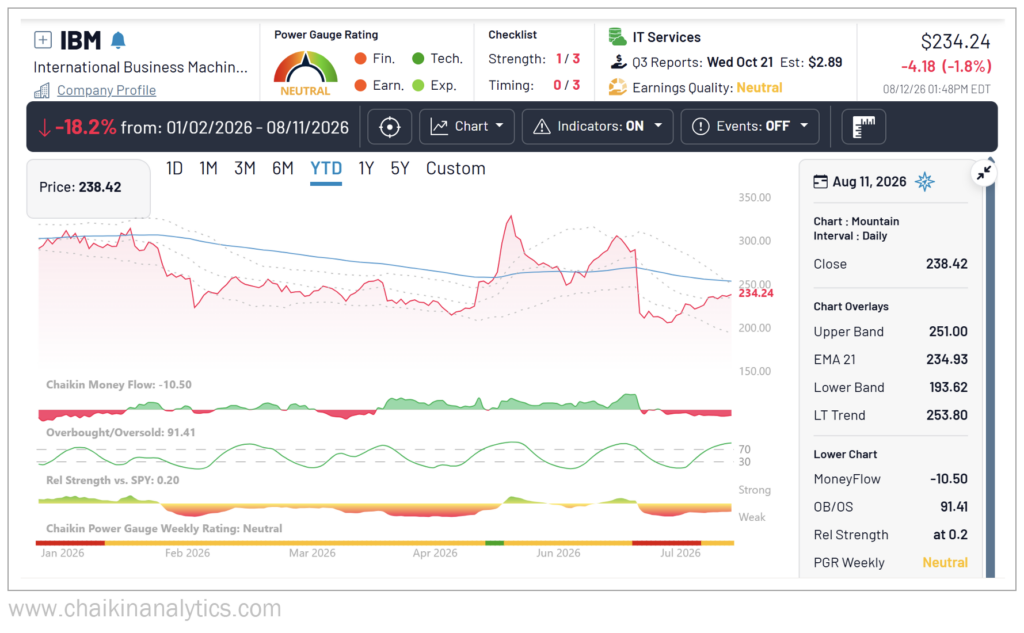
IBM stock didn’t move too much the day the Together AI deal was announced. The stock saw a very modest uptick of roughly 0.9%, closing at $238.42 on August 11. But by the next day, the stock had sunk to $231.68 before rebounding to close at just under $236.
That has been the theme for IBM, as the stock has experienced some serious turbulence since the start of the year. Overall, IBM is down 19% during that span.
The company’s overall performance, especially during the second quarter, is similar to its stock performance. Total revenue was up just 1% year over year, which fell short of analyst expectations. IBM’s free cash flow for the first half of 2026 was flat compared with last year.
Much of this can be attributed to IBM’s Infrastructure division, whose revenue plunged 7% year over year, driven by a 42% drop in the company’s signature Z mainframe revenue.
Caution seems to be the appropriate approach to take with IBM moving forward, based not only on the company’s tepid second-quarter earnings report but also on its entry into a new – and highly volatile – market.
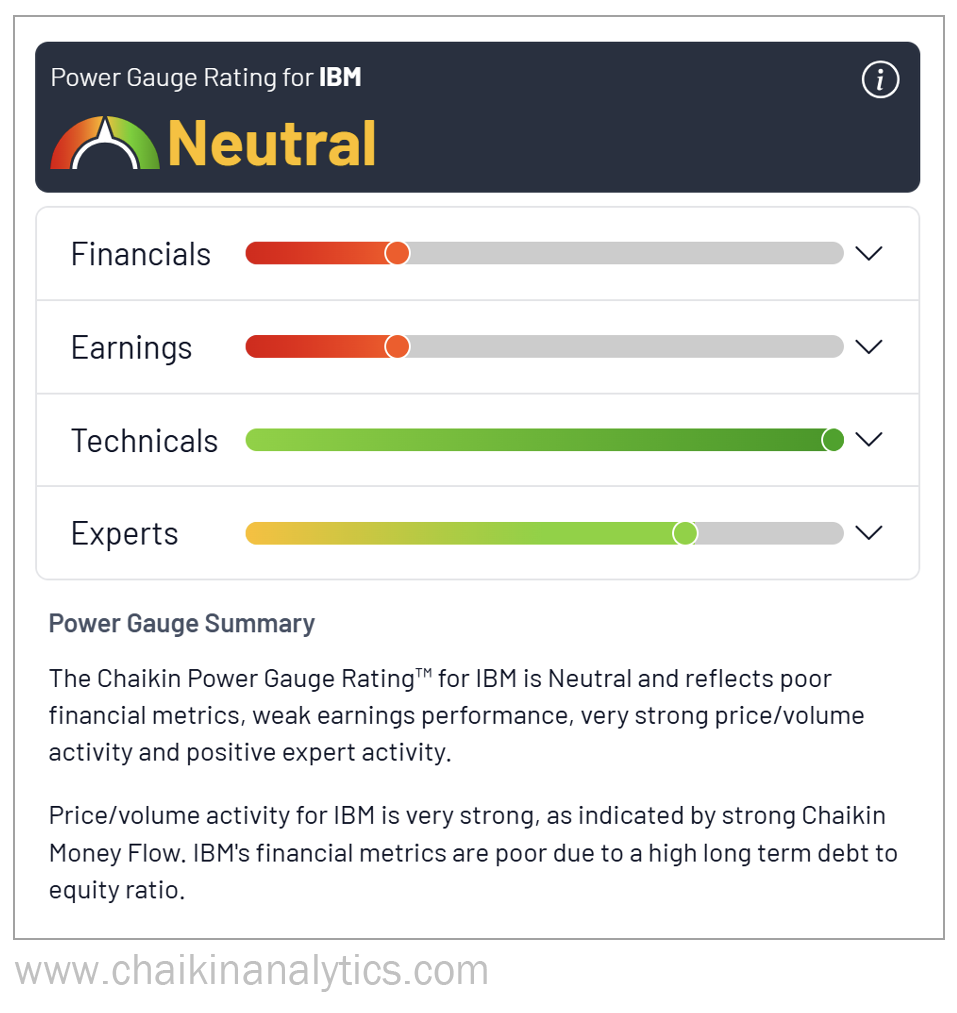
Chaikin Analytics, the investment-research platform founded in 2009 by legendary 60-year Wall Street veteran Marc Chaikin, rates IBM as “neutral” in its Chaikin Power Gauge, a 20-factor stock-rating system that scans more than 5,000 stocks and 2,300 exchange-traded funds.
Nvidia
Though not a direct participant in the IBM-Together AI deal, Nvidia still plays a pivotal role. The setup revolves around Nvidia’s first large-scale inference cluster on IBM Cloud with its advanced HGX B300 systems and Spectrum-X Ethernet networking.
Nvidia stock got a nice little bump of 1.5% in pre-market trading on August 11 after the deal was made public. But Nvidia’s stock was already quite strong. Plus, the company has so many huge deals with other businesses – this one isn’t quite the needle mover we’re used to seeing from Nvidia.
But there are a few significant layers of importance here for Nvidia.
- Nvidia says that its HGX B300 system, which links its newer Blackwell processors, provides up to 30 times more AI factory output than previous generations when paired with Nvidia’s Spectrum-X Ethernet networking. If this proves true, it’s a nice win for Nvidia.
- Speaking of Spectrum-X Ethernet, this deployment could validate the network technology’s performance as part of a huge commercial infrastructure.
- The biggest breakthrough for Nvidia may be that this specific cluster is designed to scale AI inference for large open-source and open-weight models. This is a big development, as Nvidia’s GPUs are typically used with closed-source models. And open-source AI models are gaining momentum as businesses have taken notice of cybersecurity breaches that occurred with third-party closed models from OpenAI, Anthropic, and Meta Platforms (META).
While the IBM-Together AI deal may not be the biggest or most important deal involving Nvidia, there is a lot riding on it for the company. The success (or lack thereof) within the IBM Cloud could determine how well Nvidia stock performs going forward.
Neocloud Companies Like CoreWeave and Nebius
The world’s largest publicly traded neocloud companies, CoreWeave and Nebius, didn’t feel any direct impact from the IBM-Together AI agreement. But there are plenty of tailwinds behind those two stocks at the moment.
After its strong second-quarter earnings report, Nebius stock exploded, jumping 34% from its $193.23 close on August 11 to its $259.20 close on August 12. CoreWeave experienced a similar boost after reporting that its revenue doubled year over year in the second quarter. Its shares surged 19.3% from $90.32 on August 11 to $107.73 the following day.
While separate from IBM’s foray into the neocloud world, the recent stock performances of both CoreWeave and Nebius are extremely encouraging for the industry overall. Year to date, CoreWeave is up roughly 36% and Nebius has skyrocketed roughly 188%.
That bodes well for a company like Together AI if it decides to go public, which its CEO has hinted at for 2027.
Neoclouds Still Pose Major Risks
Despite the success of neoclouds like CoreWeave and Nebius, there remains skepticism around their long-term sustainability. Yes, the demand for neocloud services is sky-high, but there’s a cost.
The equipment and data centers that neocloud businesses need to operate are prohibitively expensive. Thus, these companies are perpetually amassing debt as they continue to borrow capital to build out. If demand for neoclouds softens even a bit, that could lead to financial catastrophe.
As of late July, CoreWeave carried roughly $35.1 billion in net debt. Nebius was in far better shape, though its net debt was still roughly $220 million.
Besides heavy debt, neocloud providers are now contending with hyperscalers like Oracle (ORCL) Cloud Infrastructure, Microsoft (MSFT) Azure, and Amazon (AMZN) Web Services offering more specialized, neocloud-like services.
Let’s not forget about the volatility of the neocloud industry. As of August 12, CoreWeave’s beta – which measures a stock’s volatility against the total market – sat at an astronomically high 3.07 times as volatile as the market. Nebius wasn’t too far behind at 2.65 times as volatile.
Given these stocks’ recent surges, it’s easy to get excited about neocloud providers. But it’s important not to let the hype cloud investors’ judgments. This remains a relatively new technology and industry that is still finding its footing and experiencing both highs and lows.
Even though IBM is dipping its toes into the neocloud waters, the American tech institution finds itself in a far different situation than pure-play neocloud providers like CoreWeave and Nebius.
IBM can lean on its century-long track record (of both hits and misses, granted) and a vast portfolio of products and services that span infrastructure, software, AI, consulting, and tech support. In other words, IBM has more freedom to experiment with neocloud infrastructure, while pure-plays like CoreWeave and Nebius are far more dependent on the success of the neocloud model.
Investing in any AI-related stock – especially neoclouds – is a risky proposition that will likely take you on a bumpy ride. IBM just happens to offer a bit more stability.
Regards,
David Engle
Editor’s Note: God mode. It’s a controversial idea. Irreverent, even. But, according to 60-year market legend, Marc Chaikin, there’s no better way to brace yourself for what’s coming next for AI. Forget fake videos. The new AI emerging from Silicon Valley labs is a digital entity that thinks for itself – without human input. A year ago, that might have sounded like science fiction, but consider this a warning: Marc says we’ll hit that day this summer. And when we do, you need to be ready for AI with its own free will. Because it will change how you work, how we live, and — of course — how you invest. That’s why he’s giving away a list of stocks to buy and sell absolutely FREE to help you position your money for a virtually unrecognizable world driven by this new “godlike” technology. Get Marc’s Frontier AI Hotlist of stocks right here…