
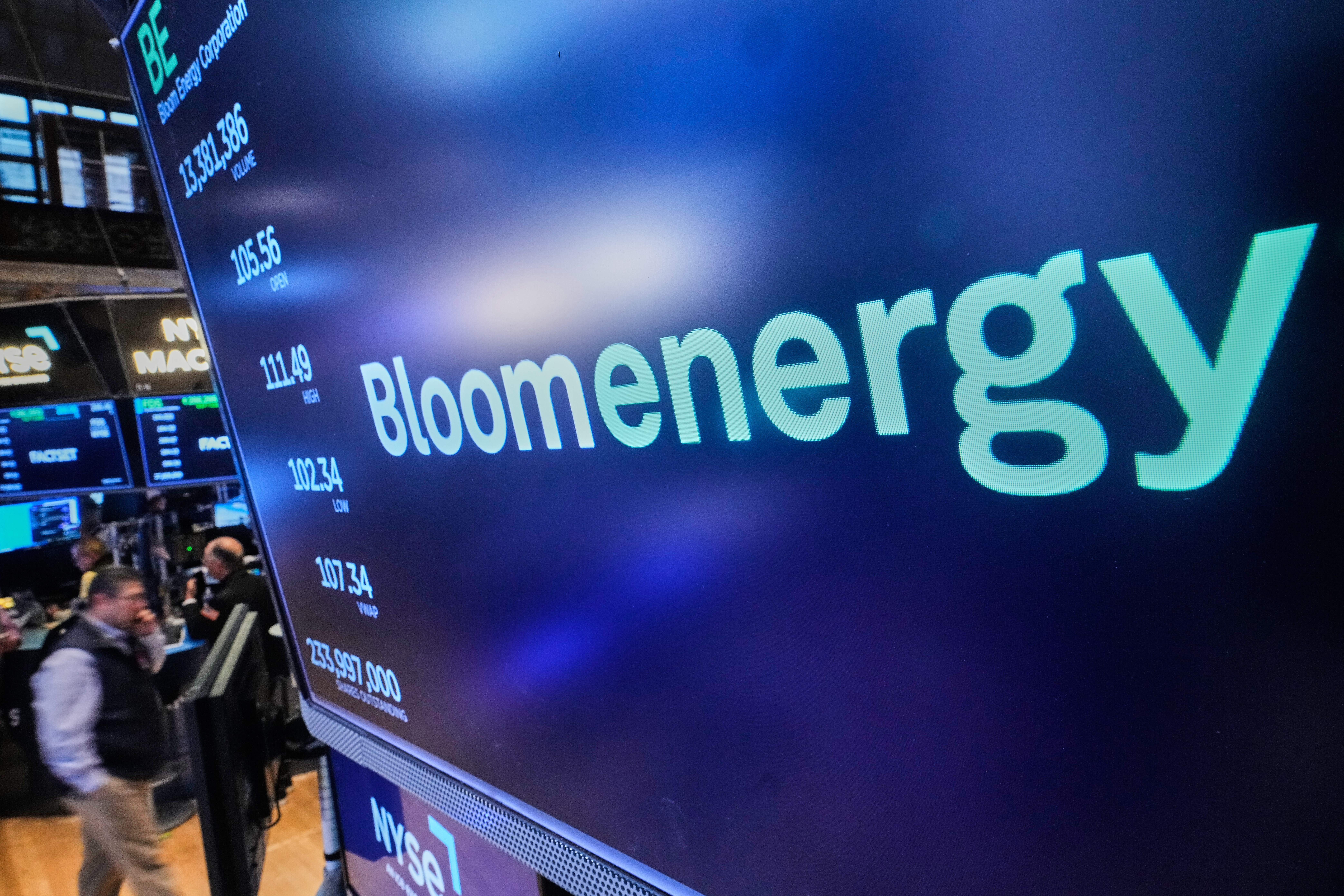
Image Credit: Associated Press
Listen to the audio version of this article (generated by AI).
Key Points
- Bloom Energy reported record second-quarter earnings as surging AI data-center demand drove strong growth and higher full-year guidance.
- The company is benefiting from increasing demand for off-grid power, with its solid-oxide fuel cells emerging as a key solution for AI infrastructure.
- Although supply-chain challenges and short-seller allegations remain risks, Bloom Energy’s leadership in AI power solutions continues to support its long-term outlook.
Bloom Energy’s (BE) stock reached an all-time closing high of $345.85 on June 22. On that date, the stock’s year-over-year increase was a staggering 1,433%. But between that all-time high and July 29, Bloom Energy stock suffered a massive 53% decline.
Despite those heavy losses over the past month or so, Bloom Energy is still up more than 460% over the past year. And, backed by an expectations-shattering second-quarter earnings performance, Bloom Energy – which designs and builds solid-oxide fuel cells (“SOFCs”) that deliver on-site, off-grid power generation – has some serious momentum at its back. Case in point: Between July 29 and July 30, the stock staged a stunning 26% rally.
So what’s driving Bloom Energy’s record earnings and volatile stock? Artificial intelligence (“AI”), of course. We all know how much power AI data centers need and that there simply isn’t enough grid availability to get that power anytime soon.
That’s where Bloom Energy comes in. Because it can provide the power data-center operators need, on-site and off-grid, the demand for Bloom Energy’s fuel cells has soared.
This year alone, Bloom Energy has forged or expanded partnerships with the following:
- A subsidiary of American Electric Power (AEP) in January, on a 20-year, $2.65 billion offtake agreement to supply SOFCs to an off-grid AI data-center project in Wyoming.
- Oracle (ORCL) in April, on an expanded master-services agreement for up to 2.8 gigawatts (“GW”) of SOFC capacity. This includes the microgrid AI campus called Project Jupiter in New Mexico.
- Nebius (NBIS) in May, on an agreement to provide around 250 megawatts (“MW”) of guaranteed power capacity for neocloud data centers in the U.S. That deal could reach up to $2.6 billion in service fees.
- Brookfield Asset Management (BAM) in June, to expand the companies’ partnership as Brookfield increases its financing of SOFC systems for AI data centers from $5 billion to $25 billion.
Bloom Energy’s Strong Earnings Beat Reflects the Surging Demand for Power
To say Bloom Energy’s second-quarter earnings performance was a success is an understatement… the results were outstanding.
Some of the year-over-year highlights included:
- A record quarterly revenue of $1.1 billion (the company’s first-ever billion-dollar quarter), a 165.5% increase.
- A 215.4% product-revenue increase to $935.4 million.
- GAAP (generally accepted accounting principles) operating income soared from a $3.5 million operating loss a year ago to $182.2 million. Non-GAAP operating income jumped from $28.6 million to $239.6 million.
- GAAP gross margin of 33.4%, up from last year’s 26.7%. Non-GAAP gross margin improved from 28.2% to 34.3%.
- Cash flow from operating activities reached $226.4 million, compared with negative $213.1 million last year.
- GAAP earnings per share (“EPS”) of $0.62, compared with last year’s negative $0.18. Non-GAAP EPS was $0.78 versus last year’s $0.10.
Just as important, Bloom Energy raised its full-year 2026 revenue guidance from a $3.4 billion to $3.8 billion range to a range between $3.9 billion and $4.2 billion.
That seems to have prompted the one-day 26% stock surge on Thursday, as investors recognized Bloom Energy’s crucial role as an off-grid, on-site energy provider for AI data centers.
SOFCs and Natural Gas Turbines Are the Big Winners as the Power Providers for AI Data Centers
Over the past couple of months, we’ve covered all types of energy and how they could be potential solutions to the AI energy crisis. Solar power, geothermal energy, nuclear power… you name it. And while arguments can be made for the viability of each, the conversation typically circles back to natural gas.
Whether that’s in the form of natural gas power plants, SOFCs, or natural gas turbines, it looks increasingly like natural gas will be at least a short-term solution for data centers and their unquenchable thirst for energy.
In my recent piece on Meta Platforms (META) and its recent push for natural gas to power its data centers, I wrote:
Natural gas turbines are becoming an increasingly popular – and efficient – way to power data centers as well…
Why? Because natural gas turbines deliver the energy data centers need, and they can be installed in a matter of months, rather than the years it would normally take to build a new power plant…
Regardless of how hyperscalers like Meta obtain it, natural gas looks increasingly like the energy source that will power data centers through the rest of the decade, and possibly beyond.
I also wrote about natural gas turbines in a July 21 article, detailing how Elon Musk recently purchased APR Energy in Jacksonville, Florida, simply to own its fleet of modular natural gas turbines to use at his SpaceX (SPCX) data centers.
But the deployment of the SOFCs that Bloom Energy manufactures is rapidly expanding. Its market growth, which was roughly $3.78 billion worldwide (at the high end of its estimated range) in 2025, is expected to reach more than $5 billion this year. Looking ahead, the SOFC market could hit more than $9.6 billion by 2030 at a compound annual growth rate (“CAGR”) of 24.4%, according to a study by BCC Research.
Right now, according to global independent research and energy-intelligence company Rystad Energy:
[SOFCs] have become the dominant technology for always-on data center power, accounting for around 53% of cumulative stationary deliveries to date. Bloom Energy holds virtually every primary-load SOFC contract in the visible order book, a concentration that presents supply chain risk if demand accelerates faster than one manufacturer’s production capacity.
That’s why fuel-cell manufacturers are working to grow production capacity. Today, the industry’s total output is 1.8 GW per year. By 2030, that output is expected to grow to 4 GW.
And considering Bloom Energy has provided more than half the SOFCs that data centers currently use for power, the company is a solid bet to continue its market domination in the coming years.
There is one thing, however, that could present a roadblock.
The X-Factor of Bloom Energy’s Future Production
A key ingredient in Bloom Energy’s SOFCs is a chemical compound called scandium oxide, which the company recovers as a byproduct of titanium, nickel, cobalt, and uranium processing. Bloom uses scandium oxide to increase power density, durability, and fuel efficiency in its fuel cells.
Bloom Energy states that scandium oxide is more abundant than lead, but that it’s generally not concentrated enough to mine directly. The company says it sources its scandium oxide from multiple countries and that its current supply chain is enough to support 25 GW of production capacity per year.
It’s important to note, however, that much of the world’s scandium oxide production comes from China. Anywhere from 60% to more than 90%, depending on the source. Bloom Energy claims on its website, however, that the company “is not dependent on China for scandium oxide.”
Not everyone agrees. Short-seller Hunterbrook Capital published an investigation in early July called “Bloom’s Big Lie,” in which it claims that Bloom Energy actually relies quite heavily on Chinese scandium. The report specifically mentions a sales representative from Hunan Oriental Scandium, alleging that the Chinese company is, in fact, Bloom Energy’s largest supplier.
Not only is there concern about that relationship, but there’s also worry that the scandium supply chain will become depleted if Bloom Energy achieves its goal of 5 GW of annual production. That 5 GW per year would require 220 tons of scandium oxide, while the world’s supply is estimated to be roughly 240 tons.
That math doesn’t add up, which is why Hunterbrook says that Bloom’s target is unrealistic.
Then there’s Bloom Energy’s reported $20 billion contract backlog. Hunterbrook claims that investigators pointed out that the company’s actual “audited, binding performance obligations remain significantly lower at roughly $492 million.”
Needless to say, these revelations – whether true or not – had an immediate negative impact on Bloom Energy’s stock, as it dipped 6% the day the report was released.
Is Bloom Energy a Good Buying Opportunity Right Now?
Between the company’s stellar second-quarter earnings report, its stranglehold on the SOFC market, the undeniable need for energy to power data centers, and the Hunterbrook allegations, there’s a lot to unpack regarding Bloom Energy.
Should investors focus more on the constant AI energy demand and Bloom’s solutions to the crisis and invest? Or should they factor in the claims made in the “Bloom’s Big Lie” report and steer clear?
The report’s allegations, if true, are certainly concerning. But Bloom Energy’s upside is difficult to ignore. Its second-quarter earnings are proof of that. And data centers’ need for power is not diminishing anytime soon. Not only that, but they need quick, clean, on-site, and off-grid power… which is exactly what Bloom Energy’s SOFCs provide.
The stock has been rather volatile lately. There was the huge drop from late June to late July. And then there was the sudden pop between July 29 and July 31. And there’s also the fact that Bloom Energy’s stock has soared over the past year, despite the recent ups and downs.
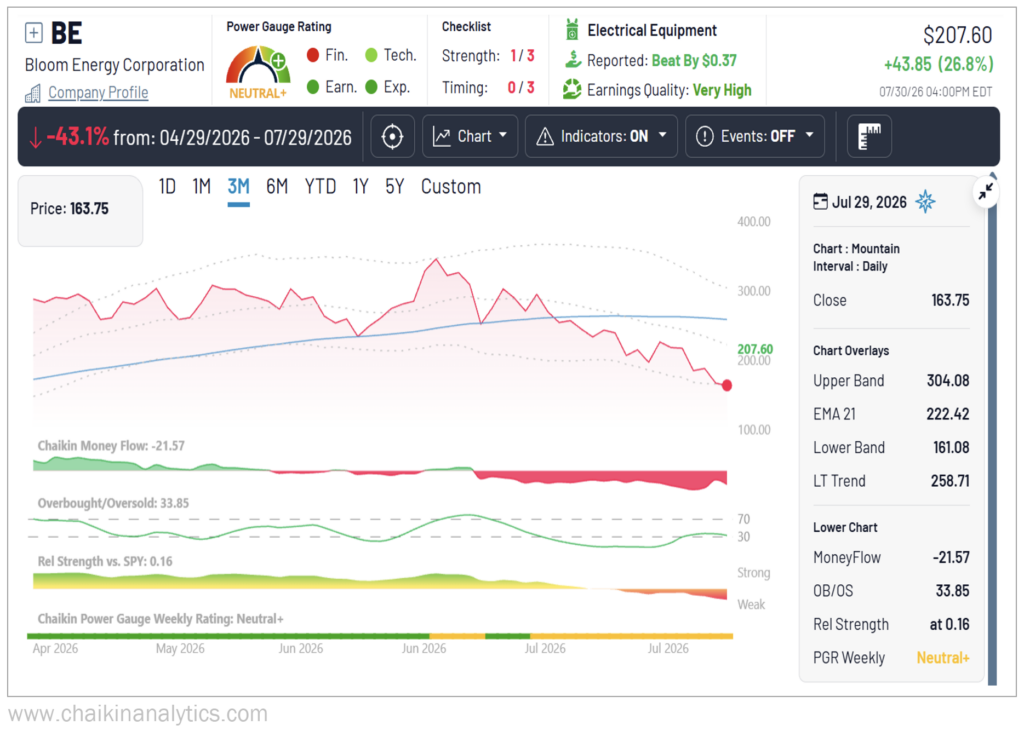
Where will Bloom Energy’s share price go next? It’s impossible to know for sure. “Bloom’s Big Lie” report aside, the company has the wind at its back based solely on the need for the fuel cells it produces. Factor in Bloom’s blowout second-quarter earnings, and there’s a lot to like about the stock right now.
Regards,
David Engle
Editor’s Note: A new “dark energy” is being rolled out as we speak… It completely bypasses our need for foreign oil. And it’s not nuclear or solar or wind or anything you would expect.
This new potential $10 trillion technology is already seeing investment by early backers of Microsoft, Google, Amazon, and more… Most important, these dozens of billionaires can’t make this tech themselves. They have to go through obscure “supplier” companies.
And in the coming months, this new “dark energy” could send three little-known stocks soaring… while wiping out 10 of the most popular stocks on the market. Learn more about this dark energy opportunity by clicking right here.
Recent Articles

The 15 Best Cybersecurity Stocks to Buy Whether AI Booms or Busts

Oracle Earnings: Watch Out for Massive OpenAI Risk Despite Blowout First Quarter