Image Credit: Associated Press
Listen to the audio version of this article (generated by AI).
Key Points
- AI just went physical. Grok (xAI) now controls Tesla’s cabin by voice, the steering-wheel-free Cybercab launched September 3 in Austin, and Optimus is next. Optimus and Full Self-Driving are the “body”; Grok is the “brain.”
- The dream is enormous. A prominent venture capitalist predicts Tesla Optimus will be bigger than the iPhone, reaching one billion units worldwide by 2036.
- The near-term reality is cautious. Optimus isn’t in full production or on sale, Tesla hasn’t officially revealed the Gen 3 robot, and external sales are targeted no earlier than the second half of 2027. Prediction markets put 2026 launch odds in the single digits.
- You may already own a piece of the AI stack. Buying TSLA stock provides indirect exposure to SpaceX, xAI, and Grok through a roughly $2 billion stake that booked a $1 billion paper gain.
- The financial reality behind the hype: Tesla’s last report showed record revenue of $28.24 billion, but operating income fell 57% and free cash flow was negative—trillion-dollar ambitions funded by a car business now burning cash.
- What to watch: A Gen 3 reveal, disclosed production numbers, and robots doing paid work. Execution, not adjectives, will be what matters.
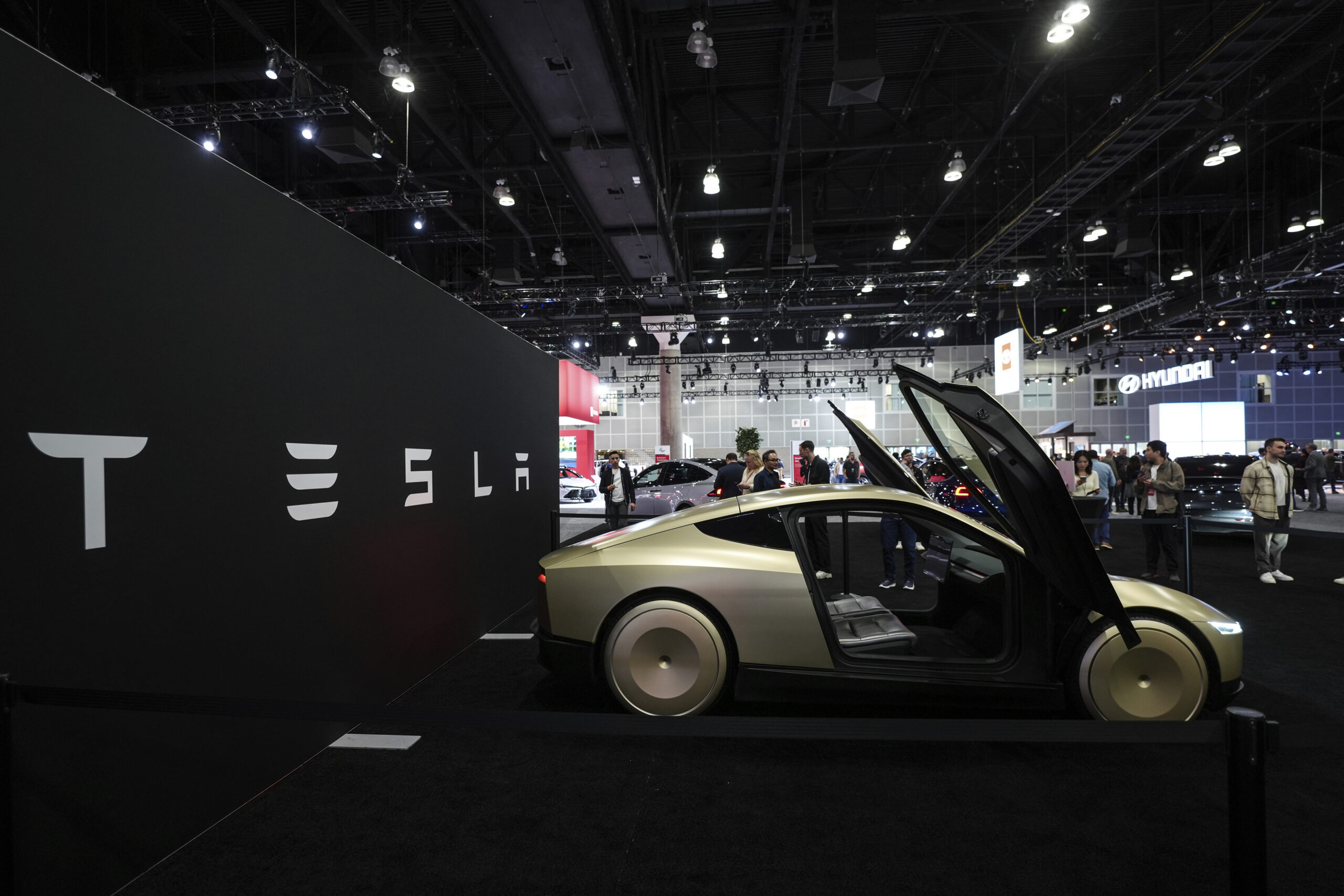
On September 3, in Austin, the Tesla Cybercab was unveiled — a two-seat robotaxi with no steering wheel and no pedals, built to drive itself using Tesla’s onboard AI. It’s a fitting image for where the company now sits: the artificial intelligence the tech world spent two years arguing about as a chatbot is becoming something physical — a car that drives you, and soon a robot that works beside you. And the assistant running the conversation inside the car? xAI’s Grok, which as of this summer controls the cabin of millions of Tesla vehicles by voice.
That’s the story the market is buying. Tesla today is really two businesses under one ticker: a car company with thinning margins, and a leveraged bet on “physical AI” — robotaxis, the Tesla Optimus humanoid robot, and the Grok stack that increasingly runs both. The bull case says Tesla is the only slice of Elon Musk’s sprawling AI empire you can own in a brokerage account. The bear case says the dream is years out and the car business funding it is under real pressure.
This piece separates the two — what’s actually shipped, what’s still a promise, and what Tesla’s own filings show once the reveal-day excitement fades.
Grok Is Now Driving the Cabin — The “Brain and Body” Thesis
The bull case for Tesla as an AI company rests on a simple split: Optimus and Full Self-Driving (FSD) are the body; Grok, from xAI, is the brain. In 2026, those two halves came together.
Tesla’s 2026 Summer Update turned Grok from a novelty chatbot into a genuine vehicle controller. Say “Hey Grok” hands-free and it now adjusts climate, makes calls, plays music, opens the glovebox, folds mirrors, toggles heated seats, and digs through settings buried in menus — chaining multiple actions from one plain-English sentence, running on xAI’s Grok Voice Think Fast 2.0. Two honest caveats: it requires the AMD Ryzen infotainment chip (older Intel cars are permanently excluded), and a community test clocked it handling 116 of 170 commands — a 68% hit rate. Useful, not flawless. And as of late August, the fully merged FSD-plus-Grok build had reached under 1% of the fleet.
The strategic point is distribution: OpenAI has an app, Anthropic has an app, and Tesla has millions of machines in driveways that just became Grok endpoints — at effectively no customer-acquisition cost, because Musk’s companies own both the AI and the cars it runs on. The next step Tesla has signaled is letting Grok sit on top of FSD as a conversational “supervisor” — tell the car “drop me at the entrance, then go park” — which is exactly the interface a driverless robotaxi passenger needs. Treat that as roadmap, not shipped.
The ecosystem TSLA is plugged into (verified, and genuinely wild): xAI merged into SpaceX in early 2026, and SpaceX went public in June in the largest IPO on record. SpaceX/xAI then agreed to buy AI-coding company Cursor (Anysphere) for $60 billion in stock — the largest acquisition of a venture-backed startup ever. And in a twist that tells you how the AI economy really works, rival Anthropic agreed to pay xAI about $1.25 billion a month through May 2029 — over $40 billion total — to rent xAI’s Colossus 1 supercomputer in Memphis, because xAI had overbuilt compute as Grok usage sagged. Tesla isn’t a direct party to those deals, but through its SpaceX stake and its deepening Grok integration, it’s wired into the same web.
The SpaceX Stake Quietly Padding Tesla’s Earnings
Here’s something almost no casual TSLA stock holder realizes they’re exposed to — and it’s the bridge to the entire AI story.
Tesla’s most recent quarter reported $1.11 billion of GAAP net income. Roughly $1.0 billion of that was an unrealized gain on Tesla’s equity stake in SpaceX — a paper mark, not operating cash. Strip it out (as Tesla itself does in its non-GAAP figures) and the quarter’s “profit” looks far thinner.
Where did that stake come from? Tesla originally invested about $2 billion in xAI. When xAI merged into SpaceX, Tesla received U.S. regulatory clearance in March 2026 to convert that position into roughly 19 million SpaceX Class A shares — under 1% of SpaceX. SpaceX then IPO’d on June 12, 2026, and its valuation surged past $2 trillion within days, lifting Tesla’s stake well above its $2 billion cost basis. Tesla carries it at fair value, so it gets re-marked every quarter — meaning it can swing the reported bottom line up or down. Mark this date on your calendar: Tesla’s sales restrictions on those shares expire in December 2026.
Why this matters for a retail trader: when you buy TSLA stock, you are also buying a slice of SpaceX — and therefore of xAI and Grok. That exposure is genuine, but it’s also a source of earnings noise. A chunk of a future “beat” or “miss” could be nothing more than SpaceX’s mark moving around. Learn to read past it.
What Is Tesla Optimus? Quick Facts
- Where it’s built: Fremont, California — Tesla shut down the former Model S/X line there and is retooling it for Optimus. A second, far larger factory is under construction at Giga Texas.
- Capacity ambition: up to ~1 million units/year at Fremont and ~10 million/year at Giga Texas over the long term.
- Target price (long-term, at scale): roughly $20,000 to $30,000 — Musk’s aspiration, not a near-term sticker.
- The brain: a vision-based neural-network stack adapted from Tesla’s FSD software, with Grok handling natural language on newer versions.
- How it learns: by imitating humans on first-person video, refining in simulation, and sharing skills across the fleet.
- External sales: targeted “as early as” the second half of 2027, per a JPMorgan note after a Fremont visit.
Treat online Gen 3 “spec sheets” with caution — Tesla has not officially revealed the robot, and most recycle older figures.
Has Tesla Optimus Actually Entered Production?
This is where careful investors separate the milestone from the marketing.
Confirmed: Tesla decommissioned its Model S/X lines at Fremont and is installing the first Optimus production lines there — documented with line photos in the Q2 2026 update. Pilot and data-collection units have been running since early 2026, doing narrow tasks like sorting battery cells. The installed-capacity table lists Optimus at both California and Texas with the status “Construction” and no capacity figure.
Not confirmed: full-scale production or any external sales. Tesla still describes Optimus production as anticipated on the new line — no firm start date, unit count, or price — and early units are earmarked for internal training, not customers.
Why the distinction matters: Musk projected roughly 10,000 Optimus units in 2025, built a small fraction, and admitted in early 2026 that none were doing “useful work” in Tesla’s factories. Converting a profitable vehicle line into a robot line is a real, expensive commitment — but “starting production” and “producing meaningful volume” are very different things, and Musk has called the ramp “agonizingly slow.”
The Optimus Bull Case: A Market Bigger Than the iPhone
The optimists aren’t arguing about next quarter — they’re arguing about the size of the prize.
Venture capitalist Jason Calacanis is the loudest voice, calling Optimus “the greatest product ever made by humanity” and predicting one billion units worldwide by 2036. It’s a prediction, not a forecast grounded in current output, but it captures the ceiling bulls are underwriting. The more sober version runs through the labor market: a Citizens Bank analysis (highlighted by Futurum strategist Shay Boloor) sizes Optimus’s long-term U.S. opportunity near $1.7 trillion, with roughly $300 billion serviceable in the near term across factories, warehouses, and back-of-house jobs — modeling a humanoid at about $5/hour versus roughly $35/hour for a person.
And Tesla has a structural edge: it can deploy Optimus in its own factories first, cutting its labor costs and proving the product before selling a single unit — its own first and most demanding customer. Add the Grok distribution advantage above, and you have the full bull thesis: the only piece of Musk’s AI stack you can buy in a brokerage account.
The Reality Check: Skeptics, Missed Dates, and Single-Digit Odds
For every bull number, there’s a counterweight — and lately the counterweights own the near term.
Prediction markets have turned cautious: on Polymarket, the odds of a commercial Optimus launch by the end of 2026 recently sat around 9%, down from a peak near 33% a month earlier. Musk himself calls Optimus Tesla’s hardest product to scale, because it requires an entirely new supply chain, and the Gen 3 reveal has slipped repeatedly without the robot being shown. The skepticism isn’t limited to bears: Tesla supporter Ross Gerber has questioned Optimus’s near-term commercial prospects, and Unitree founder Wang Xingxing has suggested humanoids may be years from their “ChatGPT moment.”
There’s also regulatory risk that grows as Grok moves deeper into the car — and as the Cybercab hits the road. The September 3 Austin event was a product unveiling, not a regulatory green light: the two-seat, wheel-free Cybercab still faces limited public access, and Tesla’s autonomy programs already sit under open federal investigations. An AI that operates vehicle functions — and eventually a driverless car with no human fallback — invites scrutiny. Expect headlines on that front.
TSLA by the Numbers: Inside Tesla’s Q2 2026 Report
Strip away the reveal-day buzz and the billion-robot predictions, and here’s the last hard financial data we have on the business paying for all of it. Tesla’s most recent report — Q2 2026, for the quarter ended June 30 — tells a sobering story beneath the record headline.
| Metric (Q2 2026) | Figure | Year-over-year |
| Total revenue | $28.24B | +26% (record; first-ever $100B+ trailing-twelve-month) |
| Automotive revenue | $20.52B | +23% |
| — Regulatory credits | $146M | −67% (from $439M) |
| Energy generation & storage | $3.14B | +13% |
| Services & other | $4.58B | +50% (record margin) |
| Total gross margin | ~16.8% | Auto GM 16.9% (16.3% ex-credits) |
| Operating income | $398M | −57% |
| Operating margin | 1.4% | down from 4.1% |
| Operating expenses | $4.35B | +47% (AI, Optimus, robotaxi, SBC) |
| GAAP net income | $1.11B | −5% (includes ~$1.0B SpaceX gain) |
| Non-GAAP EPS | $0.33 | missed ~$0.53 est.; −18% |
| Operating cash flow | $4.70B | +85% |
| Capital expenditures | $5.79B | +142% |
| Free cash flow | −$1.09B | first cash-burning quarter since early 2024 |
| Cash + investments | $43.52B | +18% |
| Deliveries | 480,126 | record for the quarter |
Record revenue, vanishing profit. Revenue hit an all-time high and Tesla crossed $100 billion in trailing-twelve-month sales for the first time. Yet operating income fell 57% to $398 million, compressing operating margin to just 1.4%. The top line grew; almost none of it reached the bottom line. Operating expenses jumped 47% as Tesla poured money into AI, Optimus, and robotaxi, plus stock-based compensation tied to the 2025 CEO pay package.
The regulatory-credit cliff is real. Automotive regulatory credits — nearly free profit Tesla has banked for years — fell 67% to $146 million from $439 million, as governmental actions restricted the programs tied to Tesla’s products. Credit revenue peaked at a record $2.76 billion in 2024. That cushion is deflating fast, and it flatters no future quarter.
The company is now burning cash. Operating cash flow rose 85% to $4.7 billion, but capital spending more than doubled to $5.79 billion, pushing free cash flow to negative $1.09 billion — Tesla’s first cash-burning quarter since early 2024. Management guided full-year 2026 capex above $25 billion and is arranging up to roughly $30 billion in borrowing capacity. Tesla ended the quarter with a still-healthy $43.5 billion in cash and investments against about $9.1 billion in principal debt, so this is an investment cycle, not a liquidity scare — but the “self-funding growth machine” narrative is on pause.
For a retail trader, the one-line takeaway is this: Tesla’s fundamentals are being re-rated on quality of earnings. The business is spending aggressively today for products that don’t generate revenue yet. Whether you’re bullish or bearish, that’s the lens.
Tesla’s Optimus Factory and Chip Fab at Giga Texas
The longer-term signal is in Austin. Permit-level filings point to two major new Giga Texas buildings: a dedicated Optimus factory and an Advanced Technology Chip Fabrication facility — the latter reportedly a joint Tesla–SpaceX effort of 470,000–490,000 square feet with a specialized vibration-mitigation foundation typical of precision chipmaking. Read together, the plan is tighter vertical integration: build the robots and the silicon that runs them on one campus. But it’s years and billions from revenue, with meaningful Texas Optimus output not expected until around summer 2027.
What It All Means for TSLA Stock
Put the pieces together and the investable summary is straightforward:
- The car business funds the bet, and it’s under pressure. Shrinking margins, collapsing regulatory credits, and negative free cash flow mean the “physical AI” ambitions are being financed through a heavier-spending, thinner-earning core than a year ago.
- The AI upside is real but priced-to-perfection. Robotaxi, Optimus, and the Grok stack are genuine option value — and the market is clearly paying for them, with TSLA carrying a roughly $1.4 trillion market cap despite the earnings compression, down more than 20% year-to-date even after an ~18% August rally.
- Watch the quality of earnings, not the headline. A future “beat” driven by the SpaceX mark or a bitcoin gain is not the same as operating strength. Separate the paper gains from the cash the business actually produces.
- It’s closer to binary than most stocks. If Optimus and autonomy land, Tesla is early in enormous new categories. If they stumble, it has poured capital into hard-to-reverse capacity against already-thin margins.
None of that is a call to buy or sell. It’s the framework for making your own call with your eyes open.
Key Milestones for TSLA Investors to Watch
- The September 3 Cybercab launch — fleet size and whether riders can actually hail one in the days after will be the first real read on how fast the robotaxi bet scales.
- The Optimus Gen 3 reveal — Tesla says it’s withholding the design until production is close; an actual reveal is the first hard timeline signal.
- A disclosed Optimus production number — it has never appeared in Tesla’s production reports.
- Q3 2026 earnings — the next read on margins, regulatory credits, and free cash flow, and whether Optimus finally shows up as a line item.
- The SpaceX share lockup expiring December 2026 — a date that could affect how Tesla’s stake and reported earnings behave.
- Grok-on-FSD rollout — the conversational “supervisor” layer landing in the fleet would validate the brain-and-body thesis.
Tesla Stock: Frequently Asked Questions (FAQ)
Does Tesla own part of SpaceX?
Yes. Tesla holds roughly 19 million SpaceX Class A shares — under 1% of the company — after converting an earlier ~$2 billion investment in xAI into SpaceX stock when the two merged. Tesla recorded about $1 billion in unrealized gains on that stake in the first half of 2026, and sales restrictions on the shares expire in December 2026.
Why did Tesla’s profit fall if revenue hit a record?
In its most recent quarter, revenue rose 26% to a record $28.24 billion, but operating income dropped 57% to $398 million. Operating expenses jumped 47% on AI, Optimus, and robotaxi spending, and high-margin regulatory-credit revenue fell 67% — so almost none of the extra revenue reached the bottom line.
Is Tesla Optimus in mass production yet?
Not full production. Tesla has decommissioned its Fremont Model S/X lines and is installing Optimus lines, with pilot and data-collection units running. But the company still describes production as “anticipated,” with no official start date, unit count, or price, and early units go to internal training rather than customers.
When can you buy a Tesla Optimus robot, and how much will it cost?
Tesla has targeted external commercial sales “as early as” the second half of 2027, with a long-term at-scale price target of roughly $20,000 to $30,000. That price is an aspiration, not a confirmed near-term figure — and given repeated delays, the timeline should be treated as tentative.
What is the Tesla Cybercab?
The Cybercab is Tesla’s purpose-built two-seat robotaxi with no steering wheel and no pedals, designed to run entirely on Tesla’s Full Self-Driving software. Its formal launch event was held September 3, 2026, in Austin — a product unveiling and limited deployment, not full public availability.
What does Grok do in a Tesla?
After the 2026 Summer Update, xAI’s Grok can control vehicle functions by voice — climate, calls, music, glovebox, seats, mirrors, and settings search — hands-free via “Hey Grok.” It requires the AMD Ryzen infotainment processor, so older Intel-based cars are excluded.
Is Optimus already priced into TSLA stock?
Tesla trades around a $1.4 trillion market cap despite compressed earnings, so the market is clearly assigning meaningful value to Optimus, robotaxi, and AI. That makes execution — a Gen 3 reveal, disclosed production numbers, and robots doing paid work — the key question for whether the valuation holds up.
The Bottom Line on Tesla in 2026
The Cybercab reveal is the visible version of Tesla’s whole thesis: AI you can sit inside. But the durable story is quieter and harder. Tesla’s own filings show a record-revenue business with thin, credit-dependent profits, now burning cash to fund an audacious bet — a bottom line flattered by a billion-dollar paper gain on a SpaceX stake that quietly links TSLA to the entire Grok/xAI universe. Layered on top is the biggest and most speculative wager of all: Optimus, a robot Tesla hasn’t officially shown, on sale to outsiders no sooner than late 2027, with single-digit near-term launch odds and trillion-dollar dreams attached.
For retail traders, the discipline is the same in either direction: separate the cash from the marks, and watch execution instead of adjectives. Production counts, a real reveal, and robots doing paid work will tell you more than any billion-unit prediction. Until then, TSLA is a story stock inside a story stock — enormous if it lands, expensive if it doesn’t.
Editor’s Note: Elon Musk revived the electric car, pioneered reusable rockets, and beamed down internet to the four corners of the Earth. But his new initiative – “XPANSE” – could be bolder… more transformative… and far more lucrative than all of these innovations combined. And, like Tesla and SpaceX, it could make early investors incredibly wealthy. Click here for the details…