Image Credit: Associated Press
Listen to the audio version of this article (generated by AI).
Key Points
- IBM CEO Arvind Krishna said the company is on track to report weaker-than-expected revenue for the second quarter of 2026.
- This news sparked the biggest sell-off in IBM’s stock in nearly 40 years – with the stock’s price dropping 25%. But users of the Chaikin Power Gauge could have gotten an early warning of this drop…
- The AI megatrend continues, based on the performance of other AI-related stocks. As AI keeps evolving, Marc Chaikin weighs in on what stocks will grow in the age of “Frontier AI.”
Next week, International Business Machines (IBM) will report weaker-than-expected earnings for its latest quarter…
We don’t have the full picture quite yet – but IBM’s CEO Arvind Krishna shared select results just this morning.
In the second quarter, IBM barely grew its total revenue, adding a measly 1% year over year. On the surface, that may not seem awful. But against the backdrop of the AI megatrend, IBM seriously underperformed… especially when it comes to its data-center infrastructure products. Sales there dropped 7%.
Naturally, investors didn’t like what they heard. Shares of IBM stock plummeted more than 25% in today’s trading.
However, the story here may contain more than meets the eye…
Krishna said this shortfall was due to IBM’s clients shifting their capital expenditure (“capex”) allocations. These customers moved large sums of money towards servers, storage, and memory purchases to secure prices on this scarce infrastructure before expected increases.
IBM offers products in those categories, but revenue from those products pales in comparison to IBM’s Z series mainframes.
These systems serve as the “compute” for a data center. And the latest version can process 5 million inference operations per second.
While that’s impressive on the tech side – it wasn’t what clients spent money on this quarter, according to Krishna.
Time will tell if IBM’s crash is an early warning sign that the broader AI bubble is about to burst. But Chaikin Analytics’ Power Gauge users could have seen it on the horizon…
IBM’s “Neutral” Power Gauge Rating Shows Prior Underperformance
The day before this huge drop in IBM’s share price – the stock sat on a year-to-date loss of less than 1%.
And the Power Gauge stock rating tool gave IBM a “neutral” rating. In fact, it has given IBM’s stock that rating for most of the year so far.
Now, if you aren’t familiar – the Power Gauge rating system is the culmination of Marc Chaikin’s 60-year career on Wall Street.
This one-of-a-kind system aims to predict the future behavior of stocks and ETFs using 20 unique factors throughout four categories. The Power Gauge distills this information down to a single, easy-to-understand rating ranging from very bearish (likely to underperform) to very bullish (likely to outperform).
So, this persistent “neutral” rating told Power Gauge users that IBM wasn’t likely to deliver big returns this year.
Users of the Chaikin Power Gauge can see much more than a simple rating, however…
This system tracks other important metrics. For instance, it keeps tabs on a stock’s “Chaikin Money Flow” – or what the biggest investors on Wall Street are doing with a specific stock.
In addition, it tracks buying or selling pressure on a stock and whether it’s outperforming the S&P 500 Index.
You’ll note these indicators in the chart below…
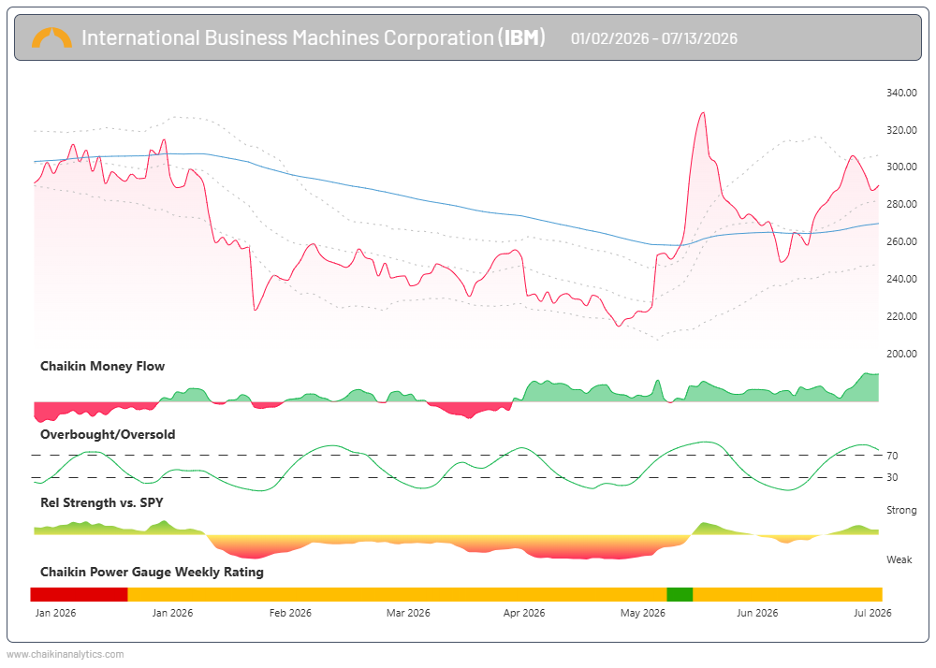
The biggest names on Wall Street took an interest in IBM’s stock back in late April. Other than one tiny dip into negative territory – these giant investors remained invested in IBM’s stock prior to this news.
Just below that – you’ll see that shares of IBM were critically overbought.
That means the price of IBM’s stock saw too much growth, way too fast, in recent weeks. It was due to cool off as investors booked profits, anyway.
Of course, Krishna’s announcement functioned as the spark that ignited this built-up pressure.
But regular users of the Power Gauge know that. In the February 26 issue of free Chaikin PowerFeed daily e-letter, I even shared that IBM’s “neutral” Power Gauge rating served as a warning after its last big, one-day drop.
Then, shares of IBM slumped 13% after AI leader Anthropic released an e-book on moving away from programming language COBOL.
COBOL is an outdated programming language that IBM used heavily in its systems. But it has not been easy for the company to move away from COBOL.
In that issue from late February, I shared the following information with PowerFeed readers.
But you’ll notice that IBM’s relative strength has declined in recent weeks. And the smart-money buying activity has also slid into the red. And as I said, the stock still gets a “neutral” grade in the Power Gauge.
Again, I don’t know how the new feud between Anthropic and IBM will pan out…
IBM might be correct with its claim that using AI to modernize software code isn’t as easy as it seems. But as far as the stock goes, the Power Gauge sees far better places to put money to work.
Investors who followed the Power Gauge’s insight and kept away from IBM are safe from today’s crash. But they may still wonder what it means for the AI boom in general…
Luckily, this crash is isolated to IBM for now. The AI megatrend isn’t at risk from IBM’s fall.
IBM’s Stock Crash Isn’t the End of the AI Boom
Put simply, other AI-related stocks started Tuesday morning higher.
Companies like Micron (MU), Intel (INTC), and Advanced Micro Devices (AMD) each opened about 4% higher than the prior day.
In addition, each of these stocks gets a “bullish” or better rating from the Power Gauge.
On a broad view, tech-heavy Nasdaq-100 Index sat about 1% higher than yesterday.
So, the AI boom still has room to run, even if IBM’s stock falters further on poor earnings later this month.
But it’s hard to ignore that IBM was an AI-related stock. And the fact is that any investor holding the stock right now is looking at a nasty decline today.
As the AI boom continues, and evolves, it gets harder to pick winning AI stocks… especially as AI fundamentally changes the world. As AI starts to think, plan, and even act on its own – it’s not easy to predict exactly where to invest your money.
Thankfully, Chaikin Analytics founder Marc Chaikin is weighing in on this pivotal question…
As you may guess – his predictions for the next biggest AI stocks don’t include IBM.
I highly recommend you hear what Marc has to say in his exclusive interview. His predictions could keep your portfolio on track during 2026.
Good investing,
Ethan Goldman