

Image Credit: Associated Press
Listen to the audio version of this article (generated by AI).
Key Points
- Amazon’s custom-chip business has surpassed a $25 billion annual revenue run rate, driven by strong demand for Trainium AI accelerators and Graviton CPUs that offer meaningful cost savings versus Nvidia hardware.
- AWS custom-chip capacity is attracting major customers including OpenAI, Anthropic, Meta Platforms, and Uber, while newer Trainium capacity is nearly sold out and future generations are being booked well ahead of launch.
- Nvidia remains the dominant AI-chip player, but Amazon’s growing in-house silicon gives AWS greater control over costs and infrastructure while creating a meaningful competitive threat to Nvidia, AMD, and Intel.
Amazon (AMZN) never ceases to amaze. The company’s custom chip business has surpassed a $25 billion annual revenue run rate, driven by the fast-growing demand for its Trainium AI accelerator chips and Graviton central processing units (“CPUs”) for cloud computing.
The reason is simple. Amazon Web Services (“AWS”) custom chips are more affordable to use, and its customers want lower-cost chips than what Nvidia (NVDA) offers.
Amazon is already the runaway e-commerce leader in the U.S., with a 40.5% market share. Meanwhile, AWS – which essentially created the cloud-computing industry – is the world’s largest cloud-infrastructure provider, with 28% global market share as of midyear.
But are there enough value-focused custom-chip customers for AWS to take a big enough bite out of Nvidia’s dominant AI-chip market share of roughly 80% to 87%?
The Lower-Cost Appeal of AWS Custom Chips
The most obvious appeal here is affordability. Sometimes, you can get high quality at a fair price, and that seems to be the case with Amazon’s chips.
AI developers who use AWS chips can save 30% to 40%, while still getting excellent performance, according to Dave Brown, AWS vice president of compute and machine learning.
As he told Yahoo Finance, “That’s what our customers are looking for, is to constantly get more compute and more performance, and then super importantly, at a lower price.”
Who wouldn’t want that combination?
Amazon notes that it builds its chips “from the ground up” to accommodate specific workloads. The end products are Amazon’s Trainium AI chips, Graviton cloud-computing chips, and Nitro chips, which provide the storage, networking, and security behind AWS’s cloud infrastructure.
So, what makes Amazon’s custom-built AI chips different from the graphics processing units (“GPUs”) that Nvidia creates? GPUs are designed for general-purpose workloads, not specific workloads. Amazon’s AI chips are custom-designed to handle the specific workloads its customers run.
Now, Amazon is not the first company to build custom chips for its clients to use. Alphabet (GOOGL), for example, was an early pioneer in that area, with its customized tensor processing unit (“TPU”) chips that deliver GPU-like performance for less money.
And money matters when it comes to AI, considering global AI spending is expected to reach nearly $2.6 trillion in 2026, according to research by Gartner. Any money businesses can save on AI costs is a win, with investors growing weary of tech companies’ wild spending sprees – and dinging their stock prices as a result.
Even a modest improvement in AI performance and efficiency can save a company millions of dollars a year. CloudExpat, a cloud-infrastructure optimization company, tested AWS Trainium1 chips against Microsoft (MSFT) Azure’s ND H100 and Nvidia GPUs in 2025 (Google’s TPU was also tested, but for this article, we’re focusing on the comparison between AWS and Nvidia).
Using dozens of highly technical tests, CloudExpat revealed that companies looking to train a GPT-4-scale AI model could save millions in cloud spend by using AWS Trainium chips versus Nvidia GPUs.
And Amazon has continued to improve the efficiency and price-performance of Trainium chips with each new generation. Amazon’s Trainium2 is reportedly four times faster than Trainium1 and cut costs by roughly 35% compared with Nvidia’s H100 chips, according to the Tech Buzz. Amazon says its Trainium3 chips offer up to 40% better price-performance than Trainium2.
And that’s just for AI training. When it comes to actually running AI models, where cost per query can add up quickly, Amazon says its Inferentia2 chips offer up to 50% lower cost per inference than GPU-based chips. When you consider that AWS sees billions of inference queries every day, that makes a massive difference.
Of course, there are other considerations here… For example, adopting AWS Trainium chips to replace Nvidia GPUs would require a company to abandon Nvidia’s very sticky – and familiar – CUDA ecosystem and implement AWS’s Neuron platform. And that’s not free.
But the chip performance itself is likely worth the swap.
A Growing Customer List Has AWS Chips Sold Out for Years
Companies are increasingly noticing the benefits of Amazon’s custom chips and signing up as customers. In February, OpenAI committed to using 2 gigawatts (“GW”) of Trainium capacity to power its frontier models starting in 2027. This development expanded the companies’ existing $38 billion multiyear agreement by $100 billion over eight years.
AI giant Anthropic followed suit in April, committing to spend more than $100 billion over the next 10 years on AWS technologies – primarily its Trainium and Graviton chip capacity. Amazon noted that Anthropic will “secure up to 5 [GW] of capacity to train and power their advanced AI models, including significant Trainium3 capacity.”
But it’s not just the big players investing in Trainium. Smaller startups such as TwelveLabs, Neura Robotics, Odyssey, Poolside, Decart, Karakuri, NetoAI, Splash Music, and Metagenomi Therapeutics (MGX) are among the many companies turning to AWS custom chips as a cheaper alternative to Nvidia.
Due to this demand, Trainium3 chip capacity is practically sold out. And AWS’s Trainium4 chips, which won’t even be released until 2027 or 2028, already have much of their capacity booked.
Even Amazon’s Graviton processors are flying off the shelves. According to Amazon, more than 130,000 customers use Graviton-based servers. And more than half of AWS’ new processing power runs on Graviton chips.
In April, Meta Platforms (META) became one of the world’s largest Graviton customers when it signed a deal to deploy tens of millions of Graviton cores to power its agentic AI workloads.
And global rideshare leader Uber Technologies (UBER) heavily employs AWS Trainium3 and Graviton4 chips to improve its infrastructure and make customer experiences smarter and faster.
Like its Trainium counterparts, Graviton processors are gaining popularity thanks to their significantly better – around 40% – price-performance and 45% savings compared with x86-based CPUs. The Tech Buzz estimated that, based on cost-optimization analyses from cloud-management platforms, “a typical Fortune 500 company running 10,000 instances on AWS could save $8-12 million annually by migrating from Intel-based instances to Graviton3.”
Amazon’s custom chips clearly have tons of momentum, which it rode to the milestone $25 billion-plus annual revenue run rate.
What Amazon Custom Chips’ $25 Billion Annual Run Rate Means for the Company and the Industry
Calling the $25 billion-plus annual revenue run rate impressive would undersell its importance. Amazon reaching this figure is changing the semiconductor and AI-infrastructure industries. Just think about it… AWS went from using someone else’s chips and selling access to those chips through the cloud to creating and selling capacity for its own silicon.
For less than the cost of an Nvidia GPU, Amazon can customize chip hardware to optimize specific types of workloads. That is a massive development.
Just as massive: Amazon is no longer solely dependent on paying companies like Nvidia or Intel (INTC) for their hardware. AWS does still buy – and will likely continue to buy – other companies’ chips to satisfy customer demand. But Amazon’s custom chips now make it a direct competitor in the market.
AWS’s 2026 second-quarter financials prove that its custom chips have had a huge impact on the semiconductor market. The results include:
- $42.2 billion in net sales, a 37% year-over-year increase, which was the fastest segment growth in 18 quarters
- More than $25 billion in annual revenue run rates for its custom-chip and AI businesses, with year-over-year growth in triple digits
- $16.6 billion in operating income, up 64% year over year
- An operating margin of 39.4%, up from 32.9% during the second quarter of 2025
- An annualized revenue run rate of $169 billion
Amazon’s custom-chip success adds even more revenue to the cash-generating machine that is AWS. As profitable as Amazon is beyond technology (remember, Amazon is far and away the No. 1 e-commerce retailer in North America), AWS accounted for roughly 60% of the entire company’s operating profit in 2025.
Where does Amazon’s chip business stand against heavyweights like Nvidia, Advanced Micro Devices (AMD), and Intel? Before comparing, it’s important to note that Amazon CEO Andy Jassy has said that AWS custom chips would double their current $25 billion revenue if the company sold its physical chips – not just chip capacity – to external customers.
In his annual letter to shareholders published in April, Jassy noted:
If we were a standalone chip company, our chips would be generating over $50 billion in annual revenue.
So, when comparing revenue with its competitors, Amazon is right there… even if its chips are not currently generating more than $50 billion in annual revenue. Nvidia remains the clear leader, with its AI-driven Data Center segment generating a company-record $89 billion during its most recent quarter (fiscal second quarter of 2027).
But Amazon is running neck and neck with Advanced Micro Devices and Intel. Advanced Micro Devices’ projected annual data-center run rate of roughly $26.9 billion (based on its actual $6.72 billion second-quarter revenues) sits just ahead of AWS’s $25 billion. And Intel, with a projected $25.04 billion annualized run rate based on its $6.26 billion second-quarter Data Center and AI segment revenue, is virtually tied with AWS.
If you factor in Jassy’s statement that Amazon’s chip business would be valued at roughly $50 billion if it sold its hardware externally, then Amazon blows right past both Advanced Micro Devices and Intel.
Is Amazon’s Stock Undervalued?
If you’re thinking about investing in Amazon, these chip developments are crucial when you consider that AWS generates most of the company’s operating profit every year. And there’s no reason to think the segment won’t keep growing rapidly.
Not only are new chips here or on the way (Graviton5 was released in June, and Trainium4 will arrive in the next year or so), but powerful frameworks and models are, too.
- Amazon Bedrock AgentCore, which was released last fall, is the system AWS uses most to build and orchestrate enterprise AI agents.
- Project Rainier in Indiana, which officially launched last October, is one of the world’s largest distributed AI supercomputing clusters. It currently hosts more than 1 million Trainium processors dedicated to training Anthropic’s frontier Claude models.
- AWS Continuum, released in June, is a new agentic security service that finds and fixes security risks.
- AWS Transform is an agentic-AI service that supports large-scale framework modernizations.
- AWS Context is another new service that automatically builds a knowledge graph from existing data to be used by a company’s agents.
That’s just the tip of the iceberg. And there’s no reason to believe AWS will stop innovating.
Amazon has been a wildly successful company for years. A major reason is the foresight it employs in developing brilliant strategies… like developing its own chips. This has already proved to be a market changer.
That kind of innovation and confidence in its strategies matters to investors. It’s one reason Amazon’s stock feels undervalued at around $260. The average price target for Amazon is roughly $327, giving the stock around 25% upside.
Amazon stock may not get the splashy spikes like Micron Technology (MU) or Sandisk (SNDK), but it has long been a consistent performer. Year to date, it’s up nearly 15%. And over the past five years, it has gained nearly 57% (largely driven by AWS).
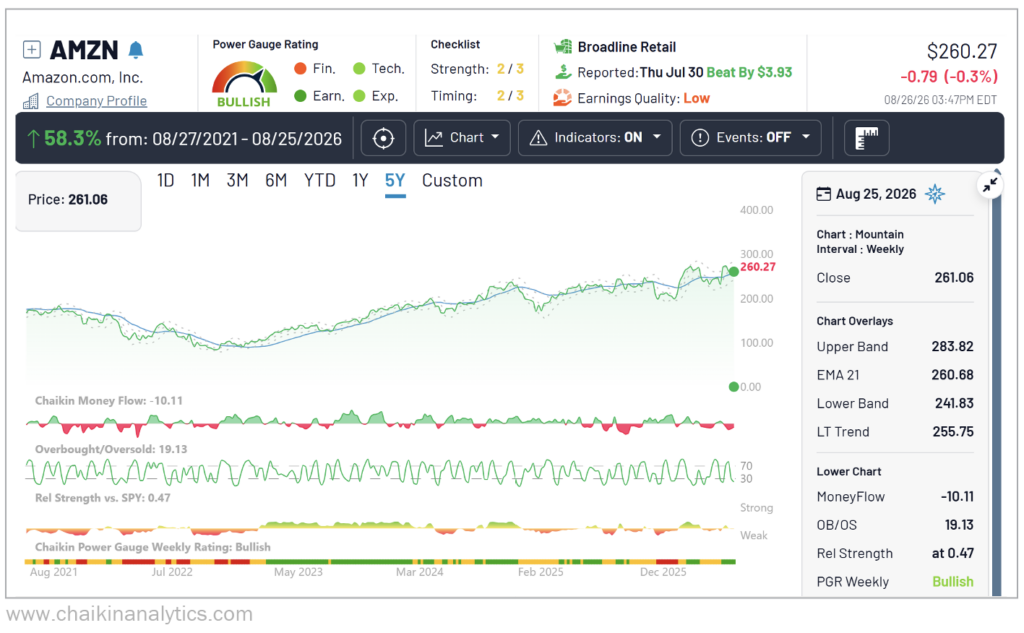
Chaikin Analytics, the investment-research platform founded in 2009 by legendary 60-year Wall Street veteran Marc Chaikin, gives Amazon a “bullish” rating in its Chaikin Power Gauge, a 20-factor stock-rating system that scans more than 5,000 stocks and 2,300 exchange-traded funds.
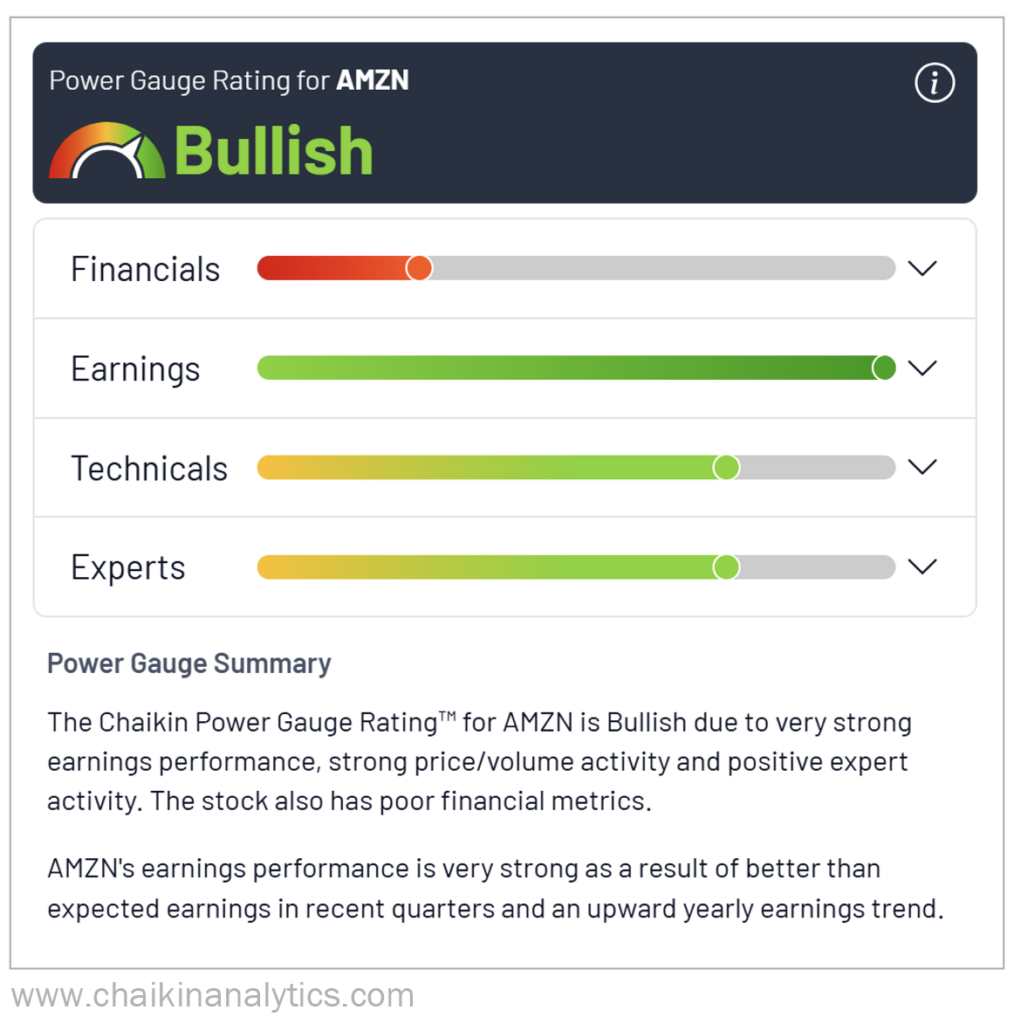
Amazon has a long history of innovation and revolutionizing entire industries. It has done that with Amazon Prime and its e-commerce business, its logistics operations, and its enterprise cloud infrastructure. The company’s development of custom AI chips and processors certainly seems to be the next industry changer.
Regards,
David Engle
Editor’s Note: Whitney Tilson called the rise of Apple, Amazon, and Netflix… as well as the collapse of dozens of companies that went bankrupt. Now the former $200M hedge fund firm manager is stepping forward with what he calls the most important financial warning of his 30-year career. He’s sharing two free stock recommendations (one to buy, one to sell immediately) along with details of a new proprietary system fueling his predictions. See it all in his free presentation.