Image Credit: Associated Press
A $2.6 billion loan just told you more about the AI buildout than any earnings call. The stock already recovered and forgot. The loan document remembers — and it’s the most honest signal in the whole trade.
Twenty years on a trading desk teaches you where to look when you want the truth about a trade.
Twenty years on a trading desk teaches you where to look when you want the truth about a trade.
You can’t use stock prices, they lie all the time. They gap on emotion, they get pinned by options dealers, they run on narrative long after the story has changed.
That’s especially true when you’re evaluating AI infrastructure stocks, where billion-dollar financing decisions often reveal more than earnings calls or analyst price targets ever will.
If you want to know quickly whether a company is actually in trouble, you watch what it costs that company to borrow money.
The lenders behind the money have done the work. They’ve read the contracts. They’ve stress-tested the cash flows. And when they suddenly demand more interest, tighter terms, and a lockbox on the revenue before they’ll hand over a dollar — that’s the smart money repricing risk in real time.
This is exactly what’s happening with one stock at the center of the next AI wave — CoreWeave Inc. (CRWV).
AI Infrastructure Stocks’ Hidden Debt Bomb
In mid-July, CoreWeave — the “neocloud” that rents out Nvidia GPUs to AI companies — went to the leveraged-loan market to raise $2.6 billion.
At first, the loan looked routine.
The structure was a delayed-draw term loan, its fifth-and-a-half such facility, nicknamed DDTL 5.5. The proceeds were earmarked to buy more GPUs and infrastructure to serve a specific set of customer contracts.
According to loan-market reporting from LSEG and Octus, the deal launched on July 16 at a spread of SOFR plus 425 to 450 basis points, offered at 99 cents on the dollar. Standard-issue for this borrower.
Then it stalled.
The lenders investing in the project weren’t convinced. And to get the deal across the line, CoreWeave had to rewrite the terms in the buyers’ favor:
- CRWV agreed to pay a much higher interest rate, making the loan significantly more expensive. The spread widened roughly 100 basis points to SOFR + 550, and the loan was discounted to around 96 cents — a four-point cut. The Financial Times pegged the all-in yield at roughly 9%. That’s a junk-grade cost of capital for a company that, months earlier, had raised GPU-backed money at investment-grade rates.
- The lenders demanded stronger protection. They imposed a cash lockbox — meaning the cash coming in from customer contracts has to go to paying down the debt first, before CoreWeave can touch it — plus a 1.35x debt-service-coverage covenant and full amortization, per Fitch and loan-market coverage. Translation: the lenders wanted a hand on the cash register.
Only after making those concessions was CoreWeave able to secure the financing. When the deal finally closed around August 10, the company described it as “meaningfully oversubscribed,” meaning more investors ultimately wanted to participate than the company needed.
At first glance, that sounds like a sign of overwhelming confidence, but remember when that demand appeared.
Investors only lined up after CoreWeave caved to the lenders’ demands. In other words, they’re there for the deal,
This was echoed by the independent credit-rating agencies. Fitch rated the loan BB+ and Moody’s rated it Ba2 — both below investment grade.
The deal did get done. But the market forced CoreWeave to pay up, pledge its cash flows, and accept a leash — before it would fund the AI buildout everyone insists is unstoppable.
The major takeaway here?
When a trade is truly bulletproof, the financing is supposed to get cheaper. But this one got more expensive, more restrictive, and harder to place, all at once.
The Stock Already Forgot. The Loan Remembers.
Here’s the part that makes this worth your attention right now.
In late July, fear peaked. The cost of insuring CoreWeave’s debt against default — its credit default swap, or CDS — blew out. Per Bloomberg data cited across market coverage, CoreWeave’s CDS topped roughly 855 basis points, a level that implied around a 50% probability of default within five years on a standard pricing model. The stock bottomed near $60.
Then the mood flipped. The loan cleared. On August 12, CoreWeave reported second-quarter revenue up more than 200% year-over-year, with a backlog it pegged at roughly $104 billion.
The stock ripped — nearly doubling off the lows to around $117 by mid-August before settling back into the high $80s.
The sell-side climbed aboard: Truist moved to Buy with a $165 target, Goldman lifted its target to $139, and Oppenheimer kept an Outperform and a $150 target, arguing AI demand runs about four times available capacity.
It only took the equity crowd about three weeks to get its optimism back. Understandable. But notice what didn’t reverse: CoreWeave still had to accept a 9% all-in cost, a cash lockbox, a maintenance covenant, and full amortization to get that money.
Those terms are baked into a signed credit agreement. They don’t un-widen because the stock bounced. The bond market did its stress test in public, and the price of that test is now a permanent line item in their budget until it’s paid in full.
This is the oldest lesson on the desk. Think of it like this…
The stock market is a voting machine — it forgot the scare in three weeks. The credit market is a weighing machine — it wrote the risk into the contract and moved on.
When those two machines disagree this much, I’ve learned which one to trust.
The Three Key Tells Buried Inside the Deal
Pull the DDTL 5.5 apart and three specific risks explain why the lenders got nervous. Each one is a flashing light that’s still on.
Tell #1: The Durations Don’t Match.
CoreWeave’s problem is the oldest one in finance — borrowing long and getting paid short. This loan runs about five years. But the customer contracts backing it average only about three. And the underlying data-center leases CoreWeave signs with its landlords can run up to 15 years.
So CoreWeave commits to 15-year obligations, funds them with a five-year debt, and covers it with three-year revenue. If those customer contracts don’t renew, the bills keep coming with no guaranteed income behind them.
Fitch flagged exactly this. Visibility gets murky beyond the current contracted window, when the company leans on renewals and re-leasing to sustain growth. If that pattern rings a bell, it should. It’s the same asset-liability mismatch that took down WeWork — long leases, short revenue, and a growth story papering over the gap.
Tell #2: The Customers are Dangerously Concentrated.
The Financial Times reported that the single largest counterparty behind this loan is Anthropic, at roughly 40%, followed by the quant trading firm Jane Street at about 35%, with Midjourney, Hudson River Trading, and Anysphere (the maker of Cursor) making up the remainder. Fitch separately noted that CoreWeave drew about 65% of its first-quarter 2026 revenue from just its top two customers.
Two things stand out. First, that is enormous concentration — a handful of contracts carrying the whole structure. Second, and more pointedly: Anthropic, the 40% anchor, is a privately held company with no public credit rating.
That’s not a knock on Anthropic — it’s one of the best-funded labs in AI, and in August it was being called the hottest upstart in the field. It’s a statement about what the lenders can actually underwrite.
You cannot price the credit risk of a counterparty you cannot rate.
When 40% of your collateral rests on an unrated private company and another 35% on a proprietary trading firm, the margin for error is thin under the best of circumstances.
There’s a footnote worth watching. As bond analyst Rod Dubitsky flagged, Fitch upgraded Jane Street — CoreWeave’s #2 counterparty — right in the middle of the period when this struggling loan was being marketed, citing factors that had been in place for years. Draw your own conclusions, but the timing feels suspicious.
Tell #3: The Lockbox is the Lenders Telling You What They Think.
You don’t demand a cash lockbox from a borrower you trust. You demand it when you want to make sure you get paid before anything else can go wrong. The concession CoreWeave had to grant is itself the verdict.
Not All AI Infrastructure Stocks Are Built the Same
While CoreWeave may be the loudest canary in the coal mine among the AI infrastructure stocks, they’re far from being alone.
The entire AI buildout runs on borrowed money and depreciating collateral.
Neoclouds like CoreWeave and Nebius fund their GPU purchases with debt secured against the chips themselves — Nvidia hardware that’s valuable today but could be a generation behind tomorrow.
CoreWeave’s own guidance calls for $31–35 billion of capital spending in 2026 against roughly $6.2 billion of trailing-twelve-month revenue.
Its first-quarter interest expense doubled to $536 million, and it has burned free cash flow every year since 2022. Revenue is expanding, yes — but so is the spending required to produce it. That treadmill only works as long as the cheap money hose keeps spitting out cash.
There’s a circularity here that should make you tilt your head: Nvidia sells the chips, is a major shareholder in CoreWeave, and is part of the capital ecosystem funding the customers who buy those chips.
When the same company is supplier, shareholder, and financier, “demand” gets harder to read at face value.
That’s why “AI infrastructure” is too broad to be a useful investment category. The companies may be building toward similar goals, but they’re operating under very different financial constraints. The way I see it, the easiest way to think about them is to divide them into two groups:
The self-funders. Amazon, Alphabet, Microsoft, and Meta are pouring hundreds of billions into the buildout too — but largely out of operating cash flow from businesses that already mint money.
Their existing profits subsidize the unprofitable early years of AI. If financing gets expensive, they can shrug.
The debt-funders. CoreWeave, Nebius, Oracle’s cloud arm, and the leveraged neocloud complex finance the same buildout with debt, leases, and project loans against short contracts and depreciating chips.
For this bucket, the cost of money is the business model. When spreads widen, their math breaks first. This isn’t limited to the neoclouds: Oracle — the largest non-financial borrower in the Bloomberg U.S. high-grade index — saw its own CDS climb above 215 basis points this year, up from about 145 at the end of last year, with its long bonds yielding close to 7.8%. Apollo’s chief economist Torsten Slok put a name on the danger: at high enough all-in yields, the AI capex cycle starts to self-throttle not because demand changes, but because financing becomes too expensive.
And the hyperscalers just made the debt-funders’ problem worse.
In mid-July, Meta announced “Meta Compute,” a service to sell bare GPU capacity to third parties — the exact business the neoclouds are built on. When your biggest potential customer becomes your competitor, the “customer concentration” and “insourcing” risks are no longer theoretical.
I call it my AI Destruction List. Big media loves to oversimplify the problem. They say “AI is a bubble” — but that’s too lazy to be useful for anyone, and it’s impossible to time.
The more precise version: the leveraged, debt-funded layer of the AI trade cracks first, and it cracks in the credit market before it cracks in the stock.
Is There Any Bull Case for CoreWeave?
Now that we’ve covered the problems, allow me a moment to argue against myself. After all, a one-sided case is a weak case — and I want you thinking, not panicking.
The bulls have real, current points. The loan did clear, oversubscribed at the wider terms — the demand exists, just at a higher price.
Many of CoreWeave’s contracts are “take-or-pay,” meaning customers owe the money whether or not they use the capacity. That ~$104 billion backlog is enormous (bear in mind it blends remaining performance obligations with other committed amounts, so it’s a scale indicator, not a bank balance).
The company is actively working to diversify the concentration I just flagged — in August it signed a fresh multi-year deal with Hudson River Trading and pushed into sticky government work through a CoreWeave Federal partnership with Leidos.
Its marquee counterparties — Anthropic, Meta, OpenAI, Jane Street — are real, growing, well-capitalized names.
The insider selling that made headlines was executed under pre-arranged 10b5-1 plans and left executives with large stakes.
And most of Wall Street is bullish, with price targets from $139 to $165 against a stock in the high $80s. A CDS spread is a probability, not a verdict — and the one that screamed in July has since calmed as the stock recovered.
Both readings are defensible from the same set of facts depending on which details you choose to focus.
The honest position isn’t “CoreWeave is going to zero.” It’s that the cost of financing the AI buildout went up in a visible, measurable, contractually permanent way — and the market charged the most leveraged players the highest prices.
What is critical to understand before committing your capital to this trade is that ignoring that risk because the stock bounced is exactly the mistake retail makes at every top.
Forewarned is forearmed.
What the Options Say About CoreWeave
People always want the trade. But before we take the trade, we need to know the range of what to expect — and on a name like this, the range tells us the story.
Every day I run a tool I built called the Volatility Visualizer, or the Vol Viz for short. This program plots the expected-move band the options market is pricing in for where a stock could realistically trade over a given window.
To be clear, this isn’t an arbitrary line I drew on a chart. This is hard data, pulled straight out of live options prices — the market’s own, dollar-weighted forecast of how far this thing can move.
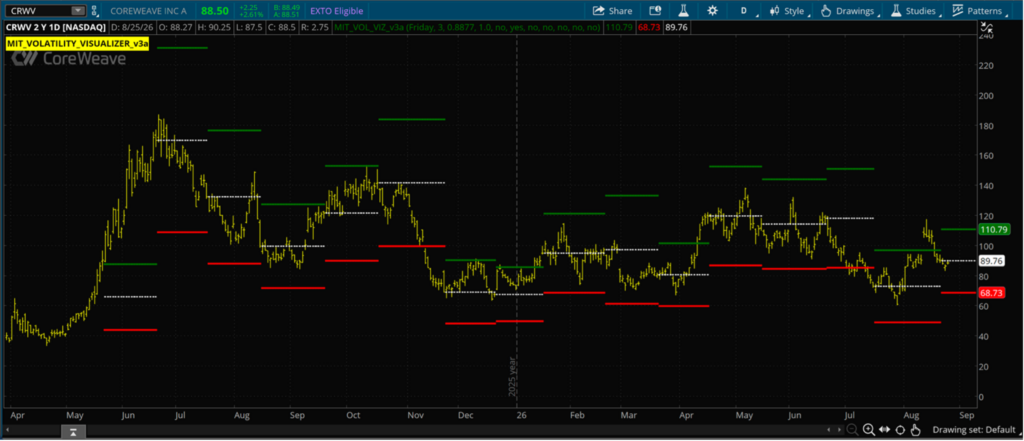
Here’s what it’s showing on CoreWeave, with the stock around $88.50: an expected-move band running from roughly $69 on the downside to $111 on the upside — a range more than 40 points wide, better than 20% in either direction.
Sit with that. The options market is pricing a swing of more than a fifth of the company’s value, up or down, on a business worth tens of billions of dollars.
That’s an unusually wide range of expected outcomes. And it echoes the same warning coming from the credit market: investors are demanding a much bigger margin for uncertainty.
The lenders demanded a cash lockbox and 9% money because they couldn’t pin down the risk. The options market is pricing a 40-point range for the same reason.
Two completely different corners of Wall Street — credit and volatility — look at CoreWeave and reach one identical verdict: nobody knows where this settles and they’re actively worried about where it might end.
Why the Expected Move Matters More Than Any Price Target
A sell-side analyst stamps a $165 target on the stock and a headline is born — but that’s one person’s guess about direction.
The expected move is the whole market’s consensus about magnitude, and it comes with probabilities attached. Roughly speaking, the market is pricing about a two-in-three chance the stock finishes inside that ~$69–$111 band over the window.
That single fact should reframe everything you’re looking at. CRWV ripping toward $110 next month? Still “inside expected” — not a breakout, not a miracle, just the top of a range the market already told you about. A decisive break below $69 or above $111 is the only thing that would count as the market being genuinely surprised.
That is how you keep your head in a stock that moves 15% before lunch. You stop flinching at every candle and start asking one question: is this move inside the expected range, or did something just break the market makers’ models?
Because the day CoreWeave slices through the low end of that band on heavy volume is the day the credit-market alarm bells stop being silent.
Five Signals I’m Watching Next
You don’t need to track every loan. Watch these:
The 10-year Treasury. With the long end elevated, the cost of all this debt is set by the bond market. Higher-for-longer is the neocloud’s enemy.
The next neocloud financing. The tell isn’t whether it gets done — it’s the spread and the structure. Wider pricing and more lockboxes mean the squeeze is tightening. Cheaper, cleaner deals mean the fear is fading.
CoreWeave and Oracle CDS. The real-time thermometer. Staying wide is the warning; the more it compresses, the smoother sailing there is ahead.
Contract renewals. The duration mismatch is critical. The first time a big three-year contract comes up and doesn’t renew at full value, the mismatch problems stop being theoretical.
Hyperscaler insourcing. Every “Meta Compute” — every hyperscaler that builds instead of rents — is a direct hit to the neocloud customer base.
The Bottom Line
The biggest mistake investors make with AI infrastructure stocks is assuming they’re all exposed to the same risks.
Financial talking heads love to go on about the AI trade as a contest of technology — whose model is smartest, whose chips are fastest. But at this scale, it’s a contest of capital allocation and financial endurance. The question is no longer whether AI demand is real in the short-term. It’s whether that demand converts to cash fast enough, and lasts long enough, to service the mountain of debt being stacked against depreciating hardware.
The stock market already voted twice — panic in July, euphoria in August. The credit market didn’t flip-flop. It wrote the risk into a contract and left it there: wider spreads, tighter terms, a cash lockbox, and a set of covenants that tell you exactly how the smartest lenders in the room see this. The stock forgot. The loan remembers.
The first crack in the AI trade won’t show up on a chart. It will be buried in the fine print of a loan document.
Always follow the money.
Editor’s Note: Forbes calls $1 billion fund manager Louis Navellier “the king of quants.” Today, he’s stepping forward to reveal why he’s investing $358 million of his own firm’s money in the next stage of Artificial Intelligence… a technological sea-change that could erase millions of jobs, solve humanity’s biggest mysteries, and spark a wave of moneymaking opportunities — both in and outside the stock market. Click here for the details…
I break down the day’s biggest market story every morning on Masters in Trading Live, 11 AM ET. I follow the top stories of the day and show you how the smart money is really positioned — no geometry, no chart-drawing, just evidence of where the money is moving. Join me each morning, drop a “Good Morning” in the chat, and let’s read the tape together. Jonathan Rose is a former CBOE market maker and the founder of Masters in Trading at InvestorPlace. I hosts Masters in Trading Live every weekday at 11 AM ET. Follow me on X at @JRoseTrades