Image Credit: Associated Press
Key Points
- Meta released Muse Glimmer for free on August 10, a 30-billion-parameter open-weight model that runs on consumer hardware and outperforms Google’s Gemma 4 31B on agentic benchmarks, with Meta stock rising following the release.
- The launch puts Meta’s massive AI spending in focus, with 2026 capex guided to $130 billion to $145 billion as free cash flow fell to $784 million last quarter and stock buybacks remained at zero for a third straight quarter.
- Meanwhile, DRAM prices have surged nearly 700% in a year and 2027 supply is already sold out, meaning Meta could be driving consumer demand for the same scarce memory components that are increasing its own AI infrastructure costs.
What Meta’s Muse Glimmer Release Actually Is, and Why META Stock Rose
Muse Glimmer is free. Meta’s $145 billion AI bill isn’t.
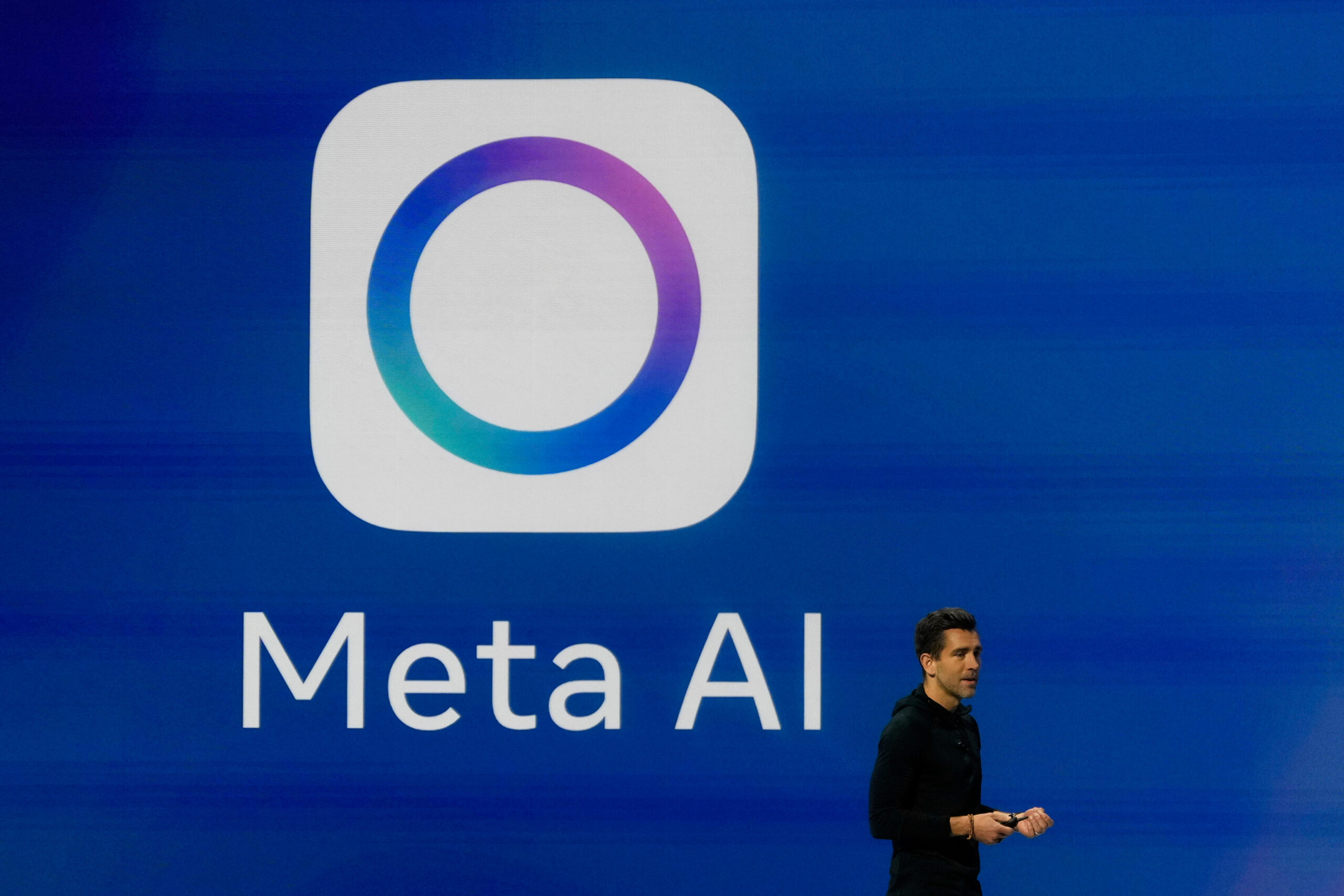
On August 10, Meta Platforms (META) released an artificial-intelligence model called Muse Glimmer… then gave it away.
With 30 billion parameters, it was published on open-source AI platform Hugging Face under the Apache 2.0 license, which is the permissive one. Anyone can download Glimmer, run it, take it apart, and build a business on top of it, without paying Meta a dollar or asking anyone’s permission.
Muse Glimmer is built specifically for agentic work. It’s designed to handle complex, multistep tasks on its own. And best of all, it’s built to run locally on your own device (instead of remotely on the cloud). It’s the smaller model distilled from Muse Spark 1.2, the frontier model Meta still keeps closed.
This is a big deal. On MCP Atlas, the benchmark that measures how reliably a model drives outside software, Muse Glimmer scores 75.5 against 54.2 for Alphabet-owned Google’s (GOOGL) Gemma 4 31B. It doesn’t lead on everything, and Alibaba’s (BABA) Qwen still beats it on raw terminal work. But on the specific job of directing other software, a free model now outperforms a Google model of the same size.
META stock rose about 2.1% in pre-market trading on Monday and closed the session up 1.28% at $599.67.
Sit with that. A company that’s being judged for its spending gave away its newest product… and the market bid up shares. That reaction tells us much more than the model itself.
What “Open Weights” and the Apache 2.0 License Actually Mean
Unlike many models favored by the hyperscalers, Glimmer is an open-weight model.
An AI model is made up of a huge set of numbers, called “weights,” that encode everything the system has learned during training. Think of it as the finished recipe book, after taking years of expensive cooking classes.
Training the model costs billions… But simply running the “recipe” is cheap. When you pay for a monthly AI subscription, you’re renting somebody else’s copy of the recipe book.
Having open weights means the company publishes the recipes itself. All the rules and parameters that went into the model are public, and users can tweak them if they want. Combine that with an Apache 2.0 license, and it means no strings: no conditions, no usage ceiling, no permission slip.
Meta released its Llama models under a custom license for years and had leaned toward keeping the good material closed. This week, though, it reversed course, making Glimmer free to download.
How Much Is Meta Spending on AI in 2026? $130 Billion to $145 Billion
Meta reported second-quarter earnings on July 29. The company has guided to between $130 billion and $145 billion in capital expenditures (“capex”) this year. Last year it spent $72.2 billion. If its expectations come true, spending will roughly double in only 12 months.
Let’s look more closely at its earnings report, though, starting with what’s working…
Second-quarter revenue was a massive $60.8 billion, up 28%, the fastest growth Meta has posted since late 2021. Advertising was $59.4 billion of that total, up 27% year over year. Nobody has stopped buying ads on Meta.
Now, let’s look at the bill. When Meta narrowed its capital-spending range in the second quarter, it did so by lifting the bottom of it. The floor moved up from $125 billion to $130 billion.
So essentially, the company promised to spend at least $5 billion more. As for total full-year expenses, including operating expenses, the company now expects $165 billion to $169 billion.
Meanwhile, the bad news… Earnings came in at $6.18 a share versus consensus expectations near $7.22, a miss of about 14%. Total costs and expenses rose 55% to $42 billion, and the operating margin fell to 31% from 43% a year ago.
Part of that was a one-off. Meta booked $2.4 billion in charges it described only as “related to legal proceedings” and has not said what they were for. CFO Susan Li flagged youth-related trials scheduled in the US this year that could produce a material loss, which is the likeliest place that exposure sits. Add $1.18 billion in severance for the 8,000-person May layoff. Strip both out, and Meta says operating income would have grown 9% year over year instead of falling 8%.
The company’s AI build-out has also gotten expensive. Meta generated $31.86 billion in operating cash flow last quarter and kept a mere $784 million of it in free cash flow… because capital spending consumed $31.08 billion. That $784 million is what was left. Buybacks were zero for the third straight quarter, against $26.25 billion returned in fiscal 2025, and long-term debt now sits at $83.7 billion.
Meta has gone from a company that returns capital freely to one that raises it.
The market’s verdict was immediate. The stock fell roughly 8% the next day to $539.03 per share.
It clawed most of that back over the following week, and the Glimmer release pushed it to $599.67 on August 10. But it closed at $578.85 on August 12, still below where it stood before the print, down about 12% year to date and roughly 27% below its record high.
Meta’s 2027 Capex Guidance: The Number Management Won’t Give
On the second-quarter call, management would not give a final capital-spending number for 2027. That’s odd. A company that knows what it plans to spend usually says so.
Wall Street filled the gap. Wells Fargo raised its 2027 estimate to $181 billion from $170 billion, on the power deals Meta signed during the quarter. JPMorgan Chase went further and modeled $202 billion, a 42% jump on this year, and said that free cash flow could turn negative for a stretch.
Plus, Meta’s augmented- and virtual-reality business is losing a lot of money. That division, Reality Labs, lost $4.62 billion from operations last quarter on just $431 million of revenue, bringing its cumulative operating losses since Q4 2020 to roughly $88 billion.
Meta hasn’t confirmed the date yet, but third-quarter results are expected after the close on Wednesday, October 28. That’s when we should get the first hard number for 2027.
Why Meta Wants Glimmer to Be Free
In the 1970s, computing power was something you rented. You bought time on somebody else’s mainframe by the minute, and an entire industry existed to keep that meter running. Then the personal computer arrived, the meter went away, and it took the companies built on the meter with it.
That is the pattern worth watching, because a huge amount of today’s AI investment case assumes the meter. Intelligence is a utility… You rent it forever, and the toll-booth operator compounds its money.
Muse Glimmer is a hole in that story, and Meta punched it deliberately.
Importantly, Meta is not doing this out of generosity. Advertising brought in more than $114 billion in sales in the first half of 2026, 97.7% of the company’s total revenue.
Unlike its competitors, Meta doesn’t sell intelligence by the token. So making Glimmer available for free costs Meta almost nothing… while costing several of its rivals their entire business model. That’s why the stock rose on the announcement rather than fell.
There’s one catch, though… Everything I just described is an argument against Meta’s competitors, not an argument for Meta’s own income statement.
Muse Glimmer doesn’t earn Meta a dollar, and that’s exactly the problem. Giving away a model, however good, cannot justify $145 billion in capital spending. And Meta’s advertising business was already growing 27% a year without it. The build-out hasn’t paid for any of that growth yet.
So Meta still has to show that $145 billion worth of spending produces better targeting, more engagement, or an entire business that it isn’t in yet.
Open weights mean a large base of people can use this model. But adoption of Glimmer won’t show up on a line item, which is precisely why the market can’t price this… and why the stock keeps moving 10% at a time on guidance rather than on results.
Running Muse Glimmer Locally: What a $2,000 Setup Proves
I don’t have a Facebook account. I don’t use it, and if you pressed me, I’d admit that I’m not a fan.
I’m telling you this first because of what has been running on a computer in my house.
I’ve spent 30 years taking whatever the vanguard technology of the moment is and wringing it out until I understand what it actually does, as opposed to what the people selling it say it does. So when a free, unrestricted model showed up that runs on hardware a normal person can buy, I found a way to try it out before I wrote a word about it.
So I got the hardware. I paid about $2,000 for a GMKtec EVO-X2, a mini PC the size of a hardcover book, with 128 gigabytes of memory. It’s built around an Advanced Micro Devices (AMD) chip whose graphics side reaches that whole memory pool directly. Memory, not speed, is the binding constraint at home. Compressed to four bits per weight, Muse Glimmer comes in at less than 20 gigabytes, which is why it fits on a desktop computer instead of in a data center.
My first run failed cold, and the culprit turned out to be a loading error rather than anything fundamental. Once it cleared, I asked the model to walk me through running an options wheel for cash flow on a volatile stock.
It handled the whole thing. Locally. No account, no subscription, and none of my personal data leaving the house.
So here is my answer to the part of this story the market can actually verify: The thing Meta gave away works.
The Memory Shortage Nobody Is Connecting to Meta’s AI Capex
Finally, one thread is running from the machine on my desk to Meta’s income statement, and I haven’t seen anyone pull on it yet.
Running one of these models at home is a memory problem before it’s a speed problem. Muse Glimmer needs at least 24 gigabytes of memory.
But memory is expensive and getting more so fast. DRAM, short for dynamic random-access memory, is the working memory inside every computer and phone. The graphics-grade version, wired directly to a GPU and usually called VRAM, or video memory, is the kind a model like Muse Glimmer needs, and it costs more per gigabyte. DRAM spot prices are up nearly 700% over the past year, and the graphics-grade stuff sits above that.
Data centers absorb an estimated 70% of global memory output. Supply growth in 2026 is running at about 16%, which lags the historical norm of 20% to 30%. New capacity from Micron Technology (MU) and SK Hynix (SKHYY) does not reach volume production until 2027 at the earliest. And the three companies that make almost all of the world’s memory have already sold out their entire 2027 output.
Meta has already told us this one hurts. When it raised capital-spending guidance in April, the company pointed to higher component pricing, and memory is the component the reporting kept naming. We should expect 2027 capex to come in at the high end of what the Street has penciled in.
And here’s the part that should bother a shareholder. By releasing a memory-hungry model like Muse Glimmer, Meta just told millions of people to go buy the scarcest component in the industry… at the same time it has to keep buying that same component itself, by the truckload, through 2027 at the earliest. It is bidding against the demand it created.
Catalysts to Watch for META Stock
- Muse Spark 1.2 open weights, promised “in the coming weeks.” Glimmer is the smaller model distilled from Spark; Spark is the flagship Meta still keeps closed. Releasing it would be the first time a US company has opened a frontier-tier model, and it’s the largest single rerating event on this thesis.
- Third-quarter earnings, Wednesday, October 28, after market close. The first hard 2027 capex number. Watch whether the range brackets or exceeds the $181 billion to $202 billion the Street has penciled in.
- Any restart of buybacks. After zero share repurchases for three quarters, a restart would signal that management believes the peak spending year is identifiable.
- Adoption over the next 30 days. Hugging Face downloads and fine-tuning counts, plus the llama.cpp, MLX, and ExecuTorch integrations landing, which is what turns “runs on a Mac” into an installed base.
Risks to Meta’s AI Spending Case
- Free cash flow. Only $784 million left over from $31.9 billion of operating cash flow leaves no cushion. If ad growth slows from 27%, the spending will not slow with it.
- The 2027 guide. JPMorgan’s scenario has free cash flow turning negative. At roughly 19.8 times forward earnings, carrying $83.7 billion of long-term debt with no buyback, the stock is priced for the capex being productive rather than survivable.
- Adoption can’t be measured. Open weights only pay off if the model gets used, and no Meta revenue line captures that.
- Security and regulation. Meta’s own numbers show Glimmer is not uniformly safer than its peers: It received 28.4% attack success on the Siren AgentDojo prompt-injection test against 25.6% for Gemma. Washington has signaled it will not require safety testing on open-weight models, a tailwind one incident could reverse.
- Reality Labs still burns about $4.6 billion a quarter through all of it.
Is META Stock a Buy? The Bottom Line
I’m not telling you to sell META. I’m telling you which number to watch from here.
The market is still debating the wisdom of Meta’s AI spending. I ran part of the answer on my own desk this week for nothing, and the technology is real.
That was never the question, though. The question is whether $145 billion buys Meta anything it can put on an income statement, and Muse Glimmer doesn’t answer it. What it does is make the bet legible: Meta is spending like an infrastructure company to defend a business that runs on ads.
So what would I do with META at roughly 19.8 times forward earnings, down 12% year to date?
I’ll start with the case I keep hearing, because it’s a good one. Some people think Meta is brilliant because it spent almost nothing to commoditize the most expensive thing its competitors own, which is a frontier model sitting behind a paywall. They’re giving away what other hyperscalers are trying to get paid for… forcing everyone else to lower prices.
I would like that to be true. I have to wonder whether it is.
Are there enough builders out there who will actually choose Muse Glimmer to make this move worth it? Or will the competitors simply cut the price on their highest tiers, eat the margin, and wait Meta out?
But remember, we already live in a DeepSeek and Kimi and Nemotron world. Serious open models have been free to download for a while now. And several of them are tuned for exactly the agentic work Muse Glimmer is aimed at. The coverage of the launch says as much, describing it as Meta’s answer to the licensing terms coming out of China.
Meta did not commoditize this market so much as join one that was already commoditizing, and it arrived with a very good product rather than a new idea. I myself was already using free local models when I decided to test out Muse Glimmer.
What Meta has that the others do not is the pipeline. This is a company that can monetize attention of nearly any kind… which might mean the model never has to earn a dollar directly for the strategy to work. That is a real edge.
But I have used the competition on my own machines, on my own time. From that point of view, this is not the screaming buy Meta would like you to think it is, and it is not the death blow to its competitors that it is being hailed as.
So I am not buying META here, and the reason sits in the name on the building. This company renamed itself for the metaverse, put roughly $88 billion into Reality Labs, and is still losing $4.62 billion a quarter on $431 million of revenue with that division. That was the last time Meta asked us to trust a spending program nobody outside could measure. Now it’s asking again, for almost twice the money.
What I’d love to see is the return of buybacks. Share repurchases have been turned off for three straight quarters, against $26.25 billion returned in fiscal 2025. Until then, I will keep testing Meta’s free model against the half-dozen others I have and keep my money where the spending has a ceiling I can find.
Good investing,
Eric Wade
Editor’s Note: One company quietly beat Apple, Amazon, and the S&P 500 — combined. Over the long run it has returned more than 8,300%… enough to turn $10,000 into $830,000. Yet most investors have never heard of it. Former fund manager Whitney Tilson says right now it’s trading at a rare discount — and he’s revealing the name and ticker, free of charge. Click here for the details…