Image Credit: Associated Press
Key Points
- SK Hynix announced a nearly $29 billion share buyback and cancellation plan after its stock plunged more than 50% in roughly five weeks, sending shares sharply higher.
- The company’s fundamentals remain strong, supported by AI-driven memory demand, sold-out inventory through 2027, and major customers including Nvidia, Apple, Advanced Micro Devices, and leading hyperscalers.
- The bigger risk is volatility: SK Hynix has a very high beta, while concerns about AI spending and elevated memory-stock valuations could continue triggering sharp pullbacks despite strong underlying demand.
Despite unrelenting demand for its memory chips – and the severe subsequent global memory shortage driven by artificial intelligence (“AI”) – South Korean memory giant SK Hynix has witnessed the decimation of its Korean shares over the past five or six weeks as it dropped more than 50%.
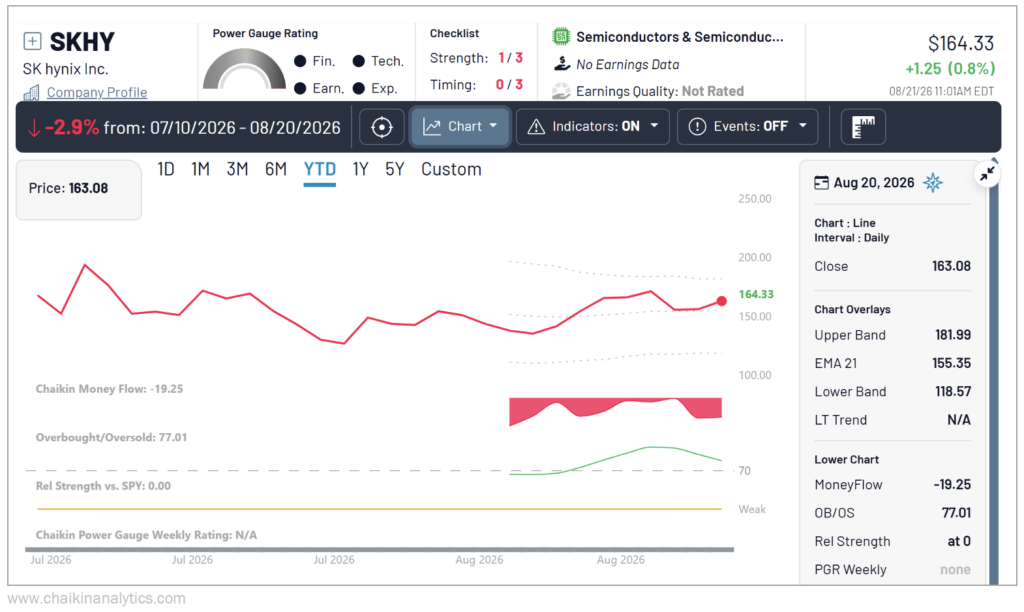
SK Hynix’s American depositary receipt (“ADR”) shares (SKHY), which debuted on the Nasdaq on July 10, have fallen as well. They’re down more than 8% from the stock’s $170 opening price as of August 19.
That lengthy rout compelled SK Hynix to announce plans to buy back 40 trillion won (nearly $29 billion) of shares as a stabilizing countermeasure to the freefall. The company stated that it will repurchase up to 24 million shares between August 20 and November 19 and then cancel them as it raised its shareholder return projection to more than 50% of free cash flow – an increase from its previous estimate of up to 50%.
The plan appears to have worked, as SK Hynix’s U.S. shares jumped more than 5% during premarket trading on August 19.
But how long will the momentum last?
What Caused SK Hynix’s Recent Freefall?
Since SK Hynix’s American IPO on July 10, its stock has taken investors on a bumpy ride both in the U.S. and in the Asian market. On Monday, July 13 (in South Korea), SK Hynix began the day at 2,113,000 won when the Korea Composite Stock Price Index (“KOSPI”) opened. It closed at 1,845,000 won, a single-day loss of 12.7%.
The stock hasn’t really recovered since then, plunging as low as 1,246,000 won during intraday trading on July 29, after SK Hynix reported its second-quarter earnings. In a little more than two weeks, SK Hynix stock lost a jarring 41% of its value.
Its Nasdaq performance moved in a similar direction. The stock peaked at $194.80 during intraday trading on July 14 before bottoming out at $124.80 on July 29 – a staggering loss of 36%.
Considering the nonstop demand for AI memory, not to mention a huge second quarter during which operating profits increased 557% year over year and revenue more than tripled, why did SK Hynix stock fall off a cliff?
The first drop, on July 13, came as investors raised concerns over the valuations of AI-related stocks. SK Hynix suffered its biggest one-day drop in nearly 20 years, while Samsung Electronics (005930.KS) – its primary competitor – fell 10.7% that same day. That was enough to pull the KOSPI index down 9% and even prompt a 20-minute trading halt.
In the U.S., memory manufacturers Micron Technology (MU), Western Digital (WDC), Sandisk (SNDK), and Seagate Technology (STX) saw their stocks tumble 4.3%, 4.6%, 12.6%, and 5.5%, respectively.
SK Hynix reported its second-quarter earnings on July 29. Despite the strong quarter, the massive sell-off came after the company announced plans to spend $31 billion to expand AI memory-chip fabrication and advanced packaging capacity.
SK Hynix wasn’t alone here. Nearly every major memory manufacturer experienced similar sell-offs around that date. Why did this happen, especially considering that most memory is completely sold out through 2027?
I covered that topic in an August 7 article, writing:
For one, as the market looks ahead, there are serious concerns about how sustainable this nonstop AI spending is, even if most of the companies spending are flush with cash. Investors cast a wary eye on hyperscalers and other tech companies and wonder whether this head-spinning spending will slow.
Second, the valuation of stocks like Micron and SK Hynix has been bolstered by huge price surges. While those increases may have been warranted based on the seemingly endless demand for their products as well as the subsequent sold-out inventory, the massive growth may already be baked into their stock prices. That leaves Micron and SK Hynix stocks with a paper-thin margin for error if demand for memory wanes even slightly.
Spending and valuation. Those are analysts’ and investors’ primary concerns about AI-related stocks right now. The amount of money being spent on AI right now by tech companies – Goldman Sachs predicts more than $1 trillion in 2026 alone – is borderline preposterous. And it’s fair to wonder how long they’ll be able to spend at this rate.
The valuation speaks for itself as we’ve watched AI and tech stocks soar into the stratosphere. It was inevitable that analysts would question whether the head-spinning growth of these stocks would eventually be reflected in their prices.
But there’s more, which I covered in that August 7 article:
Finally, this is just how the market works. Before the recent memory-stock dip, Micron, for example, experienced a huge move higher. For example, investors could have bought Micron shares for $367.85 on April 1. By June 25, the stock’s price rose to $1,213.56. That’s an increase of 230%… in less than three months. After an otherworldly surge like that, Micron was bound to fall back to Earth – which it has done since, falling roughly 27% (as of August 6) since its late-June high.
That’s simply a product of investors selling high and taking their profit, which brings the stock price back down. The market also tends to correct itself when stocks get ahead of themselves (see SpaceX). This volatility is likely the new norm for memory stocks, which will probably continue to see periods of big gains followed by pullbacks. This isn’t a reflection on the products or the demand, however. That remains real.
That’s exactly what happened the day before that article was published (on August 6). Investors sold off more memory stock over AI spending concerns, causing SK Hynix to tumble another 9.7% and Samsung to lose 6.1% during intraday trading.
This is the current reality right now for semiconductor, memory, and other AI stocks.
JPMorgan Chase said as much in an August 5 analyst note:
Stepping away from the share price moves, we do not see any fundamental indicators that signal meaningful weakness in the next 6-12 months.
In other words, hyperscalers and tech companies will continue their rabid infrastructure spending, and AI investing will remain alive and kicking despite tech-stock sell-offs.
Apparently, that wasn’t enough to reassure SK Hynix, as the company decided to prevent further losses to its stock through a share repurchase.
Why SK Hynix Decided to Buy Back Shares
Overall, it has been an outstanding year for SK Hynix and its stock. Its Korean shares gained roughly 130% through August 19, riding the strong tailwinds of memory demand during this latest phase of the AI boom.
Still, the stock has been volatile, especially since July. The August 19 plunge from 1.662 million won to 1.5 million won was seemingly the last straw for SK Hynix.
Earlier that same day, the company opted to gain some control over its stock by approving a resolution to repurchase and completely cancel 40 trillion won of its own shares. In the same announcement, SK Hynix pledged to return more than 50% of cumulative free cash flow generated between 2025 and 2027 to shareholders.
In its statement, SK Hynix said:
The decision stems from the assessment that the Company’s intrinsic value – underpinned by its business competitiveness, robust cash generation capability, and mid-to-long-term growth potential – is not fully reflected in its current stock price.
Analysts applauded the move, noting that SK Hynix satisfied its shareholders while projecting long-term confidence in the company’s growth. The massive share buyback showed that SK Hynix’s cash flows are strong and sustainable, and high demand in the AI memory industry is a proven cash generator.
Not surprisingly, the market also reacted positively to the announcement. SK Hynix’s Nasdaq shares rose as high as roughly 5.5% to $164.23 in premarket trading on the news from Seoul on August 19. The reaction in Asia was even stronger, with the company’s Korean shares surging 12.7% on August 20.
Considering the stock’s average price target stood at $245.40 on August 20, and its actual price was $156.16 at market close on August 19, there’s plenty of room to run for SK Hynix with a 57.15% upside to the average price target.
Combined with never-ending demand for memory and sold-out inventory through all of 2027, that puts SK Hynix firmly in bullish territory.
Just remember, however, that no matter how good the upside looks and how well the company is performing, memory stocks are notoriously volatile. SK Hynix’s five-year beta (for the company’s South Korean shares), which measures stock volatility relative to the overall market, is 2.39. So, it’s roughly 2.39 times more volatile than the market.
That means you can expect a bumpy ride. But if you’re comfortable with that, analyst sentiment leans strongly toward positive outcomes for SK Hynix.
Outlook on SK Hynix Stock
Concerns over the long-term sustainability of AI hardware spending aren’t going anywhere anytime soon. And those concerns are legitimate. But that doesn’t mean tech companies will stop spending as they all aim to grab a bigger slice of the AI pie.
Because SK Hynix is the primary supplier of high-bandwidth memory chips to Nvidia (NVDA), investors have a certain comfort level, knowing Nvidia is at the forefront of the AI revolution and will keep innovating.
The fact that SK Hynix also counts Apple (AAPL), Advanced Micro Devices (AMD), hyperscalers Amazon (AMZN), Microsoft (MSFT), Alphabet (GOOGL), and Meta Platforms (META), and computer manufacturers Dell Technologies (DELL), HP (HPQ), Asus, and Lenovo as its customers is another feather in the company’s cap.
SK Hynix stock is new to the American market, so it’s far from fully realizing its potential. The same might have been said for Micron when it was trading at around $51 in July 2022 (today it’s in the $950 ballpark) or Sandisk when shares could be had for roughly $35 in February 2025 (today it’s around $1,600).
That’s not to say SK Hynix will follow that trajectory. There’s no such thing as a sure thing. But given its track record in South Korea and the continuous demand for its products, it might be pretty close.
Regards,
David Engle
Editor’s Note: Marc Chaikin, the founder of Chaikin Analytics, built an award-winning system that flagged Nvidia as a BUY before it soared as high as 45,000%. It also turned “bearish” on software stocks two months before they crashed this year. Now, Marc’s warning that a “jump to lightspeed” has taken place behind the doors of a Silicon Valley AI lab – and says the repercussions are about to cleave the market in half this summer. This 60-year Wall Street legend has a FREE Hotlist of stocks to buy and an urgent Hitlist of stocks to sell now. Click for the full story, including stock names and tickers here…