Image Credit: Associated Press
Listen to the audio version of this article (generated by AI).
Key Points
- South Korea’s SK Hynix is set for its U.S. IPO on the Nasdaq stock exchange on July 10 and hopes to capitalize on investors’ ravenous appetite for AI-related stocks.
- The chipmaker is already the most highly valued company on the South Korean exchange, but the U.S. listing could push its price up even higher.
- With a cluster of high-profile AI companies filing for IPOs recently, investors should tread carefully in the notoriously cyclical memory-stock sector.
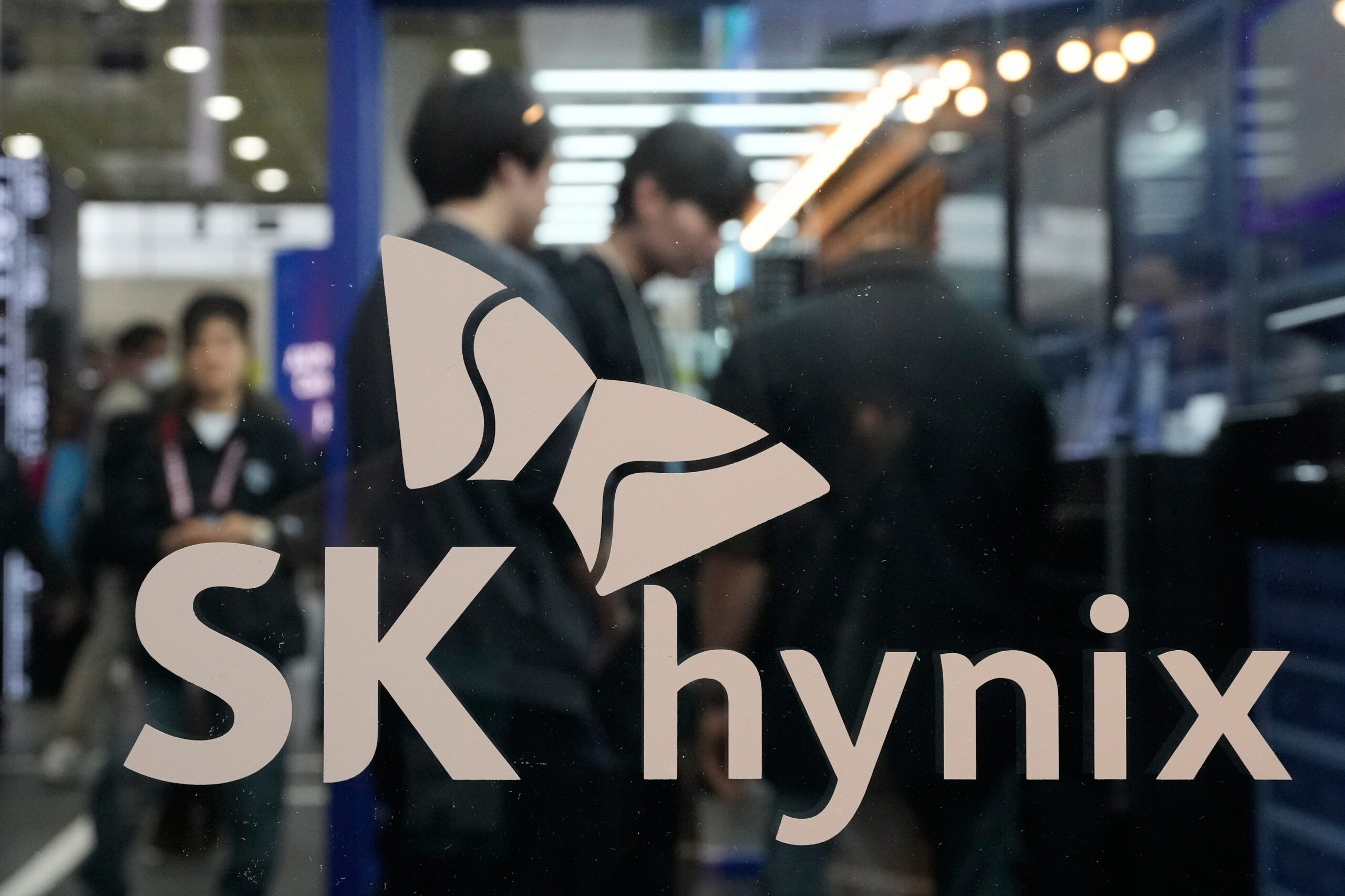
South Korea’s SK Hynix (SKHY) is set to raise up to $28 billion through an initial public offering (“IPO”) on Friday, July 10, in what would be the second-largest share sale ever. The equity offering capitalizes on investors’ white-hot interest in artificial intelligence (“AI”) plays, especially memory stocks.
SK Hynix intends to price its listing at $149 per American Depository Receipt (“ADR”) on Thursday, according to multiple reports, while offering 17.79 million shares. Bloomberg is reporting that the listing is more than seven times oversubscribed, indicating strong investor interest.
The chipmaker is already the most highly valued company on the South Korean exchange, having surpassed electronic giant Samsung, with its stock already quadrupling so far in 2026. While $28 billion is a large offering, it’s a small slice of the firm’s estimated total value of $1.3 trillion.
Technically, SK Hynix’s offering isn’t an IPO, since its shares already trade in South Korea. Instead, the company is listing as an ADR on Nasdaq, making it much easier for American investors to trade the stock.
The chipmaker said that proceeds from the offering will be used to expand its capacity in South Korea, but the benefits of the deal extend well beyond a capital raise. A U.S. listing could boost the stock price, as it compares favorably with peers such as Micron Technology (MU).
SK Hynix is the world’s largest supplier of dynamic random access memory (“DRAM”) and NAND memory. It’s also the market leader in high-bandwidth memory, with an estimated 56.4% share, according to the company’s prospectus. It has the lowest production costs, meaning its margins are the best among memory manufacturers.
Sales have grown briskly over the last few years, surging at a 72% compound annual growth rate from 2023 to 2025. Effectively, SK Hynix has tripled sales during that stretch. The first quarter of 2026 saw sales rise even faster, up 198% year over year.
So, the SK Hynix offering has a dual aspect – raising capital at a relatively high price for the stock and using the dual listing to help boost the share price on a deeper capital market.
Memory stocks such as SK Hynix, Micron, and SanDisk (SNDK) have absolutely trounced the market over the past year or so, as the intense expansion of AI data centers puts huge upward pressure on computer memory prices. But after months of scorching returns, investors should be asking themselves how much longer the blazing outperformance can continue.
With many large AI-related companies rushing to market to capitalize on high stock prices and fervent interest in AI, investors should take a cautious approach to this notoriously cyclical sector, even if near-term returns look strong.
Memory Stocks Have Gone Parabolic Over the Past Year
Memory stocks have skyrocketed over the past year, as investors have priced in soaring profits at key companies amid the massive AI build-out. Hyperscalers such as Microsoft (MSFT) and Amazon (AMZN) have been investing hundreds of billions of dollars in AI data centers, and computer memory is an integral component in the expansion.
Two of the hottest memory-stock names have been SanDisk and Micron Technology.
It’s almost hard to fathom how quickly these companies’ estimated earnings have been revised higher. Shares of Micron were trading below $110 in August 2025. Now analysts expect the company to earn about $63 per share for all of 2026, implying the stock traded at less than 2 times future earnings less than a year ago. The average estimate for 2027 earnings nearly doubles the estimates for 2026. Micron now trades for more than $1,200 a share.
If the investment cycle continues apace, Micron may have a path to $2,500, according to my colleague David Engle.
It’s a similar story for SanDisk, which spun off from Western Digital (WDC) in early 2025. It went public at less than $40 per share but now trades for more than $2,200. It’s expected to earn about $65 per share in 2026, implying it was trading for less than 1 times future earnings a little more than a year ago. Analysts expect its 2027 earnings to nearly triple, to $183 per share.
Analysts are asking whether SanDisk’s massive rally still has room to run.
SK Hynix will take advantage of its shares trading on a highly liquid U.S. market, expecting that improved analyst coverage and easier access to the stock may also push up its price.
Meanwhile, memory prices have run up so fast that SK Hynix, Samsung, and Micron are now facing an antitrust lawsuit alleging them of price-fixing. The suit charges this trio, which holds some 90% market share, with coordinating the changeover of their factories from DRAM to high-bandwidth memory, so they wouldn’t be undercut on pricing by rivals.
Investors looking to piggyback on memory-stock mania can consider the Roundhill Memory ETF (DRAM), which holds a collection of memory stocks, including SK Hynix. So, any boost in South Korean stocks from their U.S. listing could benefit this fund’s shares, too.
Does SK Hynix’s IPO Signal a Top to the Stock Market?
With SK Hynix’s massive U.S listing, 2026 will be among the largest years for equity offerings. And while that news may spur “animal spirits” for investors, it may also signal a market top.
The reason is relatively simple: Insiders who know their company best are looking to sell to outsiders who are overly enthusiastic about the stock and willing to pay a high price. So, a cluster of AI-related companies looking to sell out of the hottest market trend may look suspect.
We’re now seeing some of the highest-profile companies with some of the largest valuations ever going public or announcing that they will do so:
- Cerebras Systems (CBRS) launched the largest semiconductor IPO ever in May.
- Space Exploration Technologies (SPCX) – SpaceX – conducted the largest IPO ever by total valuation in June.
- Anthropic confidentially filed its IPO prospectus with the Securities and Exchange Commission, and analysts expect an offering in the near term.
- OpenAI has also confidentially filed its prospectus, though it walked back immediate plans for an offering, amid a stunning level of operating losses.
- This $29.4 billion offering for SK Hynix, which already has a market capitalization of $1.3 trillion.
That spate of offerings should give investors food for thought about the durability of near-term AI investment. When the people who know a company best want to cut outsiders in for a piece of the action, investors need to think carefully about why they are doing so.
In the case of SK Hynix, the company is issuing stock to take advantage of relatively high prices for memory stocks in the U.S. That might be a smart arbitrage, but memory stocks will need hyperscalers to keep their foot on the pedal of AI spending if they want to continue rising briskly.
Regards,
James Royal, PhD
Editor’s Note: “Frontier AI” is a point of no return when AI surpasses human intelligence and gains free will. Elon Musk warns this moment could hit by the end of 2026. When it happens, 60-year Wall Street legend, Marc Chaikin, predicts Frontier AI could soon become the only thing that determines which stocks make money and which grind to a halt. That’s why he’s giving away a list of stocks to buy and sell absolutely FREE to help you position your money for a virtually unrecognizable world driven by Frontier AI technology. Get Marc’s Frontier AI Hotlist of stocks right here…