
Image Credit: Associated Press
Listen to the audio version of this article (generated by AI).
Key Points
- TSMC is dramatically expanding its U.S. manufacturing footprint, raising its planned Arizona investment by $100 billion to a total of $265 billion—the largest foreign direct investment in U.S. history.
- Surging AI demand continues to drive record financial results, with TSMC reporting 33.7% revenue growth and 77.4% net income growth in the second quarter.
- Advanced chip production and CoWoS packaging capacity are largely booked through 2027, reinforcing TSMC’s dominant market position and long-term AI growth outlook.
Taiwan Semiconductor Manufacturing Corporation (TSM) – which we’ll refer to in this article as “TSMC” – is the world’s leading maker of chips by a large margin. In the first quarter of 2026, TSMC held a dominant 73% share of the global pure-foundry market. And most of its business – 78% of its second-quarter 2026 revenue – came from North American customers, like Apple (AAPL), Nvidia (NVDA), and Advanced Micro Devices (AMD).
So, it makes perfect sense for TSMC to expand its manufacturing bandwidth in North America. And that’s exactly what the chipmaking titan is doing.
TSMC’s Chief Financial Officer (“CFO”) Wendell Huang stated last week that the company is throwing another $100 billion toward the build-out of its first advanced semiconductor-manufacturing site in the U.S. in Phoenix.
That inflates the total investment to $265 billion, which Huang stated was necessary due to a “multi-year demand mega trend” from its customers, including Apple, Nvidia, AMD, Qualcomm (QCOM), Broadcom (AVGO), MediaTek, Amazon (AMZN) Web Services, and Intel (INTC). The $265 billion represents the largest foreign direct investment in American history.
It’s important to emphasize that this $265 billion is more of a promise to spend the money, not money that’s already been spent. TSMC’s plan is long-term, designed for years of continued growth based on customer demand.
TSMC’s Arizona Manufacturing Build-Out
The initial $165 billion investment in Arizona called for a sprawling complex that included six semiconductor-wafer-fabrication facilities (“fabs”), two advanced-packaging factories (where a processor is stacked next to high-bandwidth memory on a silicon wafer), and a hub for TSMC’s research and development (R&D) team.
The first fab began volume production of TSMC’s N4 process technology in late 2024. (The “N” stands for nanometer, which is the size of each individual transistor on a chip. The smaller the number, the more transistors can be put onto a chip. As that number gets smaller, the chips become more powerful and efficient.)
The second fab was completed in 2025, with N3 process technology scheduled to begin in the second half of 2027 (about a year ahead of schedule). The third fab, designed for advanced N2 and A16 nodes, broke ground last year and should begin large-scale production toward the end of the decade.
Prep work has begun on the fourth fab plant as well as the first advanced chip-packaging facility. Upon completion, the TSMC campus in Phoenix will feature 12 fabs, advanced-packaging plants, and the R&D center.
The new influx of capital will help TSMC expedite its conversion of N5 production to newer N3 process technology as the company increases its focus on advanced chip technology in America, which is about five years behind Taiwan production-wise. For example, N2 volume production began in Taiwan last year, and N3 volume production was achieved in 2022.
TSMC has traditionally produced its advanced chips in Taiwan and then sent them to customers. And until the Arizona facilities catch up to those in Taiwan – which may or may not happen – America will continue to produce the slightly older, yet still critically important, semiconductors.
Huang acknowledged as much, saying:
When you ramp the most leading-edge technologies, you need very close collaboration between the R&D and operation functions. It has to be in Taiwan. And after it stabilizes, then we can consider transferring overseas.
With that in mind, TSMC plans to continue building in Taiwan with two more advanced packaging plants just announced – even as the company significantly grows its manufacturing presence in the U.S.
How TSMC’s Arizona Investment Bolsters the Entire U.S. Semiconductor Supply Chain
President Donald Trump has made growing American manufacturing a priority during his second term in the White House. Considering the deals that the Trump administration has cut with Intel, Apple, and Nvidia, to name a few, that initiative has been successful thus far.
And TSMC’s growing campus in Phoenix is certain to put a smile on the president’s face, because it’s going to supercharge the domestic semiconductor supply chain.
Make no mistake: the U.S. is already heavily involved in the chip industry. In fact, America is the world’s leader in chip design, with companies like Nvidia, AMD, and Qualcomm driving the U.S. chip industry to account for roughly half of the world’s chip revenue.
Chip manufacturing is another story. Roughly 75% of all chips are produced in East Asia, with Taiwan responsible for building most of the world’s semiconductors. In particular, TSMC has dominated the industry for years. Meanwhile, the U.S. was responsible for only around 10% of the global chip supply as of 2024.
Much of that American output comes from Intel, GlobalFoundries (GFS), and Micron Technology (MU), which specializes in manufacturing memory and data-storage chips. But 12% of the global chipmaking share simply won’t cut it if the U.S. hopes to keep up with the constantly growing demand for AI.
That’s why TSMC’s involvement in the U.S. semiconductor supply chain is so monumental. It literally changes how American companies do business.
Less reliance on Asia to supply the necessary chips for businesses like Apple, Nvidia, and AMD means several things:
- Avoidance of prohibitive tariff charges
- Faster, more reliable product availability for AI data centers and consumer electronics
- A front-to-back supply chain – from building to packaging and shipping – contained within the U.S.
- Thousands of local jobs in the Phoenix area
- A significant American imprint on the global semiconductor supply chain
Bottom line: TSMC doubling down on its Arizona chip production is a huge deal. And it’s a massive win for American manufacturing. But it’s also important for TSMC. The company has invested hundreds of billions of dollars in building fabs on American soil, even with costs being 4 to 5 times higher than building in Taiwan.
But it’s money well spent for TSMC, according to Huang, who sees it paying off in the long term, helping nurture the burgeoning American semiconductor supply chain and grow TSMC’s revenue.
TSMC’s Stellar Earnings Finance the American Build-Out
If TSMC hadn’t enjoyed such an outstanding financial first half of 2026, the company might not have been inclined to put up another $100 billion to finance the Arizona campus expansion.
But the company’s more than $76 billion in first-half revenue helped make the investment possible. Overall, TSMC enjoyed an outstanding second quarter, with consolidated revenue of $40.2 billion and net income of $22.4 billion. That helped influence TSMC’s decision to increase its capital expenditure (“capex”) from between $52 billion and $56 billion to a range of $60 billion to $64 billion to accelerate chip production and keep up with surging demand.
The company’s second-quarter revenue increased 33.7% year over year (in USD). Even more impressive, however, was its 77.4% increase in both net income and diluted earnings per share (“EPS”), the latter of which came in at $0.86.
TSMC’s second-quarter margins were quite strong: a 67.7% gross margin, 60.3% operating margin, and 55.6% net profit margin.
And the company is expecting bigger things in the third quarter, with revenue projected to grow to between $44.6 billion and $45.8 billion.
TSMC’s current backlog supports that guidance. At mid-year, TSMC’s N3 nodes were mostly sold out through the rest of 2026 thanks to massive AI chip demand from customers such as Nvidia, Alphabet (GOOGL), Amazon, and AMD.
There’s also a huge bottleneck for TSMC’s most advanced node currently in production (N2) as well as its upcoming A16 node, both of which will be critical components for the next generation of AI. The N2 node is essentially booked out through 2027, and the A16 node’s volume-production schedule was pushed back into 2027.
Perhaps the biggest bottleneck, however, is the demand for TSMC’s advanced packaging, also known as chip-on-wafer-on-substrate (“CoWoS”). It’s not for lack of effort on TSMC’s part, however. The company has made a massive push to expand packaging bandwidth, from producing roughly 35,000 wafers per month in late 2024 to what will likely be 130,000 per month by the end of this year.
But even the quadrupling of production in two years, as well as TSMC’s CoWoS capacity growing at an 80% compound annual growth rate, isn’t enough to meet demand. Capacity is just about booked out through 2027, with lead times reaching a year or more.
That may not be ideal news for TSMC’s customers. But it’s music to the ears of its investors.
TSMC’s Outlook: Is the Stock a Good Buy Right Now?
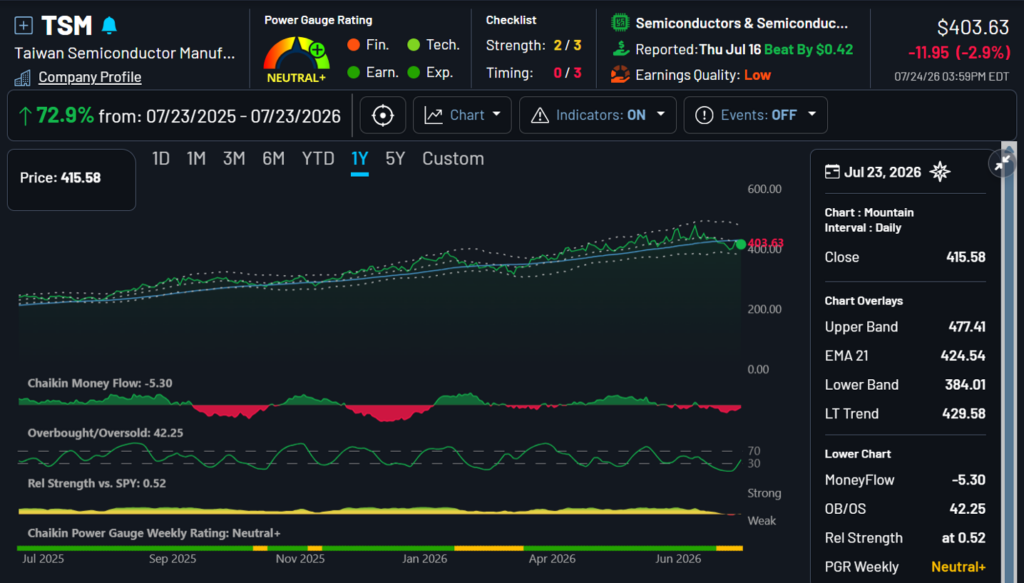
Based on its year-to-date (and beyond) performance, it’s not surprising that TSMC stock has been steadily rising. As of July 24, it’s up roughly 73% over the past year. And since the start of 2026, TSMC is up 30%.
Frankly, barring any sudden (and unlikely) drop in demand for AI chips, there’s no reason to think TSMC won’t continue along this trajectory. You’ll still see some analysts and publications panicking (yes, even us) about the impending AI-bubble burst. Could that happen? Of course.
But, considering the unholy amounts of money that companies worldwide have poured into all layers of AI, that bubble (if there even is one) isn’t likely to burst anytime soon. Four hyperscalers alone – Alphabet, Meta, Microsoft (MSFT), and Amazon – are projected to spend $650 billion in capex this year, a 71% year-over-year increase.
TSMC’s backlog is another prime example of AI’s probable longevity. Its customers have already paid for components they may not even see until 2028, and TSMC has already committed to manufacturing those products.
It may sound simplistic, but as long as there is demand for AI hardware and infrastructure, companies like TSMC will continue building it. And its customers will keep using it and order more.
Whether it did so intentionally or not, TSMC has created a nearly impenetrable moat through its state-of-the-art chip production as well as its advanced packaging. Because the company has mastered both and typically leads the way in innovation, its customers have little choice but to stick with TSMC.
As a pure-play foundry and one of the very few companies in the AI world that doesn’t compete with its own customers, TSMC has a stranglehold on the semiconductor-manufacturing industry. Think about it… can you name one or two of TSMC’s direct pure-play competitors?
Probably not, because TSMC really doesn’t have much competition. Especially when it comes to advanced chip manufacturing and packaging.
Intel doesn’t count because it’s not a pure-play foundry. The same goes for Samsung Electronics.
There are a few other players, like GlobalFoundries, United Microelectronics (UMC), and the Semiconductor Manufacturing International Corporation. But let’s just say that TSMC isn’t losing a minute of sleep over any of those “competitors.”
TSMC’s dominance is why analysts typically love its stock. Even while trading at around $416, there’s still growth potential. As of July 23, TSMC’s average price target is $516.67, meaning there’s upside of roughly 24%.
As long as companies like Nvidia, AMD, Qualcomm, Broadcom, Apple, and others are designing chips for AI and everyday commercial- and consumer-electronics items, TSMC will continue to make them. That’s about as safe a play as you can find on the market.
Regards,
David Engle
Editor’s Note: Could a major AI company’s “silent IPO” end up overshadowing both SpaceX and Anthropic?
According to Marc Chaikin — the 60-year Wall street legend who called Nvidia before it shot up 45,000% — a tech firm that been called “the unseen winner of the AI race” could soon break itself up into three separate companies.
If it does, the next Netflix… the next Tesla… and the next Amazon are all poised to spin off just from this one stock. That means, if you simply make one trade today, you could could automatically get your hands on shares of all these potential spinoff IPOs with no more work on your part.
Click to see how you can get in on this “silent IPO” before it’s too late…