
Image Credit: Associated Press
Key Points
- A new CNBC report from inside GE Vernova’s South Carolina turbine plant shows gas-turbine prices have risen roughly 300% over the past three years.
- GE Vernova’s turbine order book is sold out through 2029, with new orders extending into 2031 as hyperscalers race to secure off-grid power.
- The developments support Professor Joel Litman’s “Dark Energy” thesis that AI’s growing electricity demands are driving tech companies toward private, behind-the-meter power solutions.
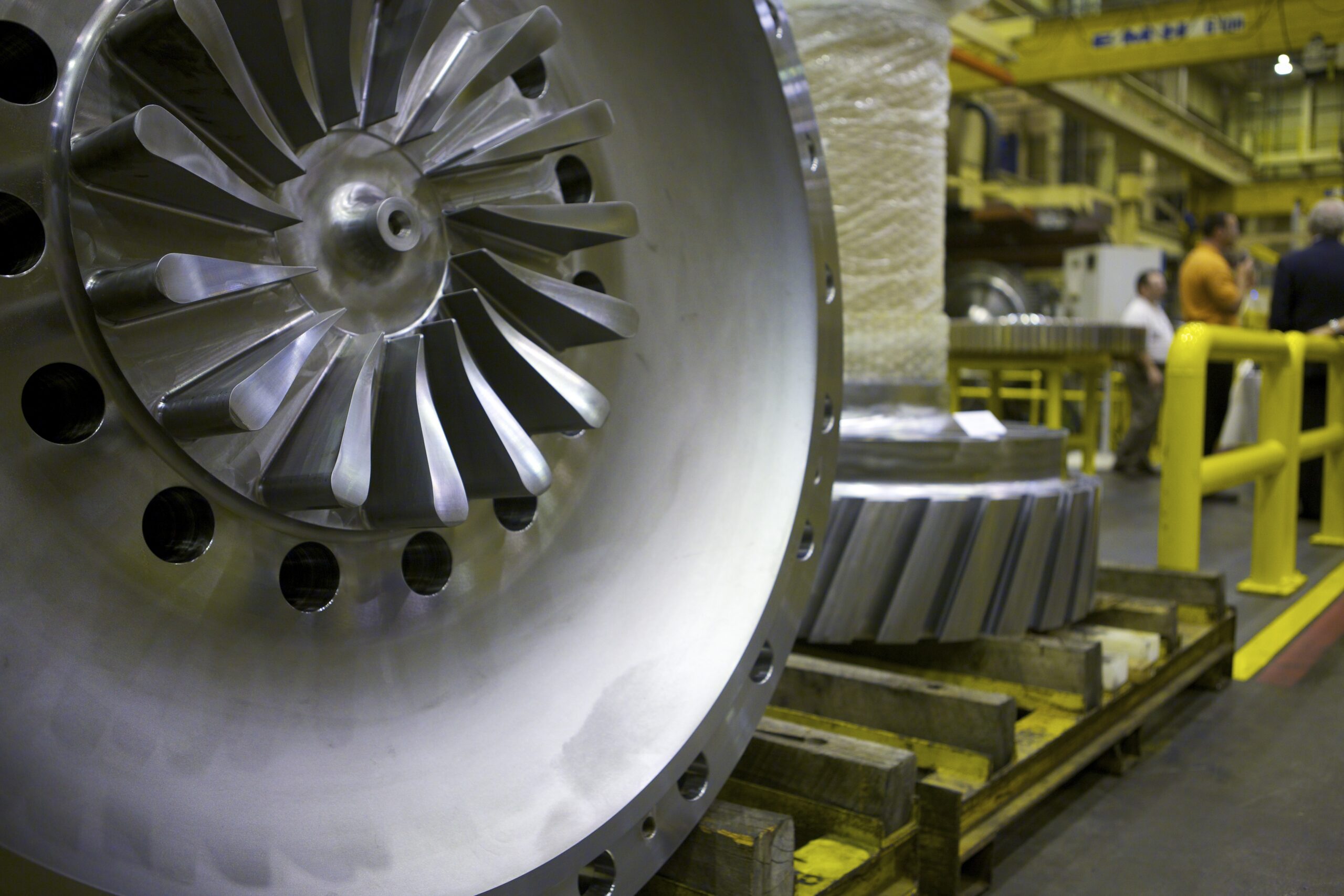
Yesterday, CNBC’s Seema Mody walked the floor of the largest gas turbine factory on the planet.
GE Vernova (GEV) has 1.7 million square feet of manufacturing space set on 400 acres in Greenville, South Carolina.
Behind her was the company’s biggest turbine… a 30-foot-tall, 280-ton monstrosity that can power as many as 500,000 homes – or one data center.
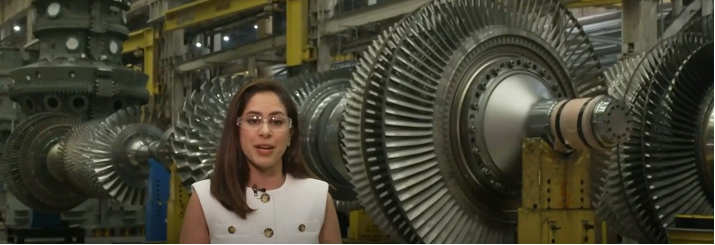
The reporter noted that executives from all the major AI-hyperscaler heavyweights have spent time in this factory.
It’s no surprise that GE Vernova’s order book is entirely sold out through 2029… even as gas turbine prices have climbed roughly 300% over the past three years.
For example, Microsoft (MSFT) recently ordered seven of these turbines for a 2.7-gigawatt Texas data center. My colleague Nick Koziol detailed Project Kilby earlier this week, a multi-firm partnership between Microsoft, GE Vernova, oil supermajor Chevron (CVX), and construction-equipment company Caterpillar (CAT). As he wrote:
I expect partnerships like this – matching energy-hungry tech giants with companies ready to supply power – to continue for years. The hyperscalers have committed more than $700 billion to the AI build-out in 2026 alone.
They’ll have to keep throwing money at AI to make sure that the massive amount they’ve already invested doesn’t go to waste. And they’ll continue to need energy to power their new data centers.
This is the story we’ve been sharing for months now… and it all relates to what Professor Joel Litman calls “Dark Energy.” (You can hear Joel tell the full story in his own words, in an exclusive presentation filmed at a Texas Panhandle data center project.)
Dark Energy Is the Current AI Bottleneck
When the people responsible for the world’s biggest investment build-out all show up to inspect the same factory, that’s a good sign you’re looking at a bottleneck…
And bottlenecks are the whole point of the Dark Energy story.
Last month, I broke down Professor Joel Litman’s “Dark Energy” prediction in detail.
Joel is a forensic accountant, a senior adviser to the massive Fermi America energy project in Texas, and the founder of our corporate affiliate research firm Altimetry. He coined “Dark Energy” to describe a specific solution to AI’s power problem. Here’s how I tried to simplify what Dark Energy actually is…
Dark Energy is a clean, reliable power source. Specifically, it’s a class of natural-gas turbines… essentially a jet engine adapted into an electric generator. They start in minutes, run on natural gas instead of jet fuel, and can produce tens of megawatts of power per unit. Stack enough of them together, and you have a private power plant.
These devices have been around for decades. They’ve powered tanks, ships, and remote oilfields.
But until recently, no one was using them at scale to power the world’s most advanced AI labs. Now that they are, the suppliers building them are sold out for years.
The fact is, the grid can’t deliver power fast enough for the AI build-out. It’s simply not possible.
Utilities in major markets are already starting to ration electricity. Some cities have even paused new data-center hookups to the grid until 2030 or later. A new high-voltage transmission line can take a decade or more to permit and build.
Meanwhile, AI spending is climbing from about $380 billion in 2025 to roughly $650 billion in 2026, according to my colleague Jim Royal.
So the tech giants face a simple choice… Wait years for the grid. Or do it themselves by bringing their own power to the data center.
GE Vernova’s gas turbines are a big beneficiary as hyperscalers increasingly choose the second option.
This is exactly what I wrote about when Elon Musk started buying up America’s gas turbines. SpaceX disclosed in its IPO filing that its xAI division plans to spend more than $2.8 billion on natural gas turbines over three years. As the company warned:
SpaceX admits in the “risks” section of its filing [that] these turbines are a big bottleneck to the AI build-out, stating: “We currently rely significantly on natural gas and gas turbine technology to power our data center operations.” The company also warned that any injunction or revoked permit could damage its AI business.
The filing from SpaceX is the clearest sign yet that any hyperscaler’s AI ambitions will rise or fall based on access to power.
And GE Vernova’s own Securities and Exchange Commission filings tell a similar story…
Digging Into GE Vernova’s Numbers
In April, the company reported its first-quarter earnings…
Orders soared by more than $18 billion, an increase of 71%, with growth in every business segment. And its total power under contract grew to 100 gigawatts.
The company also now expects to reach an incredible $200 billion backlog in 2027, a full year earlier than its prior forecast. As GE Vernova’s CEO reported on its earnings call, the company’s momentum is only growing:
Quarter-to-date, we have booked more power equipment orders in terms of value than we did in all of Q1 ’26.
On pricing, we expect our orders in the first half of ’26 to be priced 10 to 20 points higher than our 4Q ’25 orders on a dollar per [kilowatt] basis. We now expect to book 10 to 15 gigawatts of contracts in Q2 and to end ’26 with at least 110 gigawatts under contract.
On production capacity, we now have installed over 280 new machines in our gas power factories and remain on track to reach 20 gigawatts of annualized output by 3Q.
That means in the first 22 days of April, GE Vernova booked more power equipment orders than in the prior three months put together.
And Joel thinks that investors are still underestimating GE Vernova’s potential.
Dark Energy Supplier Stocks Will Profit Most
Joel has put together a series of special investment briefings for investors that detail exactly what to buy, step-by-step, to profit from the Dark Energy build-out that’s happening right now.
First, he explains his Dark Energy prediction in full, including five behind-the-scenes suppliers that sit at the perfect intersection of AI-power tailwinds, in his report titled Dark Energy: Stocks That Could Soar as AI Goes Off the Grid.
These are straightforward “picks and shovels” ways to play the AI build-out… many of which simply aren’t showing up in the headlines yet but can go from unknown to high-profile, virtually overnight. As Joel closes the report for his subscribers:
For the U.S. to achieve its AI goals, we’re going to need a lot more power.
Most of the headlines nowadays go to the companies creating AI models. But the true winners in today’s market will be the companies providing the foundation.
Investors are doubting plenty of behind-the-scenes operators. And while they’ve started to recognize a few winners, there’s still a long way to go.
Dark Energy build-out needs more than turbines. It needs cooling, switchgear, transformers, and eventually small modular reactors (“SMRs”). The companies that are benefiting from these types of bottlenecks are where Litman is hunting. And in turn, he also has three additional bonus reports…
- Dark Energy, Phase 2: How to Profit as America Goes Nuclear. This is all about the SMR boom that will come in the coming years to fuel the next stage of the AI build-out.
- The Game Changers: Unbeatable Advantage Stocks to Buy Today. This report is focused on broader stocks that could soar as AI sweeps through an increasingly “split” economy… with big winners, but even bigger losers.
- 10 Widely Held Stocks You Should Sell Immediately. Since 2008, an incredible 50 of the 57 companies Joel has publicly exposed as significant risks to investors have indeed collapsed. If you own any of these stocks, get out before it’s too late.
The fact is, every dollar of AI spending eventually has to plug into something. The grid can’t supply it.
But as Joel points out, Dark Energy can. And the little-known suppliers are how an investor can best take advantage for the biggest profits.
You can learn how to get immediate access to each of these reports by clicking here to go straight to an order form. (This link does not go to a long video.)