Image Credit: MarketWise
A small mistake at one of the world’s most valuable artificial-intelligence (“AI”) companies turned into the biggest tech leak of the year…
A debugging file got bundled into a routine software release at Anthropic, maker of the Claude AI assistant. Within hours, half a million lines of source code were being passed around the Internet – including details that the public wasn’t supposed to see for months…
Industry observers called the leak a secret road map to where the AI industry was heading next.
Already, well-known names like Ray Dalio, Goldman Sachs CEO David Solomon, Nvidia CEO Jensen Huang – who called it “incredible” – and even rivals in this space like Mark Zuckerberg are quietly harnessing this tool to completely revamp their companies.
According to Wall Street legend and financial-technology pioneer Marc Chaikin, the plan revealed in the leak, called Project Tengu, is set to spark a 4,200% tech boom… impact $500 trillion in global wealth… and turn the economy upside down.
Marc is the creator of one of Wall Street’s most popular indicators, a powerful tool found on every Bloomberg and Reuters terminal in the world. And he has called nearly every twist and turn in the stock market since 2020…
Today, Marc believes that Anthropic’s Project Tengu technology is about to detonate the next leg of the AI boom… a multitrillion shock wave that could roll through the stock market.
And he says that one small company, currently trading for around $40 a share, offers a “pre-IPO back door” into Anthropic before its planned 2026 public offering. He gives the name and ticker away for free in his exclusive Project Tengu interview, which you can watch for free by clicking right here.
Or stay on this page as we dive deep into what Marc is predicting will happen next…
Table of Contents
An Overview of Marc Chaikin’s “Project Tengu” Prediction
Anthropic is surging…
The AI company raised $30 billion in February 2026 at a $380 billion post-money valuation, more than double its valuation just months earlier.
In addition, the company’s annualized revenue climbed to $14 billion, after revenue last year reached roughly $10 billion. As Fortune magazine put it…
Artificial intelligence company Anthropic [has cemented] its position alongside rival OpenAI and Elon Musk’s SpaceX in a trio of the world’s most valuable startups that investors will be watching closely this year to see if they will become publicly traded on Wall Street.
And its customer roster is impressive…
Goldman Sachs (GS) has been working with Anthropic for six months to co-develop autonomous AI agents using Claude, with the bank’s chief information officer calling it a “digital coworker” for accounting, compliance, and client onboarding.
NASA’s Jet Propulsion Laboratory used Claude to plot a route for the Perseverance Mars rover… marking the first time an AI model has driven a vehicle on another planet.
And Spotify Technology (SPOT) uses Claude Code through an internal system called Honk to ship code… Co-CEO Gustav Söderström even told Wall Street analysts in February that the company’s best developers “have not written a single line of code since December.”
The fact is that “Project Tengu” was no ordinary product launch. Instead, it’s likely the beginning of the biggest white-collar job disruption since the personal computer. The Wall Street Journal even coined a new term:
They call it getting “Claude-pilled.”
It’s the moment software engineers, executives and investors turn their work over to Anthropic’s Claude AI – and then witness a thinking machine of shocking capability, even in an age awash in powerful artificial-intelligence tools.
This technology has already started wiping out entire categories of work. I’ve been writing about the AI revolution and its inevitable effect on American society for a while now…
Last fall, I covered Amazon’s plans to fire 30,000 white-collar workers:
“There will be millions… and perhaps tens of millions… of jobs cut in America in the years ahead thanks to artificial intelligence.”
I’ve tracked the mass layoffs at Meta, Microsoft, and Oracle, writing,
“If you’re one of the 2.5 million to 3 million folks employed by a Big Tech company… your job is absolutely at risk, whether or not the company denies it today.”
I detailed why millions of white-collar jobs are at risk thanks to Elon Musk’s Macrohard AI, which is designed to watch your computer screen in real time, tracking your every keystroke and mouse movement, with an explicit goal of learning how to do your job.
“Hundreds of billions of dollars are being spent across America on building AI… with the ultimate goal of displacing millions of American workers.”
Marc, too, points to layoffs that have hit Oracle, Amazon, and others as companies retool around AI.
As Marc said in his exclusive interview:
[Nvidia CEO Jensen] Huang believes the technology behind this innovation “is going to cause the world’s GDP to become $500 trillion.”
Now, this may come true… and if it does, it will likely become the greatest wealth-building opportunity in modern history…
But it’s going to destroy thousands of jobs, companies, and even entire business models in the process.
So, expect a big move in the stocks that benefit from agentic AI… as well as those companies that get displaced by it.
Anthropic May Be the World’s Most Important AI Company
Rival AI company OpenAI and its ChatGPT assistant still get most of the headlines…
But behind the scenes, Anthropic is increasingly known in professional circles as the AI company that does the best work. And as the Wall Street Journal just reported days ago:
Venture firms are concentrating huge bets in OpenAI and Anthropic, betting that their rapid growth rates will continue.
Anthropic, which is helmed by Chief Executive Dario Amodei, is projecting a $50 billion revenue run-rate, a forecast of annual revenue based on short-term sales, by the end of the second quarter, up from $9 billion at the end of 2025.
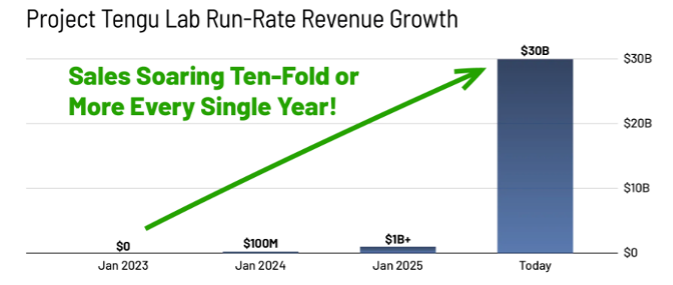
That’s a massive jump from the $30 billion in revenue that Marc noted in his interview just weeks ago…
And it’s more than triple what venture-capital funding platform Crunchbase reported in February:
Anthropic says its run-rate revenue is now over $14 billion, a figure it claims grew over 10x annually in each of the past three years since it “earned its first dollar in revenue.”
The number of customers spending over $100,000 annually on Claude (as represented by run-rate revenue) has grown 7x in the past year, the company added.
Marc put that 10-fold historical growth rate in context in his interview…
- Google parent Alphabet (GOOGL) roughly doubled its revenues during its hypergrowth phase in the early 2000s.
- Nvidia (NVDA) doubled its revenue annually through the recent generative-AI build-out.
- And OpenAI doubled or tripled revenues each year over the past three years.
The reason for Anthropic’s massive sales growth is simple: It is increasingly focused on businesses that are doing real work in the real world.
For example, Goldman has been working for months with embedded Anthropic engineers to build agents for two specific workflows: reconciling trades and onboarding new clients.
The company’s tech chief wants these AI agents to be thought of as “digital coworkers for many of the professions within the firm that are scaled, are complex and very process intensive.” And as CNBC reported:
Goldman Sachs CEO David Solomon said in October that his bank was embarking on a multiyear plan to reorganize itself around generative AI, the technology that has made waves since the arrival of OpenAI’s ChatGPT in late 2022. Even as investment banks like Goldman are experiencing surging revenue from trading and advisory activities, it will seek to “constrain headcount growth” amid the overhaul.
Anthropic deepened its push into finance earlier this month. The company unveiled a set of purpose-built financial-services AI agents at a New York event, with Anthropic’s CEO Dario Amodei sharing a stage for the first time with JPMorgan Chase (JPM) CEO Jamie Dimon.
Anthropic also pulled back the curtain on its production deployments… Financial giants JPMorgan Chase, Goldman Sachs, Citi (C), AIG (AIG), and Visa (V) are all running Claude in some part of their operations.
Meanwhile, Anthropic put up another $300 million as part of a $1.5 billion joint venture with private-equity (“PE”) firms Blackstone (BX) and Hellman & Friedman, as well as Goldman Sachs, to bring Claude into midsized businesses – including each firm’s PE-backed portfolio companies.
Even Meta Platforms (META) founder Mark Zuckerberg has been forced to acknowledge what Anthropic has built. Despite Meta’s plans to spend upward of $145 billion on AI capital expenditures this year… it is actually testing some of its new AI tools with Anthropic models rather than its own.
Marc Chaikin’s read on all this is that Anthropic is not just another AI lab. Banks, manufacturers, drugmakers, and government agencies are wiring Claude into their internal workflows.
The deeper Anthropic gets embedded, the more it becomes an operating system of sorts for corporate America.
Project Tengu and the Next “SaaSpocalypse”
Most investors think of AI as a productivity booster: a faster way to draft an email… a nifty image generator… and a search engine that directly answers a question instead of linking to a website…
Which, to be fair, is exactly how most consumers use it…
But the corporate reality is different. Inside companies, AI is starting to replace entire categories of paid software. And when an AI agent can fully replace a $50,000-per-year enterprise license, that recurring revenue goes to zero.
This was the core of the “SaaSpocalypse” that the market experienced earlier this year… a widespread sell-off in Software as a Service (“SaaS”) stocks. These are companies that provide software through the cloud for a recurring subscription fee.
The market plunge was a response to the massive upgrade in AI capability, largely from Claude Cowork. Instead of requiring collaboration with a human, Claude Cowork became autonomous… able to create and edit files, execute multistep projects, and work seamlessly between applications. As my colleague John Robertson noted at the time…
Claude can now automate tasks in marketing, customer support, data analysis, and legal workflows.
The market responded forcefully… Investors began fearing certain IT and Software as a Service (“SaaS”) business models would become obsolete.
Roughly $1 trillion in global software market value was erased in a single week in early February as the S&P 500 Software & Services Index fell nearly 13%.
And again, this was just the first “upgrade” of AI capability. AI is only going to get stronger (and smarter) from here.
Right now, you might think of Claude as a junior employee… You can assign it a task, and it can do most of the rest on its own. It can kick off subtasks, run other software, write its own code to fill gaps in its abilities, and check its own work. That’s what “agentic AI” means.
As Marc said in his interview:
Anthropic says they are planning to IPO in the fourth quarter of 2026. And they’ve been working through internal preparations for this potential listing.
They’ve engaged a law firm that helped Google, LinkedIn, and Lyft go public… and recently hired an executive who played a key role in Airbnb’s IPO.
And when this IPO happens, I expect it to fully validate Anthropic’s disruptive technology – and make the sell-off in February look like child’s play.
The “Pre-IPO Back Door” Into Anthropic
Most folks can’t buy shares of Anthropic today. It’s not yet public, for one.
More concerning, many of the shares that have traded on secondary markets to accredited investors are not necessarily valid. As the Wall Street Journal reported last week, Anthropic sparked “widespread panic” when it suggested some secondary investments could be worthless (emphasis added)…
The artificial-intelligence company updated a post on its website from February that had warned investors it won’t recognize sales of Anthropic stock that haven’t been approved by its board. The new addition was a list of “unauthorized firms” that facilitated such sales: Open Door Partners, Lionheart Ventures and Sydecar, plus Hiive and Forge for new offerings. “Any sale or transfer of Anthropic stock, or any interest in Anthropic stock, offered by these firms is void and will not be recognized on our books and records,” it wrote.
That doesn’t mean there aren’t options…
For example, Microsoft (MSFT) invested about $5 billion in Anthropic, Nvidia invested roughly $10 billion, and Amazon (AMZN) invested some $13 billion, along with the right to invest up to another $20 billion in the future.
The problem is that each of these companies is worth trillions.
Even if their Anthropic investments go up another 10-fold from here, it won’t be enough to significantly move the needle on their overall performance.
Marc has a better solution. And he gave the name and ticker away for free during his exclusive interview, which you can watch here.
The company is SK Telecom (SKM), a small, publicly traded South Korean wireless carrier. And the math is incredible…
In August 2023, SK Telecom announced it was investing $100 million in Anthropic, on top of an earlier investment from its venture arm. The deal came with a partnership agreement to fine-tune Anthropic’s Claude models for the telecom industry. At the time, Anthropic was worth around $5 billion.
Three years later, Anthropic is valued at $380 billion. That works out to a roughly 76-fold increase in the underlying company, with Zacks analyst Andrew Rocco noting that:
“SK Telecom made one of the most astute and timely private AI investments among publicly traded companies.”
SK Telecom’s stake has been diluted through subsequent funding rounds, but the gain has been dramatic. Today, the position is likely worth between $1 billion and $2 billion – a significant portion of SK Telecom’s market cap.
And it’s no surprise that the stock has soared so far this year.
Marc’s Power Gauge system turned bullish on SK Telecom earlier this year… and if you were following him, you could have made 77% or more…
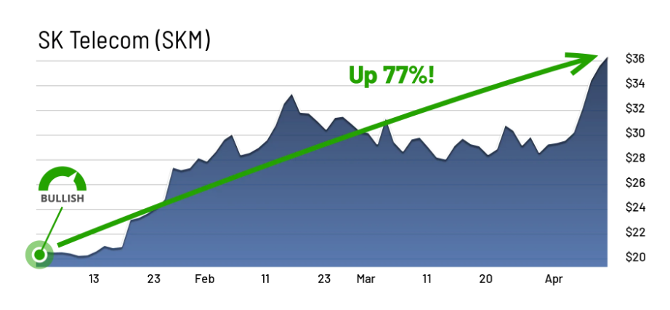
Looking forward, anytime news about Anthropic’s valuation hits headlines, you can expect SK Telecom to move roughly in tandem. Just make sure that you watch Marc’s video interview for the specific price he warns investors to avoid overpaying.
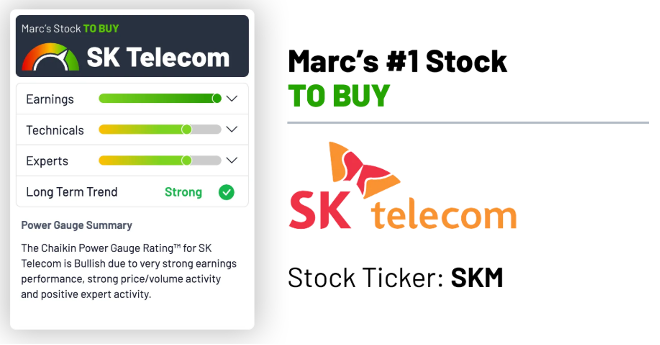
As he puts it, “If you’re looking for a pure play on Anthropic, SK Telecom is the way to go.”
And he also notes that the companies he details in his report for paid subscribers have even higher upside than Anthropic… You can learn how to get access to these reports by clicking here to go straight to the order form. (This link does not go to a long video.)
What Is Chaikin Analytics?
Chaikin Analytics is an independent financial research firm built around one idea… giving regular investors the same kind of analytical edge that Wall Street firms have used for decades.
As a financial publisher, it doesn’t manage money – that means it doesn’t take any sort of commissions or performance fees. It strictly publishes tools and investment advice, as well as model portfolios that track how its recommendations perform.
This keeps the company’s incentives aligned with its subscribers’…
If a recommendation turns out wrong too many times, folks cancel. But if recommendations consistently turn out right, then subscribers stay and renew… and even recommend Chaikin’s research to their friends.
And indeed, Marc Chaikin founded the company specifically to level a playing field he’d watched tilt against regular investors for decades. And he does that with his flagship Chaikin Power Gauge system… a 20-factor stock-rating system that scans more than 5,000 stocks and 2,300 exchange-traded funds (“ETFs”).
It breaks its rating down into four main categories: financial health, earnings performance, technical trends, and expert sentiment. In turn, each category contains five specific factors – the ones Marc has found most predictive as far as where a stock is headed next.
Financial factors measure a company’s underlying strength and valuation.
That means free cash flow, debt-to-equity ratios, return on equity, price to sales, and price to book.
The goal is identifying companies that are fundamentally solid… as well as flagging ones that are financially risky.
Earnings factors track profitability trends.
Is earnings growth consistent year over year? How have earnings per share trended over the last 12 months? Has the company beaten or missed estimates? Is the stock cheap or expensive based on forward earnings? Are earnings volatile or steady?
These are all questions an investor should answer, which the Power Gauge does for you. Strong scores here suggest improving profits that the market might reward.
Technical factors gauge price and volume patterns.
Besides Money Flow, there’s price trend versus the 200-day moving average… volume trends… price strength relative to the overall market… and six-month performance versus the S&P 500.
These factors reveal whether a stock has momentum behind it or is lagging. Positive momentum often signals that something good is happening. Persistent weakness can be a red flag.
Expert factors capture what informed insiders are doing.
Is the stock’s industry outperforming or lagging? Are executives buying shares or selling? Is short interest unusually high? Are analysts raising or lowering earnings forecasts? Are they upgrading or downgrading the stock?
Heavy insider buying plus rising analyst estimates plus a hot industry? That’s a sign of a lot of strong tailwinds converging.
Then each factor gets rated, with Marc’s proprietary formula determining how much each factor influences the final score.
The result is a single Power Gauge rating: very bullish, bullish, neutral, bearish, or very bearish. The goal is to turn what would otherwise be hours of research across multiple databases into a single-screen-ready answer for any of the more than 5,000 stocks the system covers.
- Bullish or very bullish means the stock scores well across most factors. It’s likely to outperform. Marc describes these as roughly the top 20% of opportunities.
- Bearish or very bearish means significant weakness… deteriorating fundamentals, poor money flow, negative expert signals. The stock is likely to underperform or decline.
- Neutral means nothing stands out either way. The stock will probably move with the market unless something changes.
By combining both fundamental and technical factors, Marc aims for the best of both worlds. A pure fundamental investor might miss a big shift in market sentiment. The technical factors catch that. A pure chart-watcher might overlook balance sheet risk. The financial factors flag it.
And based on the track record Marc shares, his system is adding real value for real investors.
Over the years, the company has built a solid reputation. WealthManagement.com named it Best Research Provider in 2021, beating Bloomberg and Morningstar. The company is focused on bringing institutional-grade analytic tools to regular people at a fraction of the cost.
Who Is Marc Chaikin?

Marc Chaikin’s career is the kind that gets written up in finance textbooks…
As you can tell from Marc’s Wikipedia page, he has lived several Wall Street careers… as a trader, stockbroker, analyst, and software entrepreneur.
Marc started on Wall Street in the late 1960s. He ran the options department at Tucker Anthony in the 1970s and later founded his own firm, Bomar Securities. Along the way, he worked with some of the most successful investors in history… like Paul Tudor Jones, George Soros, Michael Steinhardt, and Steve Cohen.
In fact, if you have a Bloomberg Terminal or Reuters system subscription today, you can access Marc’s indicators… They’ve been integrated into these professional-level tools for decades.
In 1998, Marc sold an analytics company and planned to retire. As he put it:
“I had spent my life’s work collecting and interpreting financial data to get to that point. It had paid off… And now, I was ready for a life filled with tennis, books, and relaxation.”
But then the global financial crisis of 2008-2009 came along… and his wife Sandy’s 401(k) account was bleeding value, even as her high-fee active financial manager avoided talking to her. As Marc recounts:
The few times she was able to get him on the phone, he was dismissive.
Then, something incredibly ominous happened…
On September 16, 2008, money-market accounts “broke the buck.” That’s the fancy way of saying that money-market savings accounts were now losing money. I vividly remember the exact words I told Sandy at the time…
“This means we’re in deep trouble.”
I called my friend, Bill Griffeth. He was CNBC’s Closing Bell host at the time.
“Marc, what’s going on? We’re just about to air,” Bill asked me. He hadn’t heard the news about the money-market accounts yet. It stunned him.
Even worse, Sandy’s actively managed account was down much more than the overall market at the time… It was sitting on losses of about 50% at that point, while the broader market was down about 20%.
That experience pulled Marc back into the business. He started Chaikin Analytics with a specific goal of bringing Wall Street-grade tools to individual investors… so that what happened to Sandy didn’t need to happen to anyone else, ever again.
Sandy is the co-founder of Chaikin Analytics. The pair built the Power Gauge as a synthesis of every metric Marc had used or developed across his career.
The goal was a single, easy-to-read score that captured all 20 factors at once so a retail investor could get a fast read on a stock the way a professional analyst would.
And of course, Marc’s influence extends well past his own business. He worked with Nasdaq and IndexIQ to bring the Power Gauge rating system into the ETF marketplace. And he still shows up on CNBC, Bloomberg, and Fox Business News, usually when an interviewer wants a data-driven read on a sharp market move.
Jim Cramer, the longtime host of CNBC’s Mad Money, has summed up Marc’s reputation in one sentence:
“I learned a long time ago not to be on the other side of a Chaikin trade.”
That’s one reason why so many readers and investors pay attention when Marc makes a multiyear, market-shaking prediction like he did with Project Tengu.
How Investors Can Profit From Project Tengu
The most important investing window of the next several years is happening right now…
You have only a few weeks left before the next Anthropic AI model is released.
Last time, it took some $1 trillion off the market and wiped out select SaaS stocks.
This time, it could be a much bigger move. As Marc noted in his market warning:
Anthropic says this is the most powerful model they’ve ever developed.
It’s potentially so disruptive that right now it’s only been made available to a select group of companies.
But it’s only a matter of time until it hits the mainstream. And when it does, it could make the sell-off in February look like child’s play.
It will lift up the few companies that are positioned to benefit from its widespread use…
And crush the firms that are most vulnerable to its technological advances.
In other words, ignore it at your peril.
Because if you play this setup wrong, you’ll regret it forever.
And frankly, even if you do nothing else… you must take the time to look over your portfolio, pass it through Marc’s Power Gauge or a similar quality-evaluation tool, and make sure that you hold strong businesses that will hold up the next time the market melts down.
Or let Marc help you through the process. With his market warning, he’s also offering a full year of the Power Gauge Report – normally a $499 subscription – for much, much less. You can click here to see the price on the order form immediately.
And with your subscription, you’ll also receive several brand-new bonus reports Marc has written to help you focus on AI winners and avoid AI losers, including…
- “The AI Cornerstone: Why It’s Time to Buy This Megatrend Winner“
- “The $150 Billion AI Power Source: Inside the Tech Industry’s Favorite Energy Supplier“
- “Amazon’s Silent Partner: The Key Supplier of the Trillion-Dollar Physical AI Revolution“
- “Sell These Stocks Immediately: 5 Powder Kegs That Anthropic Could Set Off“
And of course, all new subscribers are protected by Marc’s 30-day, money-back guarantee.
Marc’s point is that the AI shift is happening now…
Anthropic’s revenue is growing at more than 10-fold each year. Major companies like Microsoft, Goldman Sachs, and Spotify are using its Claude AI model to do real work. And the Power Gauge is your way to tell which companies will succeed in the weeks and months ahead… and which will fail.