
Key Points
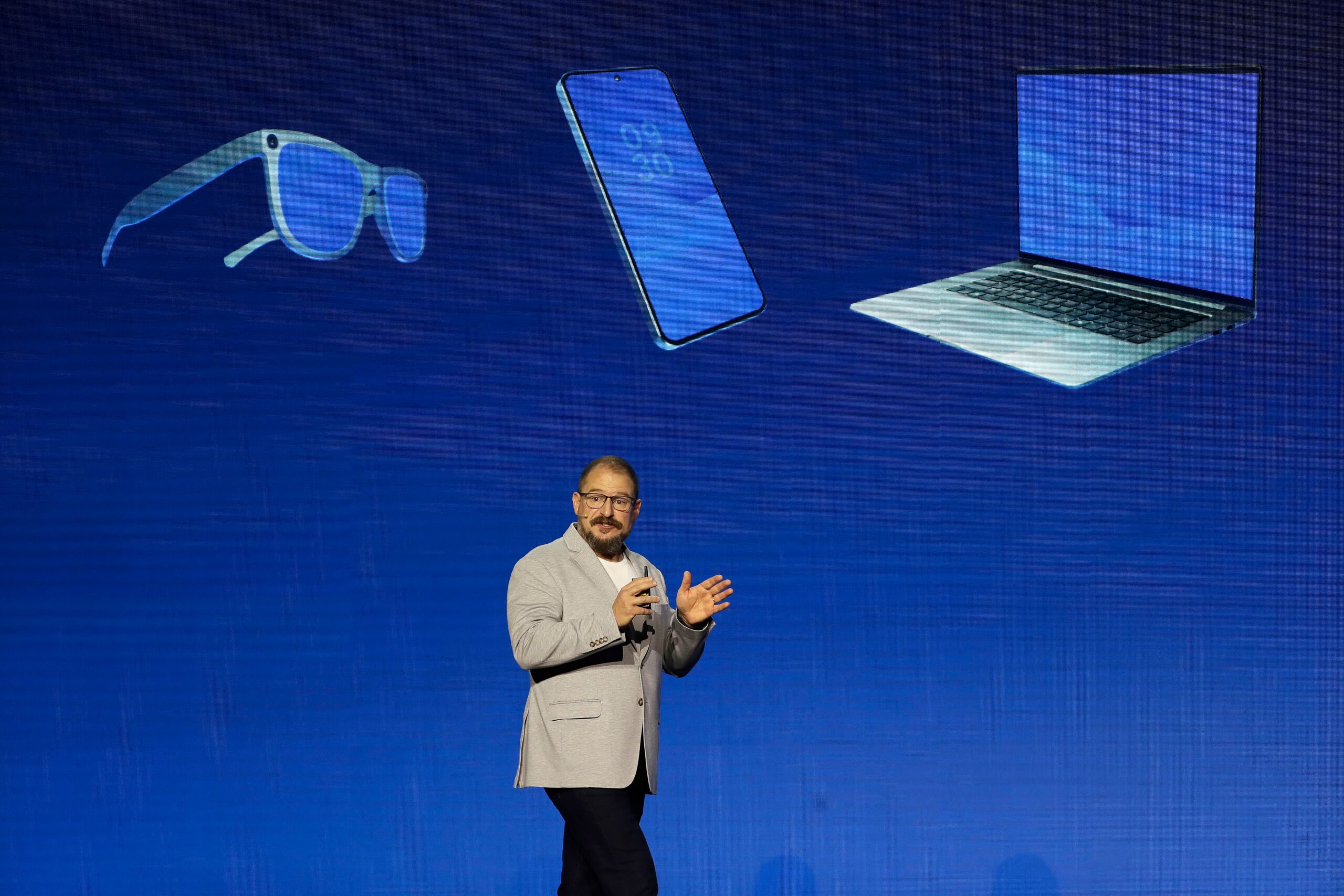
- Qualcomm is expanding beyond smartphones and into AI infrastructure, highlighted by a major chip agreement with ByteDance that strengthens its presence in the data-center market.
- The company’s key AI advantage is energy efficiency, with new accelerator chips designed to deliver strong performance while reducing power consumption and operating costs.
- Nvidia remains a formidable competitor, as its recently unveiled RTX Spark superchip has intensified competition and raised the stakes across the AI hardware industry.
Qualcomm (QCOM) reached an agreement with TikTok parent company ByteDance to produce millions of custom-built Application-Specific Integrated Circuits (ASICs) to support the Chinese hyperscaler’s AI agent software and Doubou AI chatbot in its data centers, Bloomberg News reported on May 26.
Key to this deal is that Qualcomm’s ASICs remain below the U.S. export control threshold, meaning the chips won’t be subject to significant tariffs (assuming the export restrictions remain status quo).
Unsurprisingly, Qualcomm’s stock spiked on May 26 after the ByteDance news. Its price hit an all-time closing high of $248.82 that day, increasing roughly 8% during trading hours.
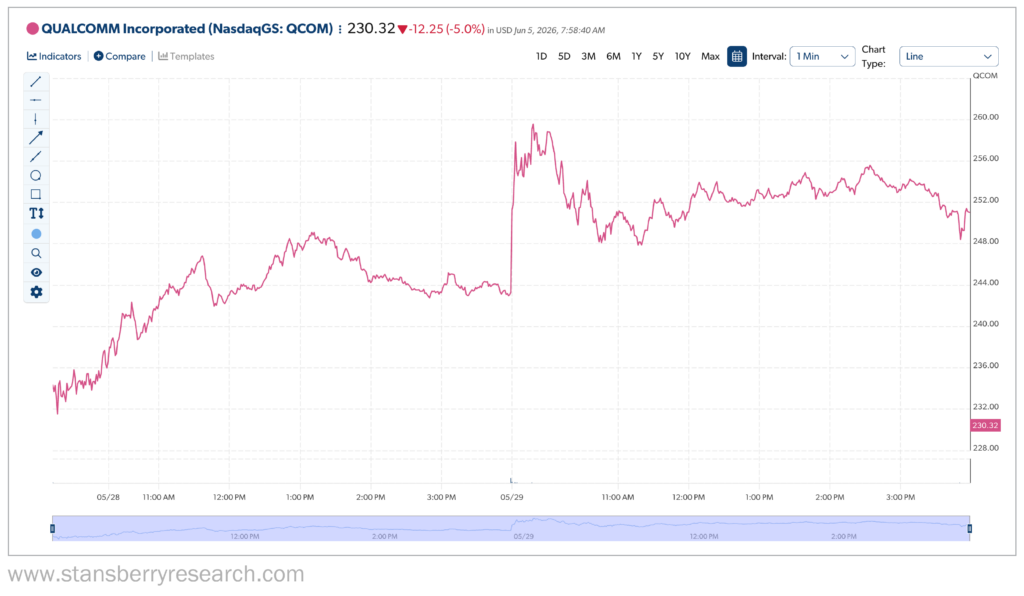
That all-time high only lasted a few days, as Qualcomm shares surged and closed at $251.02 on May 29.
But just when it looked like investors and analysts were all-in on Qualcomm’s AI ambitions in the wake of the ByteDance news and, driven by the company’s focus on AI energy and cost efficiency, Taiwan’s Computex conference on June 1 delivered a gut-punch to Qualcomm and the rest of its competitors.
What should have been a celebration of Qualcomm’s AI future turned into a major blow to the company’s aspirations.
Nvidia Steals Qualcomm’s Thunder with New Chip Announcement
At 3:15 a.m. ET on June 1, Qualcomm excitedly teased Dragonfly, the company’s new data center brand. Qualcomm didn’t offer details, only that more was to come during its Investor Day on June 24.
Then Nvidia stole the show when CEO Jensen Huang announced a new super-chip that’s poised to compete with Qualcomm’s Snapdragon chips but also to turn personal computing on its head.
Nvidia’s RTX Spark super-chip was designed specifically for Windows PCs. And it’s already been confirmed that the chip will be used in higher-end Dell (DELL), HP, Microsoft, Lenovo, Asus, and other computers starting this fall.
Here’s what Huang had to say about the RTX Spark:
The PC is being reinvented. For forty years, you launched apps. Click. Type. With RTX Spark and Microsoft Windows, you ask — and the PC does the work. RTX Spark brings everything NVIDIA has built — CUDA, RTX, our AI platform — into a single superchip. Local agents. Frontier models. Creative workflows. RTX games. All on a laptop. This is the new PC. The personal AI computer.
The problem here for Qualcomm is not just competition. It’s that the competition built a chip that is infinitely more powerful than its own. Where Qualcomm’s Snapdragon X Elite AI chip reaches speeds of 45 trillion operations per second (“TOPS”), Nvidia’s new ARM-based RTX Spark CPU exceeds 1,000 TOPS, or 1 petaflop.
Nvidia essentially just created an agentic AI supercomputer with its new chip.
And the market reacted in a big way. Qualcomm’s shares plummeted around 9.5% in pre-market trading on June 1, down to $227.20. With one announcement, Qualcomm’s market value took a nearly $20 billion hit, despite the recent ByteDance deal.
Looking at Qualcomm through this lens, it’s clear the company has an Nvidia-sized problem. But that doesn’t negate the fact that Qualcomm’s stock has been a big winner over the past year.
And that’s in large part because of the company’s AI innovation.
Qualcomm’s AI Breakthroughs
Qualcomm has been quietly changing lives for four decades, thanks to its long history of cellular innovation and chip design and development.
And, perhaps surprisingly, it’s been involved in AI technology for more than a decade.
Since 2015, Qualcomm AI Research has conducted extensive research and published a variety of white papers covering the entire spectrum of AI.
In 2016, the company began integrating its AI Engine into Snapdragon chipsets. For background, Snapdragon was developed in late 2007 and was the first System-on-Chip (“SoC”) processor – meaning it integrated a central processing unit (“CPU”), graphics processing unit (“GPU”), and cellular modem onto one chip rather than using multiple chips.
The Snapdragon 820 was the first to use the Qualcomm AI Engine to perform basic machine learning, sensor, and imaging tasks.
In 2018, Qualcomm rolled out the Snapdragon 855 – the company’s first design that integrated a dedicated tensor accelerator into its Hexagon neural processing unit (“NPU”) hardware.
Let me translate. Qualcomm’s Hexagon NPU is built specifically to handle AI tasks. Most importantly, however, its NPUs effectively accelerate AI inference (the process of AI performing a task) while using minimal power.
The technology’s ability to handle AI tasks while consuming less power is huge given how much energy AI and data centers devour.
But that’s not all Qualcomm’s Hexagon NPUs have accomplished. They essentially paved the way for “on-device” AI – which is basically edge computing – when integrated directly into Snapdragon mobile platforms. That allows AI models to run locally, right within the device, rather than relying on transmission to and from the cloud or data centers.
Qualcomm enhanced this capability in 2023, when it unveiled the Snapdragon 8 Gen 3. This chipset was designed with an upgraded NPU to handle on-device generative AI, meaning devices like smartphones could now perform AI tasks like voice recognition, computational photography, and generative AI queries completely independent of cloud-based AI inference.
And, remember, it can handle all these tasks without draining much battery life.
Qualcomm has since released updated generations of Snapdragon, including the 8 Elite. If you own a premium flagship Android phone (a Samsung Galaxy, for example), it very likely uses a Snapdragon 8 series chip.
But Qualcomm has also placed its chips in technologies beyond smartphones.
Qualcomm AI Is Everywhere
Why stop at smartphones when you have the technology to bring on-device AI tech to all types of consumer electronics?
Qualcomm seized the opportunity to put its AI-enabled Snapdragon processors into a range of devices:
- Wearables, like smartwatches, pins, and pendants, using Snapdragon Wear processors
- Augmented reality (“AR”) and virtual reality (“VR”) headsets, including Meta (META) Quest, using Snapdragon XR processors
- Android handheld gaming consoles, using Snapdragon G series processors
- Smart TVs, appliances, and other home devices, using Snapdragon Smart Home processors
- Vehicles, as I previously mentioned, using Snapdragon Automotive Digital Chassis chips
- AI-native Windows 11 PCs and laptops – including Microsoft Surface, HP, Asus, and Lenovo computers – using Snapdragon X Elite, X Plus, and C processors
Qualcomm hardware is also used for robotics, industrial automation, and drones. So, its AI footprint is already more substantial than many might think.
But Qualcomm’s most recent developments have the company positioned to make a significant splash in the AI data center world.
Can investors expect Qualcomm’s non-smartphone AI chips to push the company to new heights? History tells us yes, because Qualcomm continues to innovate behind the scenes.
Qualcomm’s Powerful AI Advantage
Last fall, Qualcomm made the somewhat surprising announcement that it was launching new chip-based accelerator cards and server racks for use in AI data centers.
The AI200 and AI250 accelerator cards and racks were built exclusively to handle AI workloads in both data centers and edge devices.
But here’s where Qualcomm’s AI data center components differ from, say, Nvidia’s or Advanced Micro Devices’ (AMD)…
The AI200 and AI250 cards are optimized to deliver high-efficiency performance using minimal power. That may not sound like much, but it could be an industry changer and a massive differentiator for Qualcomm.
We all know by now that AI data centers have an insatiable need for power. And that power costs a significant amount of money. Not only for data center operators but also for residential consumers living near data centers.
For example, in December 2024, PJM, the largest grid operator in the U.S., announced that capacity market prices would increase from $30 to $270 per megawatt-day. PJM’s capacity market today is roughly $330 per megawatt-day for the delivery period of June 2026 through May 2027.
That could increase residential electricity bills by as much as 25% by 2030, according to projections from the Open Energy Outlook Initiative.
In some areas, the rates are far worse. Bloomberg analyzed data based on electricity prices and location throughout the U.S. and concluded that, as of September 2025, electricity cost up to 267% more per month in areas located near data centers than it cost five years ago.
Take Virginia, for example, which is home to the highest concentration of data centers in the country – mostly in the Northern Virginia area. According to Dominion Energy (D), the average residential electric bill across the state will increase from around $142 to $315 by 2039.
This information illustrates just how much the energy costs of data centers are impacting both operators and local residents. And that Qualcomm’s AI200 and AI250 solutions actively address the power problem by consuming far less energy – while delivering 10 times higher effective memory bandwidth – than typical AI chips.
By using the Low-Power Double Data Rate (“LPDDR”) memory it uses in smartphones – as opposed to the far more expensive high-bandwidth memory (“HBM”) used in most data centers – Qualcomm’s AI accelerator cards not only consume less power, but they also offer greater scalability and capacity than HBM.
By designing its AI accelerator cards with 768 gigabytes (“GB”) of LPDDR memory, Qualcomm holds an advantage over competitors because its cards can run large language models (“LLMs”) and other AI workloads directly within the memory (the on-device/edge computing coming into play again).
The result? Lower latency, faster performance, and less energy consumption.
Qualcomm noted that the AI200 and AI250 are the centerpieces of a rack-scale system designed to deliver comprehensive infrastructure for data centers. The racks incorporate direct liquid cooling, PCI3 and Ethernet connectivity, and power efficiency to cover data centers’ needs.
For Qualcomm, the AI200 and AI250 chips – which will be released later this year and in 2027, respectively – will determine its standing in the AI world.
Qualcomm Stock Analysis and Outlook
Despite Nvidia taking the wind out of its – and AMD’s and Intel’s (INTC) – sails with its major chip announcement, Qualcomm has taken major strides in its AI endeavors. While Nvidia and its other rivals may hold the advantage in chip power, Qualcomm’s AI chips still have them beat efficiency-wise. And that goes a long way with data center operators.
To support its AI data center efforts, specifically related to high-speed connectivity and networking IP, Qualcomm purchased AI company Alphawave Semi late last year for $2.3 billion.
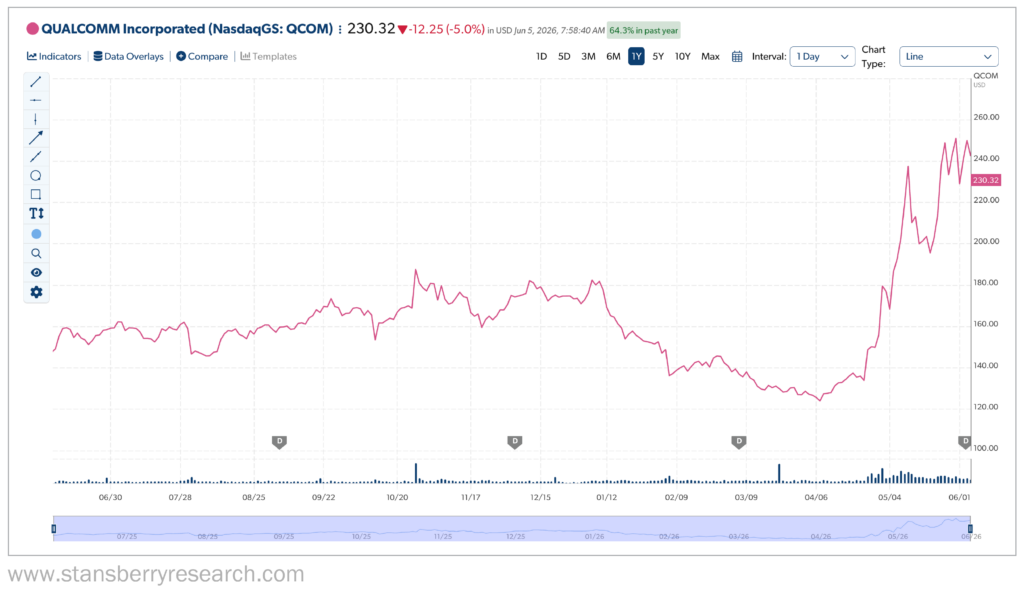
The market has reacted positively to Qualcomm’s AI focus. Its price is up nearly 62% over the past year – even when considering its June 1 dip.
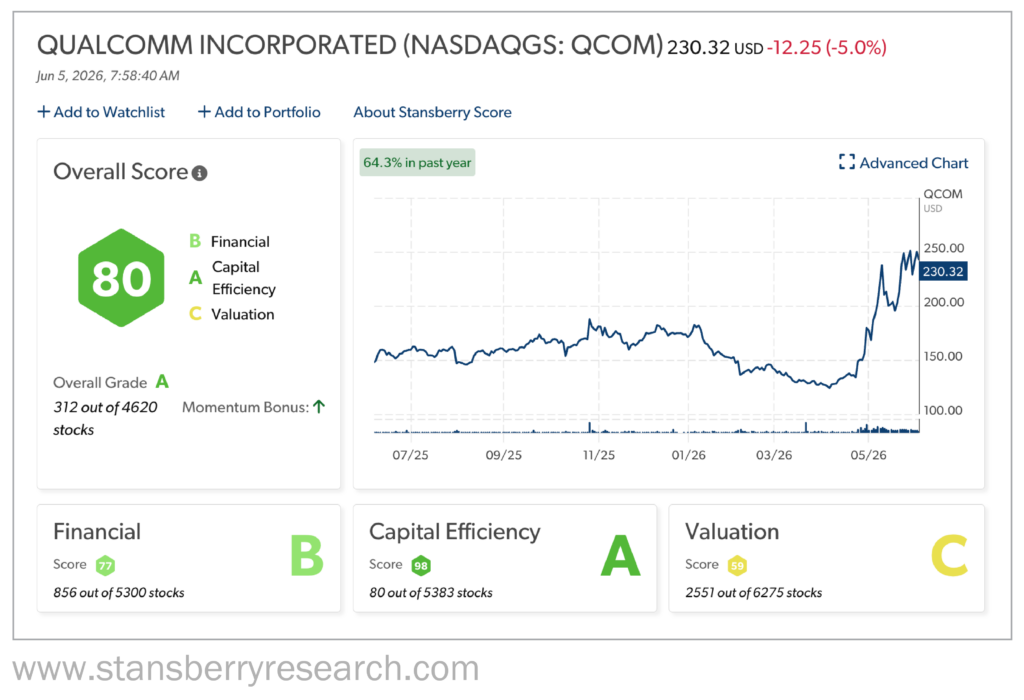
Qualcomm’s Stansberry Score, a tool that helps determine the quality and long-term value of thousands of stocks, is excellent with an overall “A” score driven by strong financials (“B”) and excellent capital efficiency (“A”).
There are some concerns about valuation, however. While there is excitement surrounding Qualcomm’s foray into AI data centers, that excitement is likely already reflected in its current price.
And, though there are certainly promising signs, we simply don’t know if Qualcomm will succeed as a data center player. Perhaps the ByteDance deal was just the tip of the iceberg. If so, Qualcomm may look like a steal.
The AI space is getting crowded, however. And as we just saw with the company getting overshadowed by Nvidia’s new super-chip, Qualcomm has a lot to prove in that space. It will be interesting to see how it all plays out the rest of the year.
Regards,
David Engle
Editor’s Note: As America celebrates its 250th birthday, a Wall Street legend is sounding the alarm. Whitney Tilson (the hedge fund manager CNBC dubbed “The Prophet”) says the AI revolution is rewriting the rules of wealth faster than most people realize.
Some investors are already seeing extraordinary gains. Others are being wiped out. Tilson says the next six months will determine which side you end up on — and he’s sharing exactly what to do about it in his free presentation here.