Image Credit: Associated Press
When OpenAI led a $252 million seed round into a brain-computer interface startup co-founded by its own CEO in January 2026, the financial press did what it always does. They wrote about the conflict of interest. They quoted ethics professors. They speculated about regulatory consequences.
I read the same news and saw something the financial press missed. A map.
Twenty-eight years on a trading desk teaches you something simple. When one person keeps moving capital in the same direction across totally different industries, that’s not a hobby. That’s a thesis. And the public companies sitting in the path of that thesis tend to keep compounding long after the headlines move on.
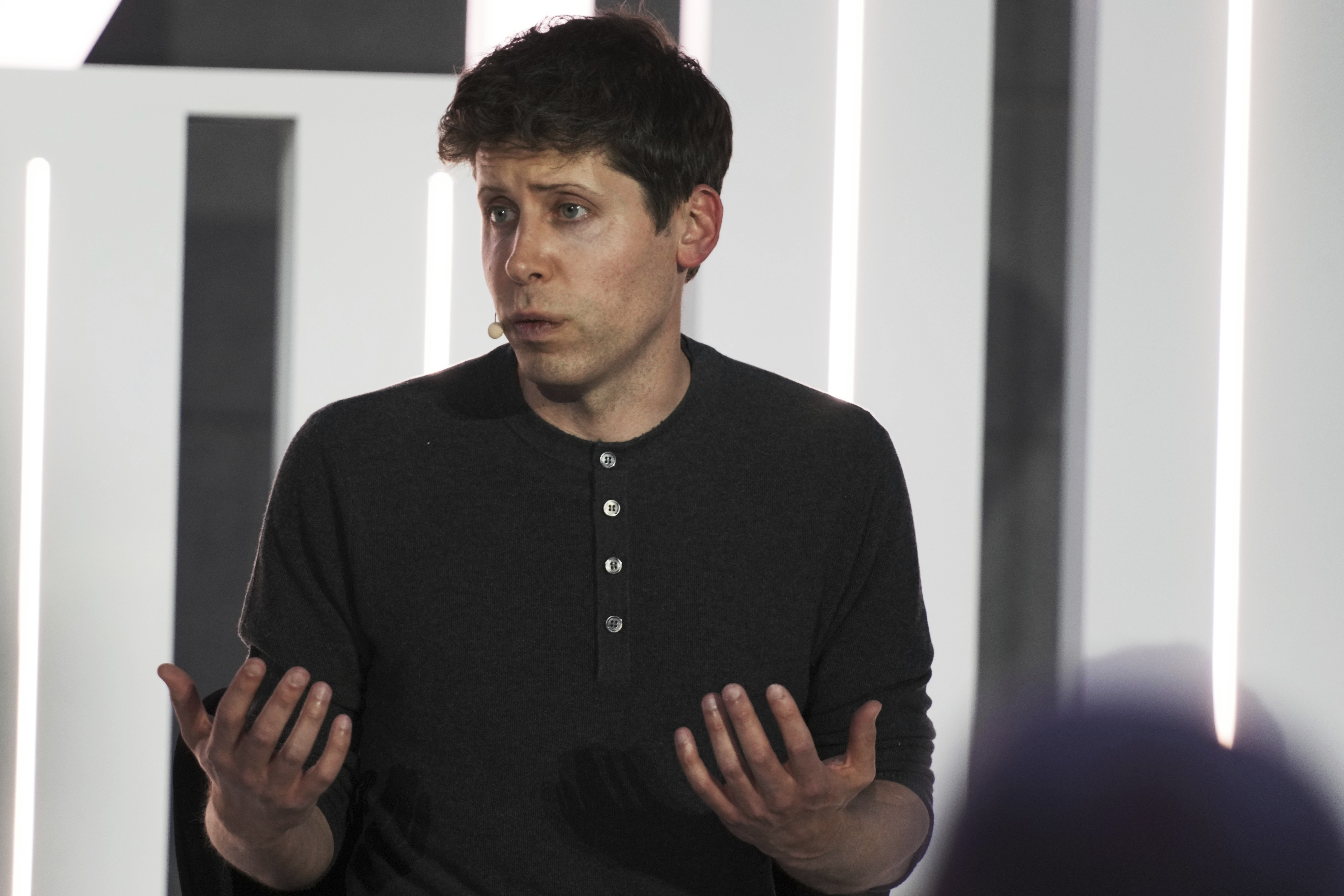
Sam Altman is the most strategically positioned individual in artificial intelligence. He runs OpenAI, the company that defined the modern AI moment. He is chairman of Tools for Humanity, the company building a global biometric identity network. He took Oklo public through his own SPAC. He was the lead investor in nuclear fusion company Helion Energy, including a $500 million funding round in 2021. And in January 2026, he co-founded Merge Labs, a brain-computer interface startup that received a $252 million check from OpenAI.
That’s not a portfolio. That’s an integrated bet on what the world looks like when artificial general intelligence becomes real, and on the energy, identity, and biological infrastructure that will be required to support it.
Most of those bets are still private. But several have already produced publicly traded proxies you can buy today. Below are seven of them. These are the public companies cashing in on what I call the OpenAI money map.
The framework is simple. Follow the money. Find the companies sitting in the path of where the smart capital is heading. Get there before the headlines force the rest of the market to catch up.
Why Sam Altman’s Investment Map Matters for Retail Investors
This isn’t a coincidence, and it isn’t a conspiracy theory. It’s a pattern. The Wall Street Journal, the Financial Times, and Bloomberg have all reported the structure. Altman invests personally or through his family fund, Hydrazine Capital. OpenAI’s Startup Fund or OpenAI itself follows with a commercial agreement, an investment, or both. The companies on the receiving end of that capital end up positioned to capture demand from one of the most capital-rich technology buildouts in modern history.
Three examples that are already public make the pattern obvious.
Helion Energy (nuclear fusion). Altman has been a shareholder since 2015 and led a $500 million funding round in 2021. Microsoft — OpenAI’s largest financial backer and exclusive cloud provider — signed a power-purchase agreement with Helion in 2023.
Oklo (nuclear fission). Altman backed the company while at Y Combinator, served as chairman, and took Oklo public in May 2024 through his own SPAC, AltC Acquisition Corp. He stepped down from the Oklo board in April 2025, citing the desire to “avoid conflict of interest” and to “open up opportunities for future deals between OpenAI and Oklo.”
Rain AI (AI chip startup). Altman invested in the seed round. OpenAI signed a letter of intent to spend $51 million with Rain on AI chips.
Those aren’t one-offs. That’s a strategy that’s been running for almost a decade. Merge Labs is just the latest visible node on the same map.
Here’s why this matters for you. The smart money is telling you exactly where the next round of compute, energy, identity, and biological infrastructure spending is going. The public companies sitting in those same lanes — even the ones with no direct relationship to Altman or OpenAI — are the cleanest way to ride that capital flow without waiting for IPOs that might be years away.
The pattern is familiar. The California Gold Rush made very few prospectors wealthy and made Levi Strauss extraordinarily so. The dot-com era is remembered for Pets.com, but the durable wealth was built by Cisco and Oracle. The smartphone era made Apple a household name and made Taiwan Semiconductor a quiet compounder. Brain-computer interfaces, advanced nuclear, and biometric identity will follow the same playbook. The headline names get the press. The supply chain gets the returns.
Top 2 Sam Altman Stocks to Own Now
If you only buy two names from this thesis, buy these.
Oklo (OKLO) — ~$11.3B market cap, ~$65 per share
This is the cleanest publicly traded Altman name and the most direct play on the AI power thesis. Oklo is building the Aurora — a small modular reactor (SMR) that produces up to 75 megawatts of electricity. The customer pipeline is roughly 14 gigawatts, including a 12 GW deal with Switch and a January 2026 partnership with Meta for a 1.2 GW nuclear campus in Pike County, Ohio. Meta is prepaying for the power and funding the project upfront.
Three things make this the lead name on the entire map.
First, the Altman connection isn’t speculation. He took the company public through his own SPAC. He stepped down from the Oklo board in April 2025 specifically to clear the runway for direct OpenAI-Oklo commercial agreements. His own words.
Second, the fundamentals are starting to validate the thesis in real time. Okla announced a partnership with Nvidia and Los Alamos National Laboratory in April 2026, tied to the federal Genesis Mission. HSBC initiated with a Buy and a $96 price target. Tigress Financial put a $130 price target on it. The stock ran from $48 in early April to an intraday high of $81.50 on April 24 before pulling back to roughly $65.
Third, the risk is real and you should know it. Oklo is pre-revenue. The Aurora isn’t built yet. AI demand could slow down. Size accordingly. But the asymmetry here — a documented Altman-OpenAI commercial path, hyperscaler customer commitments, and a federal Genesis Mission partnership all sitting on an $11 billion market cap — is exactly the kind of setup that produces outsized returns when the underlying thesis works.
Butterfly Network (BFLY) — ~$500M market cap
The Merge Labs supply-chain play. Butterfly makes a chip-based handheld ultrasound device that replaces traditional piezoelectric-crystal ultrasound technology with a single semiconductor. In October 2023, Butterfly signed a five-year, $20 million co-development agreement with Forest Neurotech to develop ultrasound-based brain-computer interfaces, with $3.5 million paid on signing and additional revenue per unit on commercialization.
Forest Neurotech is the research organization that just contributed two of its leaders to Merge Labs.
Read that again. Two of Merge Labs’ six co-founders — Tyson Aflalo and Sumner Norman — came directly from Forest Neurotech, the BCI research organization that has a five-year, $20 million co-development agreement with Butterfly Network. Mikhail Shapiro, the Caltech engineer leading the technical effort at Merge, has spent his career on the same ultrasound neural-sensing approach.
The connection between BFLY and the Altman ecosystem isn’t a guess. It’s documented. And the underlying business is in inflection: Q4 2025 revenue of $31.5 million, up 41% year-over-year. First quarter of positive operating cash flow in company history. Cash on the balance sheet sits at $150.5 million. 2026 guidance of $117 to $121 million implies 20-24% growth.
That’s the setup. Real business hitting profitability, real chip relationship with the leading non-invasive BCI research org, and that org’s people just walked into the room with Sam Altman. Limited downside, real upside. The kind of asymmetry I look for.
Bucket 2: 5 More Stocks for Full OpenAI Ecosystem Exposure
The supporting cast. Each of these companies sits in a different layer of the Altman investment map.
NVIDIA (NVDA) — The compute platform underneath every Altman bet. Oklo’s April 2026 partnership tied directly to Nvidia. OpenAI’s training infrastructure runs on Nvidia silicon. Merge Labs’ AI-driven neural interpretation will require Nvidia compute. Whichever specific Altman-ecosystem company succeeds, Nvidia is the silicon underneath.
Constellation Energy (CEG) — The conservative way to be in the AI-power trade. Constellation operates the largest U.S. nuclear fleet, generated $25.5 billion in 2025 revenue with $2.32 billion in net income, and has signed long-term power-purchase agreements with hyperscaler data centers — including reactivating Three Mile Island for Microsoft. While Oklo represents the speculative end of the nuclear-AI thesis, Constellation represents the proven, profitable end. Both can win simultaneously.
Microsoft (MSFT) — OpenAI’s largest financial backer, exclusive cloud provider, and the public-market vehicle most directly leveraged to OpenAI’s commercial success. Every dollar OpenAI spends on compute flows through Microsoft Azure. Microsoft also signed the original power-purchase agreement with Helion. If you can only own one stock on this entire map, this is the one.
Micron Technology (MU) — The memory-wall trade. Computing power has roughly doubled every two years over the last 30 years; memory bandwidth has grown only about 1.6x in the same period. That gap is the binding bottleneck for both AI training workloads and the high-bandwidth biological data Merge will eventually need to process. Micron is the cleanest U.S.-listed pure-play on high-bandwidth memory. Cyclical — buy on weakness.
Quantum-Si (QSI) — ~$194M market cap — The asymmetric biotech bet. QSI is the only commercial single-molecule protein sequencer on the market. Connectomics research consistently identifies protein sequencing as a gating technology for any serious effort to digitally map neural systems. Early-stage revenue around $2.4 million means this is a call option, not a core position. Size accordingly. Disclosure: I am personally long QSI at the time of publication.
When Will Sam Altman’s Next IPO Hit the Market?
Three Altman-ecosystem companies are most likely to file S-1s in the next 12 to 24 months.
Helion Energy. The fusion company is currently fundraising at a reduced $15 billion valuation following reports that OpenAI did not participate in its earlier larger round. Thrive Capital, which is closely associated with Altman, is expected to lead. A Helion S-1 filing would be a major event for Constellation, BWX Technologies, and other public nuclear names.
Tools for Humanity / World. Altman’s biometric identity company has 33 million App users and 15 million Orb-verified users as of late 2025. Recent reports suggest OpenAI may pursue a biometric social network using either World’s Orb or Apple’s Face ID. A Tools for Humanity IPO would be among the most-watched IPOs of the next two years.
Neuralink and Synchron. Outside the Altman map but adjacent to the Merge Labs supply chain. Neuralink raised a $650 million Series E at a $9 billion valuation in June 2025 with reports of confidential S-1 prep. Synchron raised a $200 million Series D in November 2025. Either filing would re-rate the entire BCI supply chain — most directly Butterfly Network and Quantum-Si in the basket above.
The pattern that matters: when any of these five companies files, every public stock on the map above re-rates within days. Have cash ready.
The Catalysts That Will Move Sam Altman Stocks
Three signals tell you the thesis is accelerating. These are the kind of setups I track in real time on Masters in Trading Live every weekday at 11 AM ET — but you don’t need a service to watch them. You need to know what to look for.
Any S-1 filing from Helion, Tools for Humanity, Neuralink, or Synchron. The single biggest catalyst for the basket. Watch the SEC EDGAR system directly.
OpenAI commercial agreements with public-company partners. Every press release in which OpenAI commits to buy from a hyperscaler, a chip company, or a power producer is a direct signal. Recent examples include OpenAI’s expanded compute deployments with Nvidia, Microsoft’s continued Azure capacity commitments tied to OpenAI demand, and the broader pattern of “circular financing” deals across AMD, Meta, and OpenAI’s investor base.
Hyperscaler capex guidance. Microsoft, Alphabet, Amazon, and Meta all report quarterly. Any incremental upward revision flows to NVDA, MU, MSFT, CEG, and the rest of the basket.
The Risks for Sam Altman Stocks
This is not a one-way trade.
The circular-financing risk is real. OpenAI’s investment in companies Altman co-founded has drawn scrutiny from the financial press and has the potential to attract regulatory attention as OpenAI moves toward its own IPO. Future restrictions on related-party transactions could complicate the path forward for Merge Labs, Helion, and other Altman-adjacent ventures.
Hyperscaler capex deceleration. The entire AI-power trade depends on continued capex from Microsoft, Alphabet, Amazon, and Meta. Any meaningful cut would re-rate the entire basket lower, with the speculative names (Oklo, Quantum-Si, Butterfly) hit hardest.
Pre-revenue execution risk. Oklo, Quantum-Si, and Butterfly all face genuine commercial risk. Oklo’s first reactor isn’t built. Quantum-Si is early stage. Butterfly just hit positive cash flow. Each carries real downside.
Valuation. Oklo has run from $48 to $80+ in a month. Constellation trades at a premium multiple. Microsoft is at all-time highs. The OpenAI ecosystem is widely understood — what isn’t yet priced in is the specific way Altman’s network connects the public names to the private capital flow.
A reasonable approach is a basket position rather than a concentrated bet, sized so that any individual name’s underperformance doesn’t damage the overall thesis.
The Bottom Line on Sam Altman Stocks
Most retail coverage of Sam Altman focuses on what he says about artificial intelligence. The more interesting story is what he does with capital. Across nuclear fusion, nuclear fission, brain-computer interfaces, biometric identity, and AI compute, his investments form a coordinated map. A map of where the most strategically positioned investor in the world believes the next decade of capital is heading.
Most of it is private. But the public stocks sitting in the same lanes — Oklo for advanced nuclear, Butterfly for BCI supply chain, Nvidia for compute, Constellation for proven nuclear power, Microsoft for the cloud layer, Micron for memory, Quantum-Si for protein sequencing — are how you ride the same thesis without waiting on IPOs that might be years away.
The chips trade is famous. The power trade is in motion. The cooling trade is starting to get noticed. The Sam Altman ecosystem trade — nuclear, biometric identity, BCI, and AI compute connected through one investor’s documented capital map — is the trade nobody has assembled in one place for retail yet.
Follow the money.
Jonathan Rose is a former CBOE market maker and the founder of Masters in Trading at InvestorPlace. He hosts Masters in Trading Live every weekday at 11 AM ET. Disclosure: long QSI. Follow him on X at @JRoseTrades.
Editor’s Note: Here’s what most investors don’t understand: The biggest gains don’t come from being in “the market.” They come from being in the right sectors at the right time. For 46 years, Louis Navellier has used a quantitative grading system to track where institutional billions flow before anyone else sees it. The same system wealthy firms paid $24,000 per year for me to evaluate stocks with. Companies like Palantir at $13 (before it hit $186). Applovin at $38 (before it reached $622). Carvana at $24 (before $340). His system detected institutional accumulation months before these stocks exploded. Right now, Navellier’s grades are changing across entire sectors — patterns he’s only seen twice before. See which sectors are lighting up with institutional buying in his presentation here.