Image Credit: Associated Press
Listen to the audio version of this article (generated by AI).
Key Points
- Intel (INTC) raised $20 billion through an upsized stock offering to fund AI infrastructure, foundry expansion, and other growth initiatives without adding more debt.
- The offering will dilute existing shareholders, while Intel’s heavy capital spending and negative free cash flow raise questions about how long its AI investment strategy can continue.
- Intel stock could offer upside if its AI and foundry investments pay off, but the offering also highlights the enormous costs and risks surrounding the AI infrastructure boom.
Intel (INTC) raised $20 billion from a new stock offering this week, allowing it to turbocharge the company’s AI-infrastructure investments.
Initially, Intel announced in a brief press release on Monday that it aimed to raise $15 billion from the new stock offering. Investors didn’t react very positively to that news.
Between the dilution of existing shares and companies’ uninhibited spending on AI, many investors are skeptical of and, frankly, fatigued by this type of development. Not surprisingly, Intel’s stock, which closed at $101.65 on Friday, August 7, fell during pre-market trading, opening Monday morning at $98.26.
This unexpected announcement also raised some questions.
Why the surprise public stock offering? What does it mean for Intel and its investors? And is this offering a good buying opportunity at a lower stock price, or is it an AI warning sign?
Why Intel Sold $20 Billion of Common Stock
If you guessed artificial intelligence (“AI”), you are correct! What decisions aren’t driven by AI these days? If you haven’t paid much attention to Intel in the past few years, let’s get you caught up.
As I wrote in a May 1 article about Intel’s fast-rising stock, much of Intel’s recent success can be attributed to the revival of Intel Foundry Services.
Here’s an excerpt from that article:
In 2022 and 2023, Intel Foundry Services (“IFS”) earned external foundry revenue of $895 million and $952 million, respectively.
IFS revenue then exploded to $17.5 billion in 2024 and increased to $17.8 billion last year. The pattern continued into 2026’s first quarter, with Intel’s foundry business earning $5.4 billion, a nearly $1 billion jump from the previous quarter.
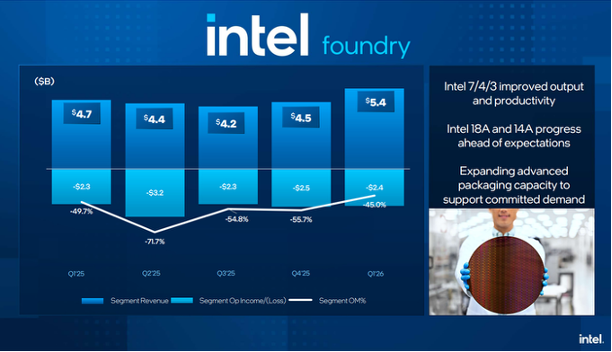
What sparked such a drastic revenue surge?
- Intel began manufacturing its own products, including the Core Ultra Series 3 and Xeon 6 processors, rather than having them manufactured by Taiwan Semiconductor.
- The AI data-center boom pushed demand for Intel’s Xeon processors to unprecedented levels.
- Intel’s application-specific integrated circuit (“ASIC”) custom chip business increased by more than 50% thanks to demand from cloud customers…
And what might be the best
AI demand is obviously still quite strong, so Intel is doubling down on its AI investments.
In its press release, Intel stated that:
Progress in emerging areas including physical AI, purpose-built silicon, advanced packaging and external wafers represent significant growth opportunities for Intel.
Thus, Intel decided to offer the common stock for sale and put the proceeds toward capital expenditures (“capex”), working capital, and growth opportunities. In other words, Intel is looking to grow its AI-infrastructure business significantly. And this offering would greatly expand the available capital Intel needs to do so.
That capital comes without Intel increasing its debt, which is important considering, in July, Intel upped its 2026 capex projection to more than $20 billion.
Other key details of the transaction:
- The offering’s share price came in at $95, meaning 210,526,315 new shares were made available for purchase.
- The offering’s underwriters will have a 30-day option (called a “greenshoe”) to purchase up to a total of $2.25 billion in additional shares of common stock at the public offering price, minus underwriting discounts.
- This would add another 31,578,947 shares of stock to the market, resulting in a total of around 242 million new shares of Intel common stock, based on the $95 share price.
- Wall Street titans JPMorgan Securities, Goldman Sachs, Morgan Stanley, and Citigroup are serving as joint book-running managers for the offering, reflecting the magnitude of this transaction.
As I mentioned earlier, Intel stock took a hit upon the initial news of the transaction, falling more than 4% on August 10. The reason? Concerns about dilution for existing Intel shareholders… a common worry whenever a company makes this much stock available for public sale.
And it’s a legitimate concern. Issuing $20 billion in new equity will, indeed, dilute Intel’s investors. But the other side of the argument is also valid. Intel stands to gain up to $20 billion in needed capital from the stock sale, giving the company tons of liquidity as it continues to invest in future growth. And it does so without increasing its debt.
The dip in stock price on August 10 may be a blip on the radar, but it’s worth monitoring for investors – especially those who own a sizable stake in the company.
The Federal Government’s 10% Stake in Intel Faces Dilution
About a year ago, the United States government, with the backing of President Donald Trump and his administration, purchased 433.3 million shares of Intel at $20.47 per share. That gave the federal government 9.9% ownership of Intel.
Whether coincidental or not, Intel has since taken off, seeing its stock price increase by nearly five times since the federal government’s investment last August. Intel and its investors – especially the government – have made a lot of money during that span.
Now, with this $20 billion stock offering, the government’s 10% stake is about to shrink. Based on the math used earlier, and the fact that the government did not participate in this sale, that 10% became roughly 9.5%.
Also, as part of the administration’s deal with Intel, the government received a five-year warrant at $20 per share for an additional 5% of Intel common shares, which, according to Intel, is “exercisable only if Intel ceases to own at least 51% of the foundry business.”
Because the August 2025 deal locked in 240.5 million warrants at $20 per share, the growing pool of total outstanding shares automatically dilutes the ownership of those warrants. In other words, the government’s 5% of additional shares from that warrant will also dip closer to 4.64%.
Unfortunately for the government, as a passive minority shareholder, it doesn’t hold any veto or voting power. So, there’s nothing Trump or his Cabinet can do to stop the offering. Ultimately, the government stayed on the sidelines.
On Monday evening, the only official comments from the administration came from White House National Economic Council Director Kevin Hassett, who told CNBC that it’s ultimately up to President Trump when the administration sells its stake – which it does not appear ready to do just yet. So, that’s also something to watch.
What the $20 Billion Offering Means for Intel Investors
We should learn the details of Intel’s stock offering after the sale closes on August 12, as the Wall Street banks running the transaction build an order book. At that point, we should have a better idea of how much Intel’s stock will be impacted.
But you can probably count on an Intel stock slide in the immediate aftermath of the transaction.
Why’s that? Dilution, for one. Then there are discounts. Underwriters often price newly available shares at a small discount (generally 2% to 5%) below the current trading price to entice institutional investors to spend millions or billions on the new shares. Sure enough, Intel’s stock was priced at $95, a discount of 2.6% from its August 10 close.
Finally, simple supply and demand negatively impact the stock’s price when millions of new shares are added without an instant surge in buyer demand. But considering Intel’s sale did see a big swing in buyer demand, this shouldn’t be much of a factor.
We don’t have to look back too far for similar examples:
- In 2020, as Tesla (TSLA) stock was soaring, Musk and company took full advantage of the high price by rolling out multiple multibillion-dollar capital raises. One example was a huge $5 billion “at-the-market” stock offering, which immediately pulled Tesla stock back, resulting in a loss of roughly 4.7% by market close that day.
- Earlier this year, Oracle (ORCL) announced it was raising nearly $40 billion in capital through mixed debt and equity offerings to bankroll its AI-infrastructure and cloud data-center build-out. The company’s shares plunged more than 12% in after-hours trading as investors lost their collective minds over the amount of money needed to support Oracle’s AI expansion.
But what about long-term impact? This is where things get more complicated. A short-term reaction – or overreaction – is one thing, because it’s typically based on impulsive investor and analyst emotion and sentiment, whether it’s sheer panic or total exuberance.
Long-term impact is generally driven by more rational and strategic thinking. It takes time to analyze and unpack how a company has performed after certain transactions have completed – in Intel’s case, the $20 billion public stock offering.
If you’re considering investing in Intel, you’ll want to see whether this transaction leads to real revenue and profit, whether there’s significant growth and expansion of its foundry facilities to handle demand for its AI hardware, and whether Intel can establish strong cash flow.
During the second quarter of fiscal year 2026, Intel operations generated an impressive $7 billion in cash flow. However, the company’s free cash flow (“FCF”) came in at negative $8.42 billion – compared with last year’s negative $1.1 billion – because of rising capex.
Intel is projecting another year of negative FCF, which would extend its streak to five straight years… the company accumulated a negative FCF of roughly $44 billion between 2022 and 2025, fueled by constant investments in AI and foundry expansions.
Here’s the thing: Intel is probably doing the right thing by increasing its capex to fund its AI infrastructure and meet customer demand. And doing so by diluting its existing shareholders was preferable to growing its debt by the billions, from Intel’s perspective.
The problem is, AI expenditures and financing are simply out of control.
Intel is seemingly doing everything right. Just look at the highlights from its July quarterly earnings report.
- $16.1 billion total revenue, well above the projected $14.4 billion.
- Data-center and AI revenue of $6.3 billion, a massive 59% year-over-year gain.
- Non-generally accepted accounting principles (“GAAP”) earnings per share (“EPS”) of $0.42, doubling expectations.
- A 40.4% gross margin, up from 27.5% year over year.
By any standard, that’s a highly successful quarter. Until you look at the company’s second-quarter net loss of $11 billion, up from $2.9 billion the year before.
All the positives are being negated by capex that appears to be unsustainable over the long term. And it shows no signs of slowing.
Intel Chief Financial Officer David Zinsner, who had already raised 2026 capex guidance from $18 billion to more than $20 billion, noted that 2027 capex would be “significantly above” that threshold.
So the questions investors must ask themselves are, “Will all of this pay off?” And, “If so, when?”
That’s yet to be determined. In the meantime, investors can take some comfort in knowing Intel is raising capital through equity rather than taking on more debt.
Which begs the question… Does this $20 billion stock offering make Intel a buy, or is this a warning that AI expenditures are simply too overwhelming for the company?
From my view, it’s another ominous warning of the prohibitive costs of financing the AI boom. Sure, the stock offering makes some sense from a bottom-line perspective. But when successful companies – and Intel has been riding a yearlong wave of success – start looking for different avenues to help them raise money to pay their seemingly endless string of capex bills, it’s worrisome.
The Bottom Line on Intel Stock
Intel has momentum. As I mentioned earlier, its stock price has nearly quintupled over the past year, clearly a positive sign. And, if Intel manages this stock offering the right way and makes smart investments with this capital, there’s no reason to think the company won’t continue along the right path, and its stock along with it.
But there’s no escaping the daunting shadow of AI capex that hovers over everything Intel does. The company has already burned billions in cash to expand its capacity, making some investors and analysts tired of the nonstop AI-related expenses that grow more exorbitant by the day.
It’s resulting in too many reputable companies with negative FCF despite growing revenues. And there’s no sure answer as to whether these massive investments will ultimately pay off. That’s just the uncertainty of the AI economy.
Intel is truly straddling the buy/sell fence right now. It’s possible the investments made using the capital from the $20 billion stock offering push Intel into “elite global foundry” territory alongside Taiwan Semiconductor Manufacturing (TSM). That makes Intel look undervalued.
But there’s also a possibility that Intel’s AI investments don’t pay off the way it envisions and the company never even remotely approaches anything close to that status. (Let’s face it, TSM has no peer and probably never will.) That, combined with shareholder dilution, is not looked upon favorably by investors.
The AI-expenditure crisis certainly isn’t unique to Intel. It spans the entire industry. But the spotlight is on Intel now, after its public stock offering. And the investing world will be watching its every move to see where it goes from here.
Regards,
David Engle
Editor’s Note: Whitney Tilson called the rise of Apple, Amazon, and Netflix… as well as the collapse of dozens of companies that went bankrupt. Now the former $200M hedge fund firm manager is stepping forward with what he calls the most important financial warning of his 30-year career. He’s sharing two free stock recommendations (one to buy, one to sell immediately) along with details of a new proprietary system fueling his predictions. See it all in his free presentation.
Recent Articles

Bitdeer’s $4.7 Billion Data-Center Lease to Cloud Startup Tied to Anthropic AI Deal: Here’s Who Benefits

Strategy’s New Bitcoin-Backed ‘Digital Credit’ Plan: Does the Juiced Preferred Stock Have Upside?