
Image Credit: Associated Press
Listen to the audio version of this article (generated by AI).
Key Points
- Qualcomm’s deal with Amazon could generate billions in chip sales and add another major hyperscaler customer as it pushes into AI data centers.
- The deal gives hyperscalers a more power-efficient alternative to Nvidia. With Amazon, Meta, and ByteDance on board, Qualcomm is increasingly positioned to chip away at Nvidia’s market share.
- Qualcomm isn’t trying to replace Nvidia outright. It’s targeting AI inference with more power-efficient CPUs and custom chips that could help hyperscalers reduce their dependence on Nvidia.
Chipmaker Qualcomm (QCOM) and Amazon (AMZN) announced a huge artificial intelligence (“AI”) data-center infrastructure collaboration with Amazon Web Services (“AWS”) on Tuesday. In the deal, Qualcomm issued Amazon warrants to purchase 25 million Qualcomm shares at $161.26 each – an investment of just over $4 billion.
According to the company’s Securities and Exchange Commission filing, these warrant shares “vest in tranches tied to the execution of certain commercial arrangements” and the purchase of up to $60 billion in Qualcomm chips and other components.
Back in early June, I wrote an article about Qualcomm’s agreement with TikTok parent company ByteDance to produce millions of custom-built Application-Specific Integrated Circuits (“ASICs”) to support ByteDance’s AI agent software and Doubou AI chatbot in its data centers. The article’s headline read, “Can Qualcomm Make a Dent in Nvidia’s AI Dominance?”
Just a few months later, Qualcomm announced a monumental deal with Amazon that showed the world – and especially chip titan Nvidia (NVDA) – that it’s dead serious about cutting into Nvidia’s AI market dominance. The market noticed, as Qualcomm stock jumped as much as 8.7% during intraday trading on Tuesday.
If you’re counting, Qualcomm has landed three hyperscaler contracts in roughly three months – the aforementioned ByteDance deal, a late-June agreement with Meta Platforms (META), and this new deal with Amazon. While specific contract values have not been disclosed, it’s a safe bet that these deals will add billions to Qualcomm’s bottom line.
And you can bet Nvidia is watching these developments very closely.
Qualcomm’s Zero-to-Billions AI Data-Center Evolution
Over the past decade, Qualcomm established itself as a dominant force in the smartphone industry.
As I wrote in early June:
Qualcomm has been quietly changing lives for four decades, thanks to its long history of cellular innovation and chip design and development.
And, perhaps surprisingly, it’s been involved in AI technology for more than a decade.
Since 2015, Qualcomm AI Research has conducted extensive research and published a variety of white papers covering the entire spectrum of AI.
In 2016, the company began integrating its AI Engine into Snapdragon chipsets. For background, Snapdragon was developed in late 2007 and was the first System-on-Chip (“SoC”) processor – meaning it integrated a central processing unit (“CPU”), graphics processing unit (“GPU”), and cellular modem onto one chip rather than using multiple chips.
Through the second quarter of 2026, Qualcomm accounted for 23% of all global smartphone SoCs shipped.
But smartphones were the extent of Qualcomm’s AI experience. In fact, Qualcomm’s data-center revenue in 2025 was exactly zero.
In fiscal 2027, Qualcomm expects that number to jump to $5 billion. By 2029, the company is aiming for $40 billion in non-handset revenue (up from an earlier $22 billion forecast), and $15 billion in data-center revenue alone. This deal with Amazon could push Qualcomm well past $15 billion by then, however.
That’s quite the jump in less than five years. Much of it will be attributed to Qualcomm’s new Dragonfly C1000 CPU, which the company is creating specifically for data centers, with a focus on AI inference. (Meta will use this CPU in its data centers once production begins in 2028.)
Amazon’s deal with Qualcomm goes a step further. In its press release announcing the deal, Qualcomm said the collaboration will “enable customized silicon at scale for large-scale AI data centers, working together on AI inference.”
As part of the partnership, Qualcomm also plans to increase its use of AWS AI infrastructure and services to shorten its chip development cycles so it can design, manufacture, and ship its future chips faster.
Additionally, Amazon and Qualcomm will collaborate on creating high-speed optical connectivity technology that reaches speeds of up to 1.6 terabits per second. This networking development would give Qualcomm both the connectivity and the computing power to offer companies as a full-stack alternative to Nvidia.
Who saw that coming?
How Qualcomm Can Eat Into Nvidia’s Market Share
Before we get into how Qualcomm and its new deal with Amazon can take a slice out of Nvidia’s stranglehold on the AI industry, it’s important to understand that this doesn’t mean Nvidia won’t continue its run of dominance.
When analyzing Advanced Micro Devices (AMD) and its deal with AI giant Anthropic in late July, I wrote:
Some analysts and industry experts may brush this deal off, considering Nvidia’s historical market-share dominance. It’s an understandable point of view. However, this latest agreement for AMD should not be minimized…
AMD is slowly but surely cutting into Nvidia’s market share. That’s indisputable. Skeptics may still point to market-share charts and argue that Nvidia still holds a huge lead over AMD and other chipmakers.
But that’s not the point. If we’re being realistic, AMD will probably never catch Nvidia. There’s simply too wide a gap that has grown exponentially for years. But AMD doesn’t have to erase the gap. It needs to erode it, and it’s succeeding there so far.
The same principle applies here. Qualcomm will likely never reach Nvidia’s market dominance, nor will it dictate the AI industry as Nvidia does now. But it doesn’t need to.
Qualcomm simply needs to make a dent in Nvidia’s armor to have a huge impact on AI – and to potentially divert billions in revenue away from Nvidia and other competitors. Here’s how the deal with Amazon will help do that…
Nvidia essentially has a monopoly on heavy large language model (“LLM”) training, which needs incredibly powerful GPU clusters. Nvidia’s Blackwell, Hopper, and Rubin GPU clusters, for example, have been dominant forces.
But there has been a recent shift toward agentic AI, which uses autonomous agents to perform complex reasoning tasks. This type of AI requires a processor that makes fast decisions and manages a highly complicated workflow. That’s what high-core CPUs, like Qualcomm’s Dragonfly C1000 (with 250-plus cores), are built to handle… way more efficiently than any GPU – or Nvidia’s newest Vera CPU (88 cores) – could.
This isn’t a Qualcomm CPU versus Nvidia GPU battle, however. Qualcomm’s Dragonfly C1000 CPUs aren’t replacing GPUs on their own. Rather, the Dragonfly C1000 CPU will work in tandem with Qualcomm’s Dragonfly AI300 inference accelerators. This pairing creates a faster, more power-efficient platform than typical GPUs. And considering how much power AI and data centers need to operate, power savings are a huge selling point.
Arguably, the more consequential development is that hyperscalers like Meta and Amazon are increasingly turning to custom architecture as data-center solutions that can save them money. Considering that Goldman Sachs (GS) projects global AI spending – most of it from hyperscalers Amazon, Meta, Alphabet (GOOGL), and Microsoft (MSFT) – to exceed $1 trillion in 2026, all cost savings are critical.
Just as importantly, these custom architectures show the desire some companies have to escape Nvidia’s sticky – and expensive – ecosystem. Specifically looking at the Qualcomm-Amazon partnership, Amazon will avoid Nvidia’s costly, power-hungry systems by using Qualcomm’s expertise to build more power-efficient AI inference clusters to handle massive workloads.
Does this signal an Nvidia collapse? No. But each deal a hyperscaler strikes with an AI competitor gradually chips away at Nvidia’s dominance (and revenue), even if it’s only half a percentage point of market share at a time.
Qualcomm Stock Analysis: Is QCOM a Good Investment?
When I wrote about Qualcomm in early June, the stock was coming down from a huge spike in May, when it peaked at an all-time high of $259.92 during intraday trading on May 29. At that point, Qualcomm was up nearly 62% year over year.
Since then? Let’s just say it has returned to Earth. Qualcomm was trading at $176.40 as of market close on September 9, so the stock is solidly up 10.6% over the past year.
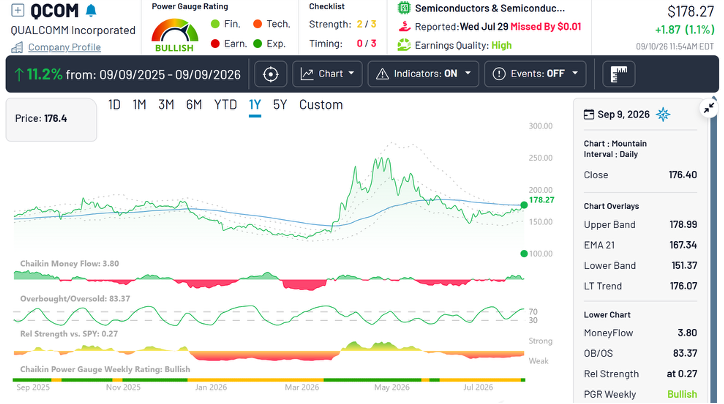
Why such a dramatic drop since May? A huge factor was Apple’s (AAPL) decision to start making its own 5G cellular modem chip rather than continue using Qualcomm’s. That was part of a larger dip in the company’s handset (phone)-driven revenue, which dropped by 20% year over year during the company’s fiscal third quarter of 2026.
Investors also likely realized that they were paying up front for Qualcomm’s potential AI growth, considering the company won’t see any real AI-driven revenue until 2027.
Despite the summertime drop, Qualcomm stock remains in decent shape. With an average price target of $199.04 as of September 9, the stock offers a potential 12.8% upside based on its $176.40 closing price.
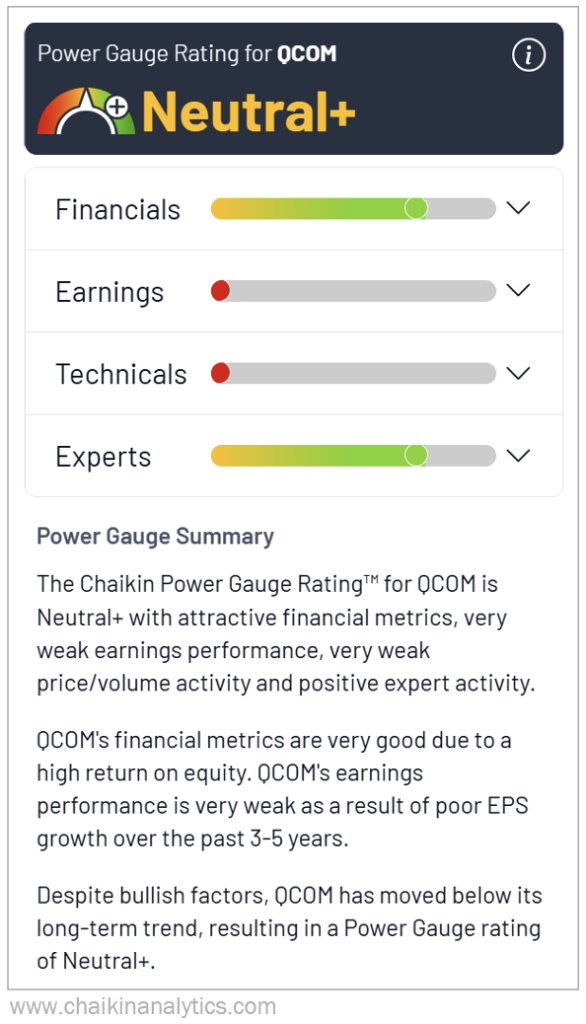
Chaikin Analytics, the investment-research platform founded in 2009 by legendary 60-year Wall Street veteran Marc Chaikin, gives Qualcomm a “bullish” rating in its Chaikin Power Gauge, a 20-factor stock-rating system that scans more than 5,000 stocks and 2,300 exchange-traded funds.
But Qualcomm does have some major AI innovation wins, multibillion-dollar hyperscaler contracts, and the overall CPU market – which Bank of America (BAC) predicts will explode from $27 billion in 2025 to $60 billion by 2030 – on its side. That’s enough to keep it on investors’ radars for the foreseeable future.
Regards,
David Engle
Editor’s Note: Whitney Tilson — the hedge fund manager CNBC called “The Prophet” — says America has reached its “Ripping Point.” The old financial order is being torn apart, and he believes most investors have no idea what’s coming in the next six months. He’s named the stocks he thinks will be destroyed in the chaos — and the ones he believes will soar. Watch his free presentation while it’s still available.
Recent Articles

Inside Sam Altman’s Next Venture: Why It Could Be 500 Times Bigger Than ChatGPT

Tesla’s Cybercab Launch: Why Markets Were So Underwhelmed by Elon Musk’s Robotaxi Showcase